-
-
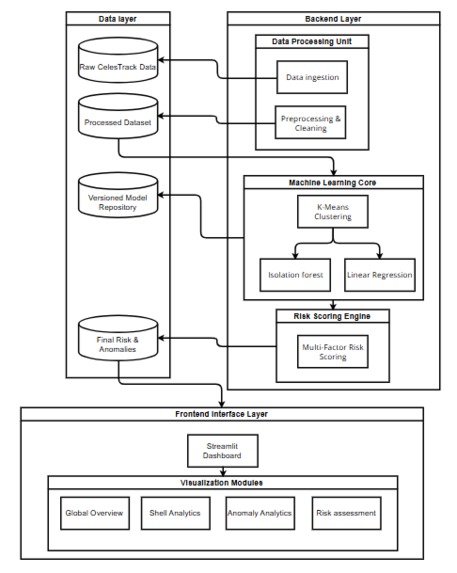
Block diagram of SpaceDebrisRadar.AI
Inspiration
Space sustainability and increasing satellite congestion in Low Earth Orbit (LEO) pose growing operational risks. As part of a third-year diploma capstone in Computer Technology, this project was conceived to apply machine learning to real orbital data and explore how data-driven methods can support safer satellite operations.
What it does
SpaceDebrisRadar.AI is a proactive satellite monitoring and decision-support system for Low Earth Orbit.
- The system analyzes orbital parameters derived from Two-Line Element (TLE) data, including BSTAR drag term, altitude, inclination, etc.
- Using unsupervised and statistical machine learning methods, it identifies anomalous satellite behavior and detects potentially unstable orbital regions.
- It generates a launch risk score (Low / Medium / High) for user-specified orbital regions, helping assess congestion and instability before new satellite deployments.
- Results are presented through a clear, interactive Streamlit-based dashboard to support interpretation and exploration.
How we built it
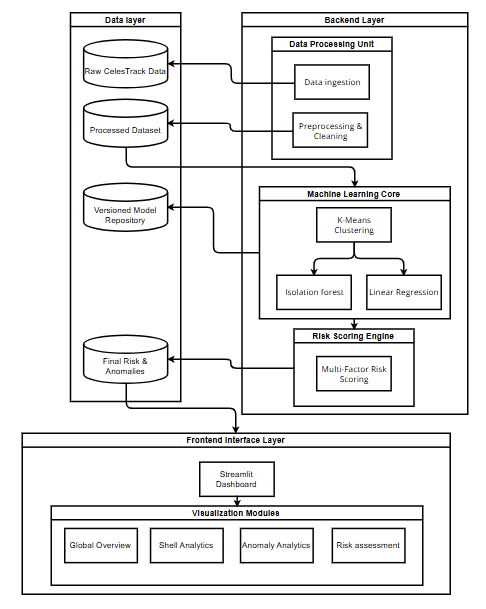
The project follows a structured machine learning pipeline:
Data Collection Orbital data was collected in CSV format from CelesTrak, covering active satellites in LEO.
Preprocessing & Feature Engineering Data cleaning, normalization, and feature extraction were applied to make orbital parameters suitable for analysis.
Modeling
- K-Means Clustering: Groups satellites into orbital shells based on similar orbital parameters.
- Isolation Forest: Detects anomalous satellites within each orbital shell that deviate significantly from typical behavior.
- Linear Regression: Models recent trends in satellite population growth and activity within shells to infer increasing congestion.
Risk Scoring Outputs from clustering, anomaly detection, and trend analysis are combined into a composite launch risk score for specific orbital regions.
Visualization & Interface All results are integrated into a Streamlit frontend for interactive analysis and visualization.
Challenges we ran into
- Model validation: Since anomaly detection and clustering are unsupervised, defining reliability and interpretation required careful analysis rather than conventional accuracy metrics.
- Data dependency: The system currently relies on a single primary data source (CelesTrak), making availability and update frequency a limitation.
Accomplishments that we're proud of
- The project was successfully extended into a research paper published in IJIRT.
- A complete end-to-end ML pipeline was implemented using real orbital data.
What we learned
- Fundamentals of orbital mechanics and TLE interpretation
- Designing and evaluating unsupervised ML pipelines
- Building interactive, Python-based analytical dashboards
What's next for SpaceDebrisRadar.AI
Future work includes:
- Incorporating time-series and probabilistic models for improved trend estimation.
- Using multiple orbital data sources for robustness.
AI tools disclosure
Some AI development assistance tools were used during implementation (for small parts). All modeling choices, data processing steps, and system design decisions were reviewed and validated by the project team.


Log in or sign up for Devpost to join the conversation.