-
-
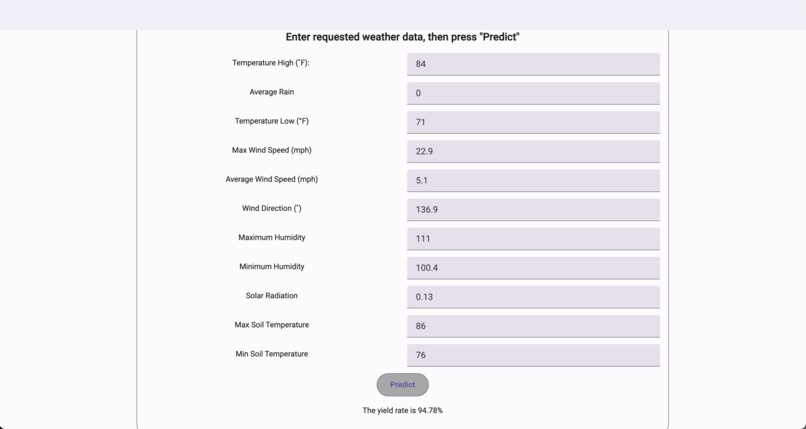
Yield Efficiency Output After Running Model
-
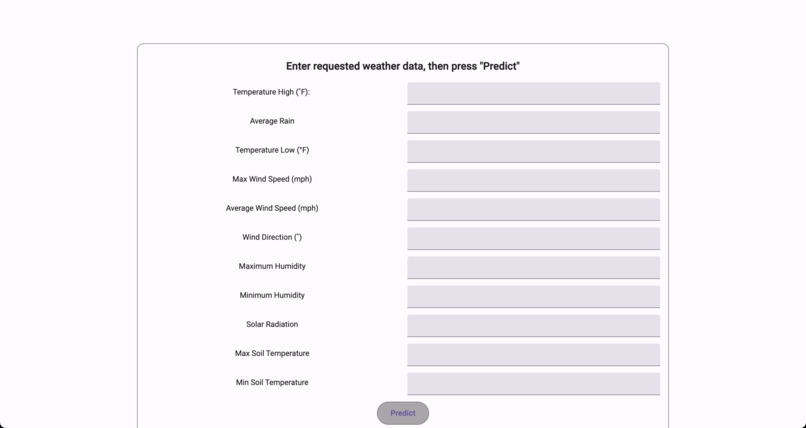
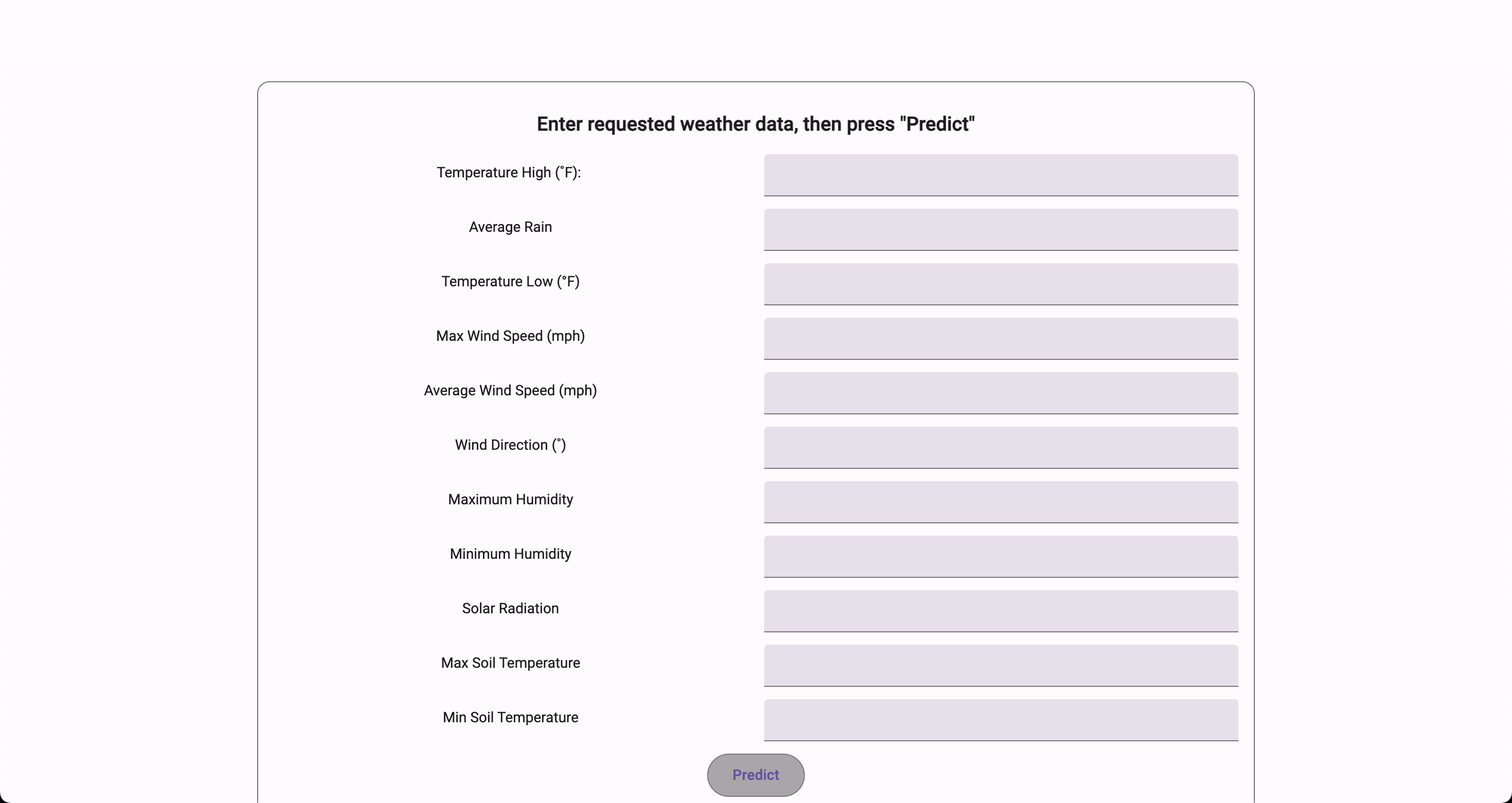
Landing Page for the Website
-
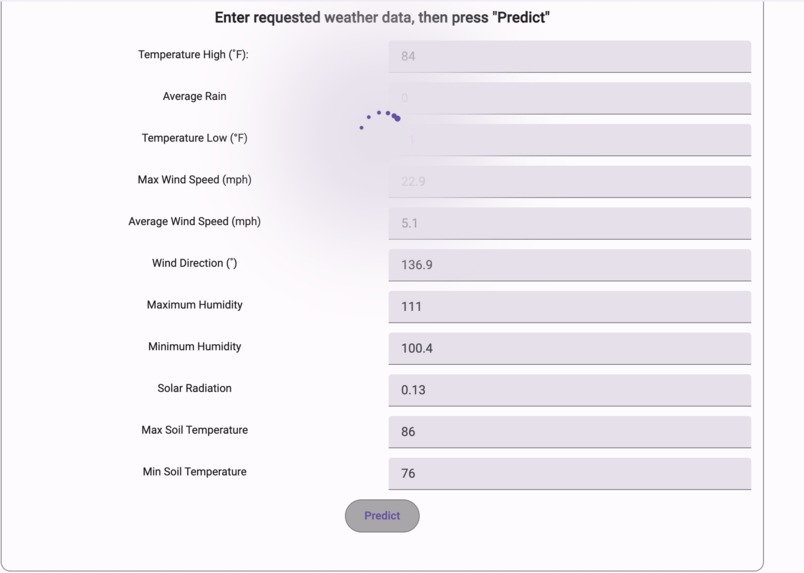
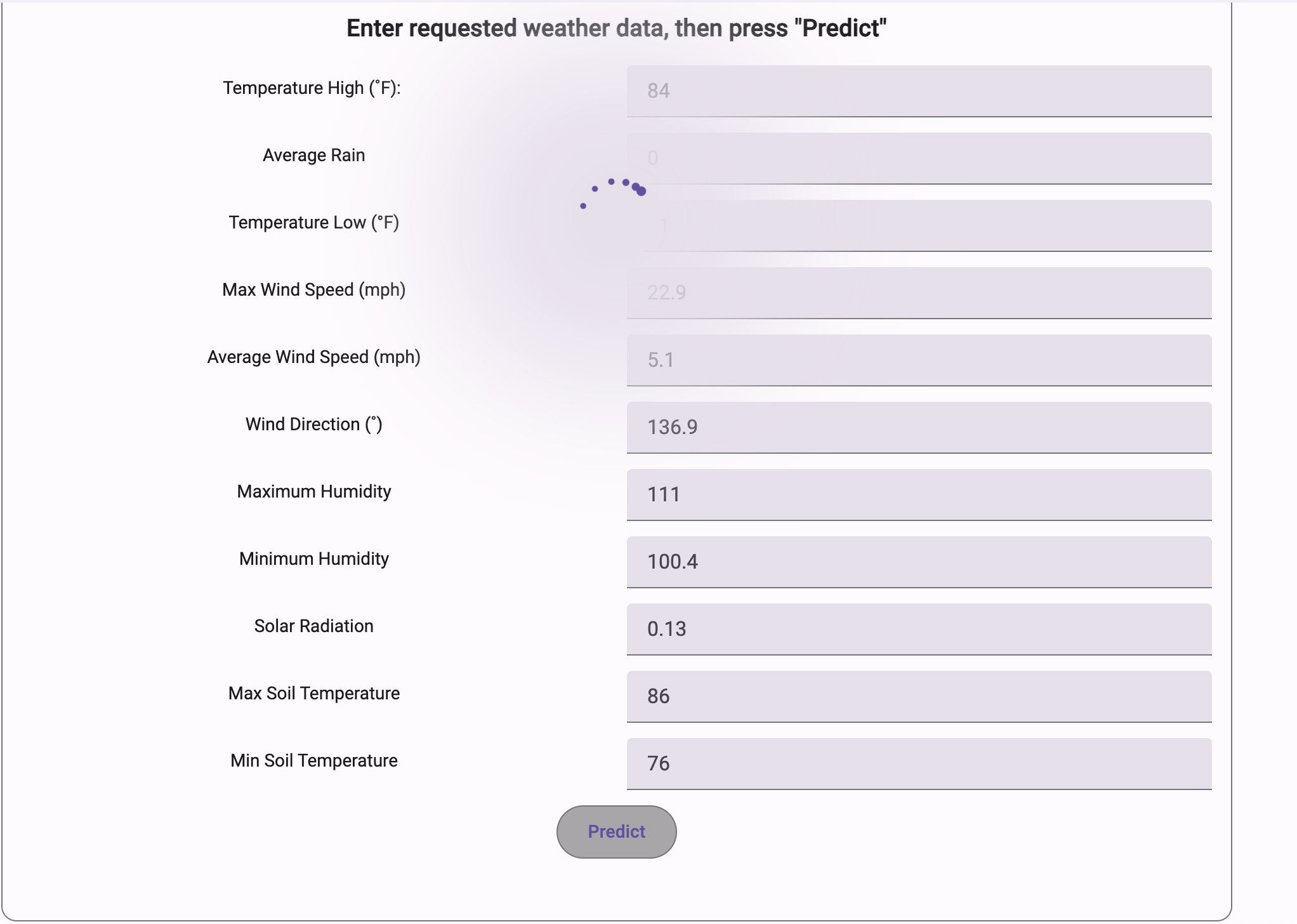
Data Entered and Loading the Prediction Model
Inspiration
Our team discovered the soybean harvest crisis in India from one of our team member’s family who is from the affected region. In the Amravati region of Maharashtra, India, 143 farmers committed suicide in 150 days. These farmers were convinced by a think tank earlier than year to switch their crops to soybean. Unfortunately, weather conditions caused soybean harvests to be extremely low. Many of these farmers suffered from financial ruin, and a government program in India that gives money to deceased farmers’ families persuaded these farmers to take their own lives. We learned about this tragedy taking place and wondered how we could solve it through better technology.
What it does
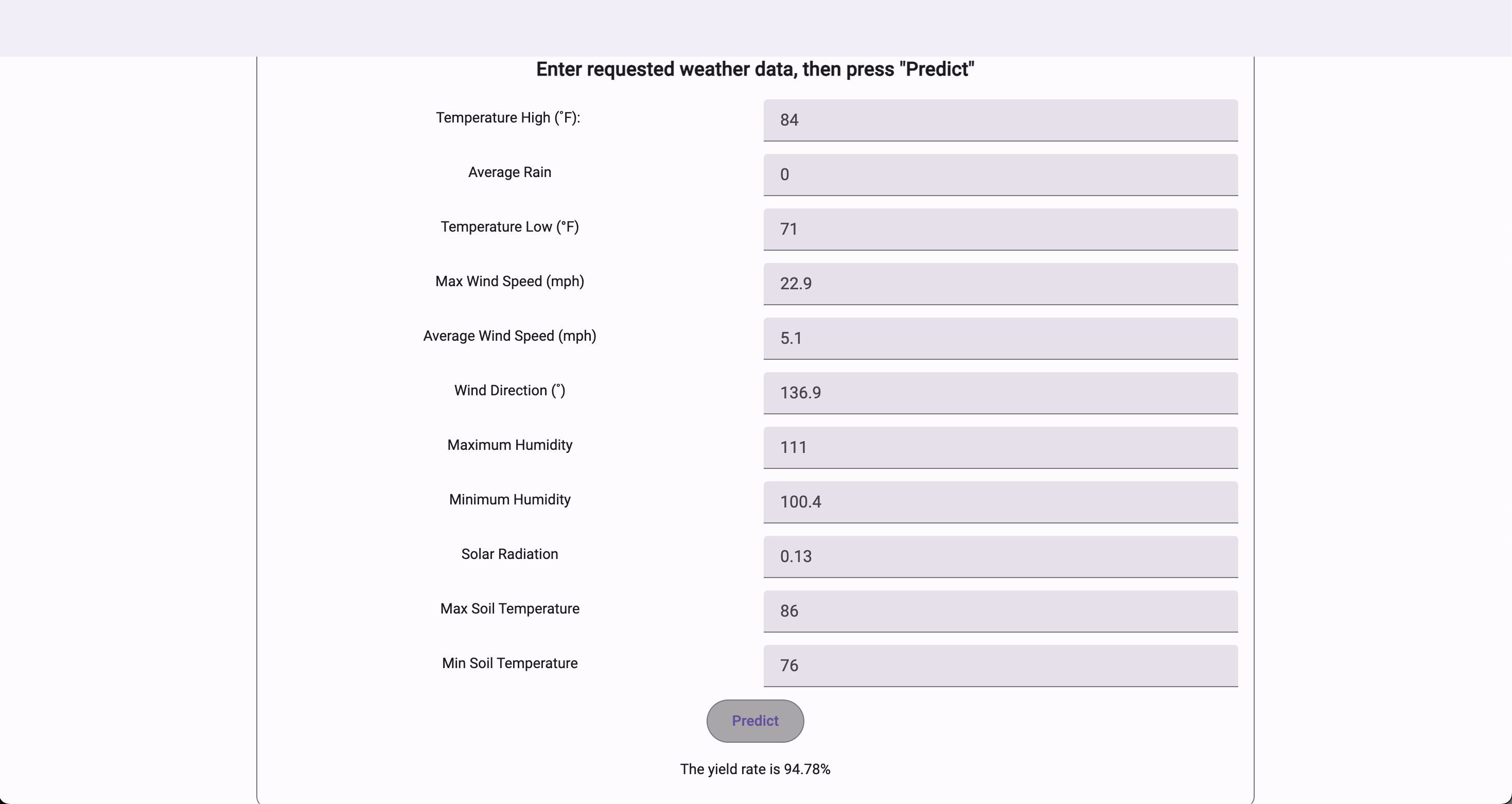
Farmers first record the weather conditions in their area over the course of a few days, the more days the better. They record as many factors as they can like minimum and maximum temperatures, minimum and maximum wind speeds, and minimum and maximum humidities. Farmers can then access the website and enter as many of the measurements they have. With the click of a button, they are given the predicted soybean harvest efficiency, the percent of acres soybean crop planted that are predicted to be harvested.
How we built it
We compiled and processed the weather data from Louisiana (a climate similar to that of Maharashtra, India), as well as the soybean harvest data from Louisiana. Using all this data for each year from 2001 to 2011, we trained a machine learning model to predict soybean harvest efficiency that year based on the corresponding weather data for the same year. Running on Google Colab, built with Python and Numpy, and a user interface built with Anvil, we created our final product- a website that can predict the soybean harvest efficiency based on the weather that year!
Challenges we ran into
When trying to gather data to train our model, we quickly realized that the crop harvest data for India is poorly documented. We were at a loss, since crop harvest data was crucial to training our machine learning model. However, with some research, we found that the US had detailed documentation of crop harvest efficiency compiled by the USDA. After analyzing the climate of Maharashtra, India, we concluded that the climate of the region was very similar to that of Louisiana. We had now found our solution, to train the model on the soybean harvest efficiency data of Louisiana, and pair this data with the detailed Louisiana weather data compiled by NOAA. Since the climates of the Louisiana and Maharashtra regions were extremely similar, we could efficiently train our model to predict harvest efficiency in Maharashtra while still maintaining accuracy of our predictions.
Accomplishments that we're proud of
Even though we all are new to the field of Artificial Intelligence and are just finding our way around, we had managed to build a functioning, effective AI model. When running our model, we have seen that our percent error hovers around 5%, which is very good for an amateur AI model.
What we learned
This was the first AI model any of us had built, and the first hackathon for most of our team. We learned so much about programming in AI, and discovered how to use tools like numpy and Google Colab’s computing resources to do so. Our team learned a lot about how to find and choose data sets to train the model with, and our success with this project encourages us to further explore machine learning. Furthermore, since this was the first hackathon for most of our group, we learned a lot about coding on a deadline, documenting our project, and the adrenaline of hackathons.
What's next for Soybean Harvest Predictor
We hope that this project will lead to more technology being used to better predict farming efficiency, in India and all over the world, saving farmers’ lives in the process. We plan to expand our model beyond just soybean farming in just Louisiana and Maharashtra to better model many crops all over the world, taking into account soil type and conditions to make our project much more useful. This project is part of the large effort to use technology to advance farming as we prepare to feed the exponentially growing population of our planet. We hope that our project can inspire better data collection and research into this field to feed our world and help farmers prosper.
Note: due to how anvil hosts webpages, we have to manually activate the back-end code right before using the website, so it may not work as shown in the video!


Log in or sign up for Devpost to join the conversation.