-
-
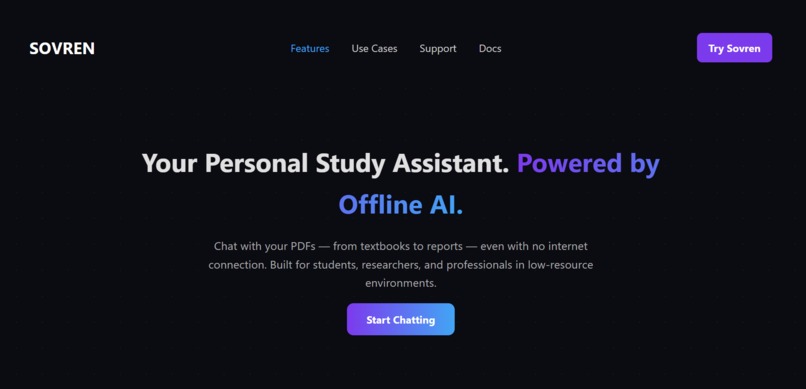
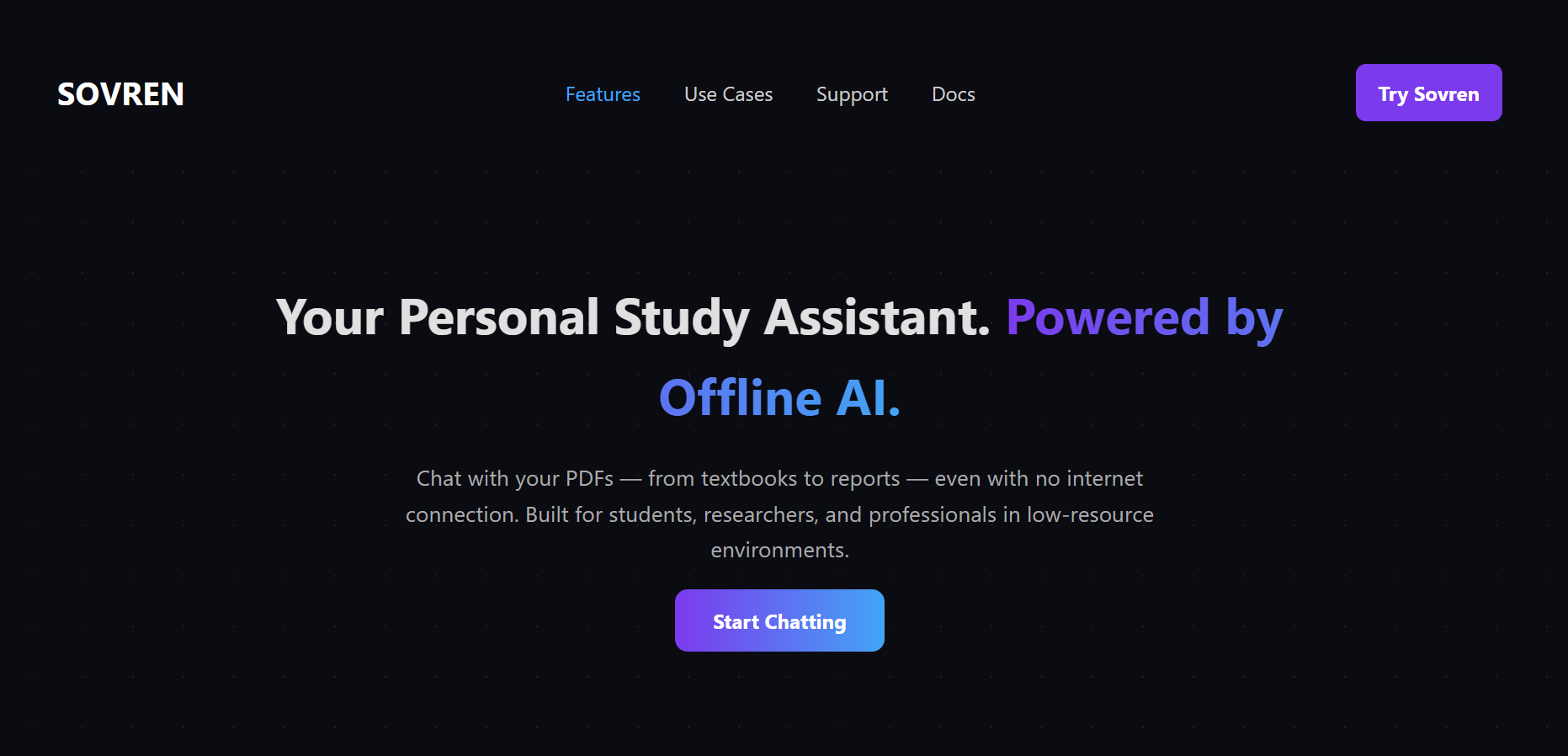
Landing Page
-
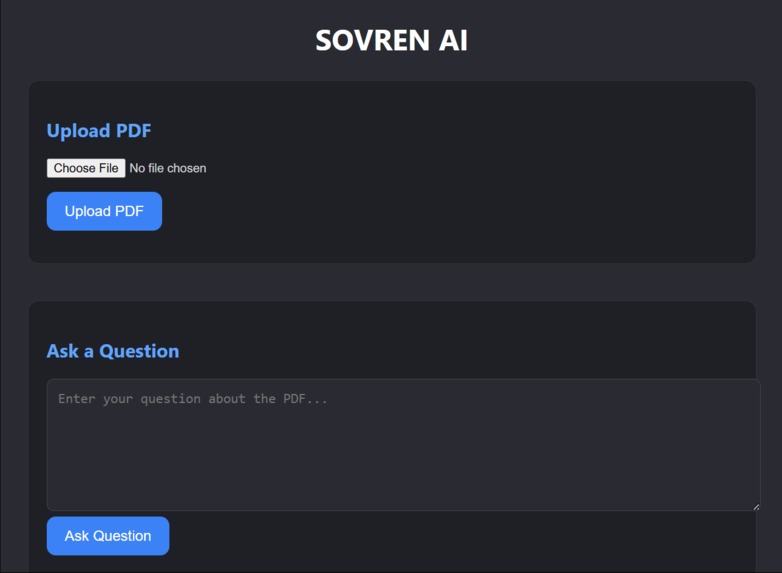
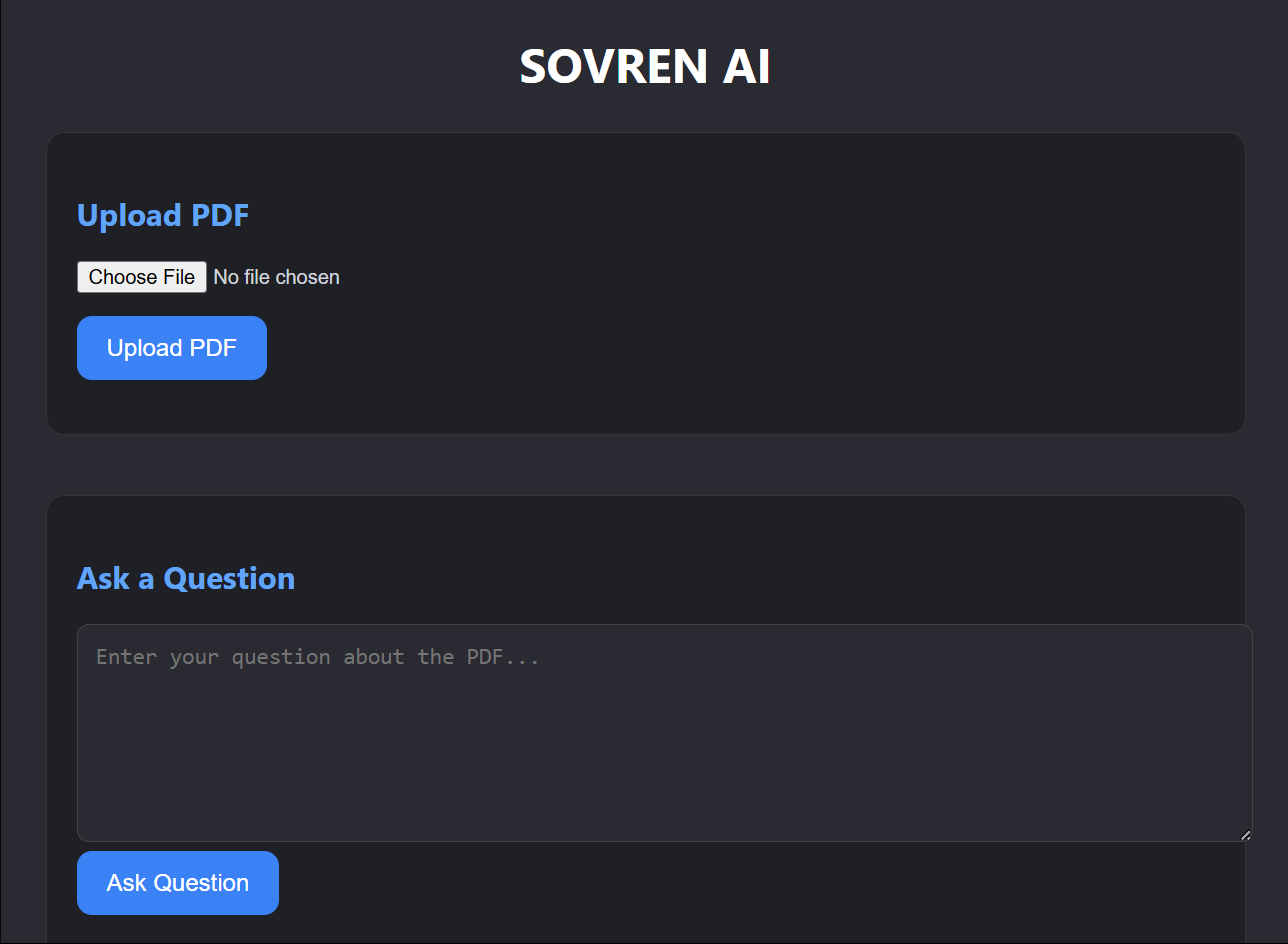
Main chat Page
Inspiration
I was inspired by the increasing popularity of tools like ChatGPT and Gemini— but also by their limitations. These tools require internet access, raise data privacy concerns, and are often tied to expensive subscription models. That’s simply not practical for students and professionals in many rural parts of the world. Sovren was born from a question: What if we could bring ChatGPT-style academic and professional support entirely offline — and make it free, private, and local?
What it does
Sovren AI is a fully offline AI assistant that allows students and professionals to upload PDFs — such as textbooks, notes, and research papers — and chat with them using natural language. It leverages a local Retrieval-Augmented Generation (RAG) pipeline to extract relevant content and generate answers using a locally hosted LLaMA 3.2 model. No internet, no subscriptions, and no privacy compromises — just intelligent, contextual academic support built for low-resource environments.
How I built it
I built Sovren using a combination of powerful backend technologies and a lightweight, fully offline-compatible frontend stack: Frontend: Developed using pure HTML, CSS, and JavaScript to ensure maximum offline compatibility and fast load times without external dependencies. Backend: Built with FastAPI (Python), handling all PDF upload, parsing, and question-answering logic. Text Parsing: PyMuPDF extracts text content from uploaded PDFs. Embeddings: I use SentenceTransformers (all-MiniLM-L6-v2) to generate semantic embeddings from PDF chunks. Vector Search: FAISS performs fast, offline similarity search across text embeddings. LLM: The LLaMA 3.2 model is served locally using Ollama, enabling all AI responses to be generated without internet access. The entire system runs on local machines, empowering users in rural and bandwidth-limited areas to access advanced AI tools with zero reliance on cloud services.
Challenges I ran into
Offline-only constraint: I couldn’t use cloud APIs, CDNs, or online fonts — every feature had to work 100% offline. PDF chunking and vector search tuning: Finding the sweet spot between chunk size, speed, and response relevance took a lot of trial and error. UI simplicity vs. functionality: I had to balance minimalism with powerful features so students could focus without confusion.
Accomplishments that i'm proud of
Built a fully offline AI system with local LLM and vector search. Created a smooth user experience using just local resources. Designed for real-world educational and professional impact — especially in regions where bandwidth and privacy are key concerns (rural areas around the world). Completed end-to-end integration between PDF input → LLM output — all locally.
What I learned
How to design and optimize a full RAG pipeline (chunking → embeddings → FAISS → LLM) from scratch. How to serve and interact with a local LLaMA model using Ollama. The power of building for offline-first users — it forces innovation and simplicity. That local AI is not just feasible — it's empowering and important for digital equity.
What's next for Sovren Ai
1.Voice-to-Text and Text-to-Voice: I plan to integrate full speech support so that students and professionals with visual impairments or reading difficulties can interact with PDFs using their voice — and hear the AI's answers read aloud. This ensures Sovren is accessible to all, regardless of ability.
2.Cross-sector Expansion: While Sovren currently focuses on education, the underlying tech can be applied to other document-heavy sectors such as: Legal – Chat with case files and legal references Healthcare – Interact with medical records or policy documents Public Services – Assist citizens in understanding policies, forms, and official communications offline
3.Nationwide Deployment in Schools and Facilities: My vision is to partner with the Kenyan government to pre-install Sovren in public schools, universities, libraries, and rural government offices. This ensures equitable access to AI-powered learning and support — especially in bandwidth-limited or underserved areas.
Built With
- css
- faiss
- fastapi
- html5
- javascript
- llama3.2
- pymupdf
- python


Log in or sign up for Devpost to join the conversation.