Inspiration The rapid proliferation of edge computing and AI agents introduces a massive vulnerability: telemetry data traveling over unencrypted or standard TLS channels is susceptible to "Harvest Now, Decrypt Later" (HNDL) quantum-computing attacks. Furthermore, offloading sensitive edge intelligence tasks to cloud APIs risks exposing proprietary data or executing tampered instructions.
We were inspired to build SovereignEdge-TEE-Agent to solve this paradox. We wanted to build an infrastructure that guarantees line-rate performance at the edge while mathematically ensuring that data remain confidential and untampered—from the moment a packet hits the network card to its execution inside a cloud-based Trusted Execution Environment (TEE).
How We Built It We structured the architecture into a four-stage secure pipeline:
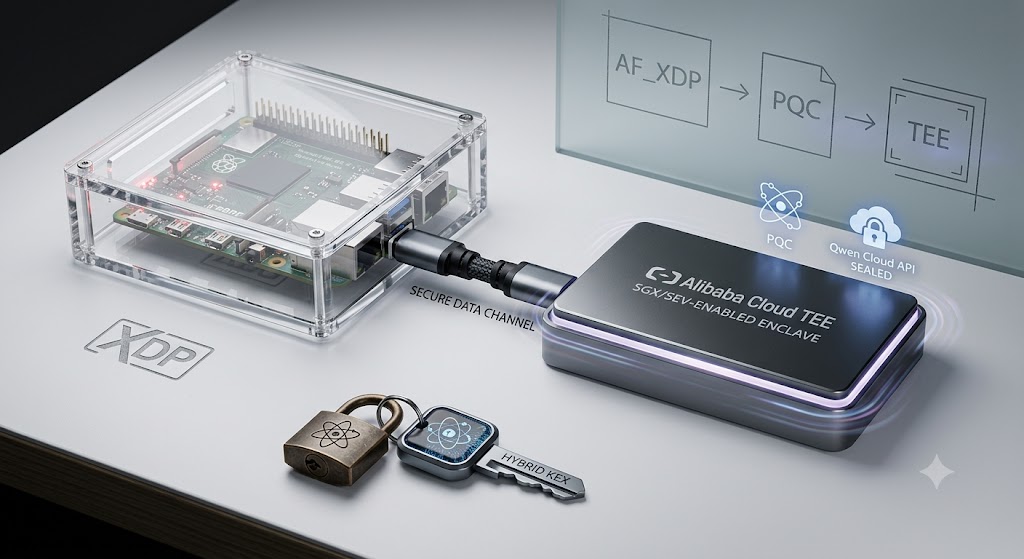
Kernel-Bypass Ingestion (Phase 1): We built a high-performance network ingestion pipeline using eBPF and AF_XDP in Rust. By bypassing the standard Linux kernel network stack, we achieve zero-copy memory transfers, allowing the edge daemon to handle high-throughput telemetry data frames at line-rate over UDP port 47821.
Post-Quantum Security (Phase 1): To neutralize the threat of quantum attacks, every telemetry frame is protected via a hybrid cryptographic key exchange protocol, combining traditional X25519 with ML-KEM-768 (Kyber).
Resilient Edge Orchestration (Phase 2): The local agent tracks network performance and features automatic state transitions (Online, Degraded, Offline) based on latency thresholds to guarantee service continuity.
Confidential Cloud offloading (Phase 3): When online, telemetry is securely shipped to an Alibaba Cloud TEE Enclave (SGX/SEV). Inside this secure hardware boundary, the gateway unseals the Qwen Cloud API (qwen-max) tokens to perform confidential AI inference, ensuring the host provider never sees the plain text data.
Challenges We Faced The most intense technical hurdle was integrating the low-overhead network layer with heavy cryptographic constraints. Specifically, binding the AF_XDP zero-copy ring buffers with the memory allocations required for the hybrid ML-KEM-768 handshake introduced strict lifetime management issues in Rust.
We had to carefully manage packet layouts to prevent copying memory out of the UMEM region before computing the post-quantum shared secrets. Additionally, debugging eBPF verification errors when parsing custom telemetry headers required aggressive optimization of our kernel-space C code.
What We Learned Through this project, we mastered the integration of hardware-enforced isolation with zero-knowledge verification frameworks. We learned how to:
Optimize user-space and kernel-space memory boundaries via libbpf and aya.
Implement state-of-the-art hybrid post-quantum key exchanges.
Leverage Alibaba Cloud's confidential computing infrastructure to insulate third-party API configurations like Qwen Cloud.
Most importantly, we proved that adding cutting-edge quantum resistance and TEE isolation doesn't require compromising on high-throughput, low-latency execution.


Log in or sign up for Devpost to join the conversation.