-
-
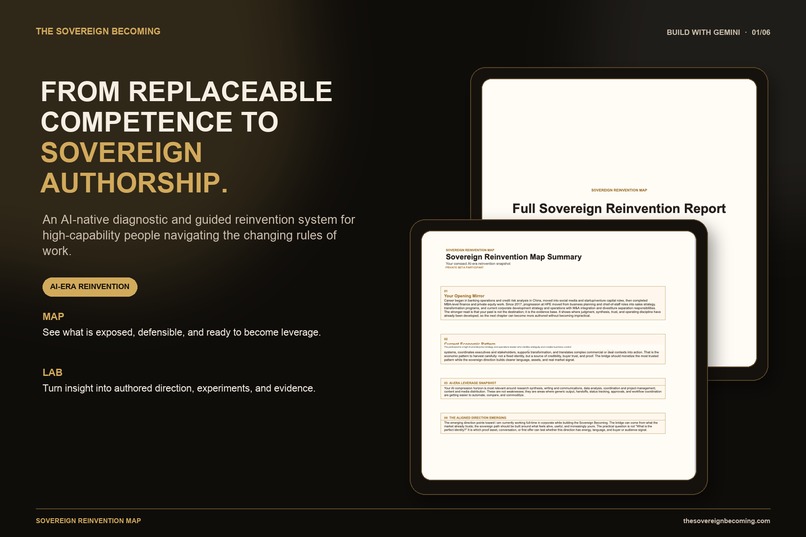
An AI-native diagnostic and guided reinvention system that helps people move from replaceable competence to sovereign authorship.
-
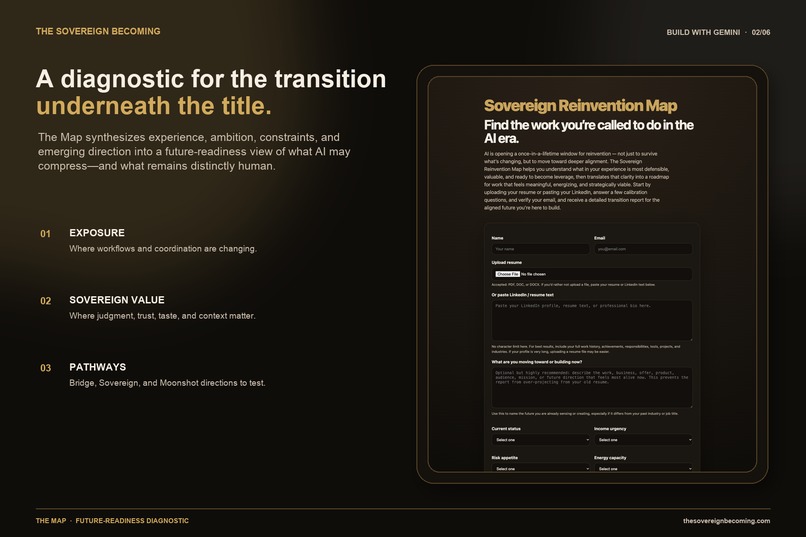
The Map turns experience, ambition, constraints, and emerging direction into AI-era exposure, defensible value, and pathways.
-
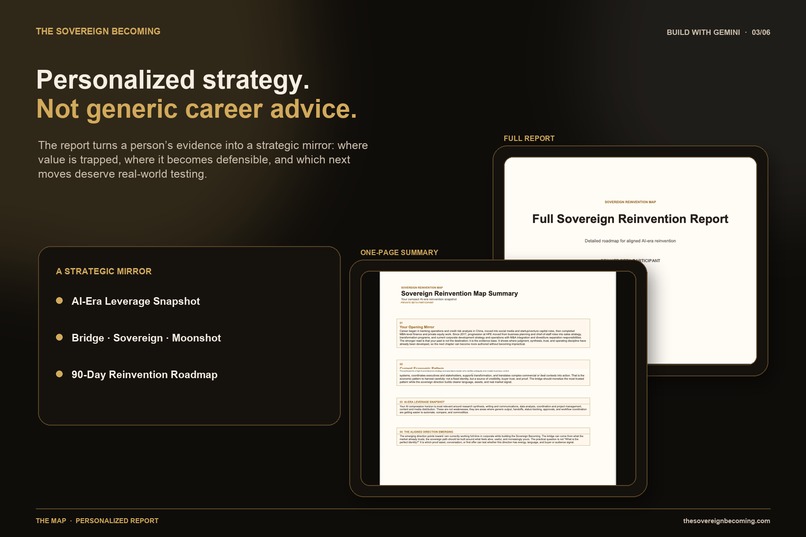
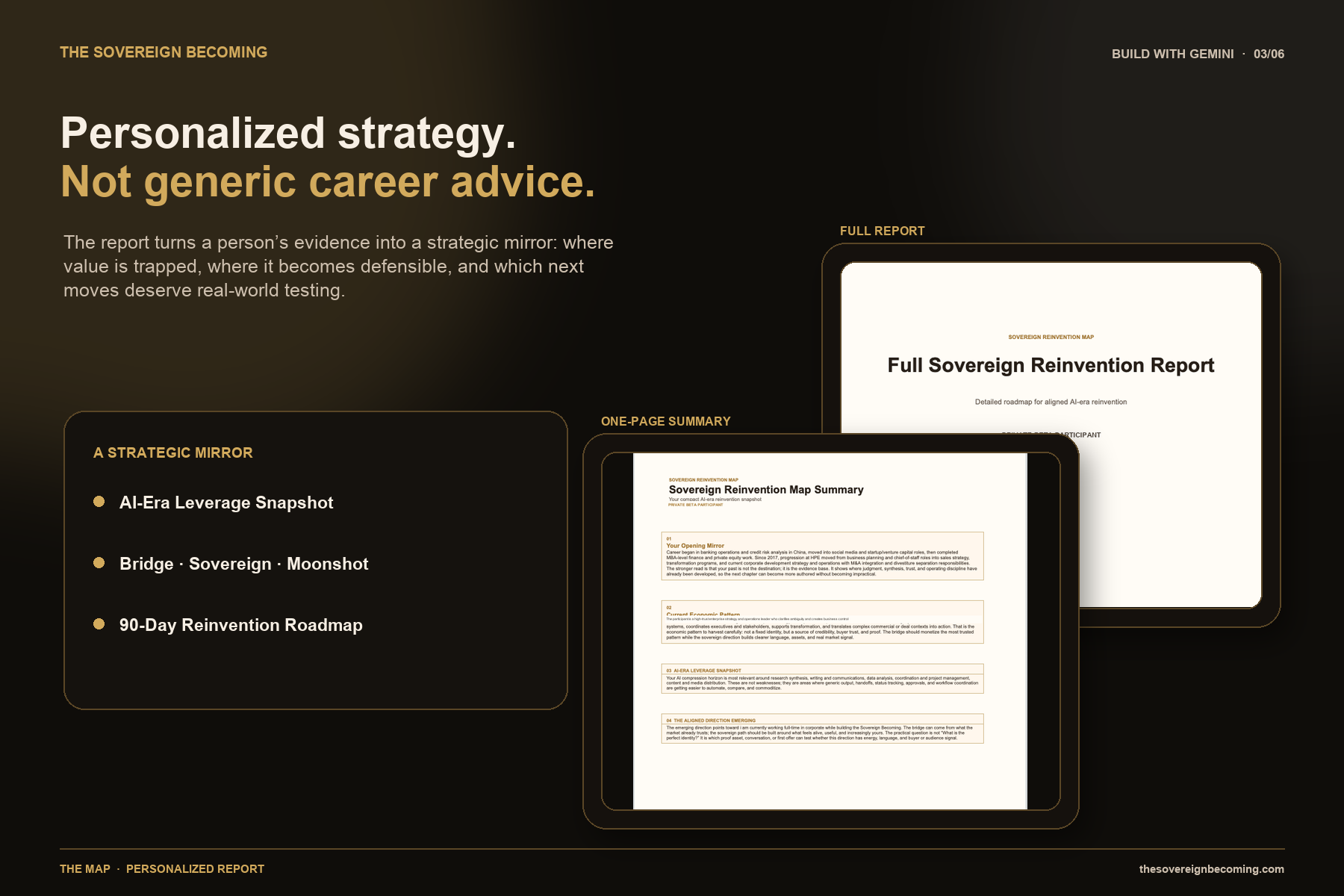
A personalized one-page summary and full report reveal AI-era leverage, three reinvention pathways, and a 90-day roadmap.
-
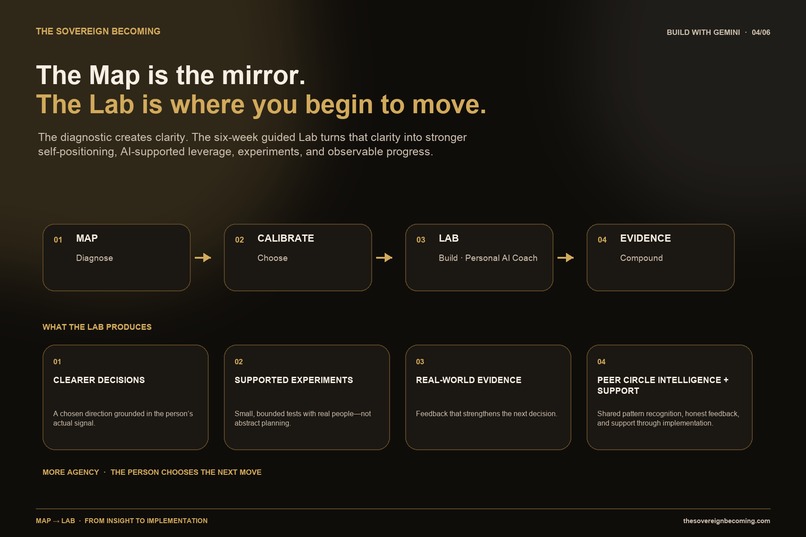
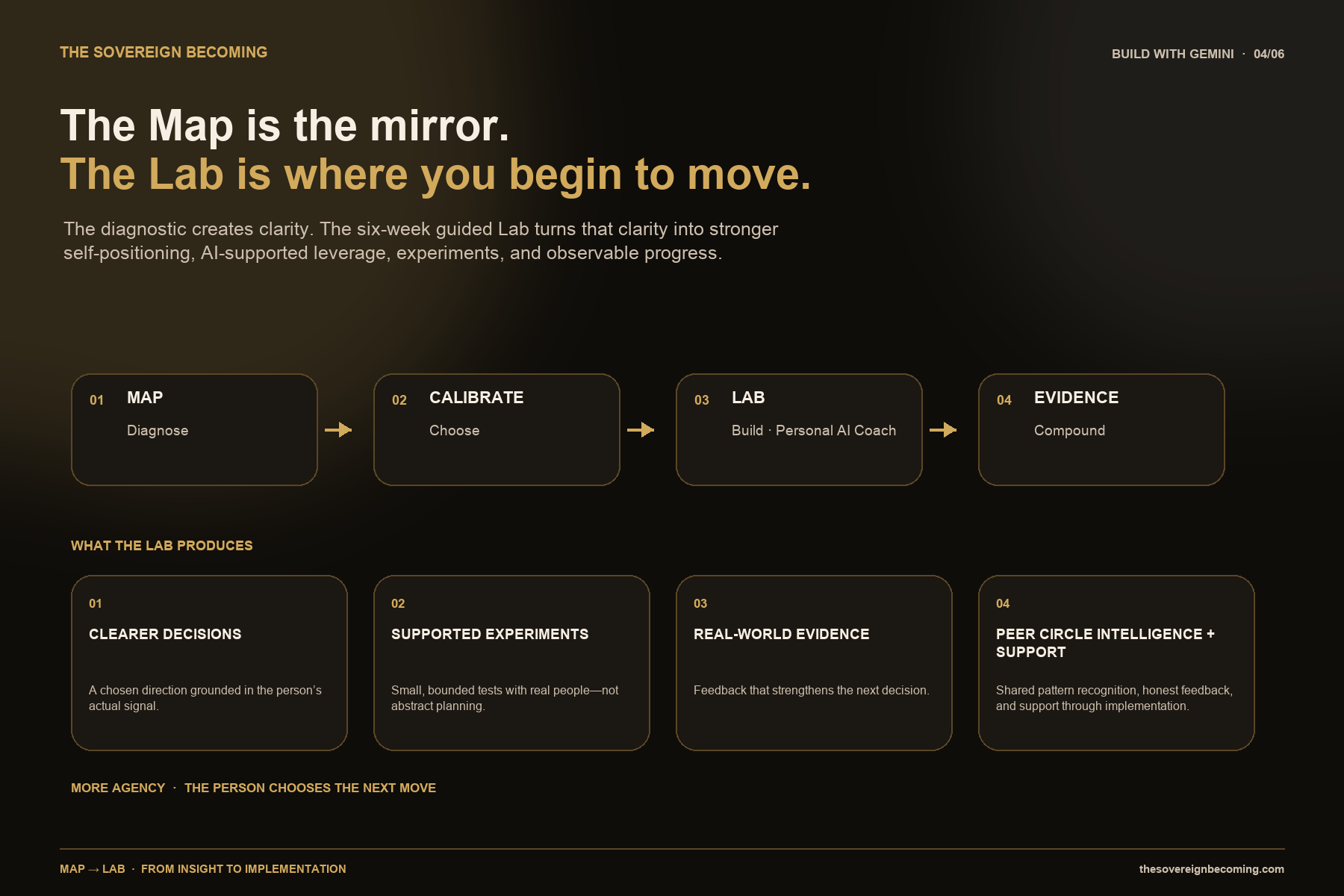
The Lab turns insight into action through a personal AI coach, supported experiments, real-world evidence, and peer-circle support.
-
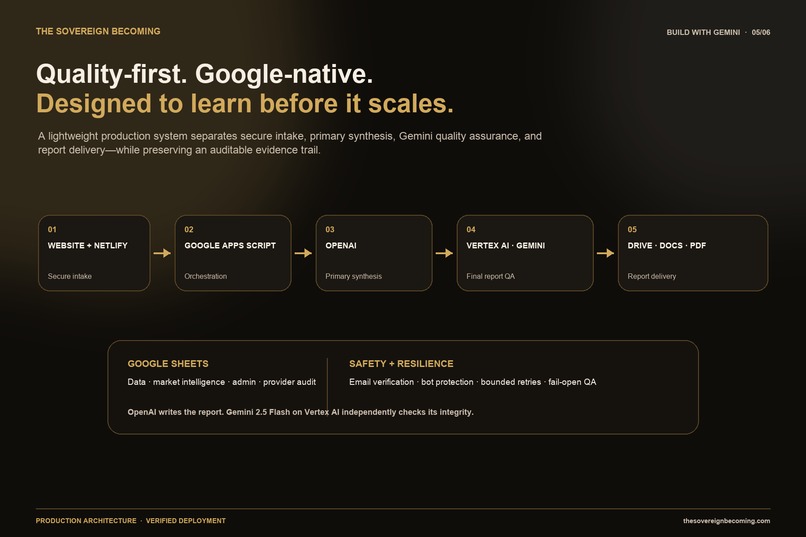
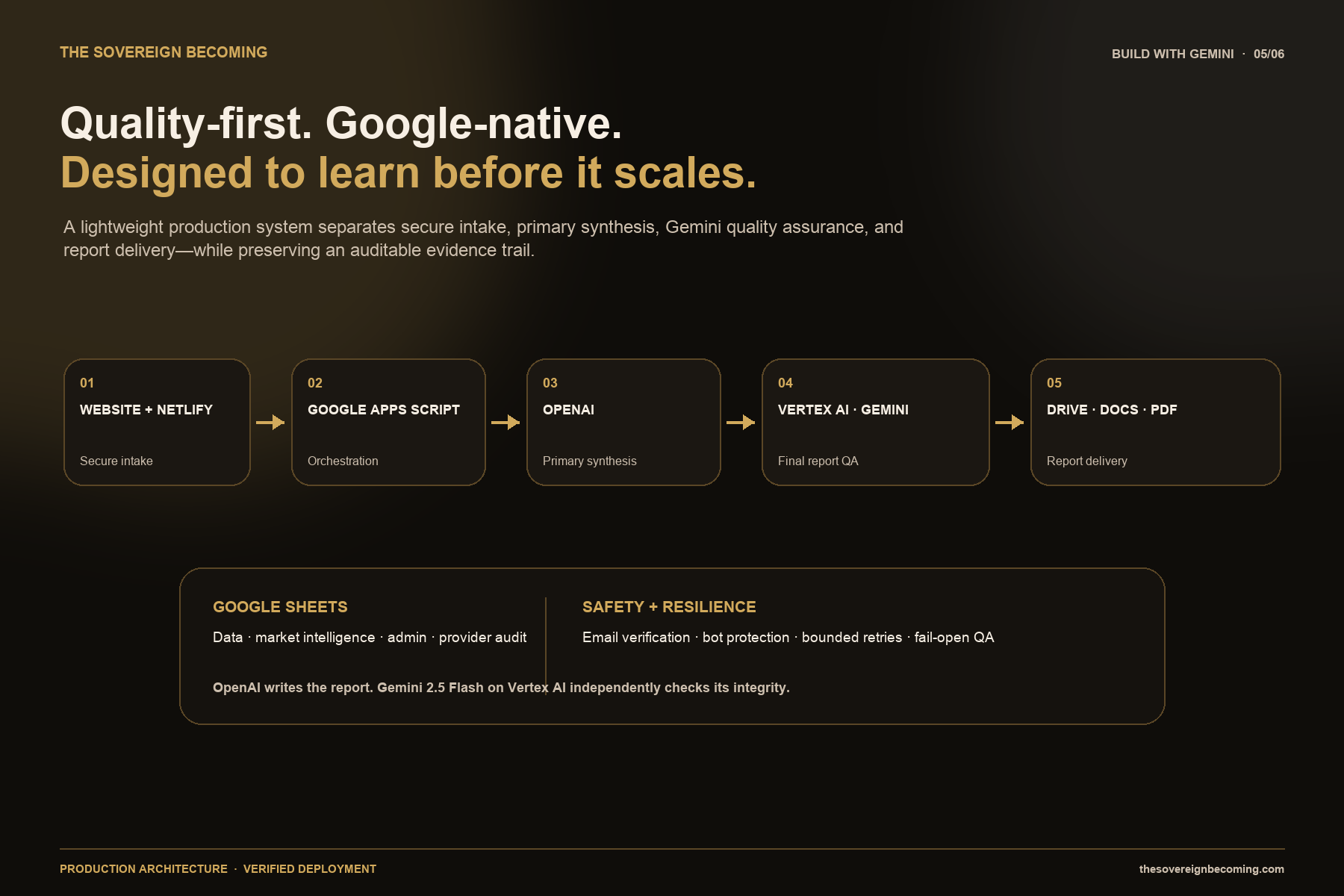
A Google-centered workflow combines secure intake, OpenAI synthesis, Gemini 2.5 Flash QA on Vertex AI, and report delivery.
-
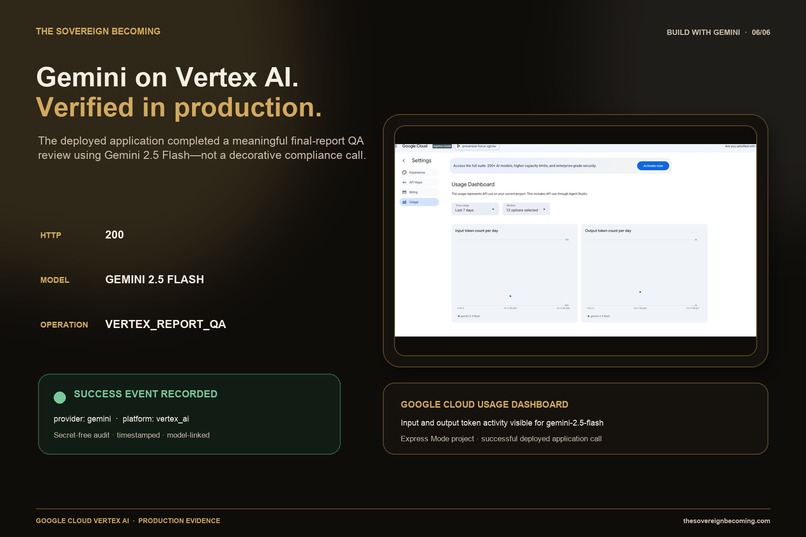
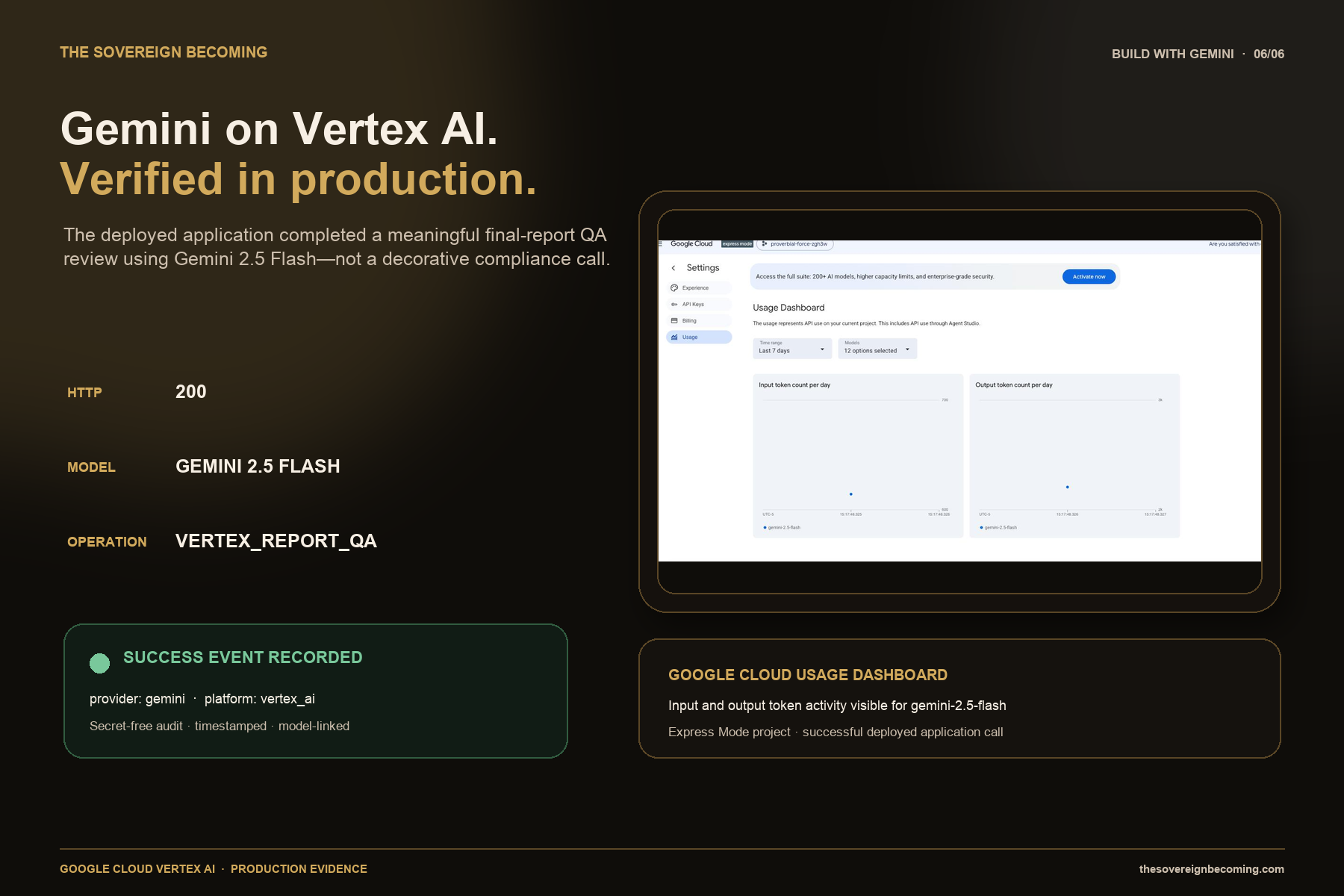
Production proof: Gemini 2.5 Flash returned HTTP 200 for final-report QA on Vertex AI, with token usage and an auditable event.
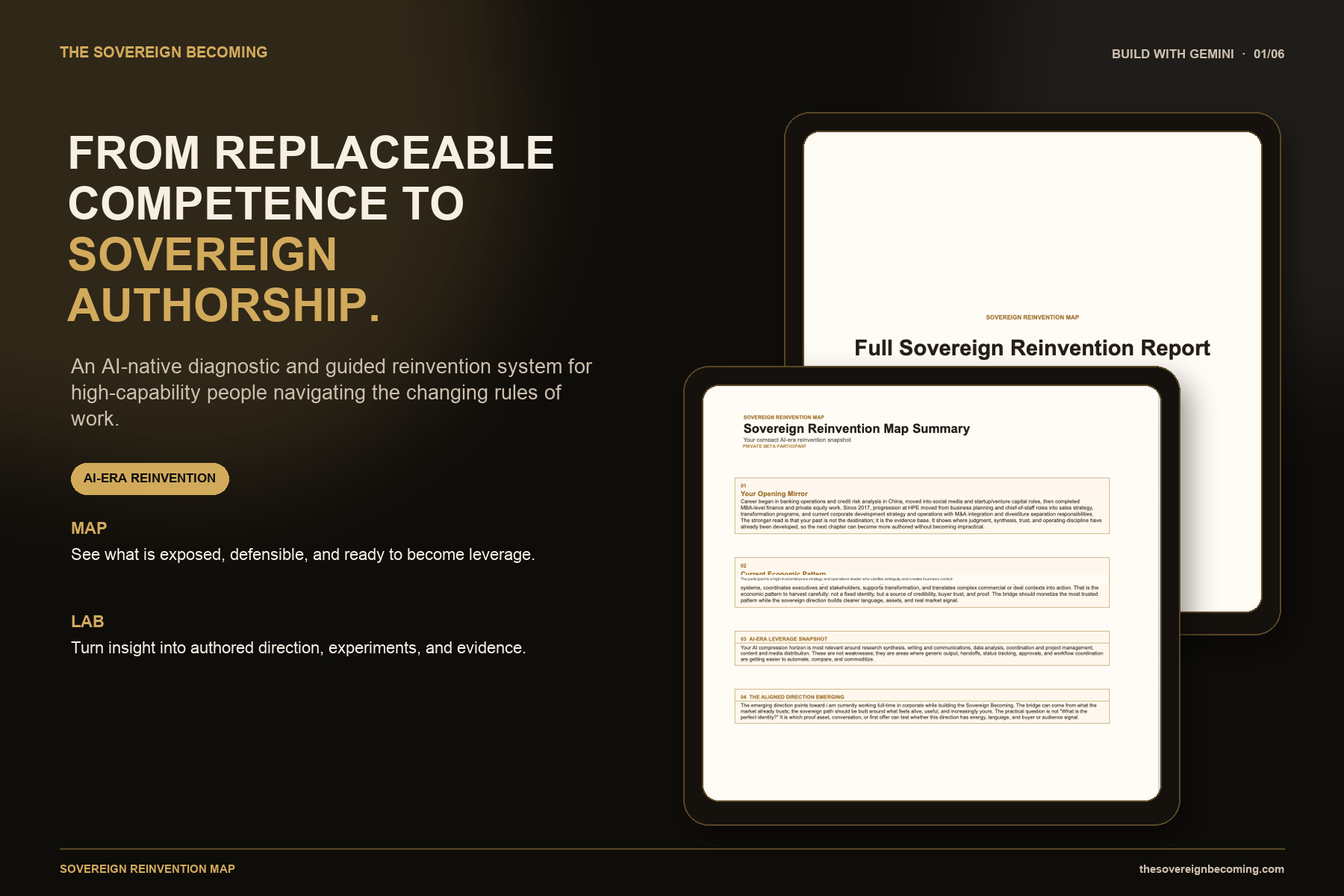
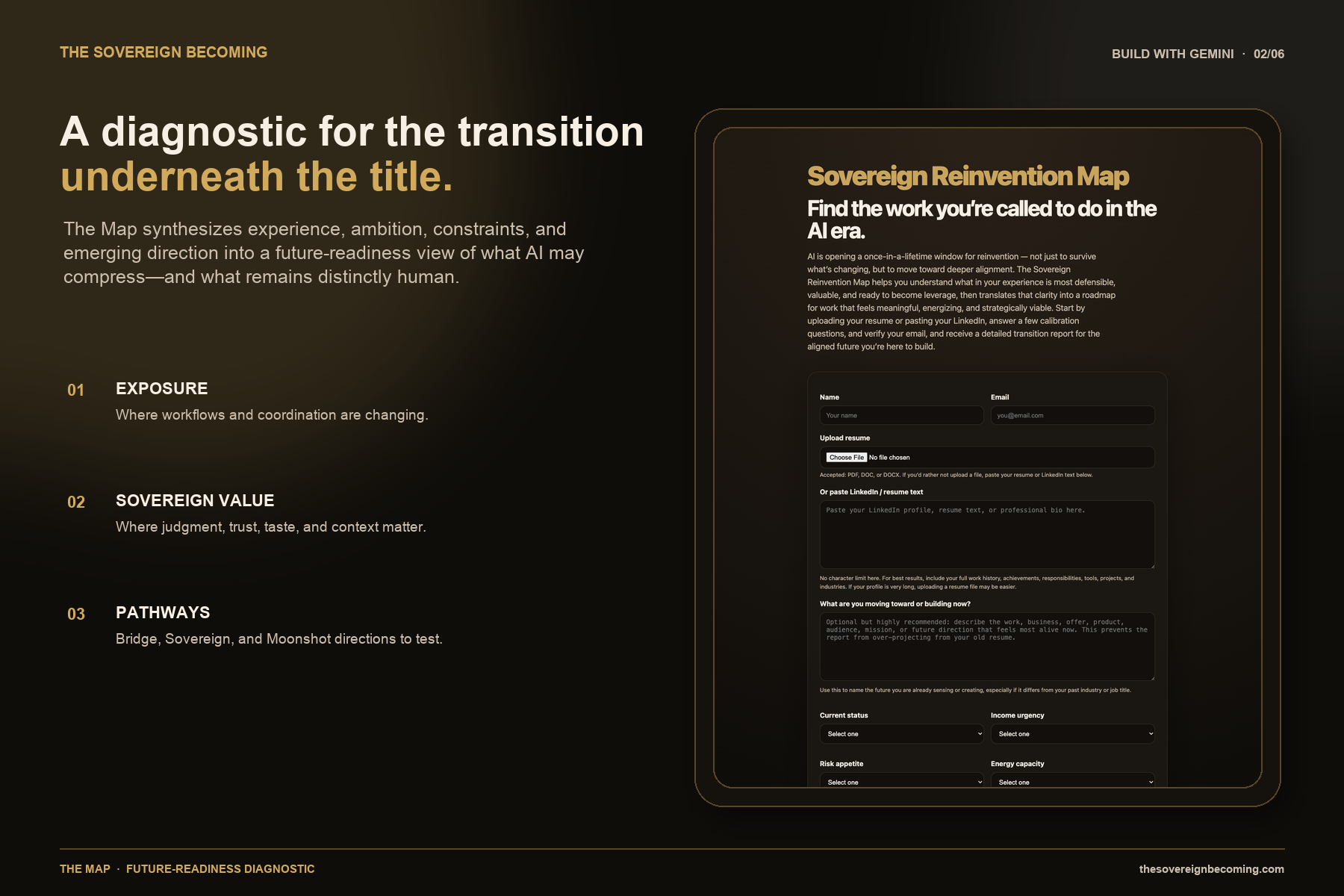
Sovereign Reinvention Map is an AI-native diagnostic that helps ambitious professionals understand how AI may reshape their work, identify their defensible human value, and design an aligned path forward. It is the diagnostic entry point to the Sovereign Reinvention Lab—a guided implementation experience/program designed to turn ideas & insights into real-world experiments, authored work, and measurable progress, and ultimately helping people to reinvent themselves to live a more sovereign, meaningful and fulfilling life.
Inspiration
AI is changing more than individual tasks. It is changing workflows, organizational structures, and the economic value of many forms of white-collar competence. And the deeper disruption is identity: AI is quietly renegotiating what traditionally makes human valuable.
For high-performing professionals, this creates a hard kind of transition. Most are not failing. They are highly capable inside roles, systems, and definitions of success that may be losing relevance quickly. Traditional career tools would start with "What job should you pursue next?"
We wanted to ask something deeper: what in your experience is becoming easier to automate or redesign, what remains distinctly valuable, and what are you being called to author next? And, I personally believe that if people don't ever need to worry about money & survival, they would do something completely different than their jobs today. Something that truly lights them up and fulfills them.
That inquiry and belief became the foundation of Sovereign Reinvention Map (& Lab program): a private AI-native diagnostic for people navigating AI exposure, career or identity transition, and the move from replaceable competence toward judgment, trust, authorship, sovereignty and aligned work.
The project rests on a thesis: reinvention will become an essential capability and skill to hone in the AI era. But reinvention is not panic, job survival, or a new set of productivity tools. It should help people see the value beneath their titles, uncover their inner passion & massive transformative purposes, use AI without outsourcing discernment, and build practical evidence for a next chapter that is both strategically viable and personally meaningful.
What it does
The Sovereign Reinvention Map is a future-readiness diagnostic for high-capability professionals navigating AI-driven change. It synthesizes a person’s experience, ambitions, constraints, and emerging direction into a strategic view of where their current value is exposed, where it remains defensible, and what an aligned next chapter could look like.
Rather than recommend another conventional job title, the Map helps users distinguish between work AI may compress and the human value rooted in judgment, trust, context, taste, accountability, and authorship. It frames several levels of possibility—from a practical Bridge to a more independent Sovereign path or longer-term Moonshot—and translates them into an initial direction for action.
The Map is the diagnostic entry point; the Sovereign Reinvention Lab is the implementation layer. The Lab is designed as a six-week guided experience, followed by an optional implementation runway, where participants turn insight into a clearer operating direction, stronger self-positioning, AI-supported leverage, and real-world experiments. The Lab has been designed but has not yet been validated through a paid cohort; its next phase is a small founding-cohort test focused on willingness to pay, participant progress, and measurable outcomes.
Challenges we ran into
My biggest challenge of this project is on customer acquisition: AI tools massively eliminated barriers for non-technical founders like me to create a product from scratch, and significantly compressed the timeline from thesis to functioning product. However, it did not produce distribution, trust, urgency, or paying customers. Acquisition became the harder problem, if there is no existing distribution or network of potential customers.
The second challenge is the Map appears replicable. One tester raised the obvious objection: why not go straight to ChatGPT and ask for similar advice? We agree that a standalone AI-generated report is not a moat. This changed how we understand the product. The Map is the diagnostic entry point, not the business. Its job is to make an abstract transition personally legible and create structured context for a deeper implementation experience, a.k.a. the Lab program.
We deliberately chose rapid prototyping: launch a lean, low-cost MVP, learn from real-world feedback, and improve it over time. This surfaced smaller but important issues in report rendering and delivery, reinforcing that an AI product is the entire workflow around the model, not simply a prompt. We also added bot protection, email verification, rate controls, bounded retries, provider logging, and model routing to manage costs while recognizing that the infrastructure will need to evolve as we scale toward a more premium and controllable experience.
Accomplishments that we're proud of:
The single biggest accomplishment I am so proud of is shipping a working AI-native MVP as a solo, non-technical founder whose background is in finance and M&A. I, together with my AI agents as my "co-founders", designed the reinvention methodology and the Map-to-Lab product architecture, built the public website and Google-native operating stack, integrated production API calls, and created a functioning end-to-end workflow that turns a user’s context into a personalized report. Before the current generation of AI tools, this would likely have required a multidisciplinary technical team, substantially more capital, and a much longer development cycle.
What makes this meaningful is not only the product itself, but what the process demonstrates: AI can dramatically expand individual agency. It allowed me to move beyond having an idea—to prototype it, test it with real people, improve it, and deploy it. The product is still early, but moving from concept to a secure, working system is tangible evidence of what becomes possible when domain expertise, lived conviction, and AI-enabled execution come together.
I am also proud that we did not treat AI as a shortcut around product discipline. At the same time, we stayed honest about what remains unproven: customer demand, willingness to pay, and measurable transformation through the Lab.
What we learned
My key learning is that AI has dramatically lowered the cost of building. It has not lowered the cost of earning trust. I discussed the thesis and product with 8 people in my network. All 8 recognized AI-era disruption as credible and agreed reinvention will become an increasingly important capability. These were discovery and thesis-validation conversations, not proof of willingness to pay.
These early feedback is encouraging, but it is not yet transformational evidence. We do not yet have paid Sovereign Reinvention Lab customers or proof that participants will complete the longer journey and achieve meaningful outcomes. The conversations also sharpened our most important market uncertainty: timing.
The question may be less about whether AI will reshape white-collar work than about when the disruption becomes immediate and personal enough for a specific customer to seek and pay for structured reinvention support. People can intellectually agree with a future need before they feel sufficient urgency to act.
We learned that the Map is the entry point or the lead magnet, not the moat. Long-term differentiation comes from the compounding reinvention system around it: a distinct methodology, trusted founder judgment, personalized AI support grounded in each participant’s context, structured implementation, peer intelligence, accountability, and repeated real-world experimentation. The advantage is not simply generating a report; it is building a learning system that becomes more credible, useful, and defensible as participant outcomes and trusted distribution accumulate.
What's next for Sovereign Transition OS
The Map is the entry point. The Sovereign Reinvention Lab is where reinvention actually gets built: a six-week guided experience with an optional implementation runway, taking participants from seeing the system that shaped them to running real experiments and compounding the results. Each stage produces a concrete artifact, ending in a 90-day reinvention roadmap the participant owns and executes.
The Lab is designed. It has not been validated with a paid cohort. That is the next problem. I plan to recruit a small founding cohort at a meaningful price through founder-led outreach and a modest paid test, because payment is the only signal that separates agreement from demand. A shorter, feedback-for-access version may run alongside it to reveal which parts of the methodology create value fastest, though I treat that as research rather than proof. In parallel, I will keep building a focused public presence on social media around AI-era reinvention, on the assumption that in a market still forming, trust is commercial infrastructure and not a marketing activity.
The next goal is not more positive feedback. It is evidence of urgency, payment, implementation, and change that holds over time.

Log in or sign up for Devpost to join the conversation.