-
-
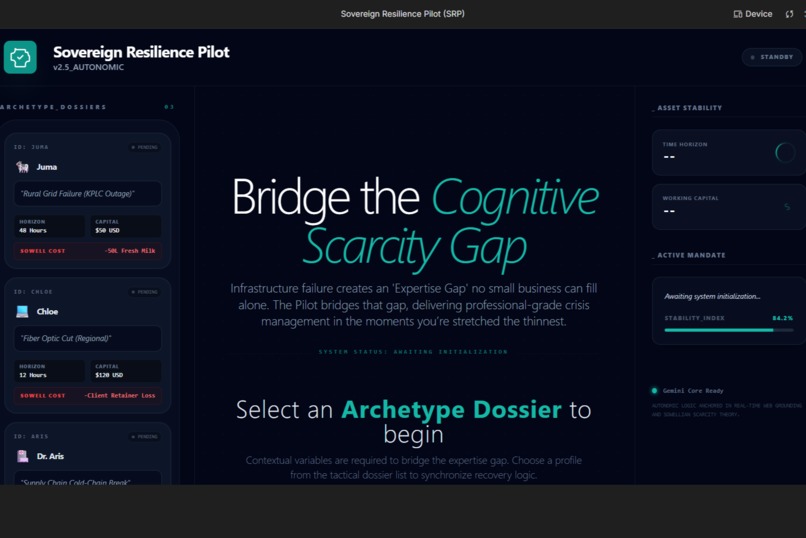
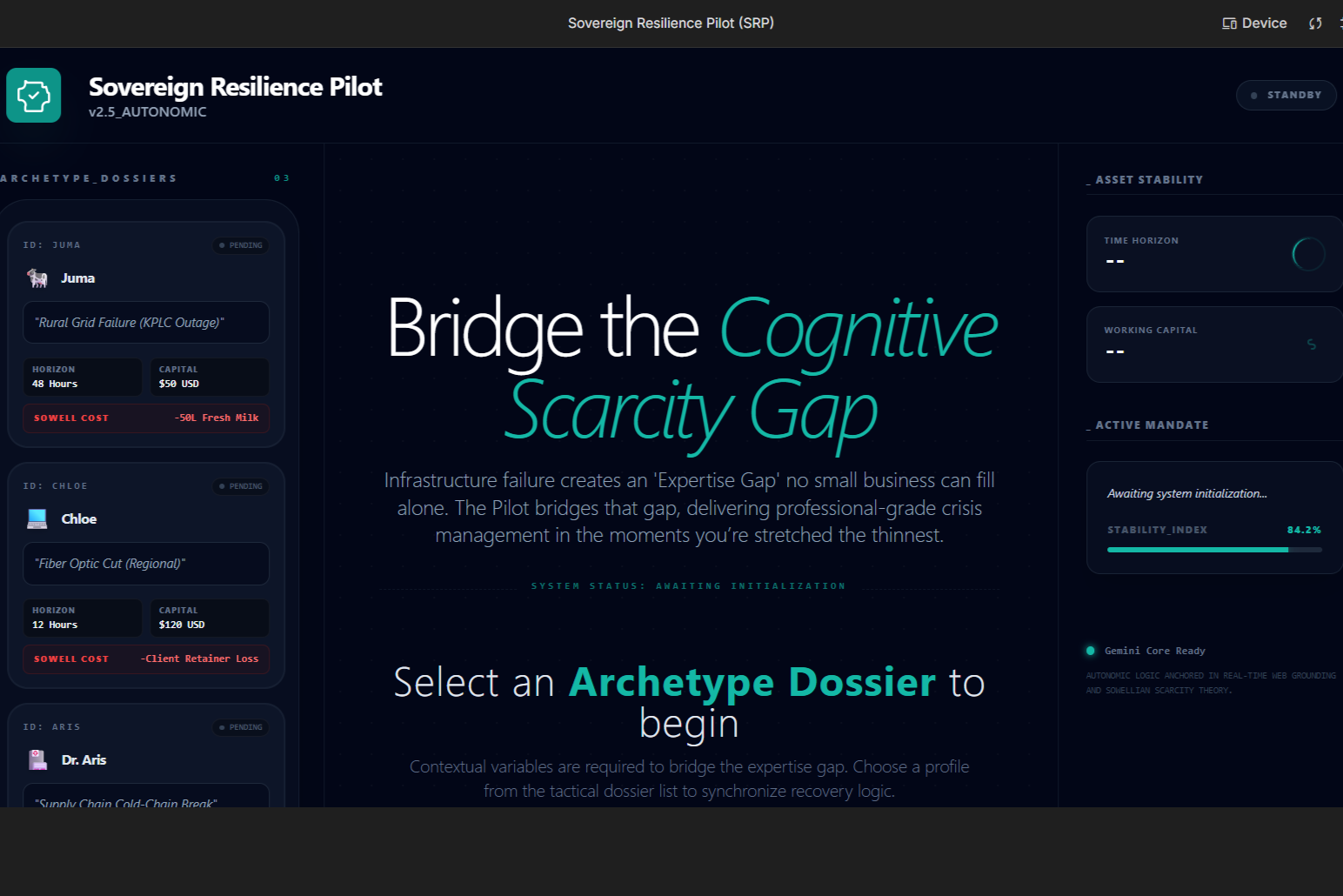
Sovereign Resilience Pilot Landing Page
Inspiration: Scarcity is Not Just Physical
The Sovereign Resilience Pilot (SRP) was born from a singular observation in emerging markets: when infrastructure fails (a grid outage in Nairobi or a fiber cut in Lagos), the primary loss isn't just electricity or data, it is expert bandwidth. Large corporations have crisis management teams; a micro-entrepreneur only has their own exhausted cognitive capacity. This is what we call the Expertise Gap. Inspired by Thomas Sowell’s economic principles, we built SRP to act as an autonomic "Second Brain" that manages resource trade-offs when the user is most vulnerable.
What it does: The Logic: Sowellian Scarcity & Stage-Two Thinking
The Logic: Stage-Two Thinking MSMEs don't just face technical glitches; they face Scarcity Conflicts. As Thomas Sowell famously said: "There are no solutions, only trade-offs."
The SRP rejects Stage-One Thinking (immediate, expensive fixes) for Stage-Two Thinking (consequential impacts). It asks: "If I spend this cash today, will I have enough to survive tomorrow?"
The Resilience Calculus The Pilot manages three scarce variables to find the smartest path forward:
Working Capital: Your liquid survival fuel.
Time Horizon: The "burn time" before your assets (like milk or vaccines) are lost forever.
Opportunity Cost: The "Sowell Factor"—the total value of what you lose if the mission fails (including future customer trust).
The SRP Pivot in Action The Stage-One Fix: Spend $40 of your remaining $50 on a risky, immediate repair. (Result: You're broke, and if the repair fails, the business dies).
The Stage-Two Pivot: Spend $15 on ice and a courier to move the assets to safety. (Result: Your assets are saved, you keep $35 in cash, and you've neutralized the time pressure).
The Sovereign Advantage: Maintaining control through calculated trade-offs rather than desperate spending.
How we built it
SRP is a high-stakes orchestration layer built with:
- React & Tailwind CSS: A "Tactical UI" designed for high legibility under stress (dark mode, glassmorphism, and high-contrast metadata).
- Gemini 3 Pro Preview: Used as the central "Reasoning Engine" for recursive reflection and Google Search grounding to verify real-world infrastructure status.
- Gemini 2.5 Flash TTS: Powers the "Voice Co-Pilot," delivering hands-free directives in both English and native languages (Swahili, Yoruba, Tagalog) to minimize cognitive load.
- Zho’thephun Framework: A custom recursive prompting logic that forces the AI to analyze Remediation, Risk, and Validation in three distinct logical passes.
Challenges we ran into
- The Latency-Trust Tradeoff: Crisis management requires speed, but complex "Thinking" takes time. we solved this with the Marathon Orchestrator UI, which visualizes the AI's internal reasoning steps to maintain user trust during the 10-second "deep think."
-Multilingual Nuance: Translating technical crisis directives into native languages while maintaining "authoritative urgency" required precise temperature control in the TTS generation.
-Data Stality: Infrastructure changes by the minute. Integrating Search Grounding was critical to ensure the Pilot didn't suggest a "Plan A" that was already physically blocked by real-world events.
Accomplishments that we're proud of
Bridging the "Librarian Trap" We are proud to have moved beyond the standard "Stateless AI" model. Most agents act like a Librarian, providing information and then resetting. We successfully engineered a Marathon State system that maintains Thought Continuity and Goal Persistence across multi-day recovery missions. The SRP doesn't just answer questions; it stays "locked in" until the crisis is resolved.
Operationalizing Stage-Two Thinking We successfully translated complex economic theory into a functional reasoning engine. By integrating Sowellian Scarcity principles, the Pilot rejects "Stage-One" immediate fixes in favor of Stage-Two analysis.
- The Result: An AI that can tell a user not to spend money, identifying that the Opportunity Cost of a repair is often higher than the cost of a strategic pivot.
- Solving for "Cognitive Scarcity" We designed the SRP specifically for the Expertise Wall. Recognizing that human decision-making quality drops by 70% during a crisis, we built an interface and logic flow that acts as "External Scaffolding" for the brain.
- Innovation: Our Voice Hand-off feature via Gemini 2.5 Flash allows users to transition from complex digital planning to hands-free physical execution, preserving their remaining mental energy when it matters most.
High-Fidelity Gemini Integration We pushed the boundaries of the Gemini 3 Pro Thinking Budget. By maximizing the 32,768-token reasoning window, we enabled the model to perform deep, recursive reflections. We coupled this with Google Search Grounding to solve the "Stale Data" problem, ensuring the Pilot’s directives are always based on Ground Truth (like live power outage maps) rather than outdated training data.
Multilingual MSME Empowerment We are proud of the Pilot’s ability to serve Micro-Small-Medium Enterprises (MSMEs) in their native languages. By generating authoritative, low-latency directives in Swahili, Yoruba, and Tagalog, we’ve ensured that high-level strategic resilience isn't limited by language barriers or educational gaps.
What we learned
We learned that AI "helpfulness" is useless without grounding. An AI that suggests a $1,000 generator to a business owner with $50 in capital has failed. By feeding the Scarcity Ledger directly into the LLM’s context window, the AI transitions from a "chatbot" to an "infrastructure orchestrator."
What's next for Sovereign Resilience Pilot
The road ahead for the Sovereign Resilience Pilot (SRP) involves moving from reactive crisis management to predictive, systemic orchestration. Our goal is to transform the SRP from a "pilot you call in an emergency" to a "silent guardian" that prevents the Expertise Wall from ever being reached.
- The "Sovereign Sensing" Layer (IoT Integration) The current Pilot relies on user input and Google Search. The next evolution is direct integration with IoT telemetry.
The Vision: Juma’s milk cooler or Chloe’s car sensors will feed real-time health data directly into the Resource Ledger.
The Impact: The SRP will detect a "Stage-Two" risk (like a slow coolant leak) days before it becomes a "Stage-One" crisis, allowing for low-cost preventive maintenance instead of high-cost emergency repairs.
- Collective Resilience Networks Crises like power outages often affect entire communities. We plan to develop Peer-to-Peer Resilience.
The Vision: If Dr. Aris’s clinic and Juma’s farm are both hit by a blackout, the SRP can coordinate a shared resource pool—identifying that Juma has excess solar capacity while Dr. Aris has a specialized technician on-site.
The Impact: This moves the "Value of Resiliency" (VoR) from an individual metric to a community-wide stability score.
- Financial & Insurance Autonomy To truly solve the Scarcity Conflict, the Pilot needs the ability to act on the "Working Capital" variable.
The Vision: Integration with fintech APIs to trigger Micro-Resilience Loans. If the Pilot identifies that spending $50 now saves $500 in assets, it can automatically secure a 24-hour liquidity bridge based on the AI-verified crisis state.
The Impact: This eliminates the "Capital Gap" that often prevents MSMEs from taking the optimal Stage-Two path.
- AR-Enhanced Voice Co-Pilot While the current "Voice Hand-off" is effective, we are moving toward Spatial Resilience.
The Vision: Utilizing AR glasses or mobile camera overlays, the Pilot won't just tell Juma which valve to turn, it will highlight it in his field of vision in real-time.
The Impact: This completely demolishes the Expertise Wall, allowing anyone to perform professional-grade repairs with zero prior training.
- Institutional "Resilience as a Service" (RaaS) We aim to provide the SRP's reasoning engine to insurance companies and governments as a standard for Infrastructure Hardening. By modeling thousands of "Stage-Two" outcomes, the SRP can help city planners identify exactly where cognitive and physical scarcity will hit hardest during the next major disruption.
Built With
- gemini-2.5-flash
- gemini-3-pro-preview
- gemini-intelligence
- google-ai-studio
- google-search-grounding
- react
- tailwind
- text-to-speech
- thinking-budget
- thought-signatures

Log in or sign up for Devpost to join the conversation.