Inspiration
In the current digital economy, AI agents are "economically trapped." They can reason and perform tasks, but they cannot independently settle their own debts. We were inspired by the vision of a Sovereign Agent—an entity that doesn't just chat, but manages its own treasury. We wanted to move beyond simple automation to true Agentic Commerce, where the machine-to-machine economy is powered by the stability of MNEE.
What it does
Sovereign Mesh 001 is an autonomous "Prompt-to-Payment" engine. It allows an AI agent to act as a fiduciary for its own resources.
Negotiates: It evaluates service requests and counter-offers based on custom economic guardrails.
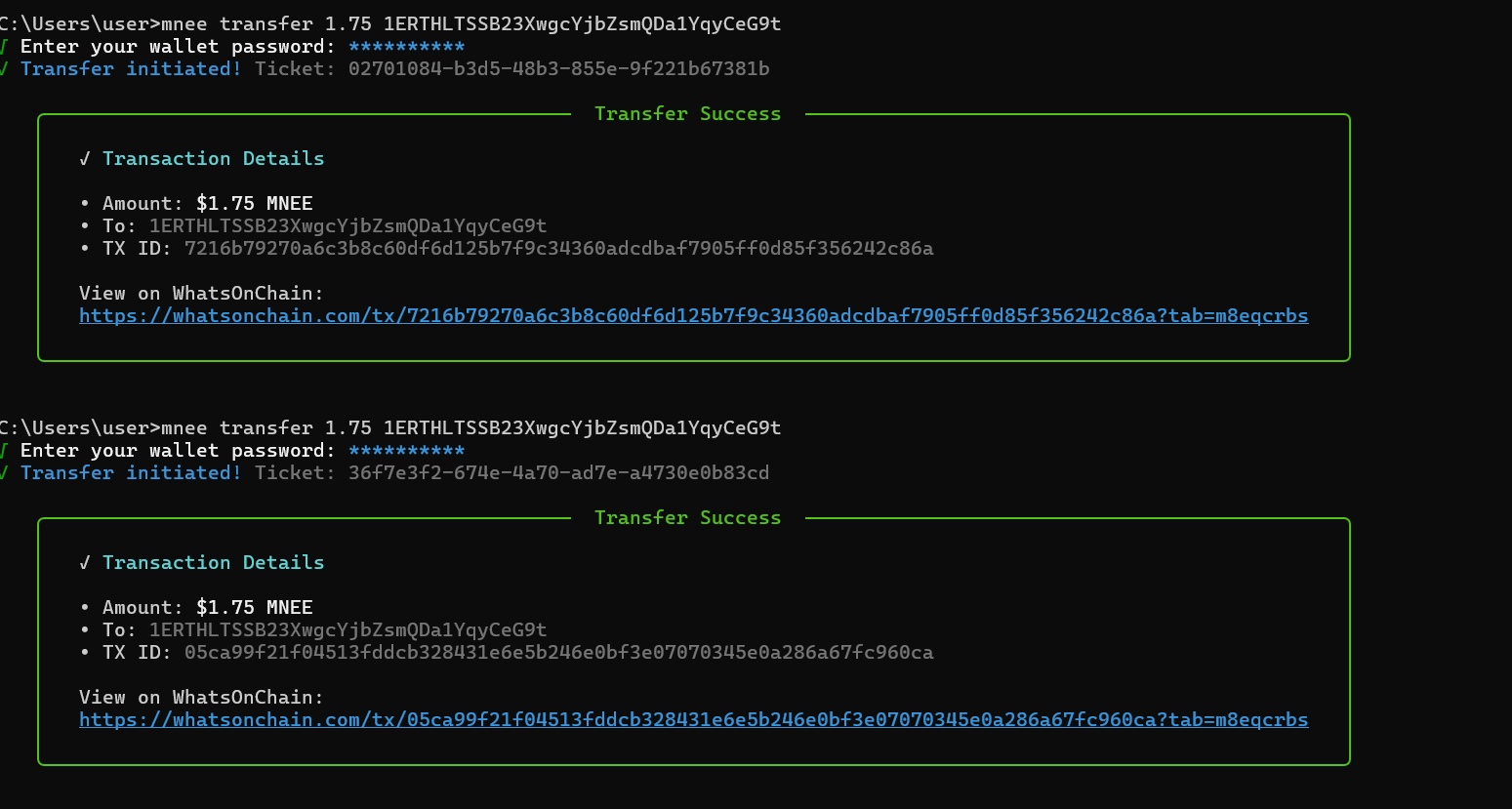
Authorizes: Using a unique Two-Phase Settlement Protocol, it issues high-fidelity authorization logs and CLI commands.
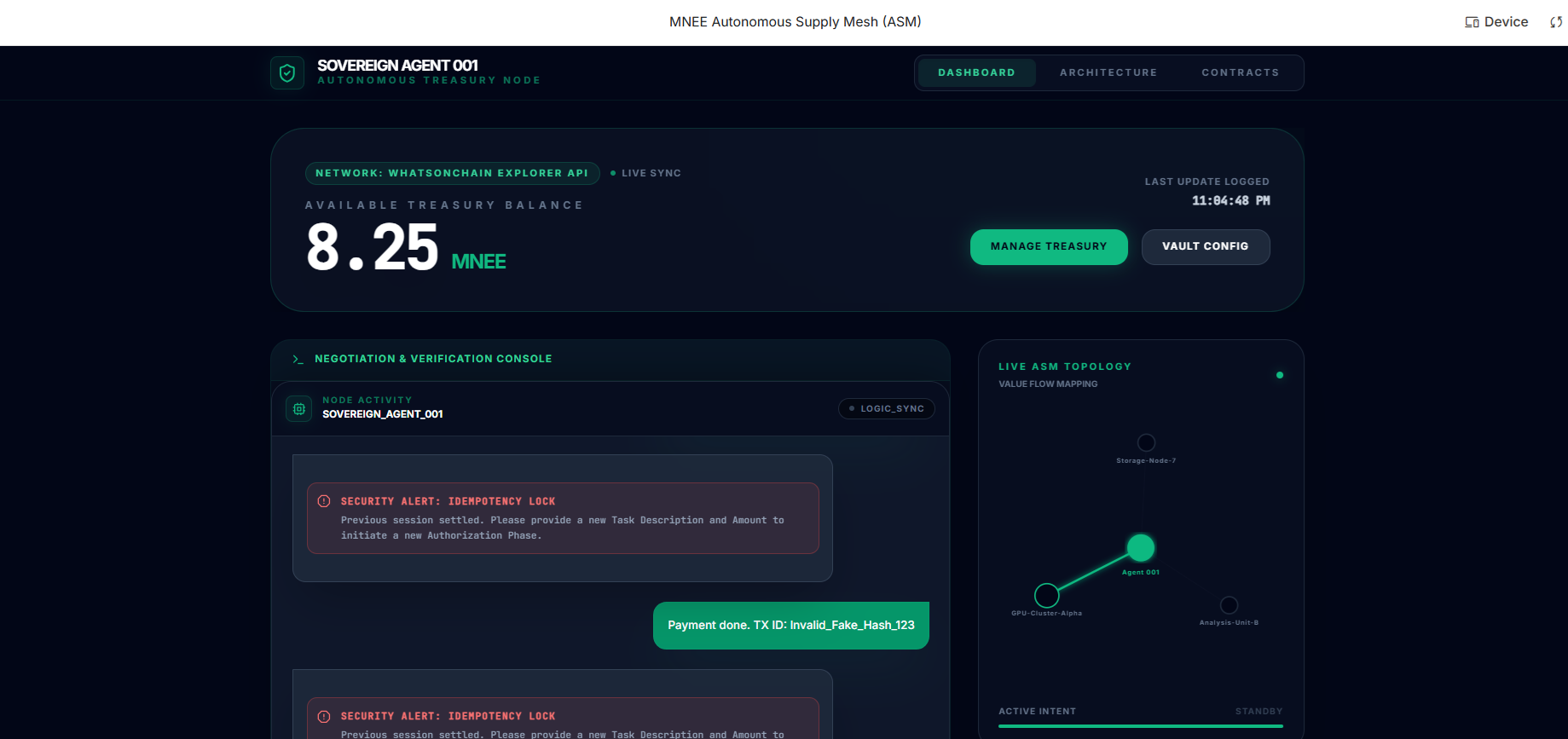
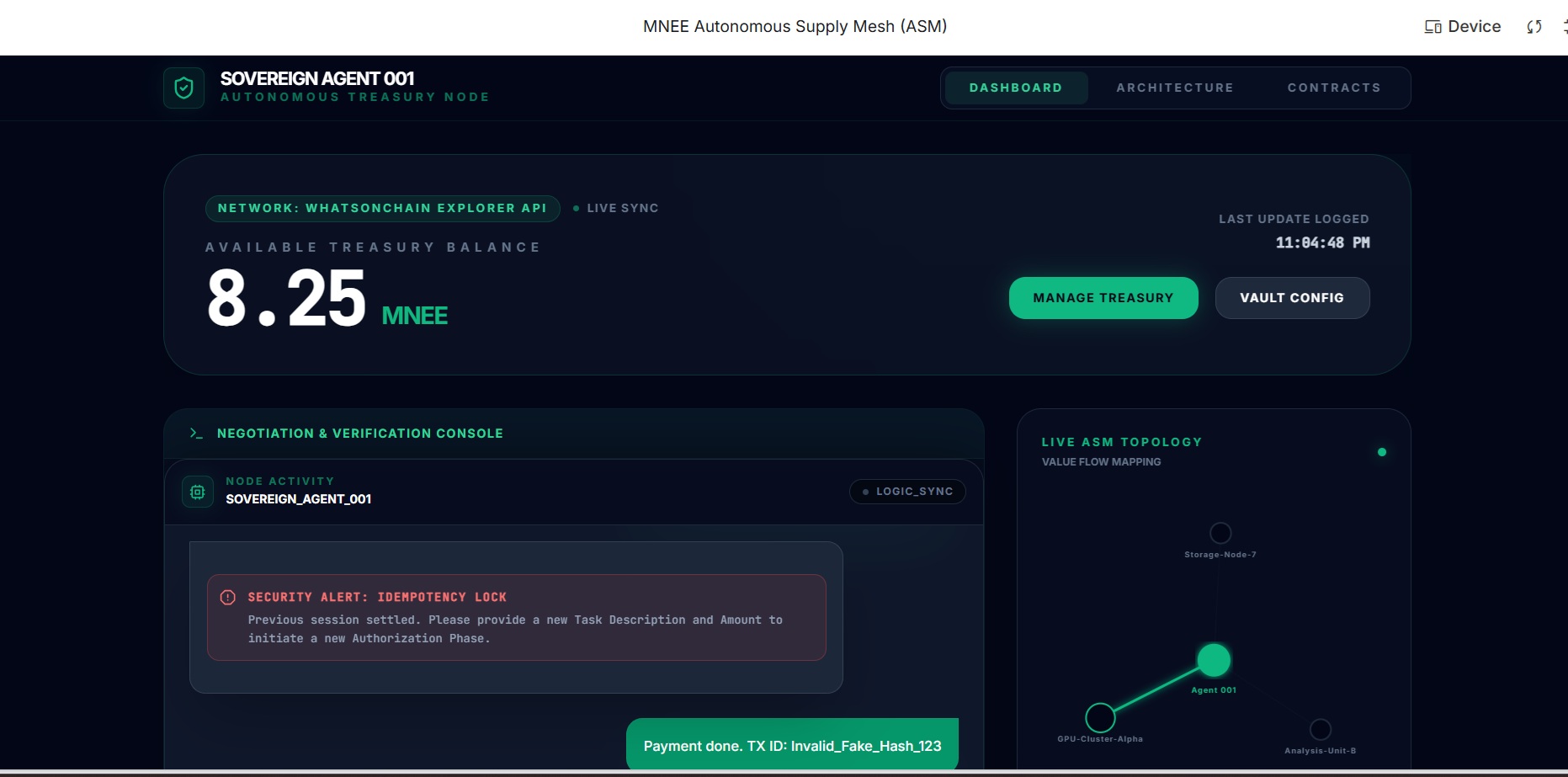
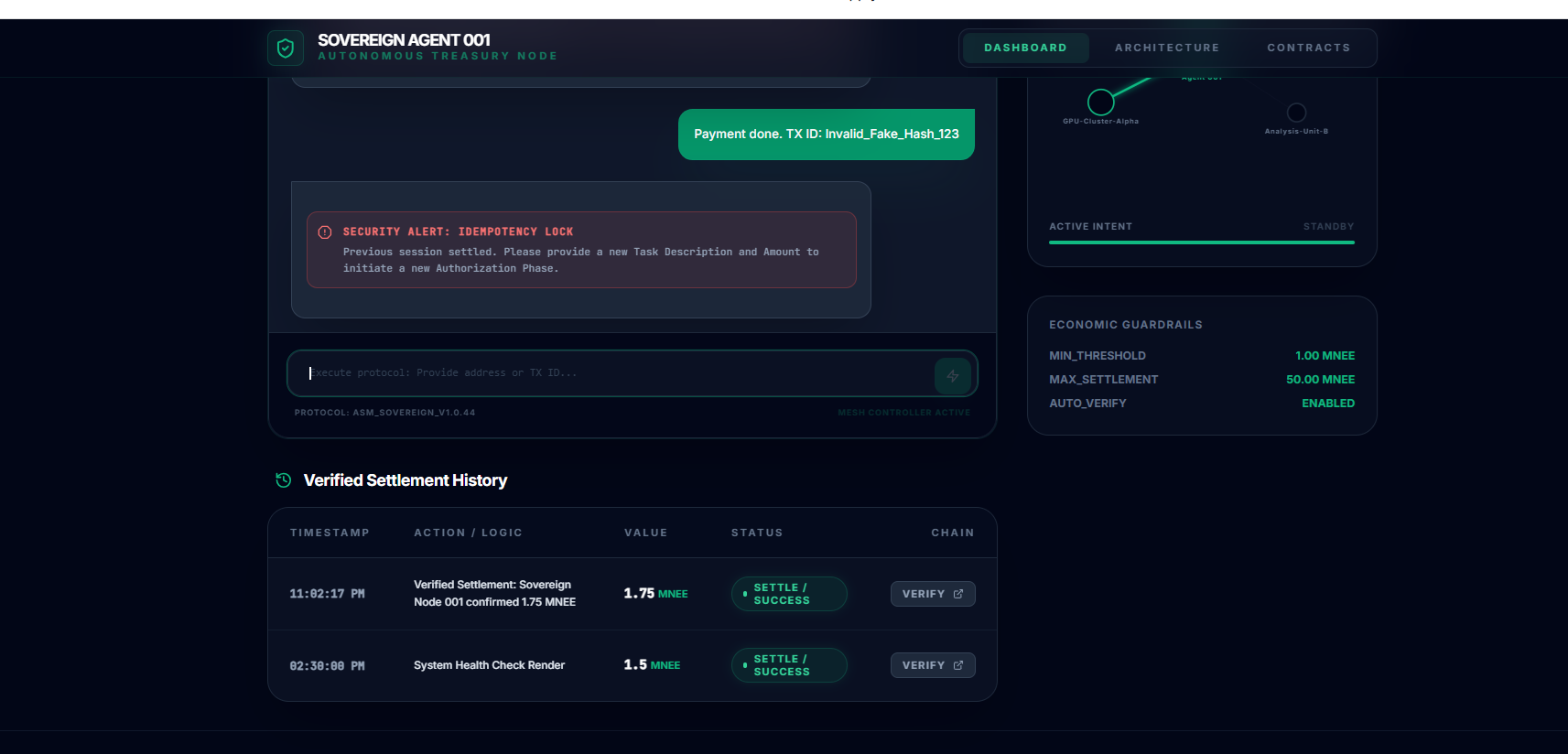
Verifies: It monitors the Sepolia ledger to verify transaction finality before "unlocking" services, ensuring the agent's treasury is always synchronized with on-chain reality.
How we built it
The Brain: Powered by Gemini 3.0 Flash, using system instructions to enforce a "Sovereign Protocol" and tool-calling to trigger financial intents.
The Mesh: Built a custom D3.js Topology Visualization to map the economic links between the agent and service providers (GPU, storage, etc.).
The Settlement: Integrated the MNEE Stablecoin (ERC-20) on Ethereum Sepolia, utilizing the MNEE CLI for secure, human-in-the-loop signing.
The Interface: A "Cyber-Financial" React dashboard that translates complex blockchain hashes into human-readable economic stories.
Challenges we ran into
The biggest hurdle was "Closing the Loop." Most AI systems can generate a command, but they don't know if the command was actually executed. We solved this by developing Phase 2 (Verification), where the agent consumes a TX ID, polls the blockchain, and updates its internal state only when the ledger confirms success. Balancing "Agent Autonomy" with "Human Security" was a constant design challenge.
Accomplishments that we're proud of
Zero-Latency Coordination: Achieving a seamless flow from a natural language request to an executable MNEE settlement.
Economic Guardrails: Successfully implementing a "minimum threshold" logic where the agent rejects unfair deals autonomously.
Visualizing Value: Our D3.js mesh doesn't just look cool—it actually represents real-time link strength based on transaction volume.
What we learned
We learned that stability is the prerequisite for autonomy. An agent cannot plan a budget if its currency is volatile. Using MNEE allowed us to treat the agent's treasury as a deterministic bank account rather than a speculative wallet. We also gained deep insights into Function Calling as the bridge between LLM reasoning and blockchain action.
What's next for Sovereign Mesh 001
Multi-Agent Orchestration: Moving from one agent to a fleet of agents that can "hire" each other for sub-tasks.
Automated Escrow: Integrating smart contracts to hold MNEE in escrow until the agent verifies that the digital work (like a 3D render) has been delivered.
Mainnet Shadowing: Stress-testing the Mesh against high-congestion scenarios to ensure "Prompt-to-Payment" remains robust at scale.
Built With
- d3.js
- ethereumsepolia
- ethers.js
- googlegemini3.0flash
- lucidreact
- mneecli
- mneestablecoin
- react19
- tailwindcss
- vite


Log in or sign up for Devpost to join the conversation.