-
-
Sovereign Grid Architecture
Inspiration Autonomous agents are rapidly shifting from experimental tools to core operational drivers. However, with this speed comes a critical governance gap. I was inspired to build Sovereign Grid after realizing that high-intensity agent operations—those capable of executing system-wide changes—often lack a robust safety layer. I wanted to create a system that doesn't just manage agents, but ensures they remain transparent, accountable, and, most importantly, human-verified.
What it does Sovereign Grid is a human-in-the-loop (HITL) orchestration framework that acts as a secure governance middleware for autonomous agents. It intercepts incoming agent-driven operations, forces them into a PENDING_APPROVAL state within the grid, and prevents execution until a human operator validates the intent via our live interface. It provides a real-time audit trail and state management system that ensures every autonomous action is documented and sanctioned.
How we built it The architecture is built for security, scalability, and performance:
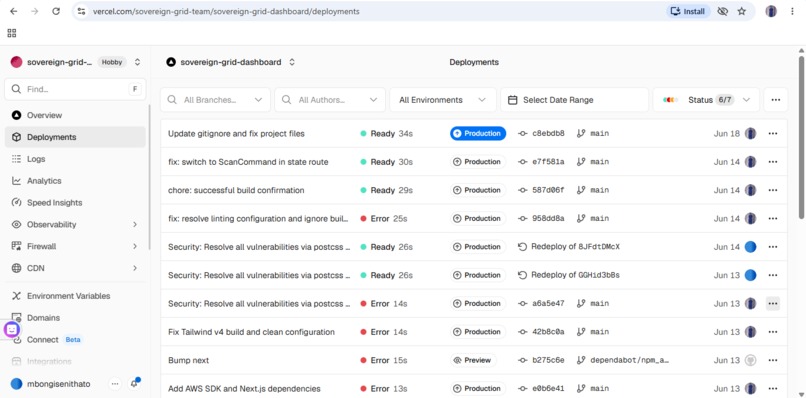
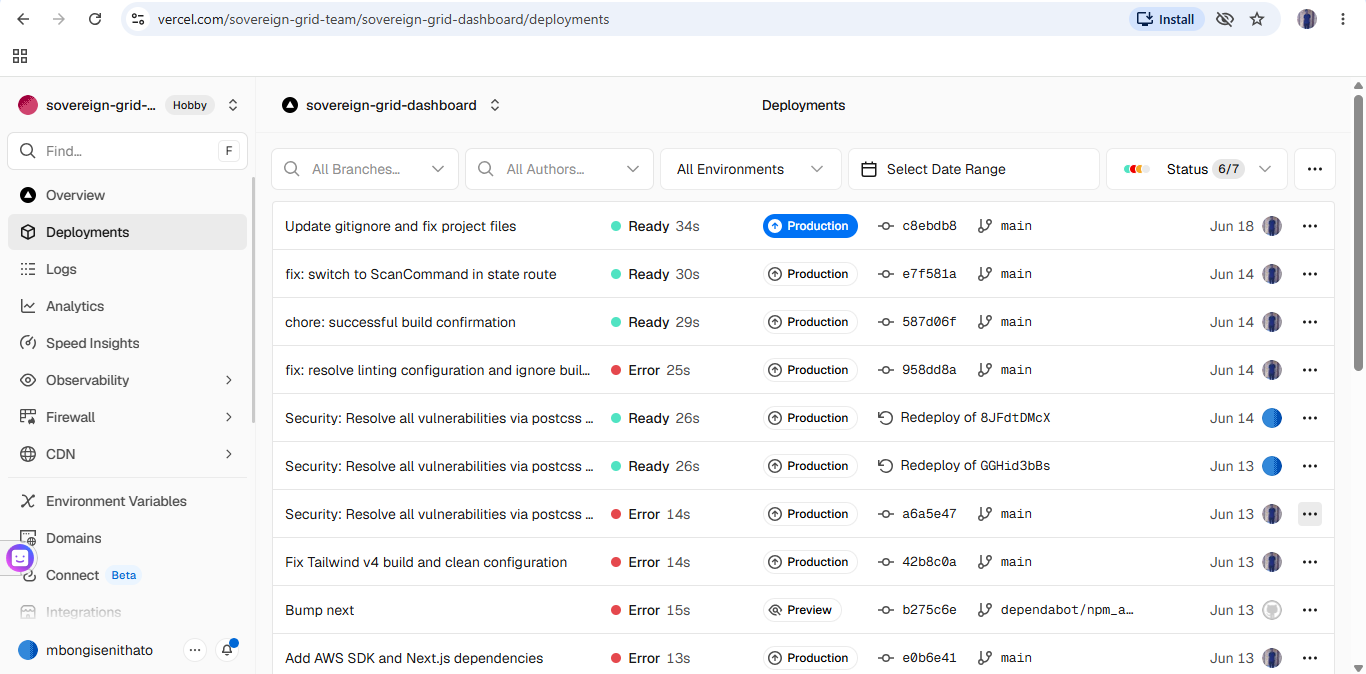
Frontend: A high-performance dashboard built with Next.js, deployed and managed via Vercel.
Database: Amazon DynamoDB serves as our high-performance "Source of Truth." It handles our EventTelemetryTable, ensuring sub-millisecond latency when tracking swarm state changes.
Integration: We utilized Vercel’s environment variable management to securely interface with AWS, ensuring that database credentials remain protected while enabling a seamless CI/CD pipeline.
Challenges we ran into The biggest technical hurdle was implementing a decoupled, asynchronous governance model that felt synchronous to the user. We needed to ensure the dashboard reflected the agent state in real-time without introducing lag. By optimizing our DynamoDB query patterns and leveraging Vercel's edge-network capabilities, we successfully synchronized the state transitions, ensuring the human operator has an up-to-the-millisecond view of the grid.
Accomplishments that we're proud of I am particularly proud of the state-machine logic that powers the verification queue. Building a system that successfully bridges the gap between raw autonomous output and a clean, user-friendly approval UI was a complex challenge that demonstrates true full-stack craftsmanship.
What we learned Building this project emphasized that "Operational Excellence" is as important as the model itself. I learned that data infrastructure—specifically using a robust tool like Amazon DynamoDB—is the backbone of any scalable AI application. Relying on this proven stack allowed me to focus on the governance logic rather than infrastructure overhead.
What's next for Sovereign Grid: HITL Agent Orchestrator The next phase for Sovereign Grid involves integrating predictive anomaly detection. I plan to add an automated "pre-verification" step where the system compares an agent's intended action against historical success patterns, flagging suspicious operations for human review before they are even dispatched to the grid. This will further reduce the cognitive load on the human operator while maintaining the highest level of security.
Built With
- languages:-javascript-(typescript)-frameworks:-next.js-(react)-frontend/hosting:-vercel-database:-amazon-dynamodb-governance-logic:-human-in-the-loop-(hitl)-orchestration-framework-development-tools:-github
- tailwind
- vs-code

Log in or sign up for Devpost to join the conversation.