-
-
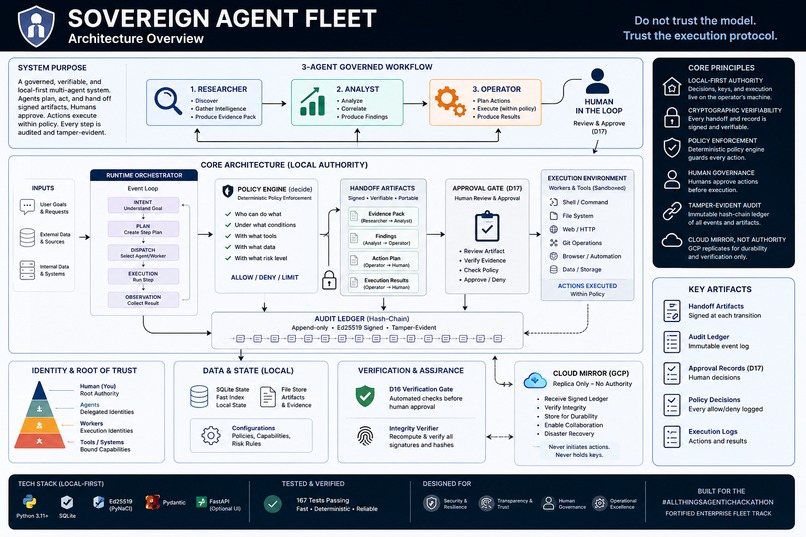
architecture
-
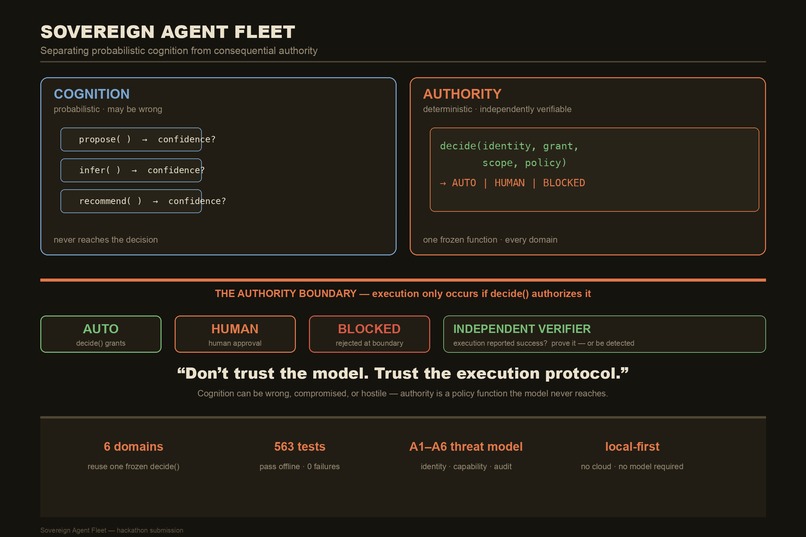
sovereign-agent-fleet
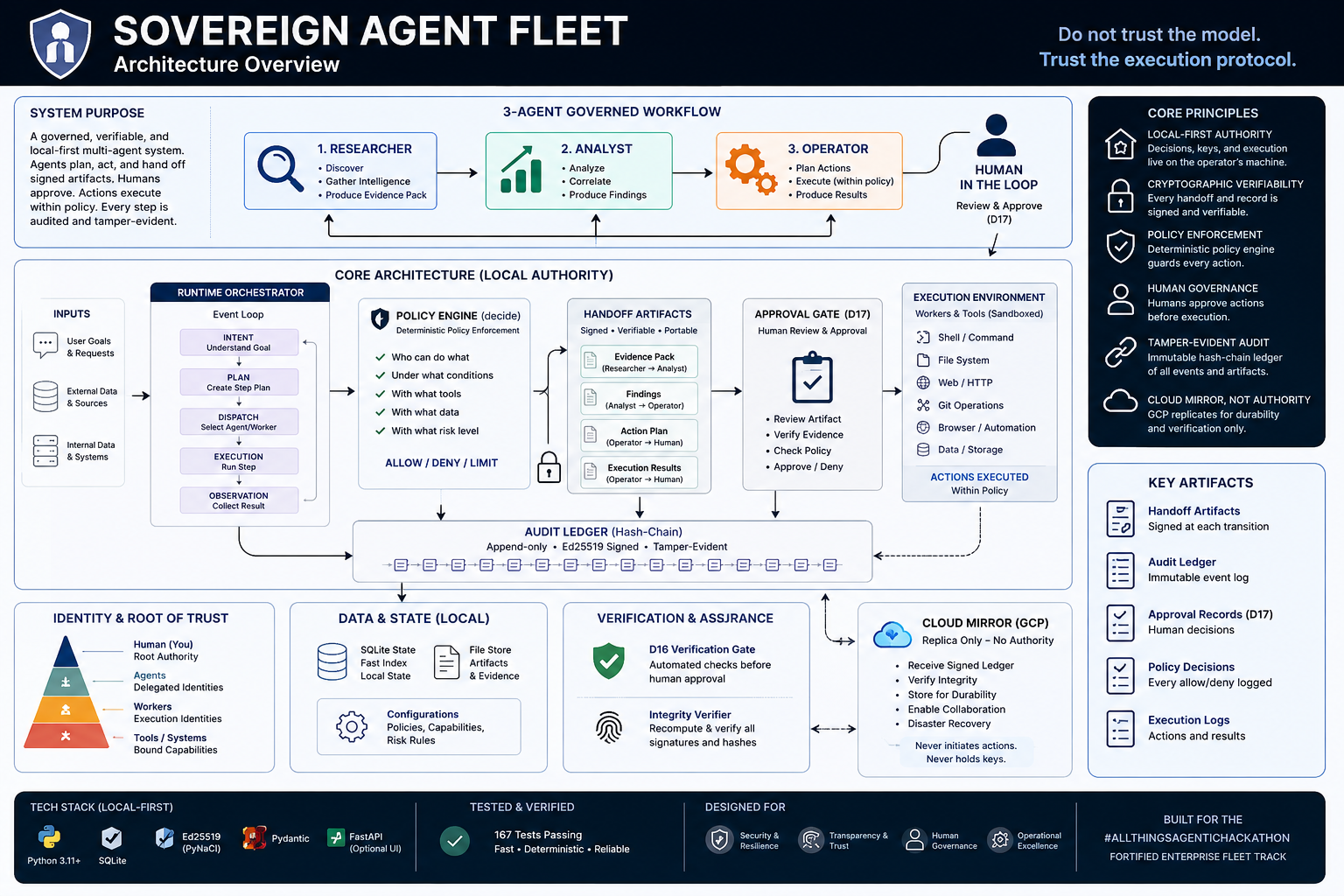
Inspiration
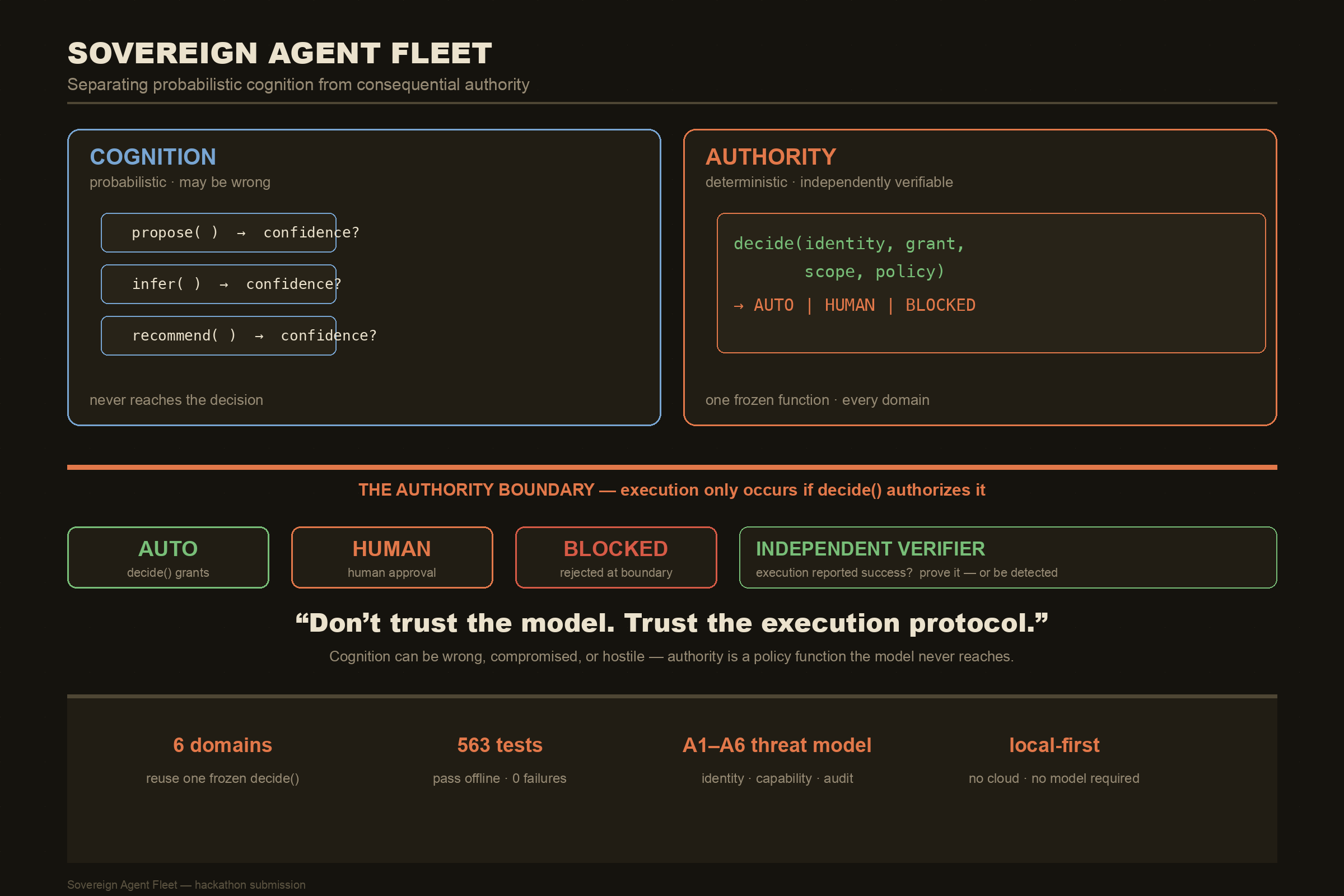
Every popular agent framework treats the model as the agent: it reasons and it acts. But cognition is probabilistic — it can be wrong, it can be compromised, and it can be adversarially steered. When the same component that thinks also holds the keys, a single failure (a hallucination, a prompt injection, a bribed endpoint) becomes a consequential action in the real world.
The insight that started this project: a confident model is not an authorized one, a correct model is not a permitted one, and an identity can be compromised yet still be prevented from escalating authority. The fix is not "make the model safer" — it is to stop letting the model be the authority. That became the thesis behind everything here:
Do not trust the model. Trust the execution protocol.
What it does
Sovereign Agent Fleet is a local-first governance substrate that keeps cognition and authority in separate trust domains that never share a process boundary.
- A frozen, deterministic authorization function —
fleet.epistemic.decide(). A pure function with no model output, no RNG, no wall clock, and no network. It returns exactly one verdict:
$$ \text{decide}(\text{identity},\ \text{grant},\ \text{scope},\ \text{request},\ \text{constraints},\ \text{epoch},\ \text{now},\ \text{trusted_issuer}) \;\in\; {\text{AUTO},\ \text{HUMAN},\ \text{BLOCKED}} $$
An import wall. The cognition layer is physically blocked from importing authority modules. A structural test parses
evaluation.pyand fails the build if it imports any gateway, policy, runtime, finance, or incident module — so the model's reasoning code cannot reach the decision code.A real crypto chain. Argon2id KDF → Ed25519 identity → XChaCha20-Poly1305 sealed envelopes. Capability grants are bound to a pinned issuer key and verified by an independent verifier.
Six independent domains — exchange/finance, incident, supply, hypothesis, mirror, and grid — each reuse the same
decide()with zero substrate edits. The brain behind a proposal is irrelevant.Independent verification. An executor that falsely reports success is detected, not trusted. Execution only occurs if
decide()authorized it.
The governing invariant is written in one line:
$$ \boxed{\text{MODEL OUTPUT} \;\neq\; \text{AUTHORIZATION}} $$
How we built it
- Language & runtime: Python 3.11–3.13, intentionally dependency-light — stdlib crypto
plus
cryptography,pynacl, andargon2-cffi. - Control plane: a canonical FastAPI surface (
fleet/api) with awebsocketslive ticker client andhttpx-backed test client. - Authorization core: a single frozen, deterministic
decide()function — the only thing that can grant authority — with no model path in or out. - Verification gate: Pytest drives 563 offline tests against an explicit A1–A6 threat model (identity forgery, capability escalation, approval mutation, artifact tampering, audit tampering, cross-domain authorization). 4 live-venue integration tests are network-marked and deselected by default.
- CI: GitHub Actions runs the full suite across the Python matrix; a separate supply-chain
audit (
fleet-security) runspip-auditfail-closed with a CycloneDX SBOM. - Demo: a scripted Playwright capture narrated over the paper, assembled with
ffmpeg. - Optional cloud: Cloud Run / Firestore / Pub-Sub and OpenTelemetry are an add-on layer
(
requirements-gcp.txt) — never required to run the suite.
Challenges we ran into
- The portability trap. The import-wall test originally opened its source file through a
hardcoded absolute path to a developer laptop (
/Users/.../evaluation.py). It passed locally for weeks while every CI run failed withFileNotFoundError. Tests are code — they must be portable, or your green badge is a lie. Fixing it flipped both workflows from red to green. - Holding the wall as the system grew. Adding six domains, an API, and a demo create
constant temptation to "just import
decidefrom cognition." The import-wall test is the only thing that held the boundary; without it the architecture would have silently collapsed back into an ordinary framework. - Walking back our own language. Once "experimentally evaluated" lands in an abstract, it is painful to retract. Calibrating claims to what was actually measured was the hardest part of the writeup — and the most worthwhile.
- The demo pipeline. The narration TTS is deterministic per input text, so a garbled beat could only be fixed by rephrasing the script — which changed the clip duration and forced re-capturing every visual, re-syncing timings, and re-assembling the video.
Accomplishments that we're proud of
- The frozen authorization function genuinely never reads or trusts model output — verified by a structural import-wall test, not by convention.
- Six real domains reusing one
decide()with zero substrate edits, proving the architecture is domain-general rather than finance-specific. - 563 tests passing offline against a named A1–A6 threat model, including a genuinely blind fuzz harness of 5,000 randomized attack vectors with zero false authorizations.
- Two green CI workflows (CI + supply-chain audit) after a real, reproducible portability bug that had been masking failures for weeks.
- An honest paper that says what it is — conformance testing, not science — and names knowledge poisoning as an unsolved problem instead of hiding it.
What we learned
- Confirmatory tests are not "adversarial experiments." A referee review forced us to stop
over-claiming. The suite verifies the system against its own author-specified threat model —
that is conformance testing. Only a genuinely blind fuzz of
decide()earns the word adversarial. Calibrating the evidentiary register honestly matters as much as the architecture does. - Authority integrity is not truth. The protocol can guarantee that no unauthorized action occurs. It cannot guarantee the knowledge the model reasoned from was untampered. Knowledge poisoning — feeding the cognition layer false premises — is an open problem we now state explicitly.
- Green locally means nothing; green in CI means something. The portability bug taught us to trust the reproducible environment over our own machines.
What's next for Sovereign Agent Fleet: Trust the Protocol, Not the Model
- Close the knowledge-poisoning gap. Add provenance and integrity attestation for the cognition layer's inputs, so a tampered premise is detected before it becomes a (correctly authorized, wrongly reasoned) proposal.
- Formal verification. Lift the five invariants from English into a machine-checked spec (e.g., TLA+ or a dependent type) so "the boundary holds" is a proof, not a test.
- A governed executor runtime. Ship the reference execution environment that enforces decided scopes end-to-end, not just the decision function.
- Broader domain adapters. Demonstrate the same frozen
decide()governing code-execution, email-sending, and infrastructure-change domains. - Production deploy. Publish the demo to
danielkliewer.comand a public Cloud Run instance behind the supply-chain-audited pipeline.
Built With
- actions
- argon2
- cloud
- cryptography
- fastapi
- github
- httpx
- opentelemetry
- pyca
- pynacl
- pytest
- python
- websockets


Log in or sign up for Devpost to join the conversation.