-
-
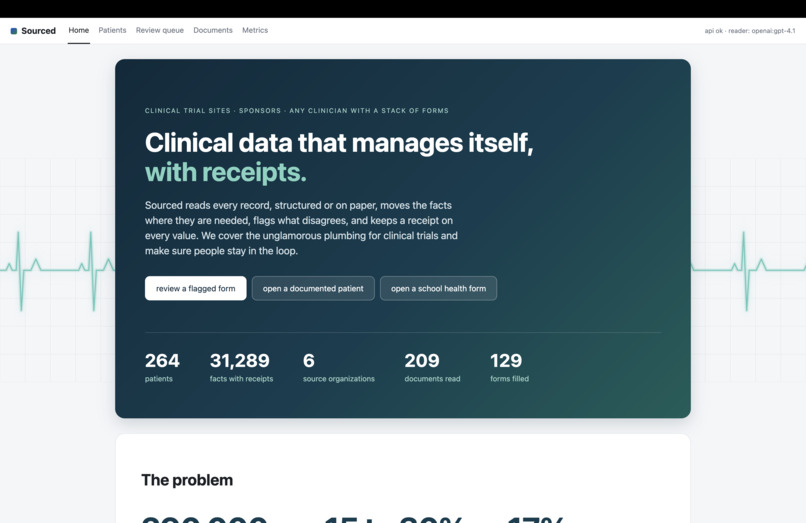
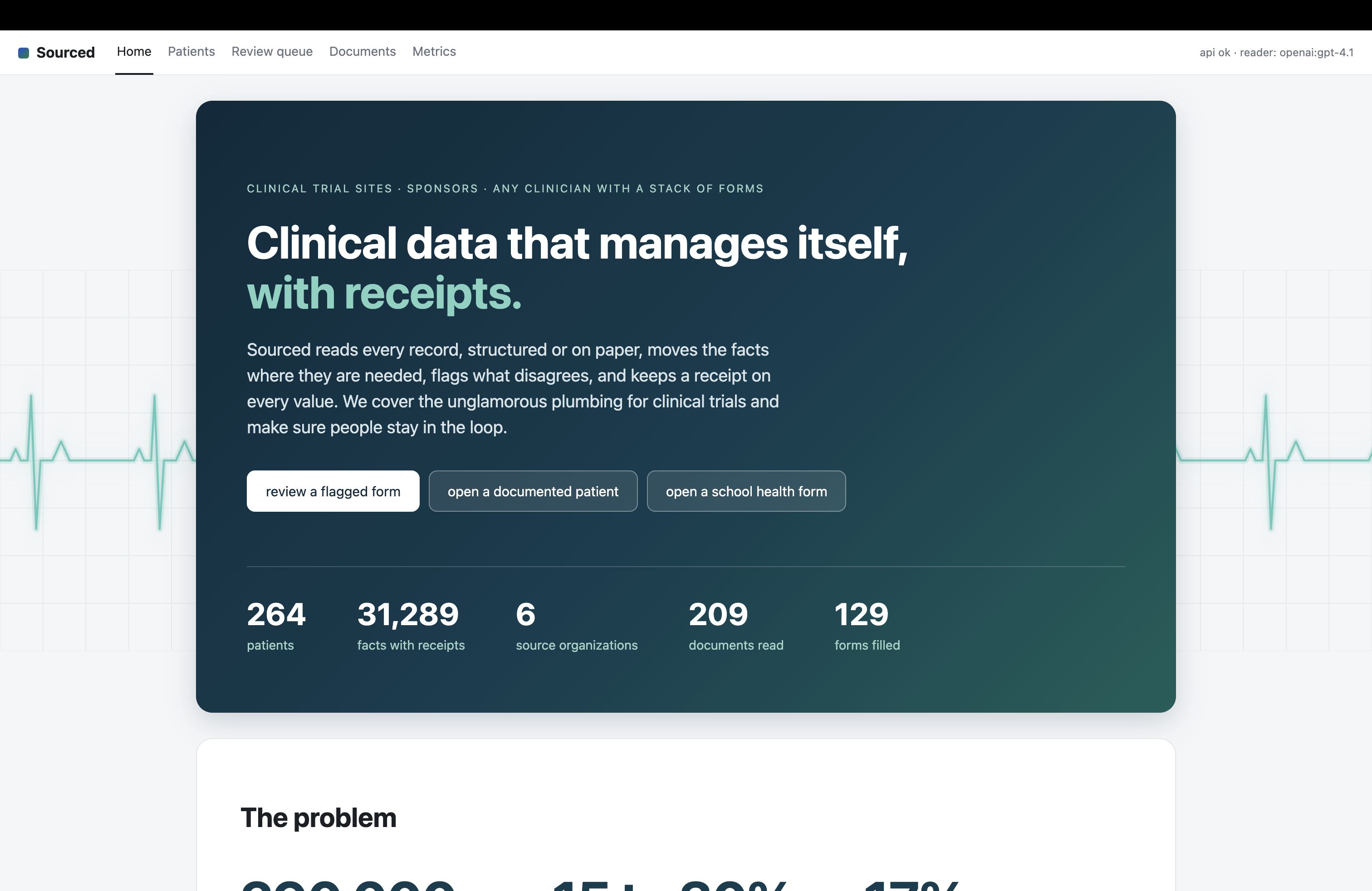
Landing Page
-
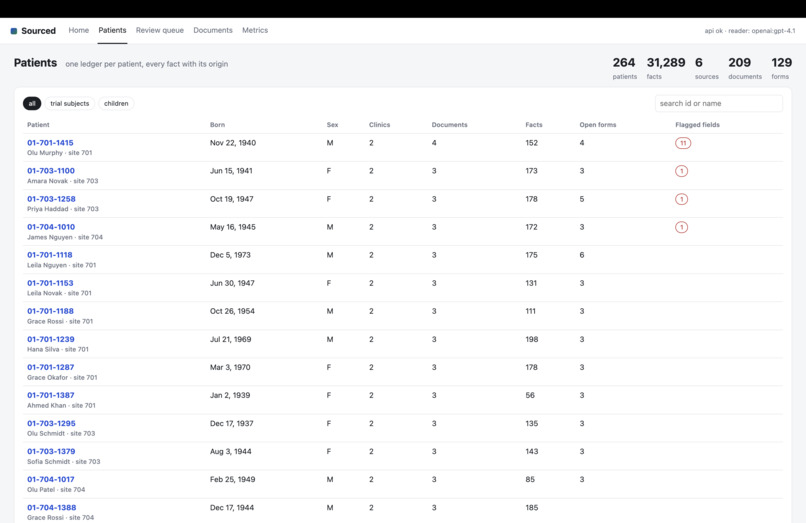
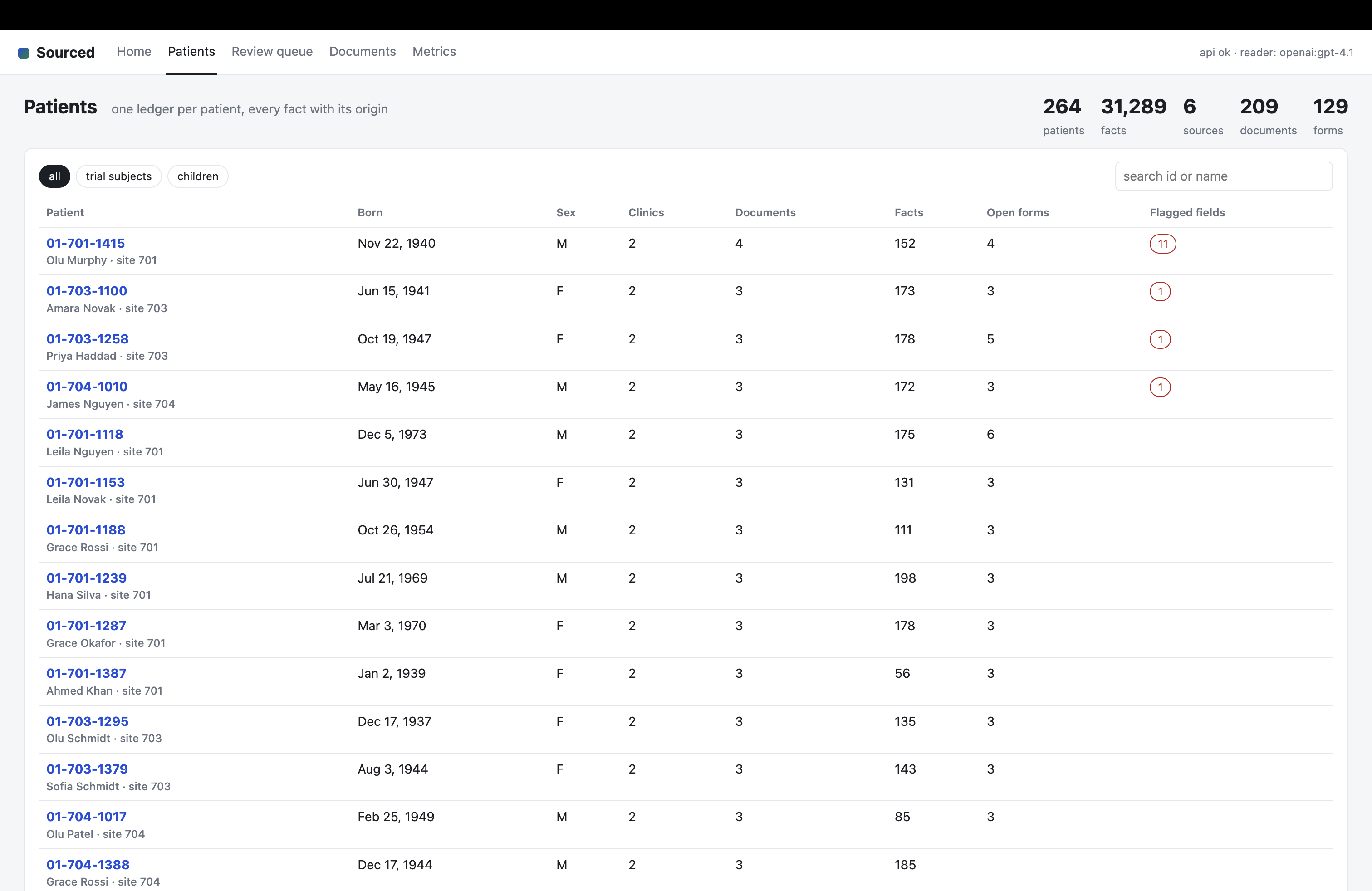
Total Patient List, With Search Option
-
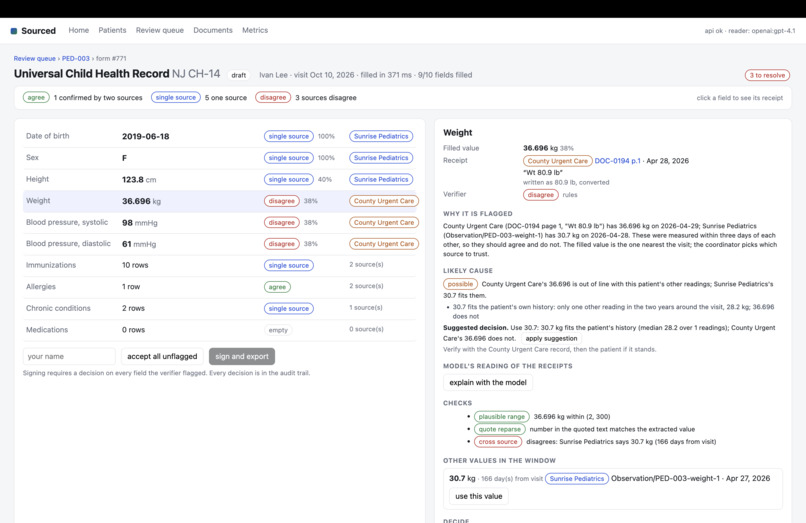
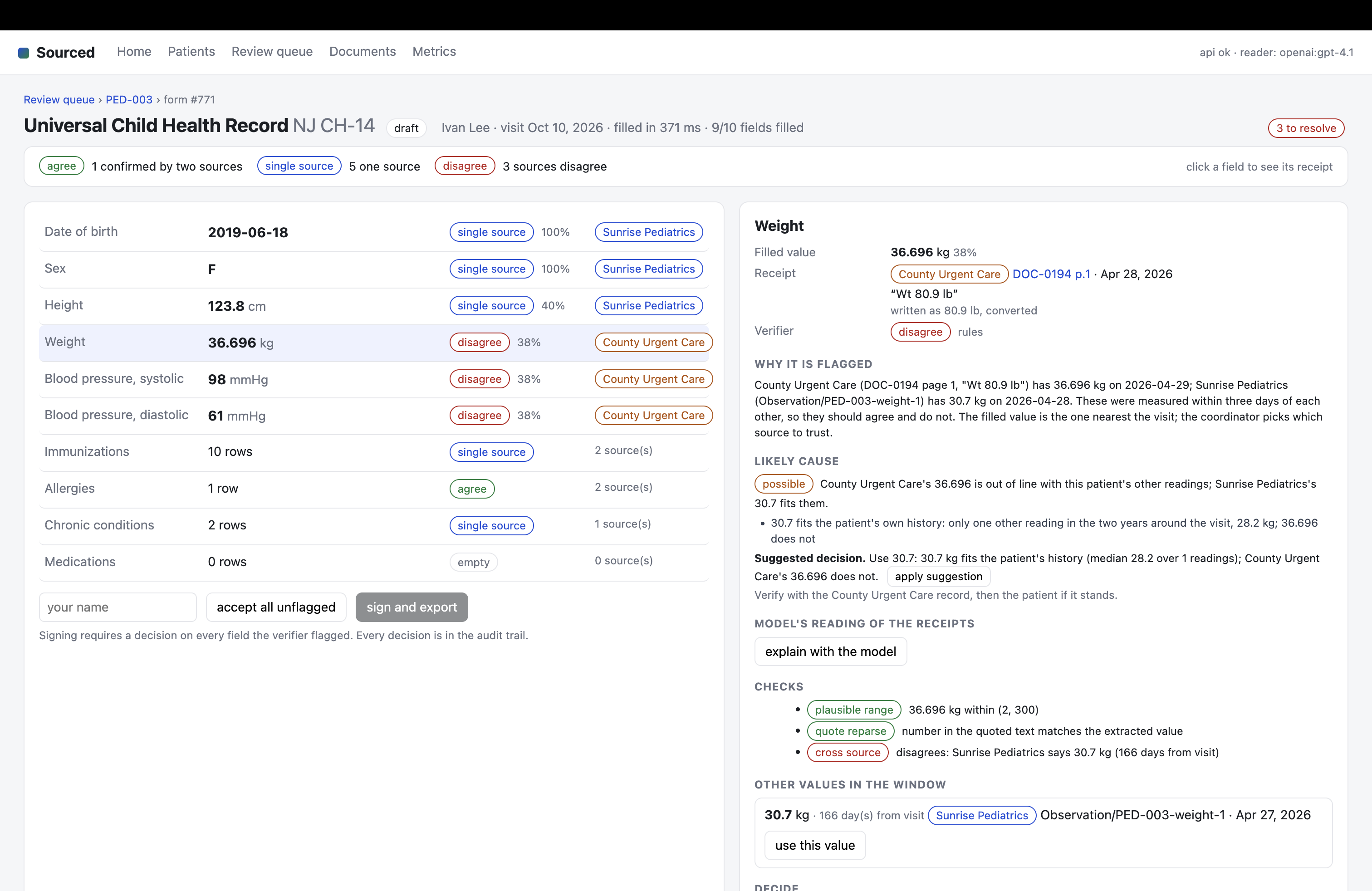
A look inside a conflict case where the agent identified a possible cause of confusion
-
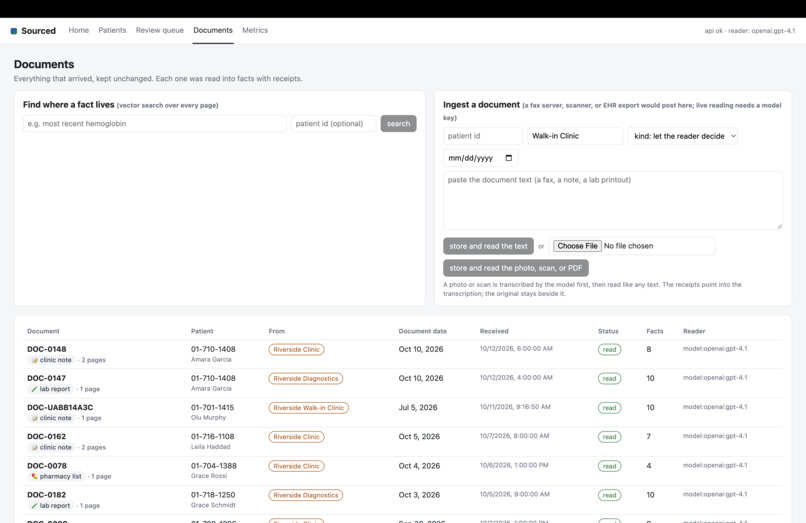
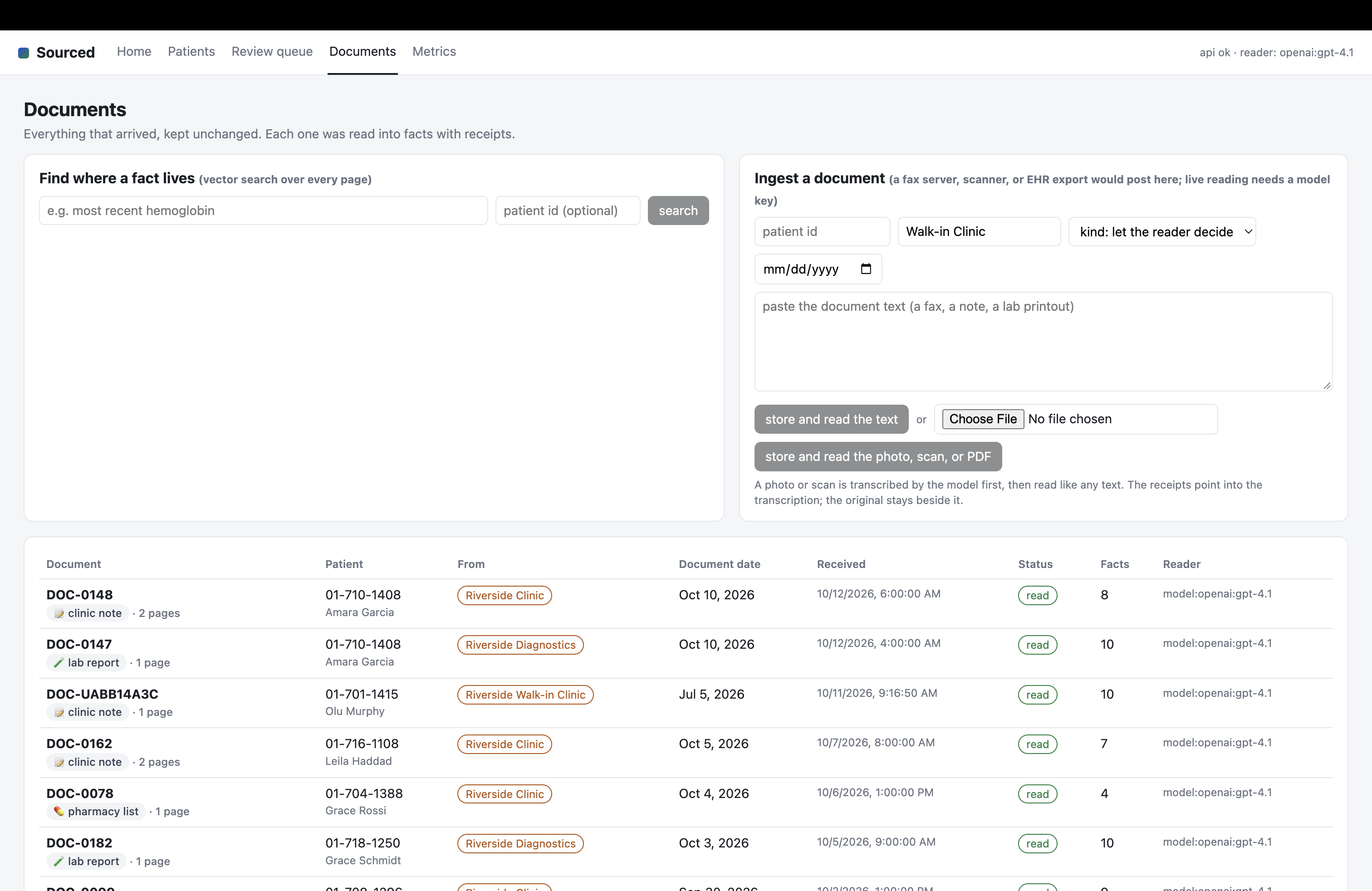
Document Hub, for managing and uploading new entries, can connect to a different service
-
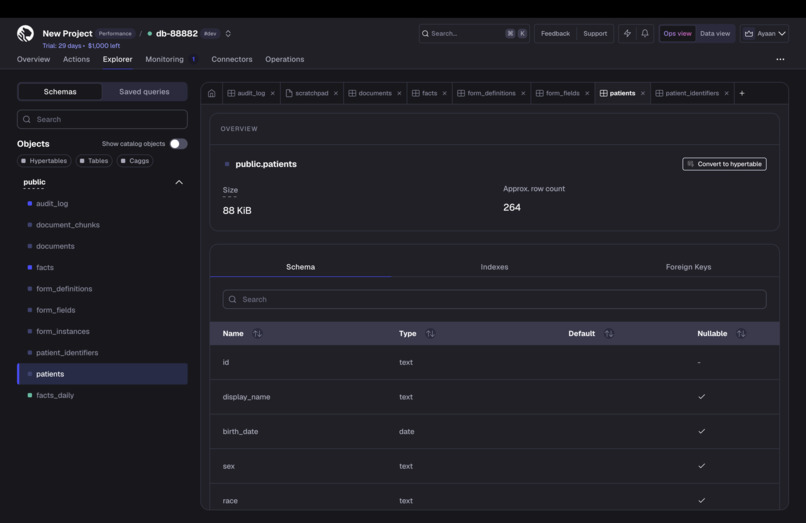
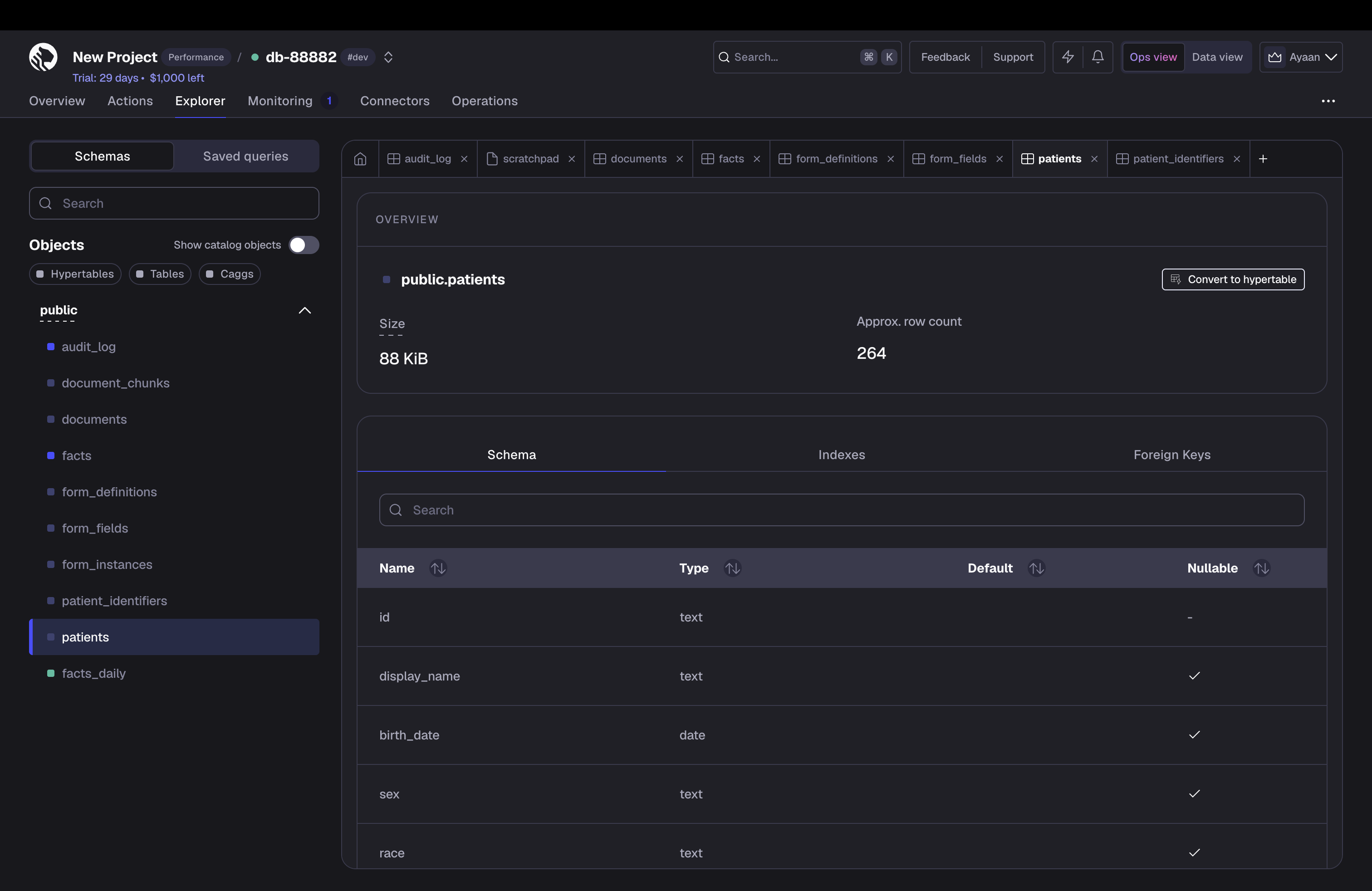
Glimpse into our Tiger Data postgres store
-
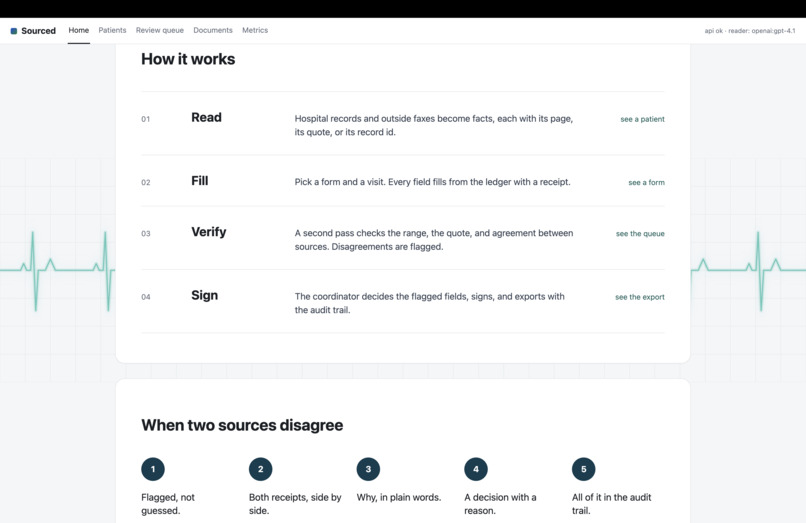
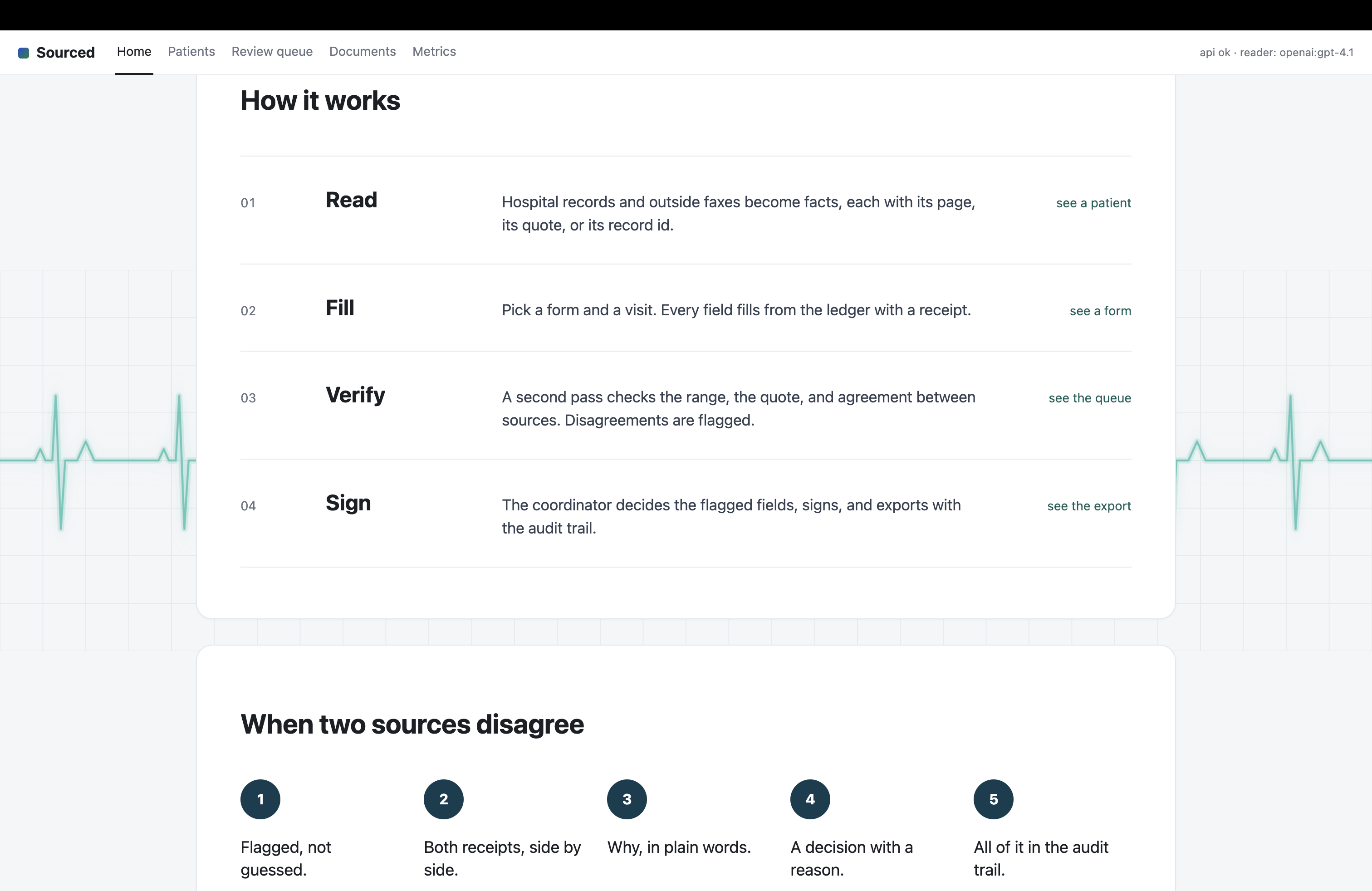
Process Overview
Inspiration
“Every medicine you have ever taken got there through a clinical trial: years of patient visits where everything is measured, recorded, and proven to the FDA. Here is what that proving costs, and how we lowered it."
A 400-patient Phase 3 clinical trial produces about 290,000 data points. Each one is typed by a coordinator from a hospital record into the sponsor's forms, then checked against the source by a monitor for correctness. That checking is 15 to 30 percent of a trial's cost in time and money.
Old-fashioned connectors that move structured hospital data into trial databases via scripts and regex reach about 17 percent of the data (TransFAIR, BMJ Health & Care Informatics 2023). The rest of the data exists as faxes, scanned lab reports, and clinic notes that they struggled to automate. Our solution is Sourced, an agentic solution following Regeneron's site agents outline, naming Source-to-EDC as the first data agent to build, with one rule: every value cited and traceable.
What it does
Sourced is clinical data that manages itself, with receipts.
- Reads every source. FHIR from the hospital; text, photos, scans, or PDFs from everywhere else. Every fact keeps its document, page, span, and verbatim quote, or its FHIR resource id.
- Fills the forms. CDASH visit pages (demographics, vital signs, labs, medications) and the New Jersey school health record as an example, from one ledger per patient, nearest value to the visit first.
- Checks every field again. Plausible range, the quote matches the value, sources agree within three days, no conflicts inside medication rows.
- Explains every disagreement. Who recorded what, where, and when; the likely cause (a unit error, transposed digits, a dispensing list that cannot show a stop, a value out of line with the patient's own history); and a suggested decision(s).
- A person in the loop decides what gets reported with records, signs, and exports ODM-shaped JSON with the receipts inside. Every action lands in an append-only audit trail.
- For any future forms that need filling, we minimize the likelihood of missing, poor, or unusable data, saving time and money across both ends of the process in processing forms and creating forms.
How we built it
The model reads. The rules fill and check. The human signs.
- Reader: gpt-4.1 / Gemini Flash under a strict JSON schema. It must quote every value verbatim, and we locate each quote to a page and character span. A photo is transcribed first, then read like text.
- Ledger on Tiger Data: a hypertable of facts with compression, a continuous aggregate for the live chart, pgvector for document search.
- Filler and verifier: pure Python rules over a small vocabulary of LOINC codes and unit conversions.
- Test world: the CDISC SDTM pilot study (254 subjects) plus generated outside-clinic documents, with planted gaps, unit traps, and conflicts recorded in an answer key. A regex extractor is kept as the baseline sites use today.
Challenges we ran into
- Making a model checkable: it must quote, and the locator must find the quote even when whitespace or degree signs are mangled.
- False alarms: same-day duplicate vitals, one-letter labels fuzzy-matched to blood pressure, a single dose with no end date read as "still active". Each one became a rule.
- Staying honest without a key: an oracle reader plays the answer key and cached model reads reproduce every number from a clean clone.
Accomplishments that we're proud of
On 60 patients and 1,009 fields with a known truth: 100% filled, 100% accurate, every field with a receipt, 35 of 35 planted conflicts caught, 0 false alarms. The reader recalls 100% of facts against 43.9% for the regex baseline, which falls to 0.7% on layouts it was not written for. On the demo forms, structured data alone fills 68% of the fields; with the reader, 99.7%. A photographed fax becomes ten located facts in eight seconds
What we learned
The 17 percent ceiling is not a technology limit. It is where the data lives. Free text and other sites hold the rest, and reading them is only useful when every value can be traced back to the page it came from.
What's next for Sourced
Connectors for fax servers and EHR document exports, a real EDC export target, scanned PDFs at volume, and the "acts alone once proven" switch from the Regeneron outline: an agent that stops asking about the field types it has been right about.
Why an Agentic solution, why not more scripts?
Sites already automate the structured part; connectors reach about 17 percent of trial data, and regex scripts patch the rest. A script is written for one layout. Ours reads 74 percent of the facts on the layouts it was written for and under 1 percent on the ones it was not, and a third of real documents are the ones it was not. We also didn't want to just add more scripts because some documents simply lack structure entirely and require the language processing exclusive to trained models. A model that must quote every value reads 100 percent of both types of documents, and because every quote is located, the rules around it can check its work. That is the step up: not a smarter script, but an agent whose output is verifiable, with a human deciding only what disagreed.
Additional Thoughts; Clinical Tech
Every value on a form carries its receipt, the document, page, and quote, or the FHIR resource. That is the “original source cited and traceable” must-have in Regeneron’s site agents outline, and the attributable and original part of ALCOA+ that ICH E6(R3) and FDA’s eSource guidance expect. Signing needs a human decision with a reason on every flagged field, and every action lands in an append-only, SHA-256 hash-chained audit trail that can be re-verified on demand, the tamper evidence 21 CFR Part 11 asks of electronic records. It speaks what sites already run: FHIR R4 in, LOINC codes, CDASH forms, an ODM-shaped export an EDC can import, and intake endpoints for what fax servers and EHR exports produce. Regeneron’s outline asks for an agent that “acts alone once proven” with the coordinator accountable: the Metrics page is the proof, the sign-off is the accountability.
Additional Thoughts; Tiger Data
A clinical ledger is time series, relational rows, JSON, and vectors at once, and Tiger Cloud is one Postgres that holds all four. The facts table is a TimescaleDB hypertable chunked by observed_at, so the filler’s “nearest reading to this visit” query touches only the chunks that overlap the window. Trial history is append-mostly, so Tiger’s native columnar compression fits it: chunks older than 400 days compress on a policy, segmented by patient, and stay queryable in place (22 of 24 chunks in our load). The live chart is a continuous aggregate, time_bucket('1 day') by organization, refreshed incrementally rather than re-counted per page view. Document search is pgvector in the same database, a 384-dimension column under an HNSW index, so “find the fax that mentions this drug” runs beside the joins with no separate vector store. Receipts are JSONB, the audit trail is a second hypertable with a SHA-256 hash chain, and it is all SQL that hospital IT already knows how to secure. The demo runs on Tiger Cloud (PostgreSQL 18, TimescaleDB 2.30, pgvector 0.8). TLDR Tiger Data ended up being incredibly fitting, more than we thought it'd be!
Built With
- cdisc-cdash
- cdisc-odm
- fastapi
- fhir-r4
- gemini
- loinc
- openai-gpt-4.1
- pgvector
- postgresql
- psycopg
- pydantic
- pymupdf
- python
- react
- recharts
- tiger-data
- timescaledb
- vite


Log in or sign up for Devpost to join the conversation.