-
-
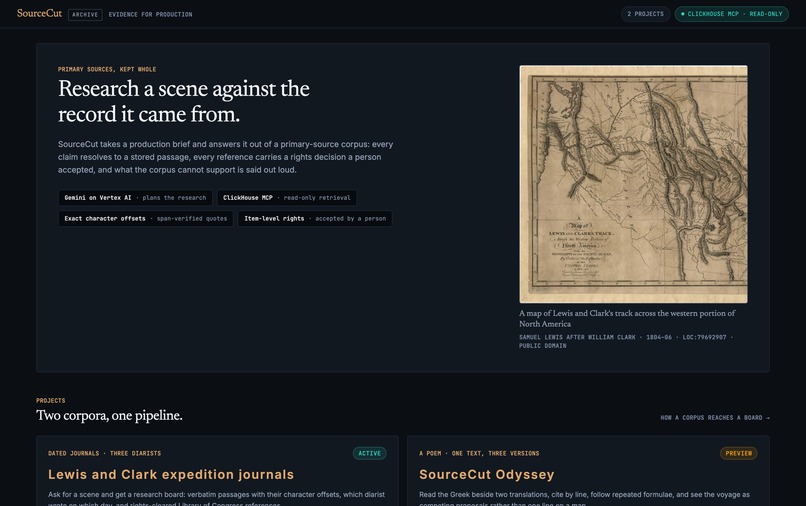
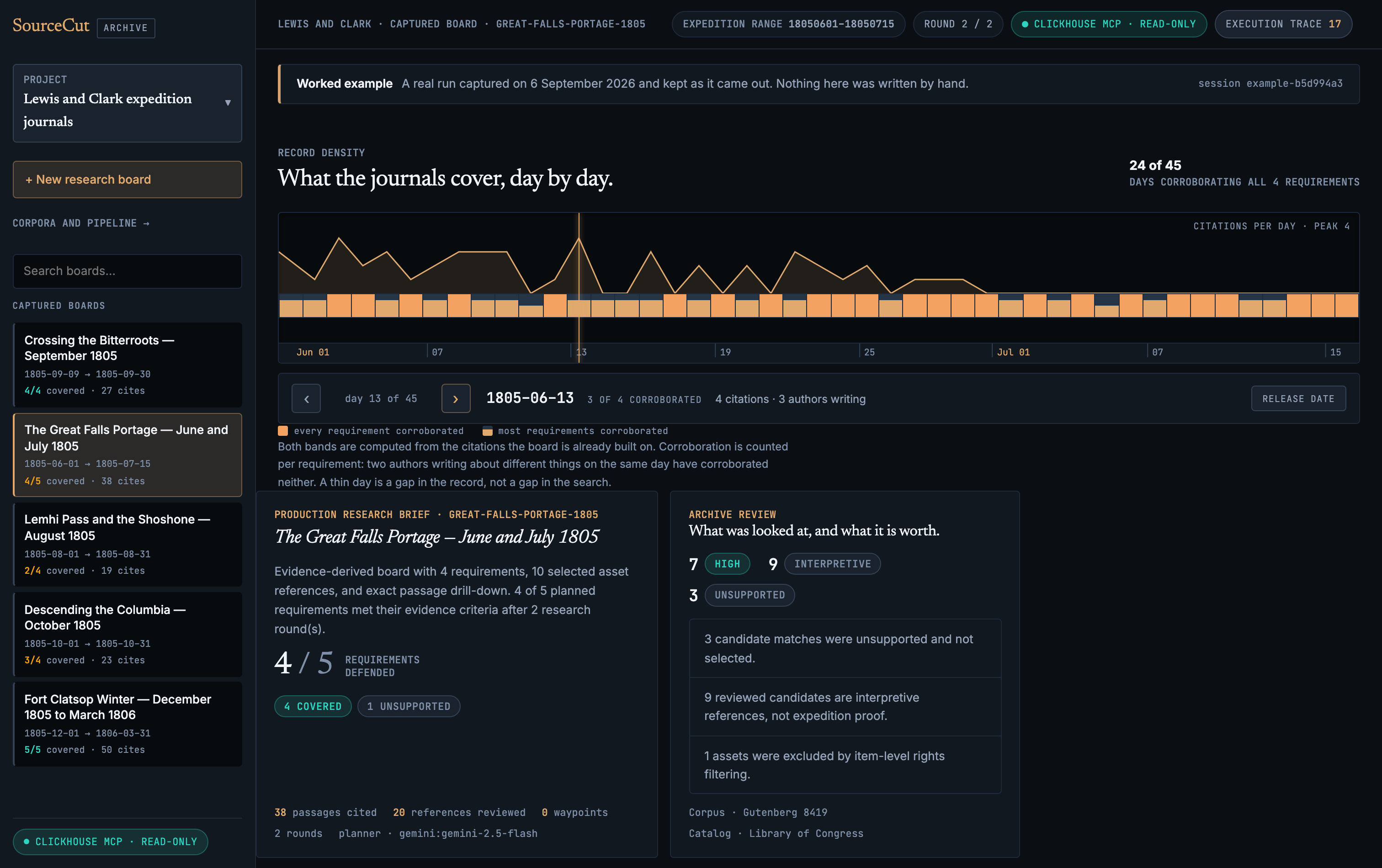
Describe a scene; get a research board
-
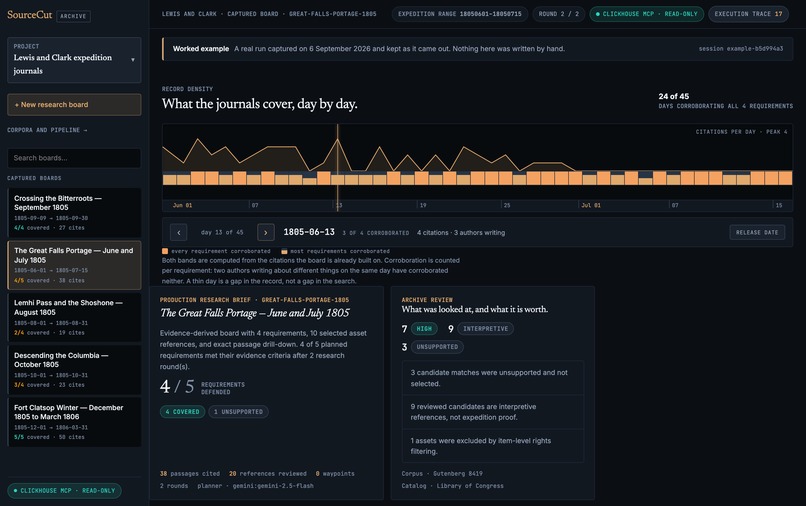
Every day of the window, and what the journals back up
-
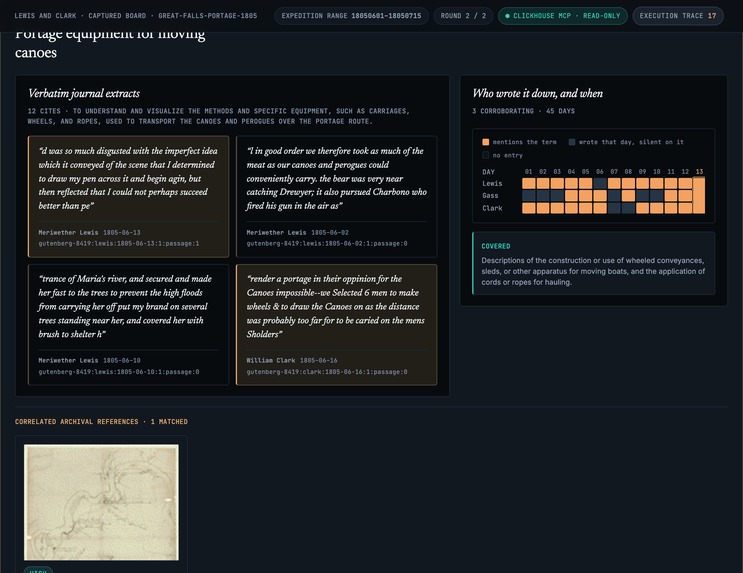
Verbatim extracts, and who wrote what, on which day
-
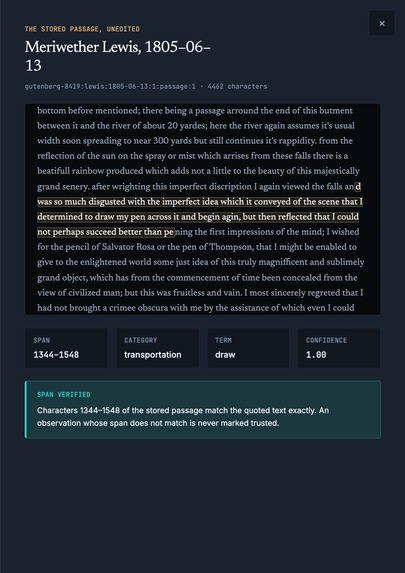
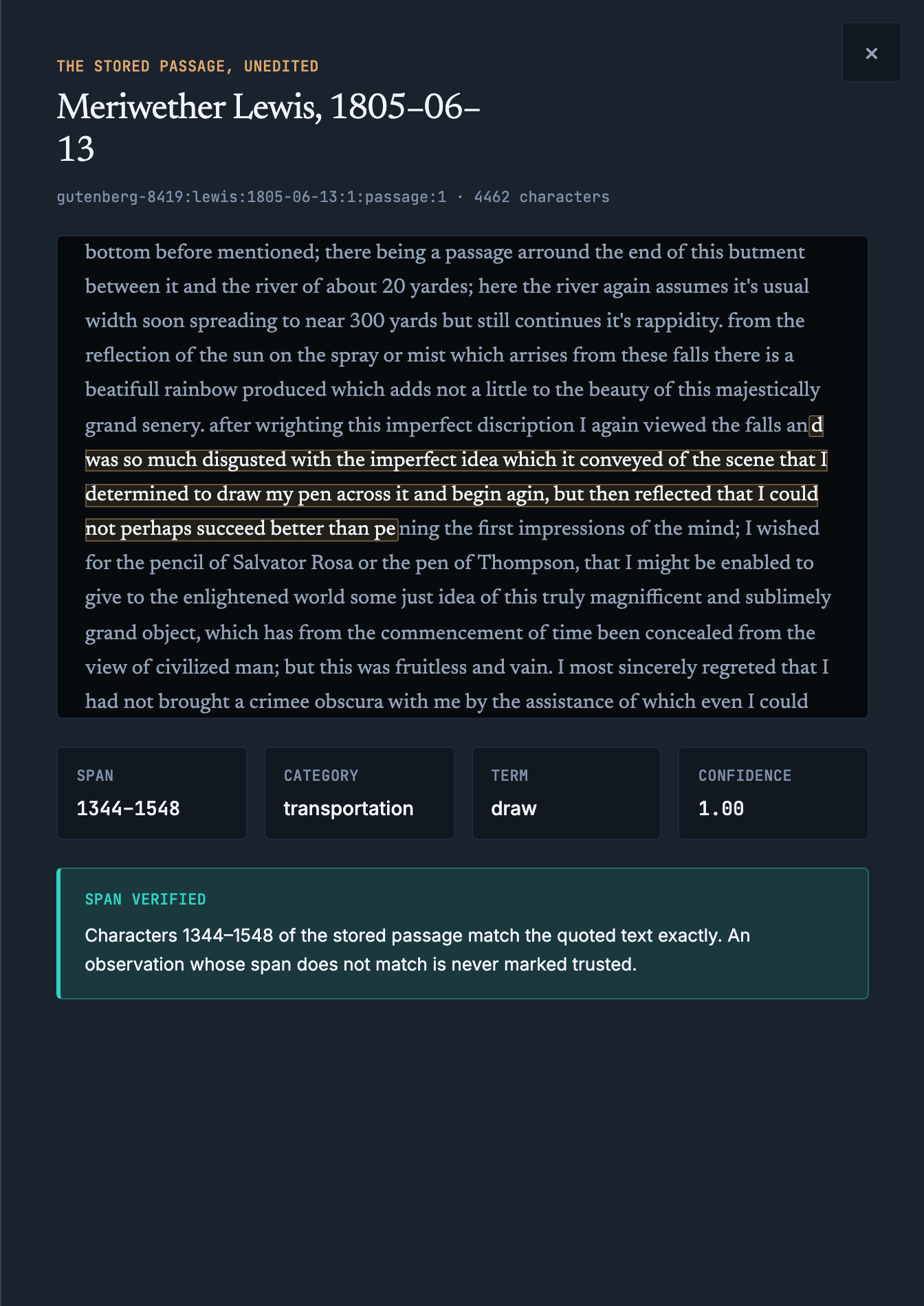
Every quote checked against the stored passage
-
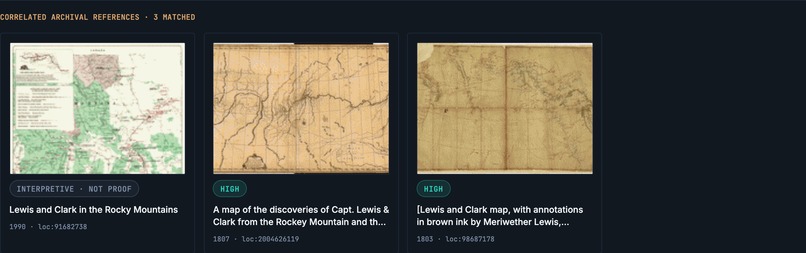
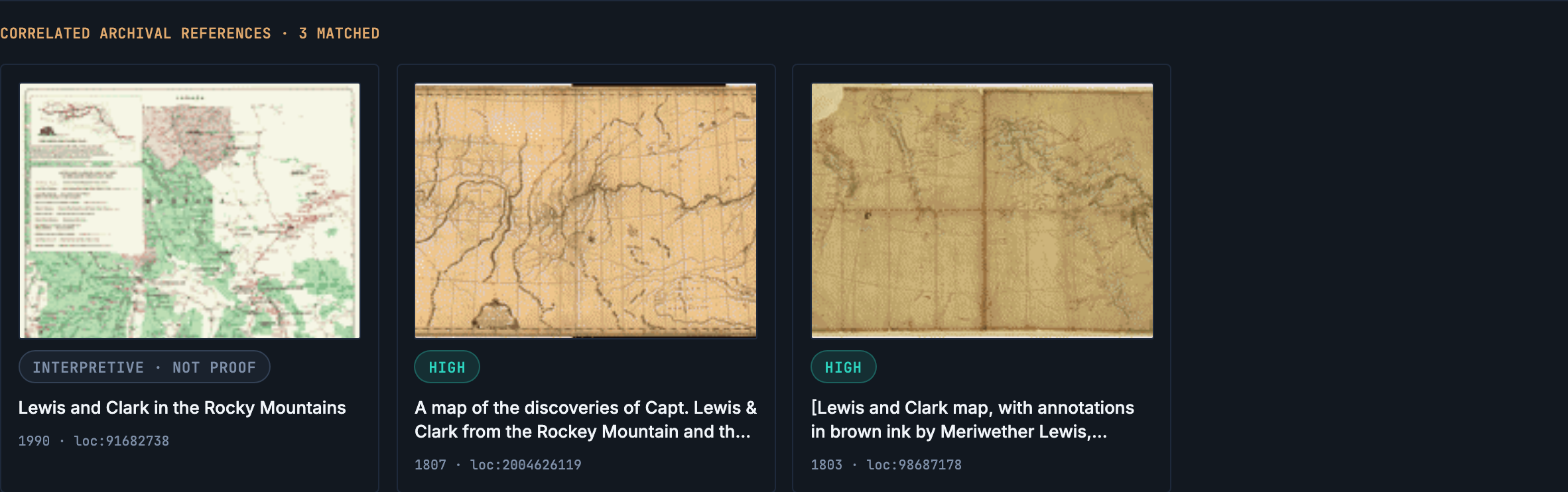
Period maps, labelled by how much each proves
-
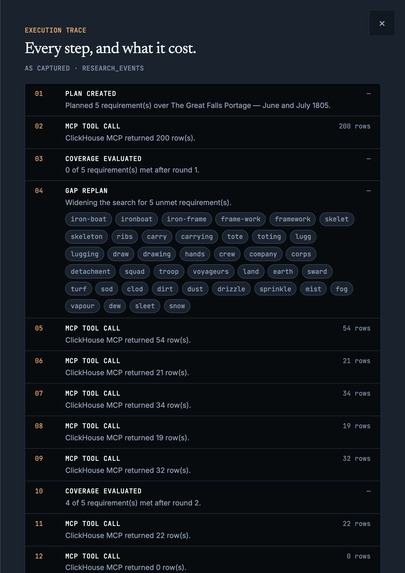
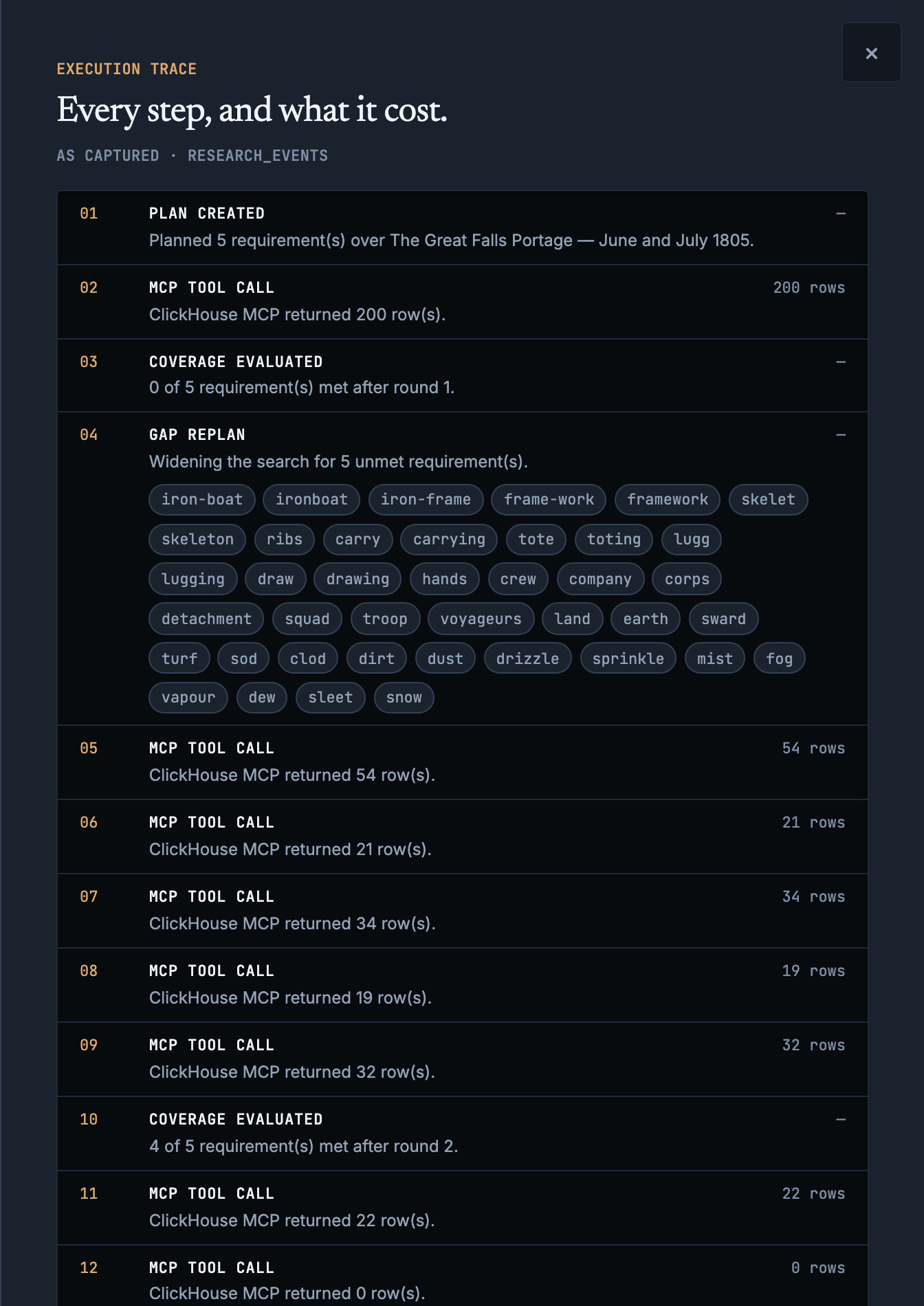
Every step of a run is a row in ClickHouse
-
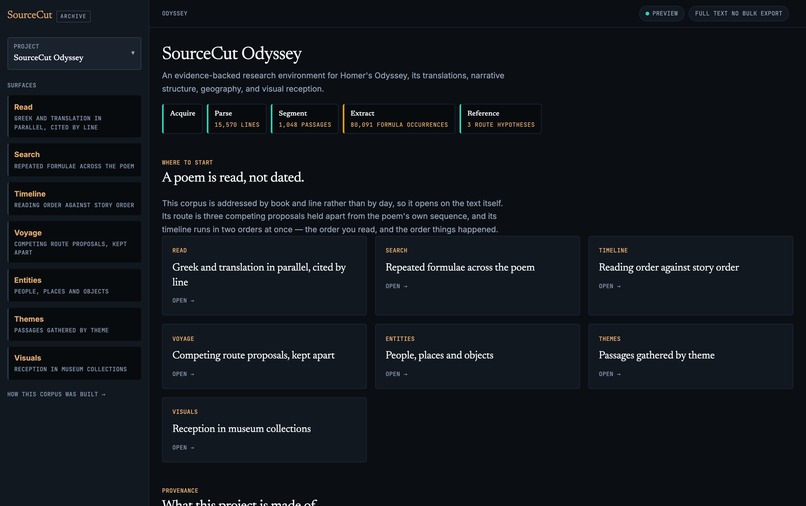
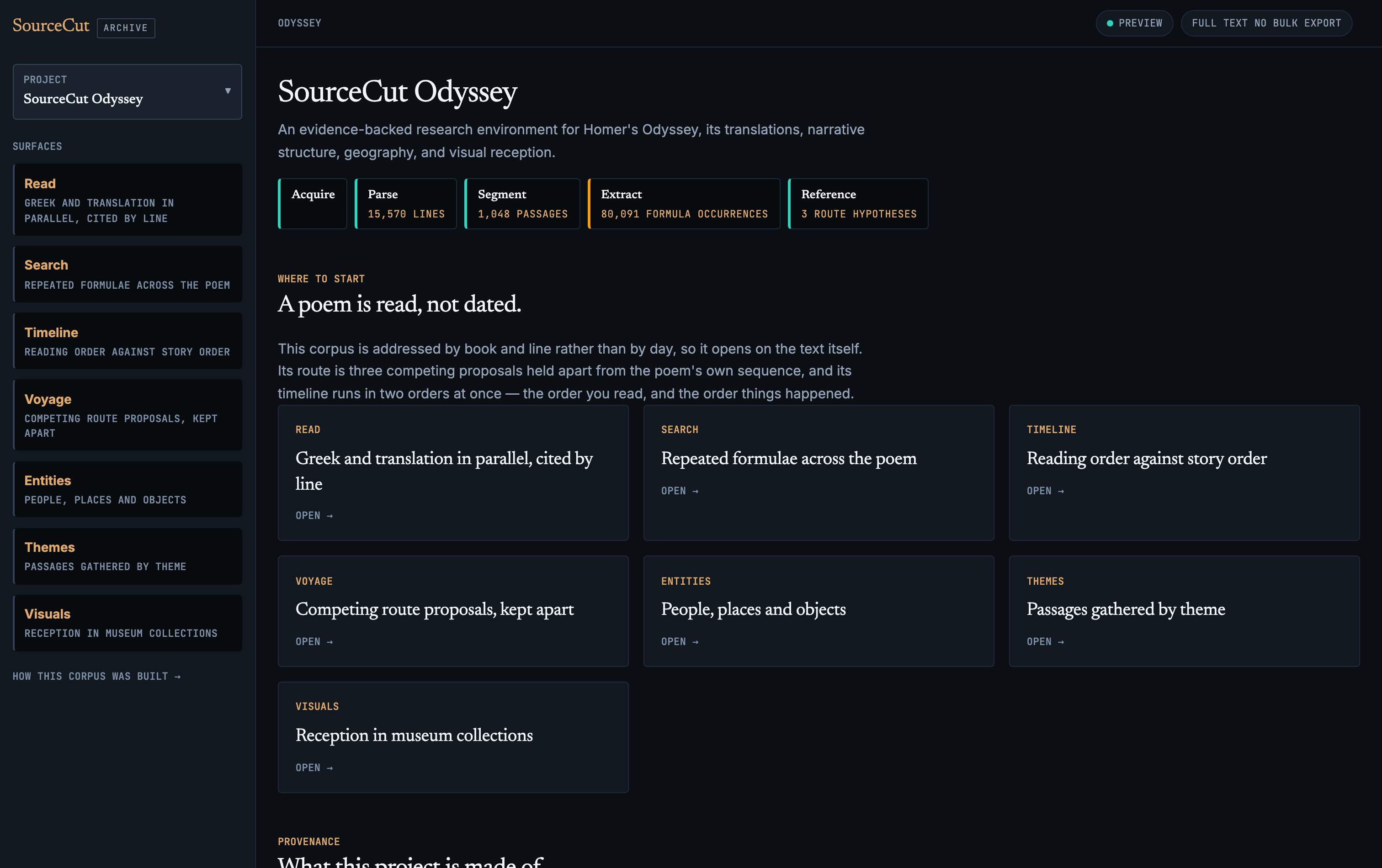
The same five stages on a poem: by book and line
-
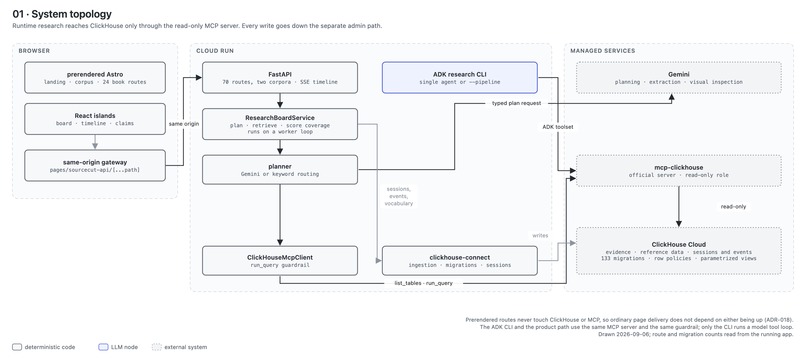
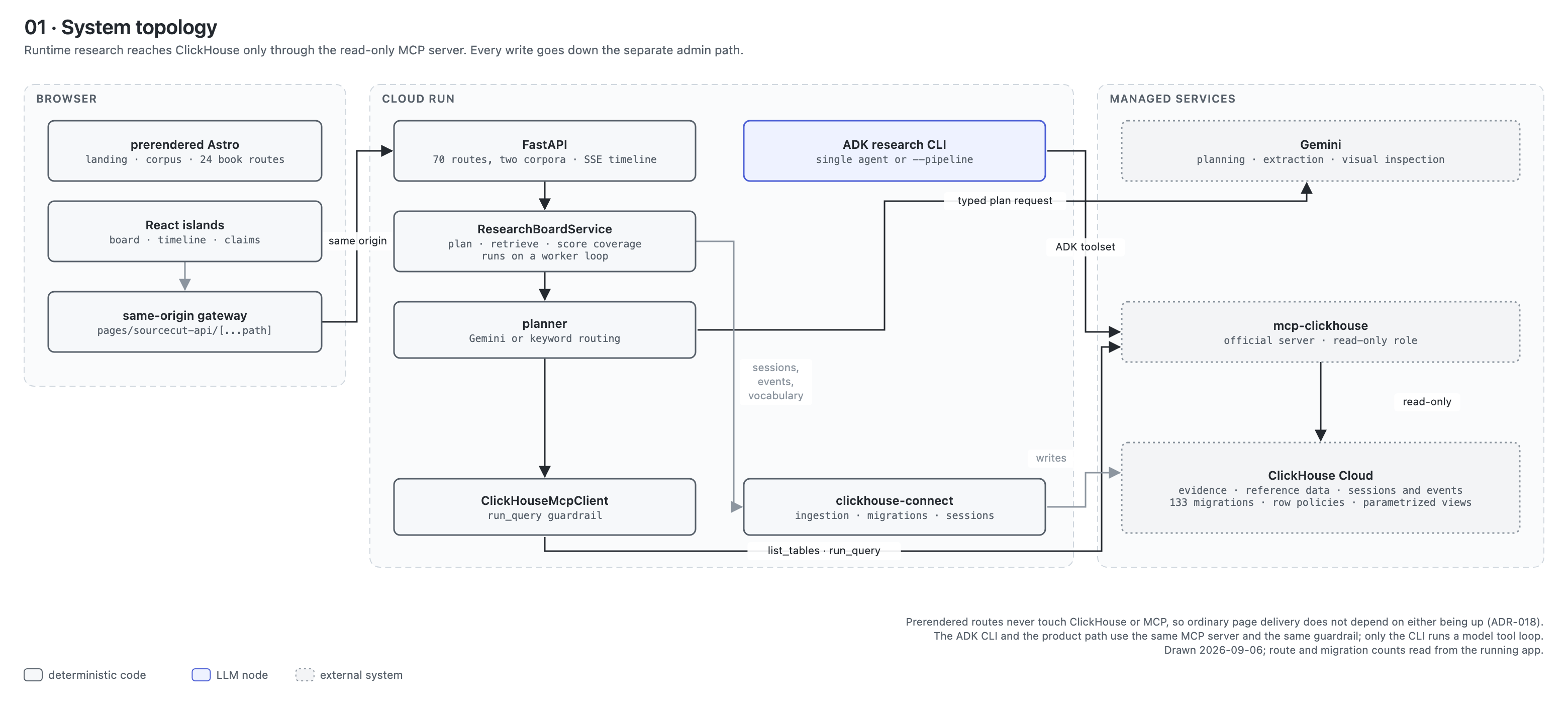
System topology: Read-only MCP at runtime; writes on a separate path
-
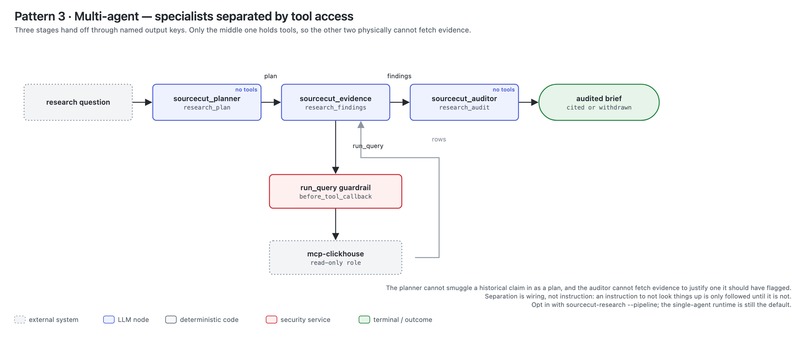
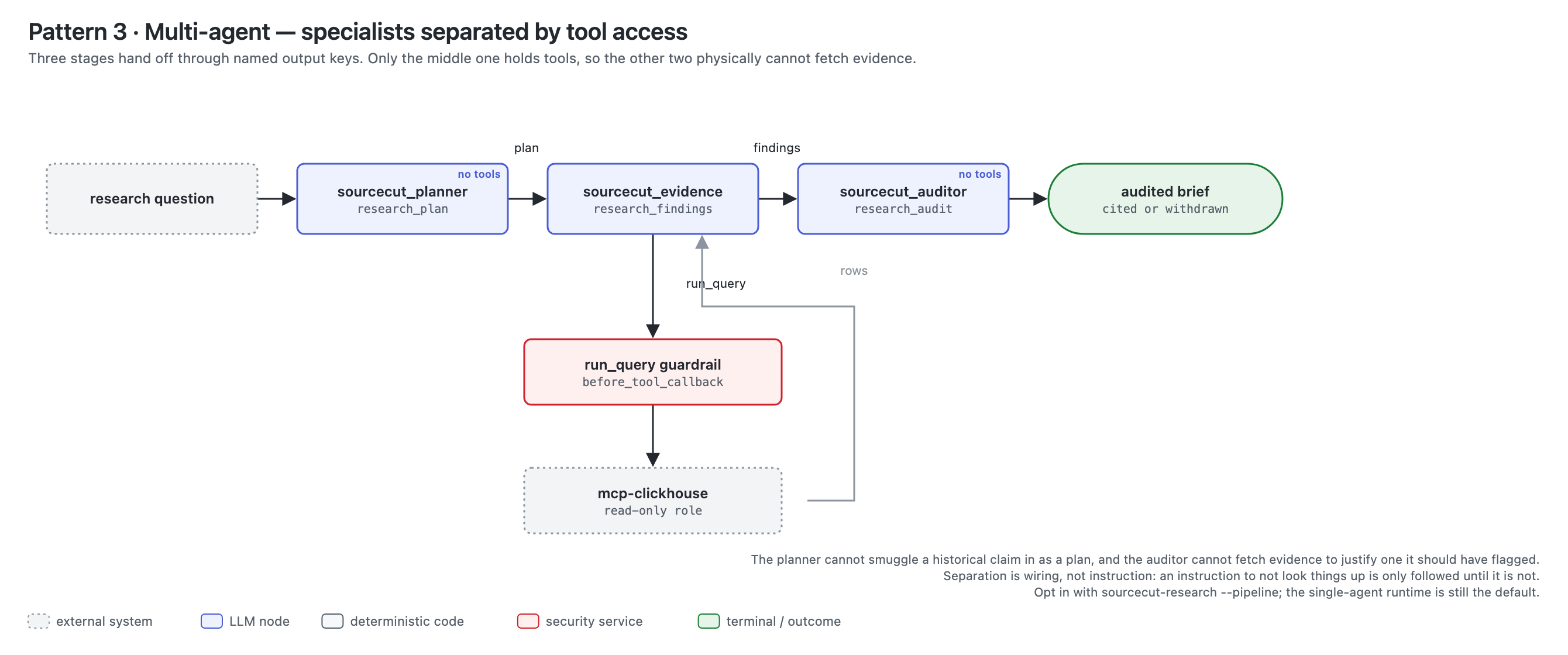
The ADK runtime: planner, researcher and auditor in sequence
-
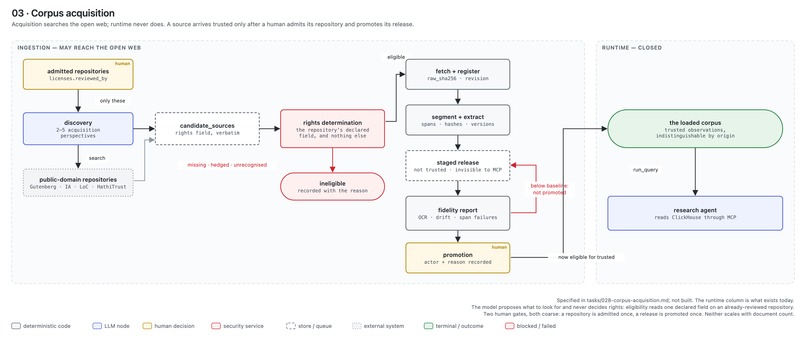
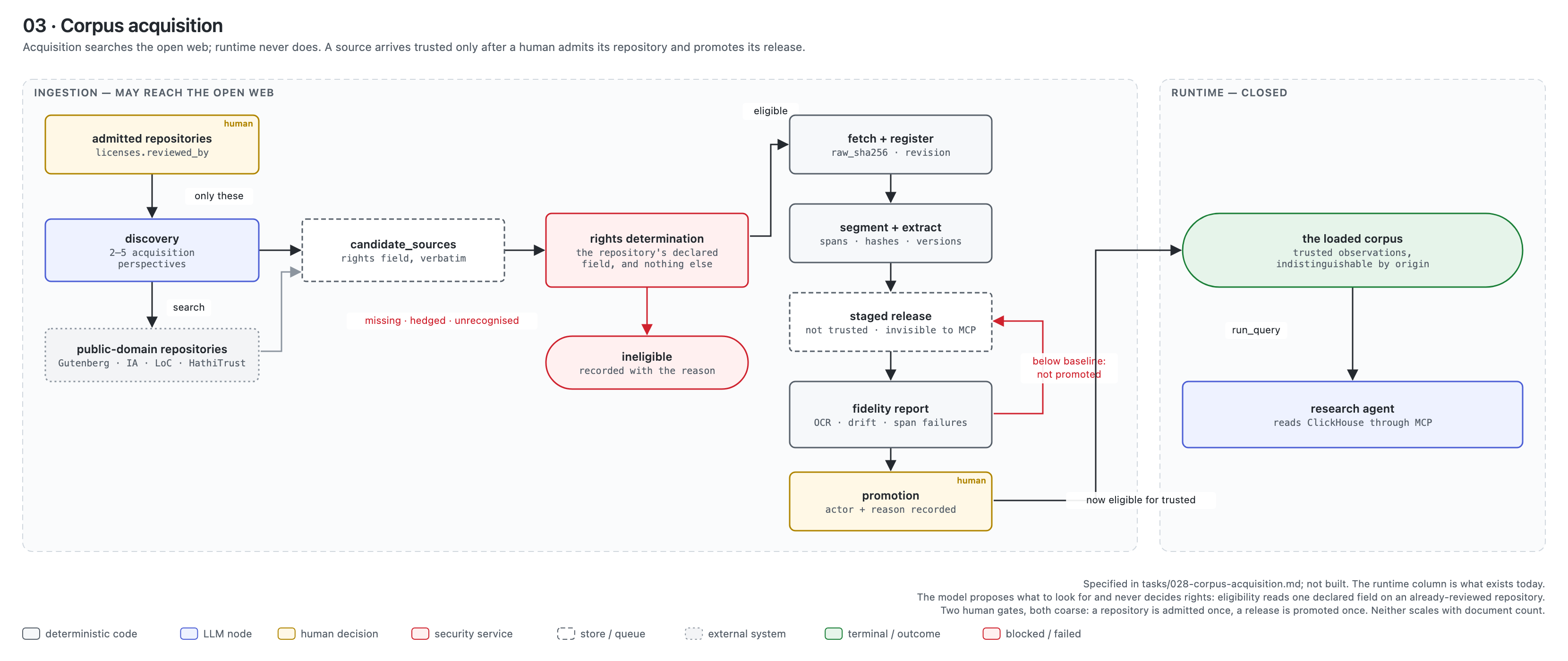
The extraction workflow: acquire, parse, segment, extract, reference
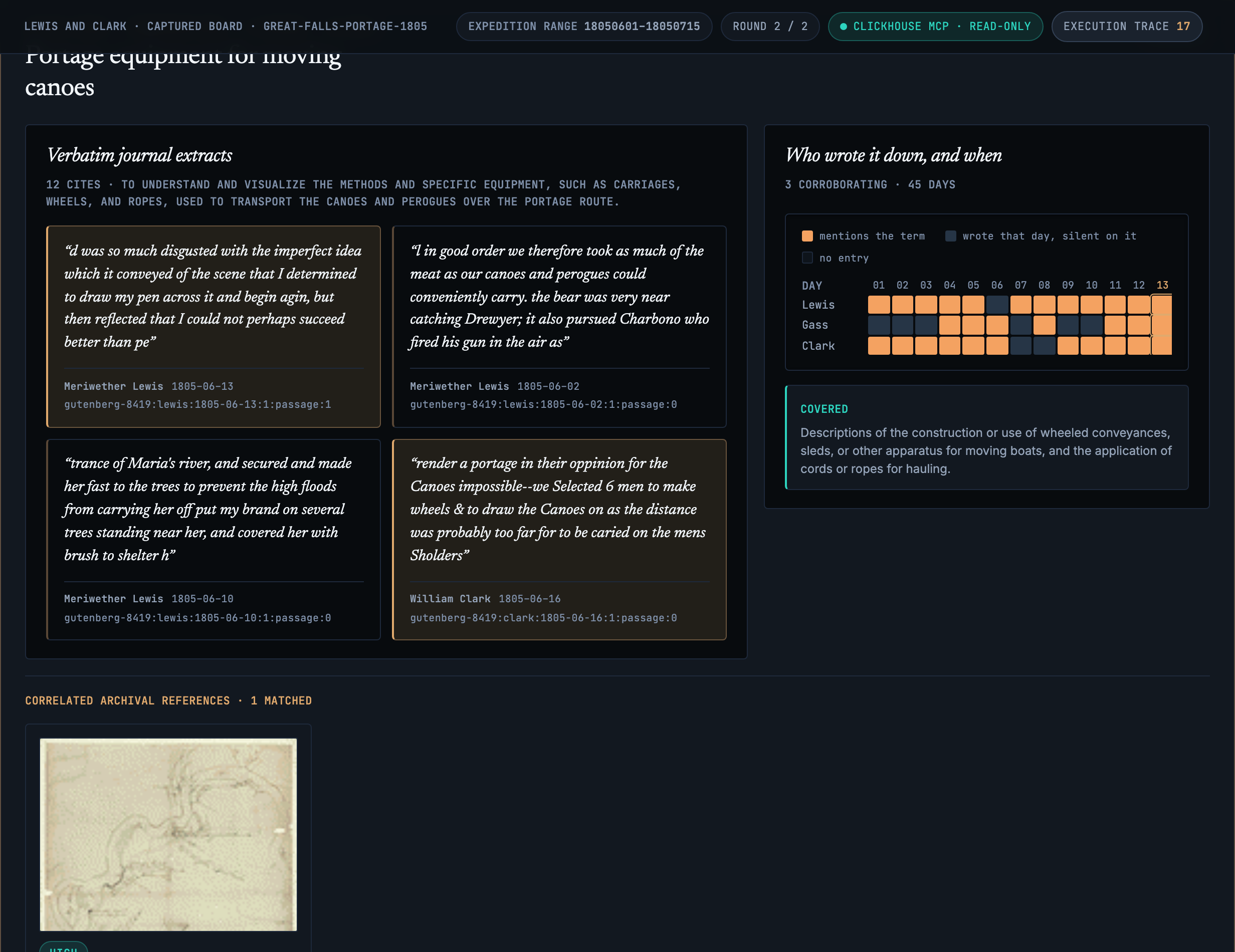
Getting the past right means getting small things right — what people ate, what they carried, what the weather did on a particular afternoon. Those answers sit in what people wrote at the time: diaries, letters, logs, poems. Finding them means reading, and reading is the part a production schedule never has room for.
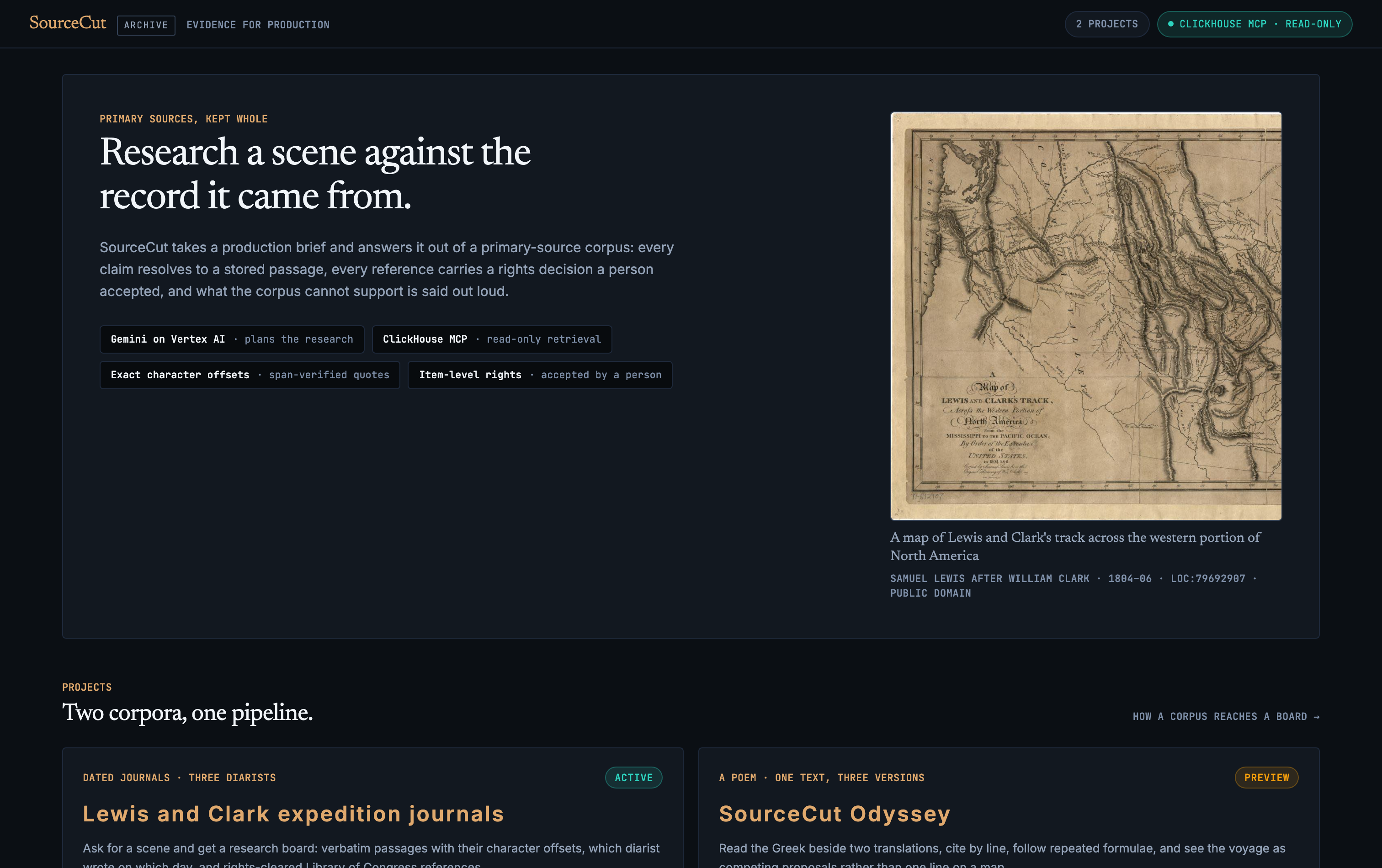
SourceCut is an agentic research producer for historically grounded film and documentary. Describe a scene the way you would brief an art department, and it researches that scene against a primary-source corpus and hands back a research board where every claim resolves to a passage somebody actually wrote.
What it does
Plans the research. Gemini on Vertex AI turns a scene brief into a plan: which stretch of the record to search, which requirements the scene needs, and which period spellings to look for. The date window is read from a curated file of expedition segments rather than guessed.
Retrieves through ClickHouse. Every search is read-only SQL sent through the official ClickHouse MCP server — parametrized views for the date window, vector search over passage embeddings, and row policies on the tables underneath. The research role can read the texts and nothing else.
Scores coverage one requirement at a time. Each requirement carries its own success criterion, so the run knows exactly which ones are still unmet. When a round comes up short it widens the vocabulary for those requirements only — reaching for the words a diarist would have written in 1805, ironboat, sward, vapour — and searches the same window again.
Verifies every quotation. An observation stores the character offsets of the text it cites, and those characters are checked against the stored passage. A span that does not match is never marked trusted, so a quotation on the board is the source's words rather than a paraphrase of them.
Correlates archive material. Library of Congress maps and photographs arrive
with their provider, catalogue number, rights status, and a confidence label
saying how much each one actually proves — HIGH, INTERPRETIVE · NOT PROOF,
or unsupported.
Says what the corpus cannot support. Where the record is silent the board says so. The expedition's iron-frame boat is in the history books; it is not in these three diaries, and the board reports that rather than reaching for something that sounds close.
How a corpus is built
The research agent is only as good as the corpus under it, so the extraction workflow is the other half of the product — five stages, each one a command that can be re-run and audited.
Acquire. A public-domain or openly-licensed source is fetched once and pinned to a source version, with its licence recorded against it: Project Gutenberg 8419 and an archive.org OCR of Gass's 1904 edition for the journals, Perseus for the Greek and both translations of the Odyssey.
Parse. Raw text becomes dated entries with an author attached — 2,267 of them for the journals — or, for a poem, numbered lines.
Segment. Entries become passages carrying their character offsets and a SHA-256 of the text, which is what makes a quotation checkable later.
Extract. Gemini reads one passage at a time and proposes observations, each naming a category, a term, and the exact character span it is claiming. The same passage is sampled three times and only candidates that recur in at least two runs survive, matched on the span they point at — a reading that appears once in three is exactly the kind not to trust. What survives is then validated against the stored text: spans that do not match the source are rejected, as are exact duplicates. Only what is left becomes a trusted observation.
Reference. Archive material is correlated to requirements, and its rights are accepted by a person. The model never decides what may be used.
Extraction runs over a bounded window — a source and a date range — so a corpus grows in reviewable increments rather than one unrepeatable pass, and every count on the project page traces back to a command someone can run again.
Two corpora, one pipeline
The five stages — acquire, parse, segment, extract, reference — are not built around diaries.
The Lewis and Clark journals: 2,267 dated entries from three diarists, 2,384 passages, 14,685 trusted observations over 5,546 distinct terms, 22 catalogued archive references, nine route waypoints.
Homer's Odyssey: 15,570 lines and 87,189 tokens across the Greek and two translations, 1,048 passages, 80,091 formula occurrences, 39 narrative events, 16 places, and three competing route hypotheses held apart rather than merged into one line on a map. A poem is read, not dated, so it is addressed by book and line — same pipeline, same evidence rules.
The agentic research — planning, coverage rounds, vocabulary memory — runs on the journals. The Odyssey carries the rest: the five stages, the span checking, and the same refusal to assert what the text does not support, addressed by book and line instead of by date. Its pages say so, where a reader arriving from the journals would otherwise look for a research brief.
How we built it
Agents — Google's Agent Development Kit runs a sequential pipeline of
planner, researcher and auditor, separated by what each one can touch. The
planner holds no tools at all; only the researcher holds the ClickHouse toolset,
and a before_tool_callback guardrail validates every query before it leaves
the process.
Models — Gemini 2.5 Flash through Vertex AI, using the service account's own credentials, so the deployed services carry no model API key.
Data — ClickHouse Cloud behind the official mcp-clickhouse server, with a
dedicated read-only role, row policies, parametrized views for date windows, and
cosineDistance for vector ranking. 133 migrations back the schema. Every step
of every run is itself a row in ClickHouse, which is what the execution trace in
the UI reads back.
Surface — an Astro + React application on Cloud Run. Every page is prerendered from committed example boards, so the record stays readable even when the backend is asleep.
Challenges
ClickHouse Date and Date32 do not reach back to 1804, so historical dates
are stored as sortable Int32 YYYYMMDD values.
Gass's journal is an OCR transcription of a 1904 edition, and its spelling is the editor's rather than the manuscript's — which is why vocabulary expansion had to be a first-class step rather than a fallback.
Span verification caught what nothing else would have: a model will paraphrase a quotation while believing it is quoting. Checking offsets against the stored text is the difference between a citation and a claim.
ClickHouse Cloud suspends when idle and refuses the first connection while it resumes. Both clients now wait that out and retry, so an idle link answers slowly instead of failing.
What we learned
Evidence beats fluency. The most useful thing the system does is decline — naming the requirement the corpus cannot defend is worth more to a production than a confident paragraph that cannot be traced.
Coverage has to be measured per requirement. A single score for a whole board hides exactly the gap somebody needs to know about.
What's next
A third corpus is scoped: Scott's Terra Nova journals, 378 dated entries, 357 of which resolve to a unique year by weekday alone.
Built With
- agent-development-kit
- astro
- clickhouse
- cloud-run
- cloud-storage
- fastapi
- gemini
- google-cloud
- google-genai
- mcp-clickhouse
- model-context-protocol
- playwright
- pydantic
- python
- react
- secret-manager
- typescript
- vertex-ai