-
-
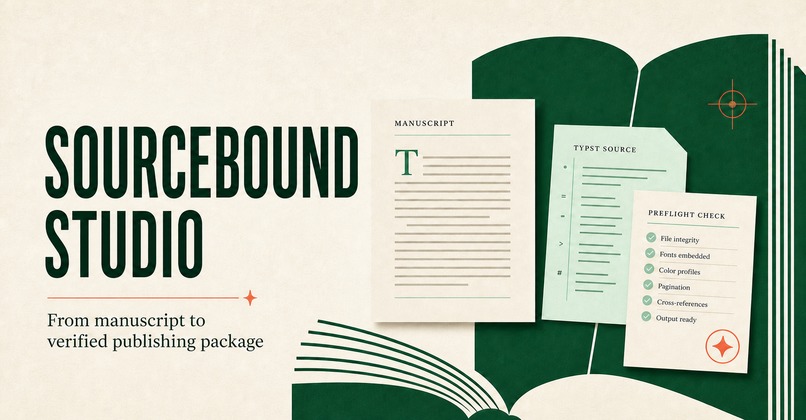
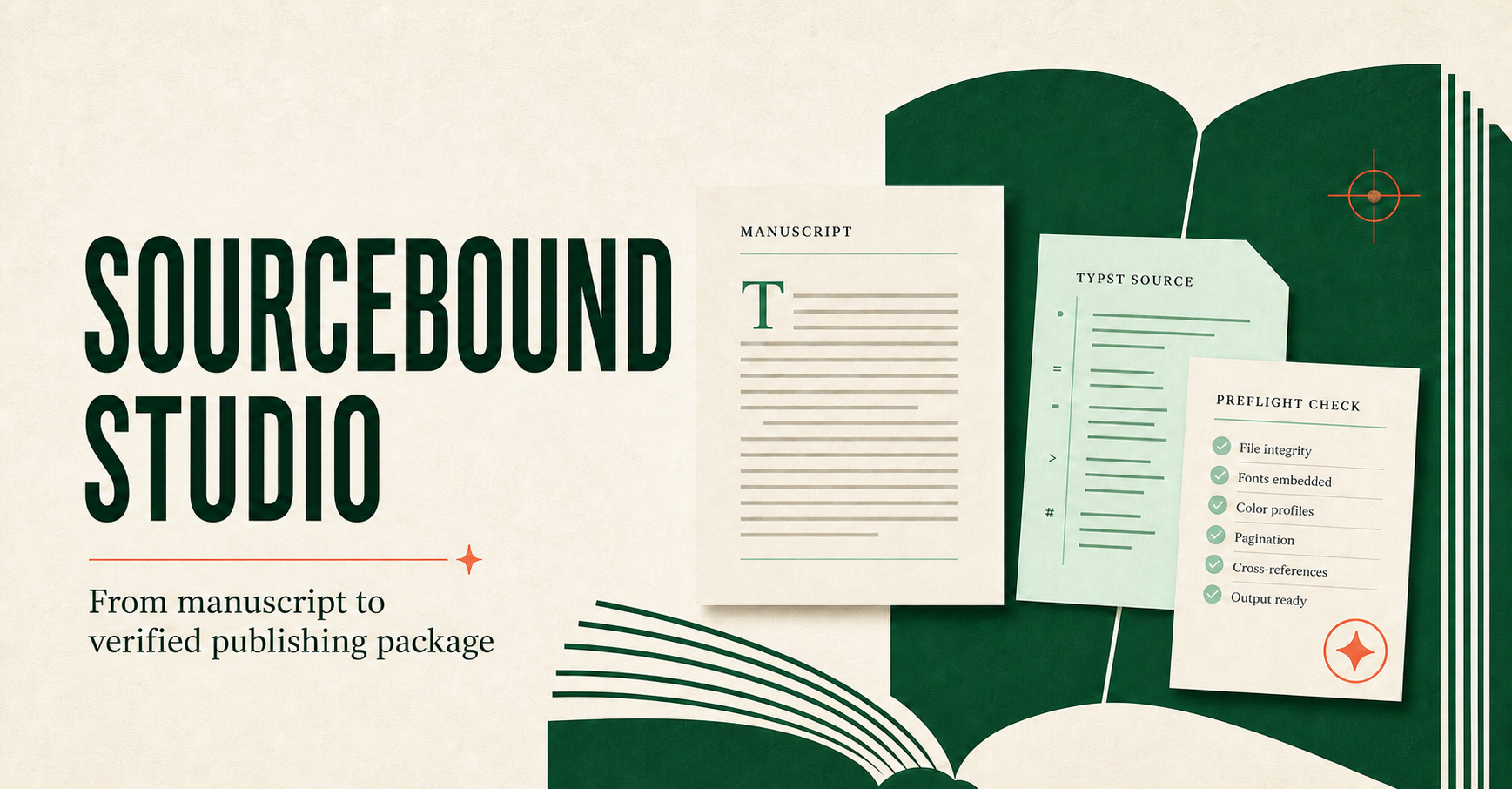
Sourcebound Project Cover
-
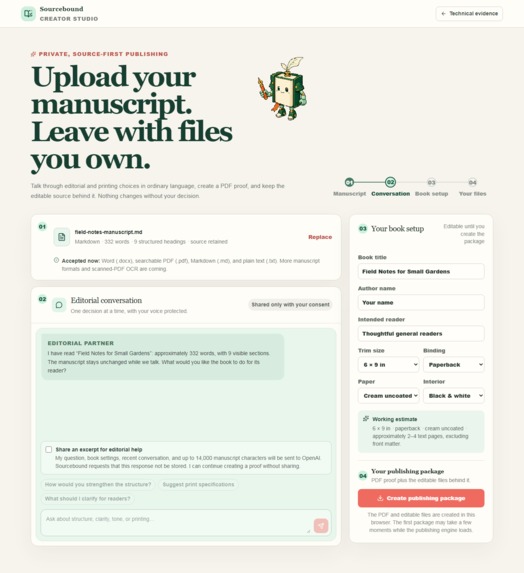
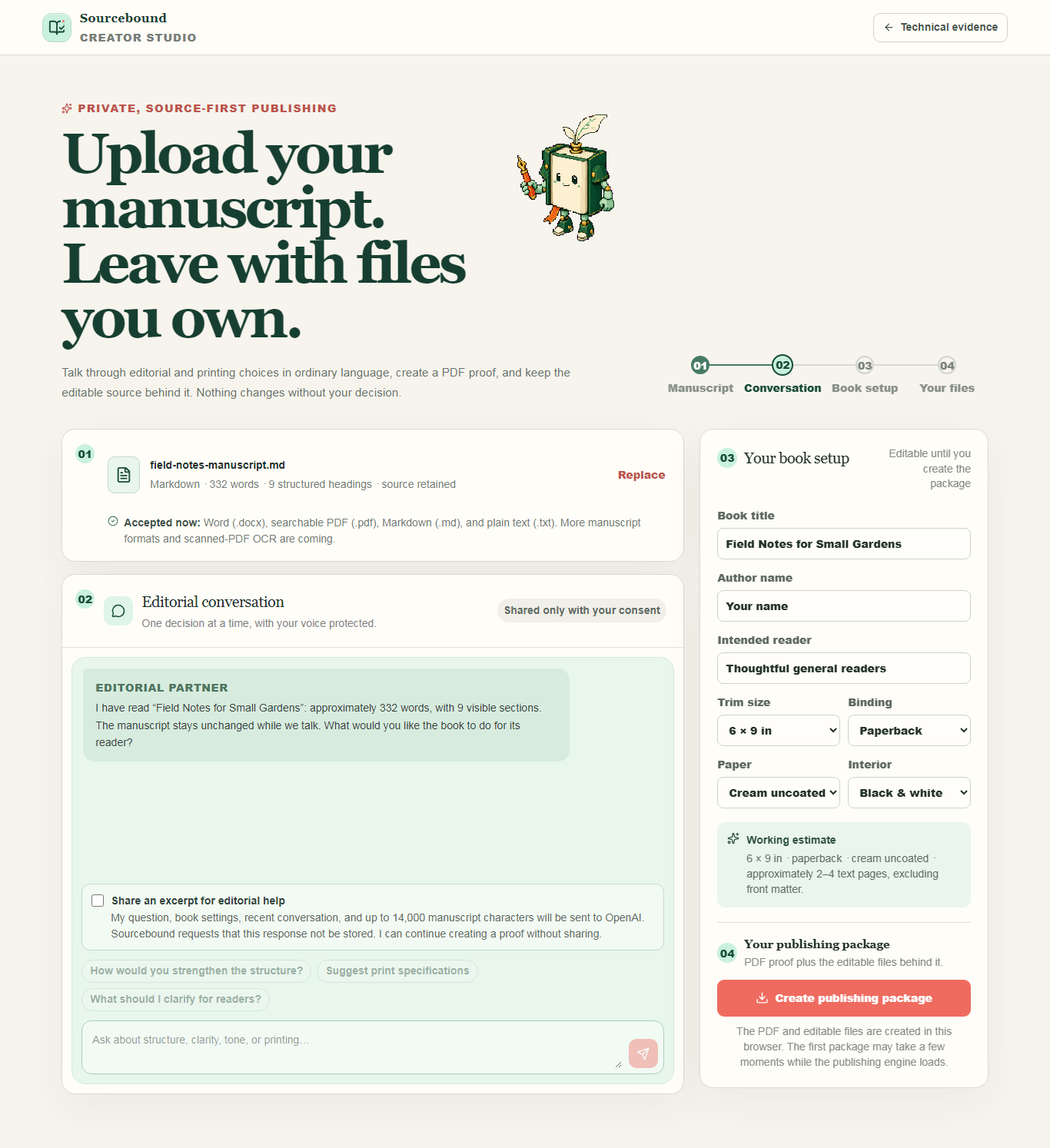
Sourcebound Studio Website
-
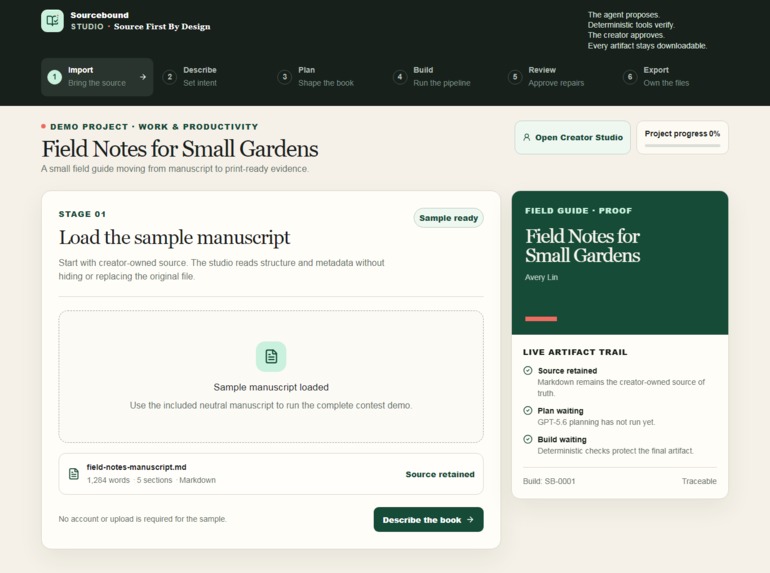
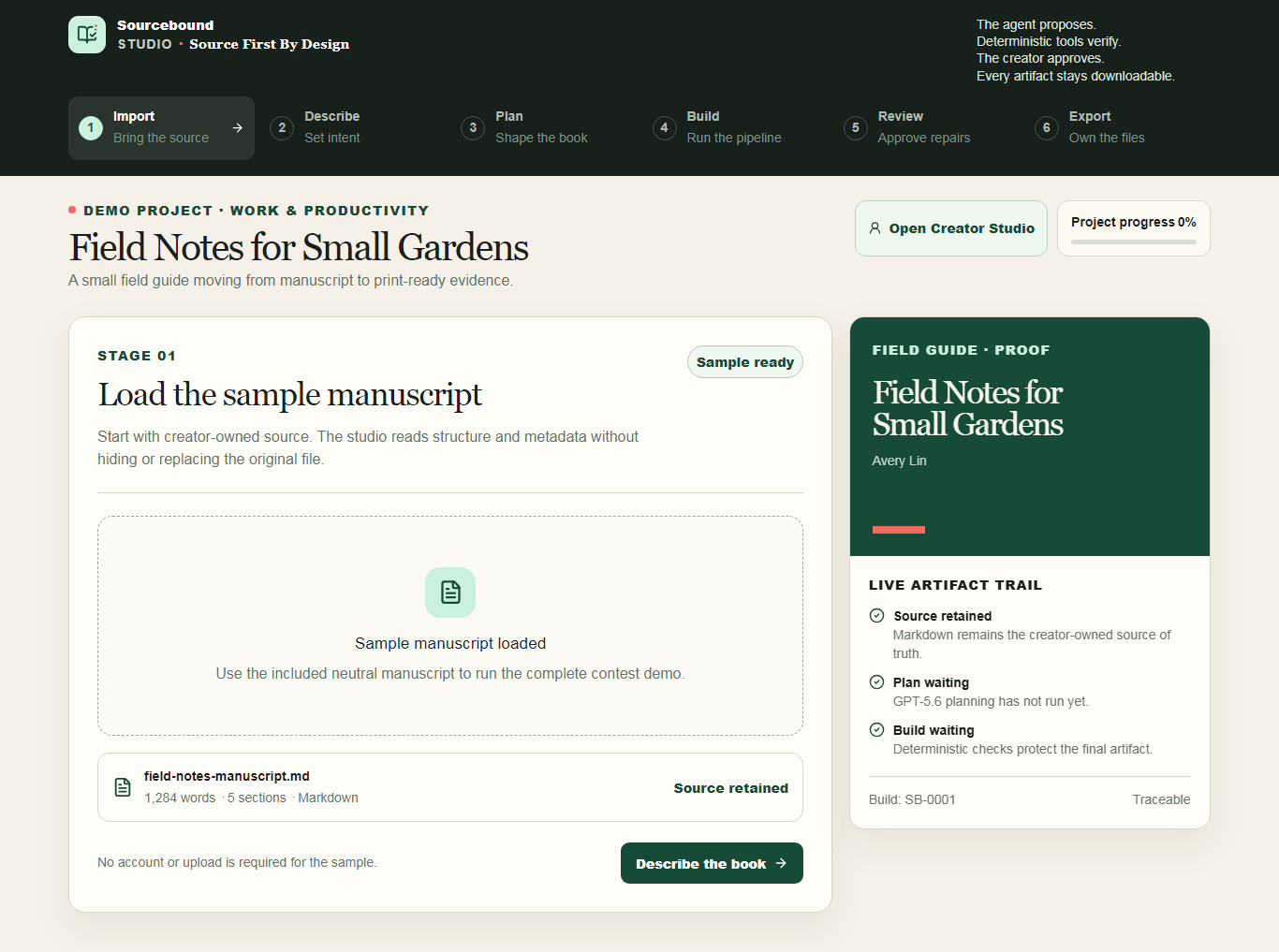
Workflow Evidence Site
-
Mascot Source Sprout
Inspiration
I did not begin Sourcebound Studio because I needed an idea for a contest. I began it because I needed it myself.
While juggling two jobs, I have also been trying to continue my self-publishing journey. An independent creator is rarely only a writer. We also become the editor, production coordinator, layout operator, proofreader, file manager, and publisher. Traditional publishing software gives us control, but every revision can mean reopening several files, repeating the same instructions, negotiating routine production details, and checking whether one small change has broken something elsewhere.
When time is limited, the book is often the first thing that has to wait.
As agentic services matured, I began to see a different possibility. Production time could be shortened. Repetitive coordination and unnecessary negotiation could be reduced. Most importantly, the number of creative possibilities could grow instead of shrink. A creator could explore another format, revise a title, change the intended reader, or rebuild an edition without starting the entire production process again.
I first explored this workflow while developing another publishing project. Eventually, the publishing infrastructure became mixed together with that project’s specifications, brand book, product bible, and creative assets. OpenAI Build Week gave me a useful short-term goal: separate the reusable publishing engine from any one brand and turn it into a product that other independent creators could understand.
That became Sourcebound Studio.
What it does
Sourcebound Studio is a source-first, AI-assisted self-publishing workflow that helps move a creator-owned manuscript toward a verified, print-ready book package.
The name has two meanings. It describes the journey from source material to a bound book, but it also means that every output remains connected and traceable to its source.
The prototype has two complementary surfaces.
The Creator Studio is the simple, human-facing workspace. A creator can upload a Word document, searchable PDF, Markdown, or text manuscript; discuss editorial and print decisions with GPT-5.6; choose book specifications; and generate a manuscript-specific PDF proof. The manuscript stays on the creator’s device until an editorial question is intentionally sent.
The Workflow Evidence Lab reveals what normally remains invisible. It presents the publishing process as six stages: manuscript, book description, editorial plan, build, review, and export. GPT-5.6 can recommend an editorial direction, but it does not silently rewrite the creator’s work. Deterministic checks decide whether the source is ready to build. A proposed repair must be visible and approved before it is applied. Typst then handles the repeatable composition of the PDF.
The exported package can include the finished PDF, editable source, structured book data, a preflight report, and a build manifest. The goal is not only to produce a file, but to let the creator understand what changed, approve it, and reproduce the result.
How I built it
I worked with Codex as my primary development collaborator. I brought the publishing needs, creative decisions, and user perspective; Codex helped translate them into the product architecture, interface, build workflow, tests, and deployed prototype.
The application was built with Next.js. GPT-5.6 is connected through the OpenAI Responses API for editorial planning and creator conversations. Typst and its browser compiler provide deterministic composition, allowing the same structured source to generate a repeatable PDF without depending on manual page-by-page placement.
The central division of responsibility is intentional:
- GPT-5.6 interprets the creator’s goals and proposes.
- Codex helped build and refine the production system.
- Deterministic rules verify the source and output.
- Typst composes the document.
- The creator keeps final editorial control.
Affinity Publisher can remain an optional finishing studio for highly visual or handcrafted editions, but it is not a hidden requirement for the core workflow.
Challenges
The hardest challenge was not generating a PDF. It was making the relationship between the manuscript, the creator’s decisions, the checks, and the final PDF honest and visible.
An early version explained the architecture well, but it felt more like a testing environment designed for agents and judges than a workspace designed for a human creator. I realized that the sophisticated automation should remain mostly invisible during normal use. This led to the separation between the Creator Studio—the cockpit—and the Evidence Lab, where the underlying engine can still be inspected.
Another challenge was balancing AI flexibility with publishing reliability. Language models are useful for interpretation, planning, and proposing changes, but a production file cannot pass inspection simply because an AI says that it looks correct. That is why Sourcebound Studio separates agentic recommendations from deterministic validation and requires human approval for meaningful repairs.
Supporting real creator files while protecting manuscript ownership was also important. Uploading common formats had to feel simple, while AI transmission and local PDF generation needed to remain clear rather than hidden.
What I learned
I learned that publishing is not one prompt and one export button. It is a chain of decisions, dependencies, revisions, and approvals.
Agentic and deterministic systems are not competitors. They are strongest when they work together. AI can understand intention and make possibilities abundant; rules can keep the result stable and reproducible; the creator can decide which possibility should become the book.
I also learned that automation should not remove human judgment. It should remove the repeated explanations, routine handoffs, and mechanical work that prevent people from using their judgment where it matters.
Most of all, I learned that building the engine is only half of the product. The interface must help a creator feel oriented, capable, and still connected to their own work.
What’s next
Sourcebound Studio was shaped during Build Week, but it was never intended to end with the contest.
My next steps are to expand the creator workflow with more book templates and trim sizes, stronger revision history, OCR for scanned manuscripts, cover-production support, and clearer comparisons between editions generated from the same source. In the longer term, I imagine it as a local-first or hybrid publishing studio where creators benefit from cloud-based AI services without losing ownership of their files.
Success, to me, is simple: a creator begins with a manuscript that has been waiting on their computer and ends with a book they understand, control, and are finally able to publish.
Built With
- api
- cloudflare
- codex
- css
- gpt-5.6
- next.js
- node.js
- openai
- pdf.js
- react
- responses
- tailwind
- typescript
- typst
- typst.ts
- webassembly
- workers


Log in or sign up for Devpost to join the conversation.