Inspiration
Living in a fast-paced world, I saw friends and colleagues struggling with stress, poor focus, and sleepless nights—none of the one-size-fits-all audio tools felt truly personal. As someone passionate about neuroscience and sound therapy, I wanted to blend AI with proven frequency-based healing (beta/alpha/delta/theta waves) to create something tailored to each person’s mood and goals.
What it does
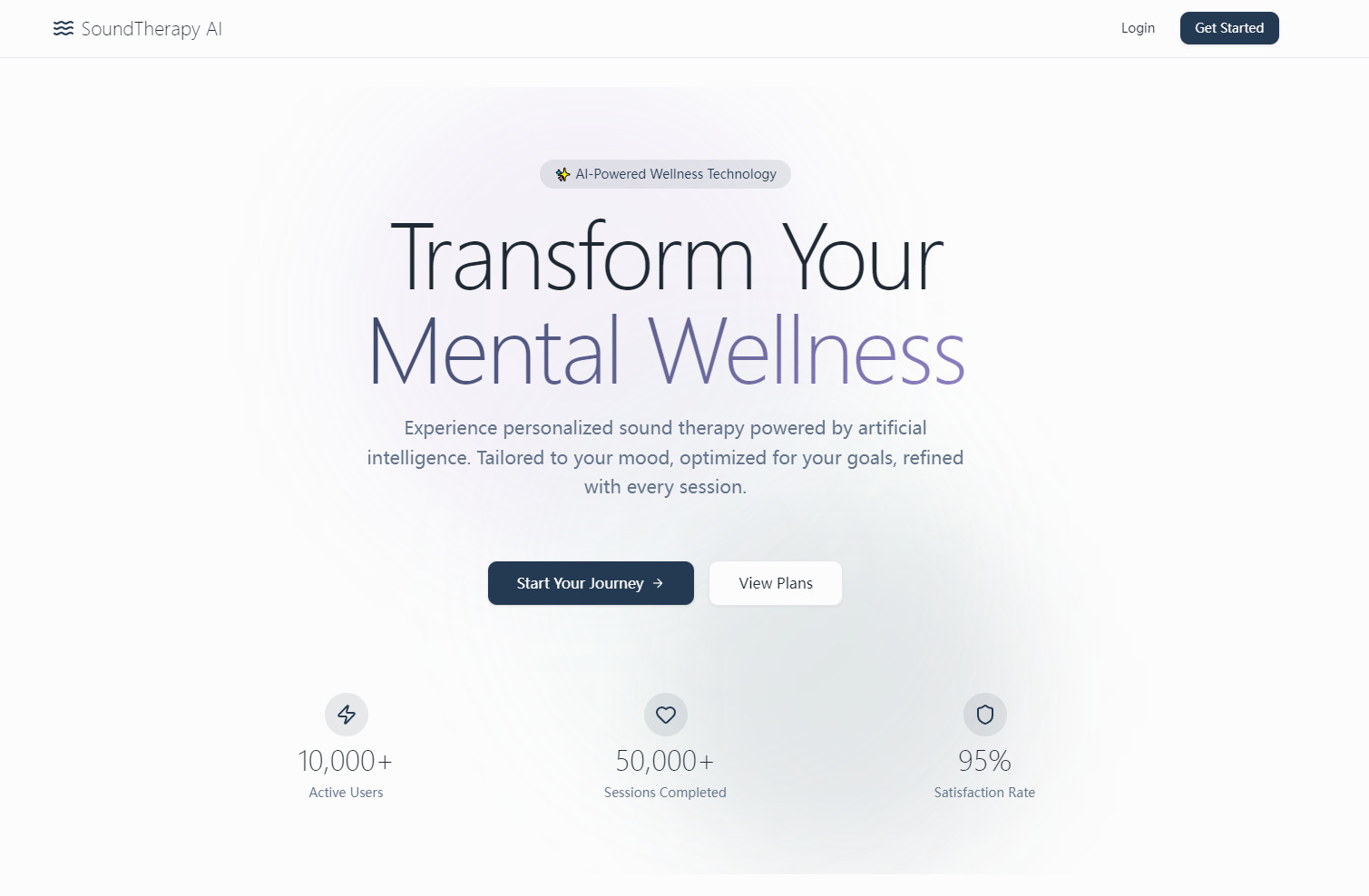
SoundTherapy AI analyzes your emotional state (via mood selection/text input) and therapy goal (focus/relax/sleep/creativity) to generate custom audio—binaural beats, isochronic tones, and ambient sounds—paired with optional integration of your Spotify/Apple Music playlists. It learns from your feedback to refine future sessions, plus includes timers, waveform visualization, and saved sessions for ongoing wellness.
How we built it
I started by mapping therapy goals to scientific frequency ranges (e.g., delta waves for sleep: 0.5-4 Hz). Using JavaScript/React for the frontend, I built the mood/goal selection flows and real-time waveform visualization with Chart.js. The backend (Node.js/Express) handles AI sound generation logic, user data storage (MongoDB), and API integrations (Spotify/Apple Music/Stripe). AWS hosted the app for cross-device access, and I implemented subscription logic to tier free/premium features.
Challenges we ran into
The biggest hurdle was real-time audio generation—balancing dynamic frequency adjustments with smooth playback. Music API integration also had roadblocks: inconsistent auth flows between Spotify and Apple Music required custom error handling. Additionally, refining the AI learning logic to accurately interpret feedback (ratings + listening duration) took multiple iterations to avoid biased personalization.
Accomplishments that we're proud of
Creating a seamless blend of science-backed sound therapy and personalization—users report improved focus during work and better sleep within weeks. The music integration feature became a fan favorite, and the AI learning loop now consistently delivers more tailored audio over time. We also built a intuitive UX that makes complex audio tech accessible to non-technical users.
What we learned
I deepened my understanding of neurosound principles and real-time audio processing. API integration taught me to anticipate platform-specific quirks, and user testing revealed how critical implicit feedback (listening duration) is when explicit feedback is missing. Most importantly, I learned that personalization beats "one-size-fits-all"—even small adjustments to frequency based on mood make a huge difference in user experience.
What's next for this project
We plan to expand beyond Spotify/Apple Music to include more streaming platforms, add voice-based mood input for hands-free use, and integrate wearable device data to adjust therapy sounds based on biometrics (e.g., heart rate). We’re also exploring guided meditation voice coaching and a custom sound library upload feature to make the tool even more flexible for daily wellness routines.
Built With
- javascript
- node.js
- react
- spotifyapi

Log in or sign up for Devpost to join the conversation.