-
-
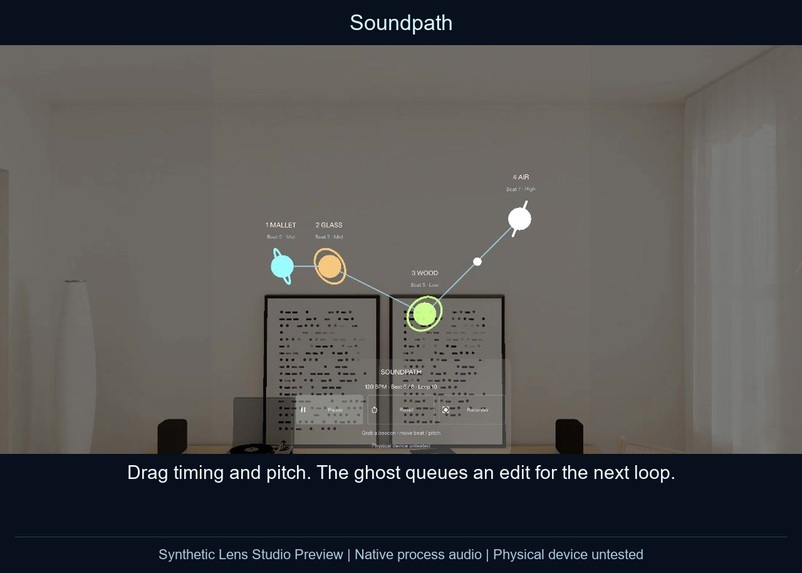
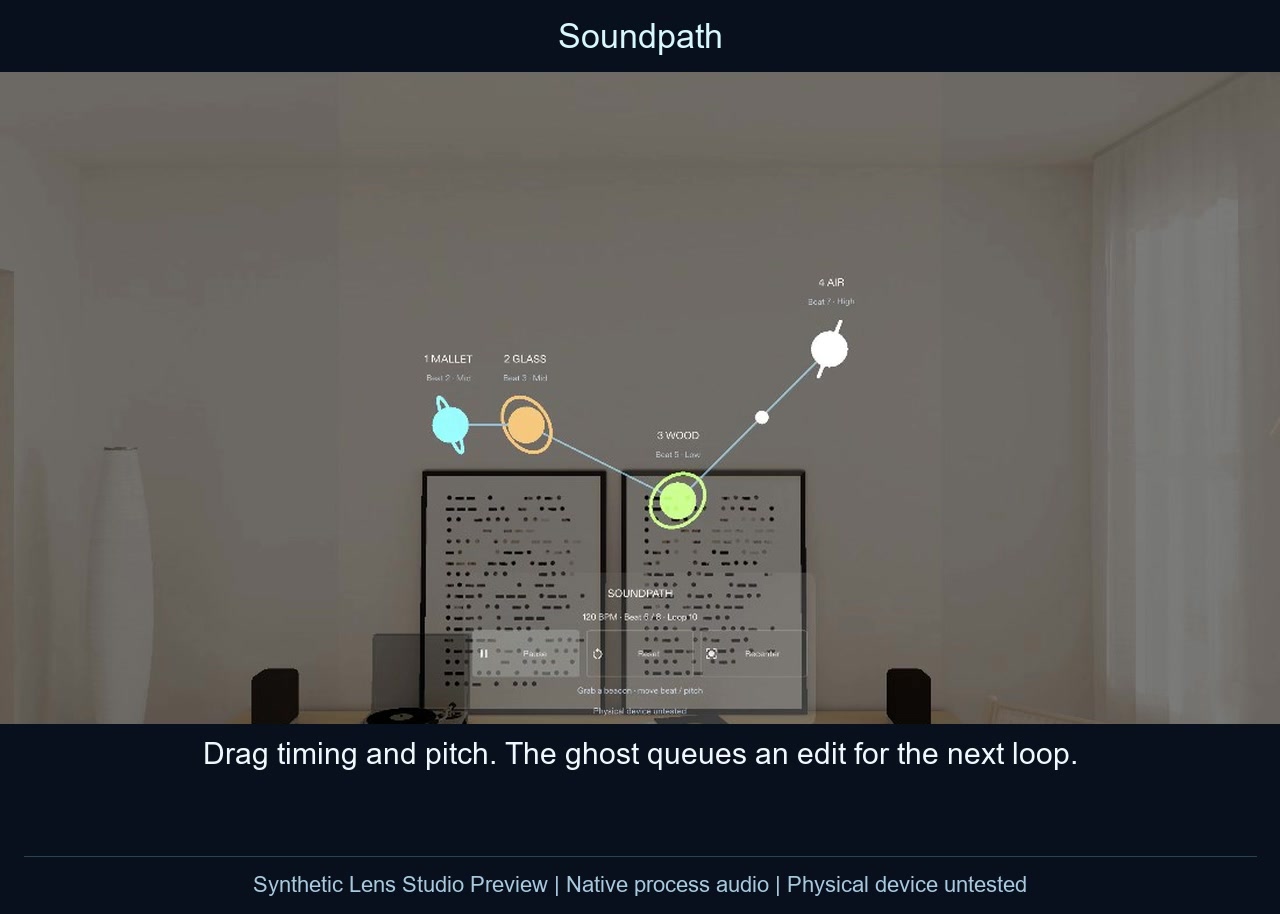
From the native-audio demo: synthetic Lens Studio Preview and simulated SIK. Physical Specs remain untested.
Inspiration
Soundpath explores a simple spatial question. Can the arrangement of a musical pattern become something a person can see, reach for and reshape? Four sound beacons make the timing and pitch of a short loop visible in the surrounding workspace.
What it does
Soundpath is a spatial step sequencer for Specs. Four animated beacons represent Mallet, Glass, Wood and Air. Horizontal movement chooses one of eight beat slots, and vertical movement chooses one of three pitches. At 120 BPM the pattern repeats every two seconds. A ghost shows a queued edit, which commits at the next loop boundary. Voices that share a beat receive separate reachable handles. Play, Pause, Reset and Recenter provide transport and workspace control. A short pinch on a paused beacon auditions its current note. Recenter preserves the current and queued pattern.
How we built it
The project was created during Round 2 in Lens Studio 5.23.2 with the Spectacles target. Codex used the official Learn skill pack for the retained devpost planning documents and the CLAD / Lens Studio MCP workflow for implementation and native Preview work. TypeScript components use Spectacles Interaction Kit, SpectaclesUIKit and an elapsed-time step scheduler. Functional animated meshes were authored with MeshBuilder. Twelve mono PCM timbres were generated locally with the CLAD build-music tone engine. The project uses Lens Studio's built-in Default template and the retained platform packages. The concept and implementation were developed with Codex under delegated creative direction.
Challenges
A loop-boundary update could move the overlap layout while a beacon was still being held. The targeted fix freezes the grab offset and captures the requested musical coordinates on release. A native completion flag also remained active at a sample tail, so an explicit duration guard handles one-shot cleanup. Native audio recording required a process-scoped Windows PCM capture helper with an agile COM completion callback. The recording captures the Lens Studio process rendering the project's own procedural sounds.
Accomplishments
The prototype supports normal simulated SIK input for transport, queued beat and pitch edits, independent overlapping voices, paused audition, Reset and Recenter. A targeted native regression reproduced the held-drag pitch error on the previous code and passed after the fix. The new private delivery contains the Lens project, original procedural sounds, a self-generated environment HDR and the required planning documents. A completed 94.03-second demonstration now captures the synthetic Lens Studio Preview, simulated SIK interaction and native process audio, with same-run timestamp synchronization. The final video passed visual, packet-timestamp and full-decode checks; physical Specs operation and subjective listening remain unvalidated.
What we learned
The implementation made the interaction boundary explicit. A drag gesture needs a stable coordinate frame while the musical scheduler commits other notes. Audio verification also needs separate observations of playback state, rendered PCM and physical-device listening. The retained evidence records those scopes independently.
What's next
The next validation step is physical Specs testing of hand tracking, comfortable reach, perceived timing, pitch clarity and spatial localization. The current demonstration uses Lens Studio's synthetic Sunlit Room with simulated SIK interaction.
Built With
- clad
- codex
- leaf
- lens-studio-5.23.2
- lens-studio-mcp
- meshbuilder
- specs
- spectacles-interaction-kit
- spectaclesuikit
- typescript
