-
-
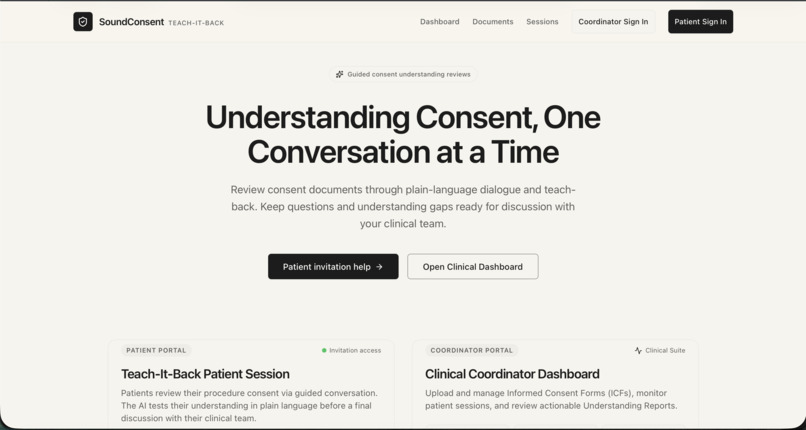
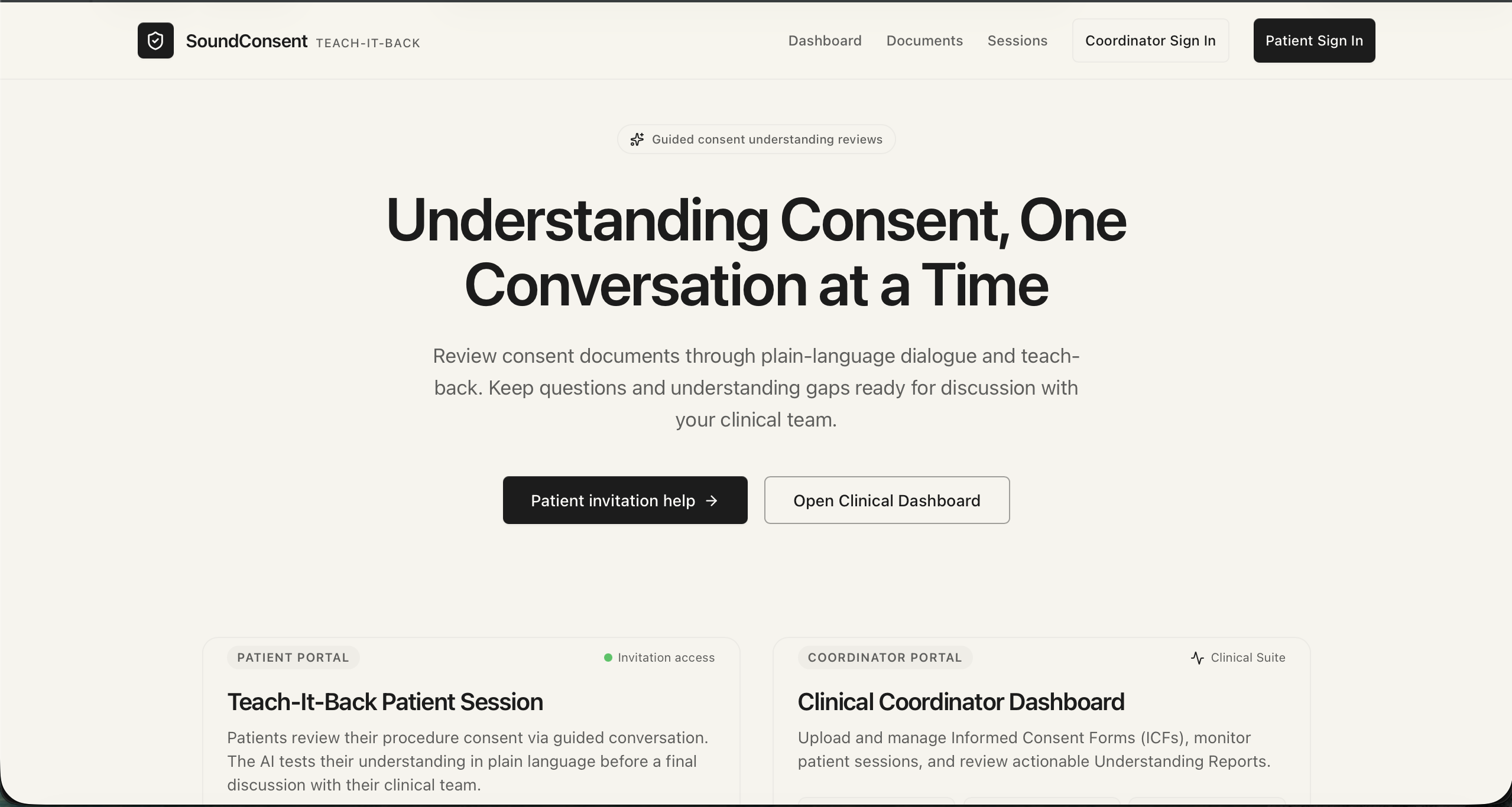
SoundConsent Home Page
-
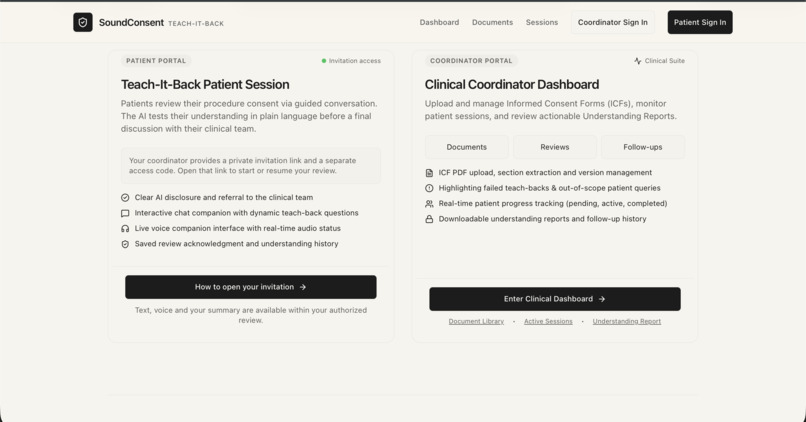
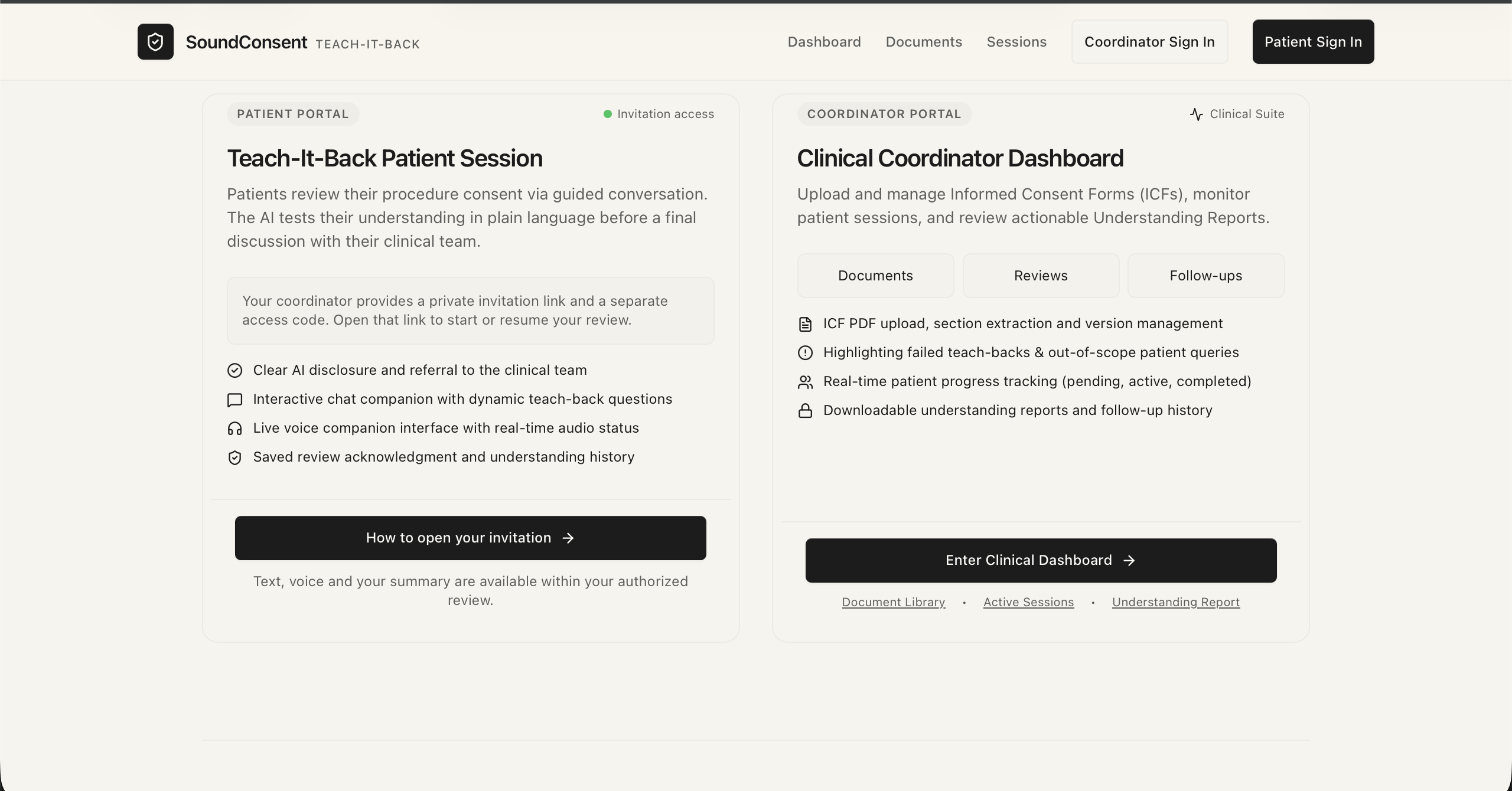
SoundConsent Solutions
-
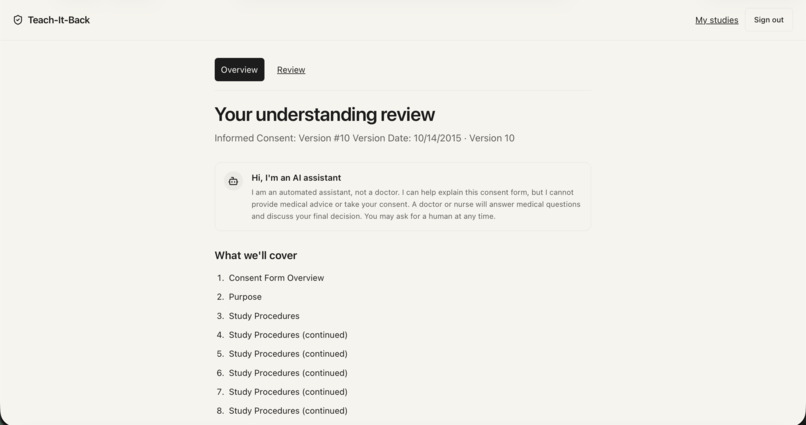
SoundConsent Patient Home Page
-
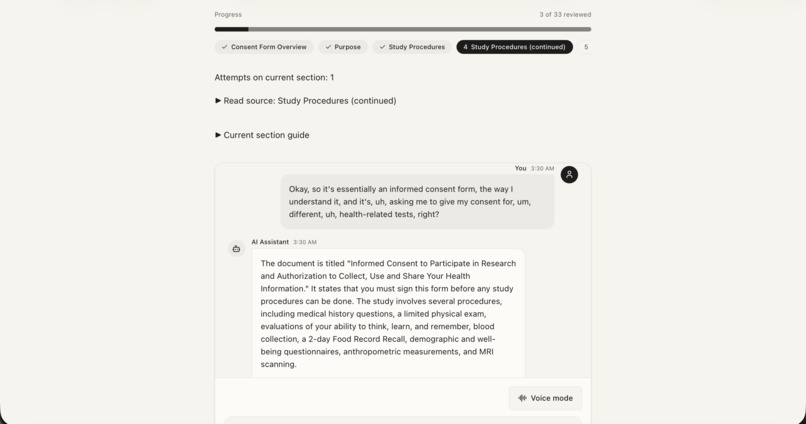
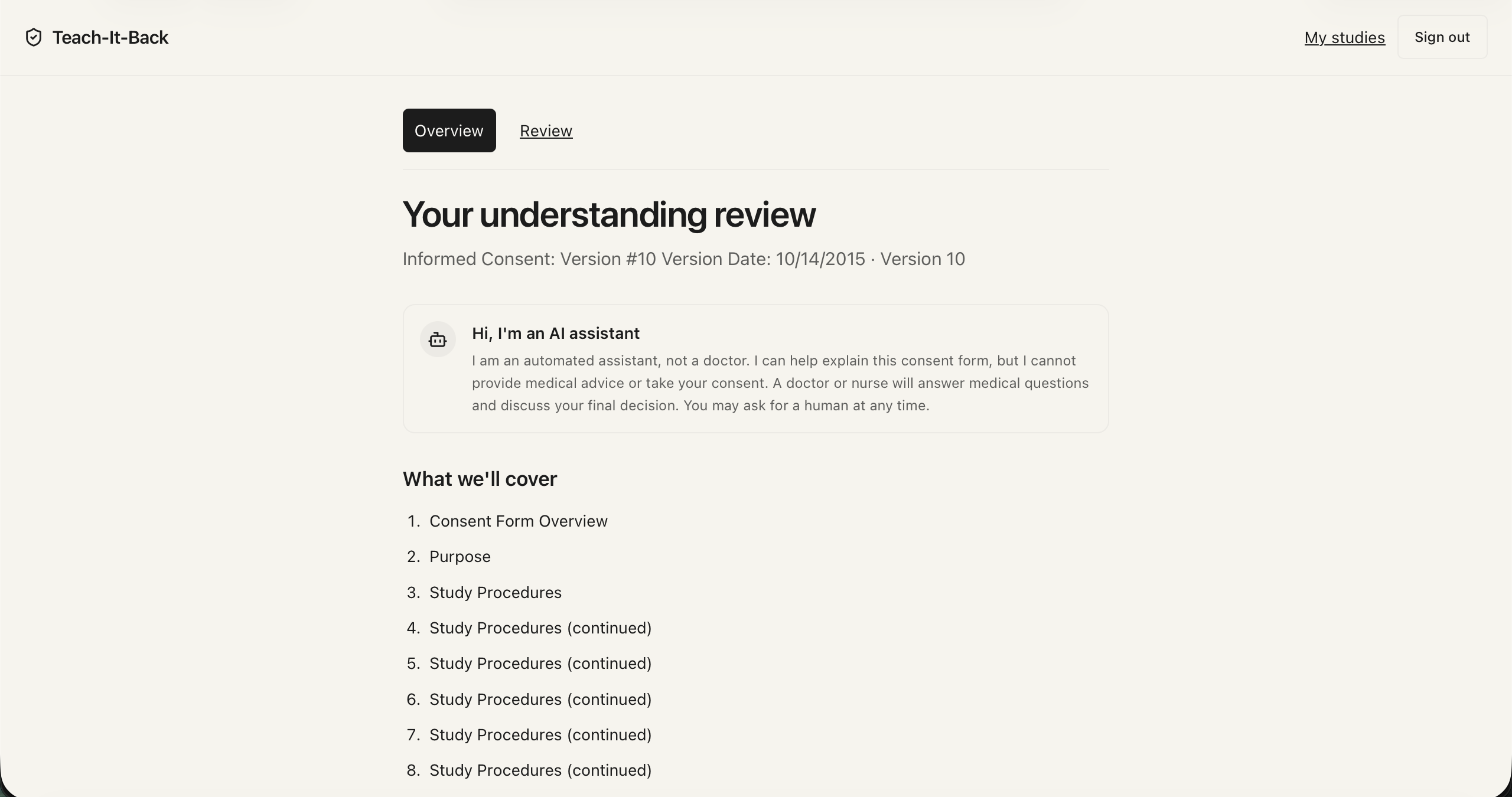
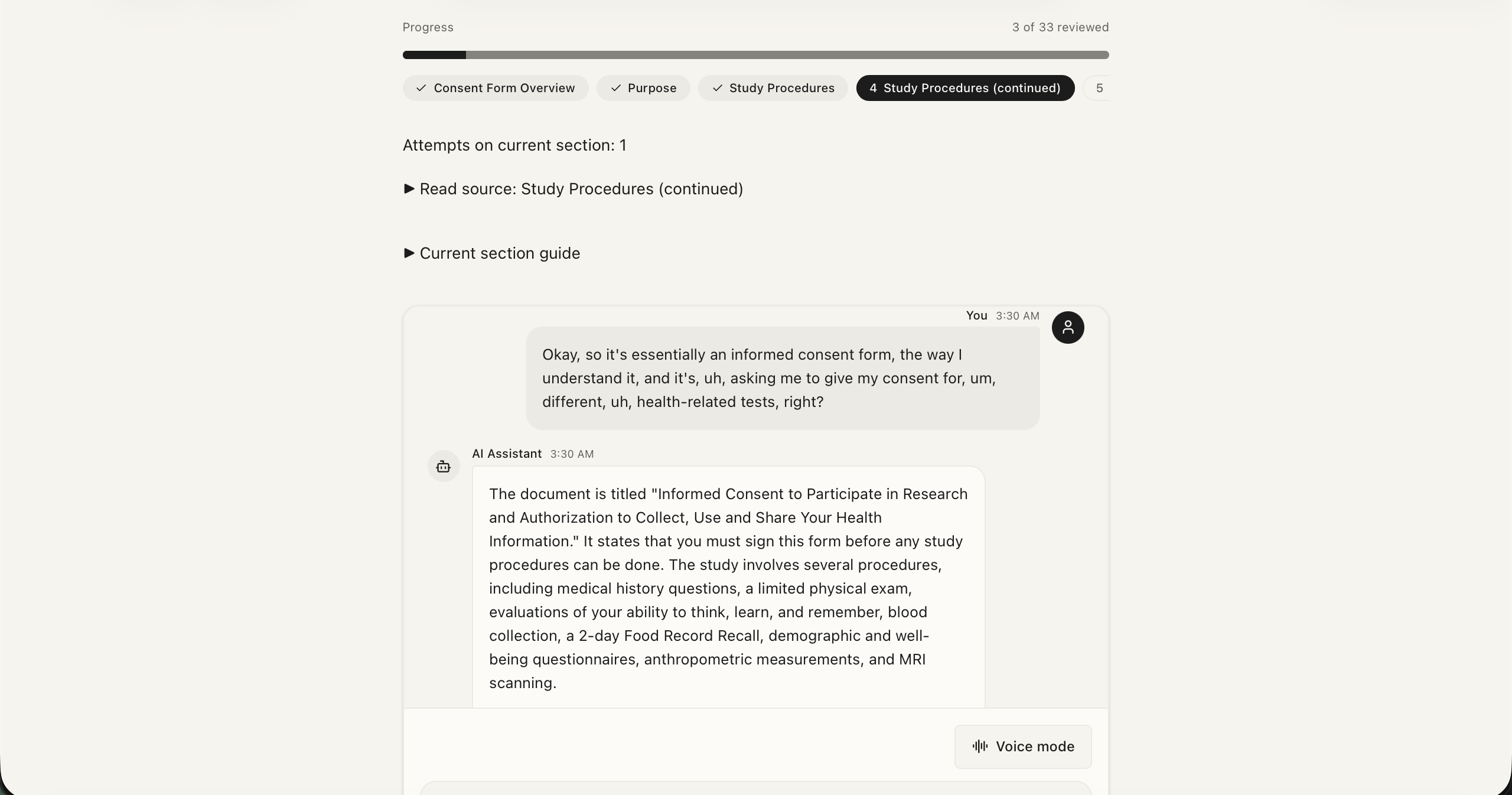
SoundConsent Patient Review Page
-
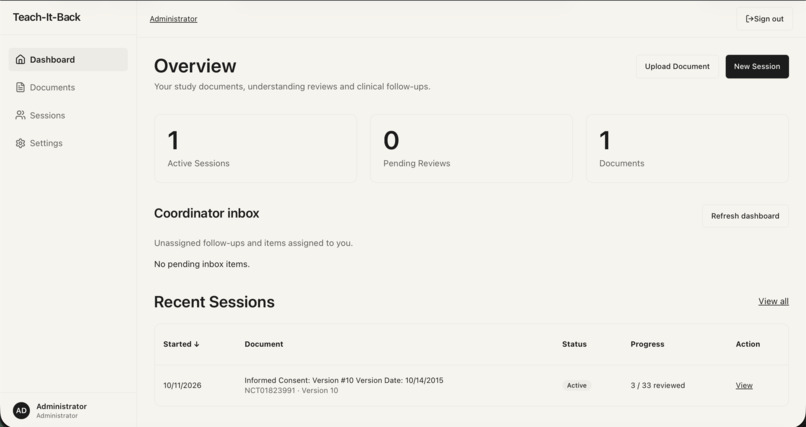
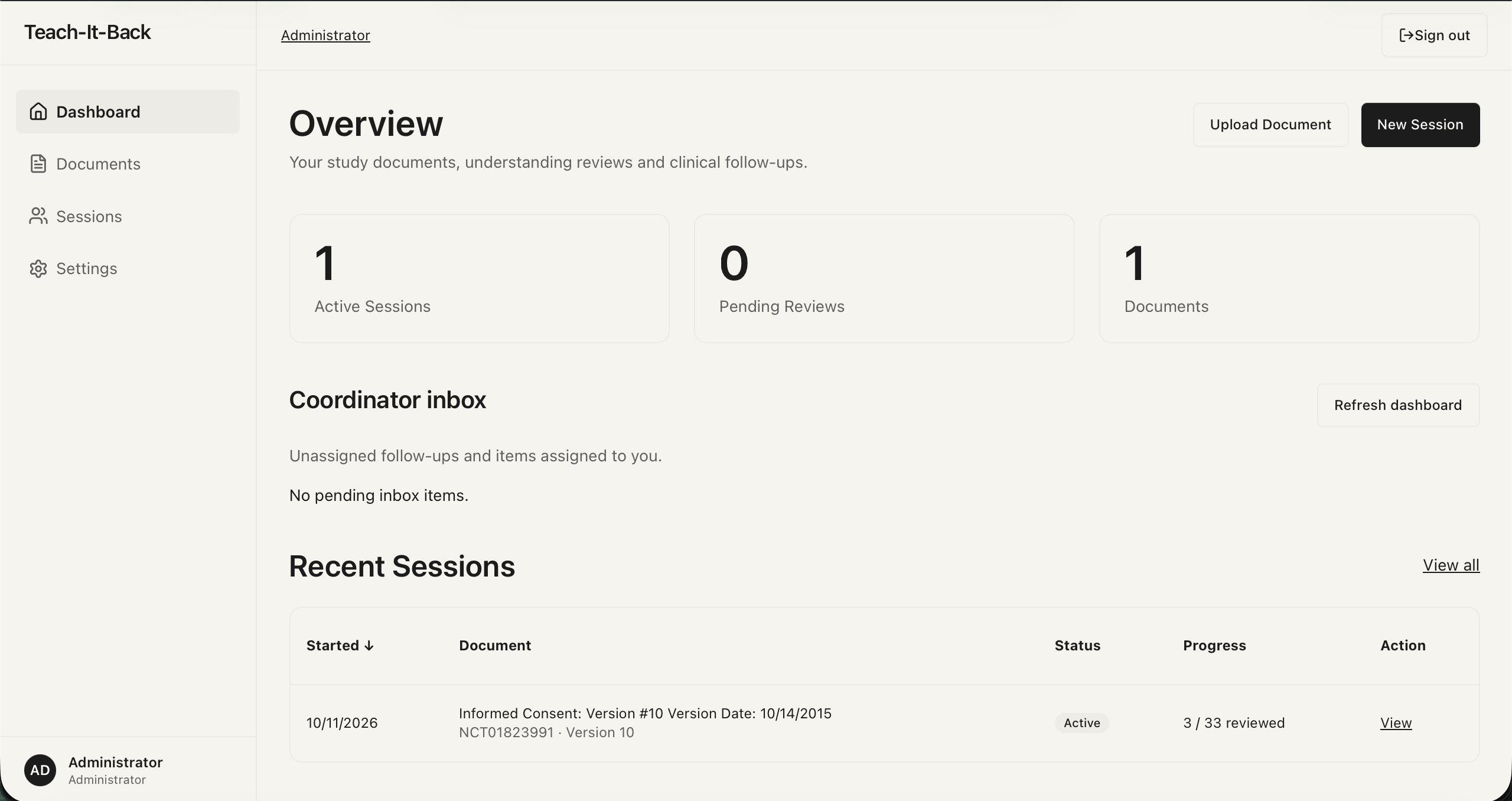
Sound Consent Coordinator DashBoard Page
Inspiration
A signature tells us that someone signed a consent form. It does not tell us what they understood.
We built SoundConsent around that gap. Clinical trial consent forms can contain unfamiliar terminology and complex explanations, often presented when patients already have a lot to process. We wanted to give people space to ask questions and explain their understanding in their own words.
Our inspiration was teach-back: explain a concept, then ask the person to describe it back. SoundConsent brings that approach into an interactive voice and text experience that helps patients prepare for a conversation with their research team.
What it does
SoundConsent is an AI-powered consent education companion for clinical trials.
A coordinator uploads a consent document, checks its version against a configured approval list, and invites a participant to review it. SoundConsent walks through the document section by section, provides plain-language explanations, and asks teach-back questions.
Participants can type, dictate a message, or use conversational voice. When an answer reveals a misunderstanding, the companion rephrases the explanation. If confusion remains after the allowed attempts, it flags the topic for human follow-up.
The research team receives an Understanding Report showing section-level outcomes and questions that need attention. Coordinators can assign follow-ups and track their resolution.
SoundConsent supports preparation and comprehension. The human research team remains responsible for the final consent discussion.
Potential impact
SoundConsent could help research teams spend less time repeating explanations and more time addressing each participant’s questions. To explore that potential, we modeled an assumed 45-minute consent discussion, 10 reviews per clinician per week, and 52 weeks per year. We valued clinician time at $63.46/hour, the BLS May 2025 mean wage for healthcare diagnosing or treating practitioners, a broad proxy for the staff involved.
| Assumed time reduction | Time returned per review | Annual hours returned | Annual wage value |
|---|---|---|---|
| 20% | 9 minutes | 78 | $4,950 |
| 30% | 13.5 minutes | 117 | $7,425 |
| 50% | 22.5 minutes | 195 | $12,375 |
In an illustrative 25% reduction scenario, SoundConsent could return 97.5 hours per clinician annually, representing approximately $6,187 in staff capacity. At a hypothetical scale of 100,000 reviews per year, the same assumption translates to 18,750 hours, valued at approximately $1.19 million. These estimates represent potential staff capacity before software, implementation, and oversight costs; they are not demonstrated cash savings. Our next step is to measure total staff time, including report review and follow-up, alongside participant comprehension to test whether these benefits hold in practice.
How we built it
We built the frontend with React, TypeScript, Vite, and Tailwind CSS, with separate experiences for participants and coordinators. A Fastify and TypeScript backend manages documents, authentication, review progress, and reports.
Our document pipeline extracts text from uploaded PDFs, organizes it into sections, and creates embeddings to retrieve relevant source material. Google’s generative AI APIs power explanations, question routing, and teach-back assessment, using Gemma for backend text processing and Gemini for embeddings and transcription.
ElevenLabs Conversational AI powers voice conversations. Voice and text connect to the same review workflow, so participants can switch modes while preserving progress.
We also implemented a secondary grounding check to evaluate generated answers against the consent text, with fallback responses that direct unsupported questions to the research team.
Challenges we ran into
One challenge was making the conversation flexible without losing structure. A participant might answer a teach-back question, ask something new, or do both in one message. We needed to distinguish those situations so that asking a question would not consume an assessment attempt.
Another challenge was keeping voice, text, and saved progress synchronized. Retries, page refreshes, and delayed responses must not grade the same answer twice or advance the wrong section. We addressed this with serialized updates, revision checks, and duplicate-request protection.
We also had to balance simpler explanations with fidelity to the source. Our approach combines document retrieval, constrained generation, and grounding checks, while recognizing that clinical validation remains necessary.
Accomplishments that we're proud of
We built a connected workflow from document upload and participant invitation through guided review, understanding reports, and coordinator follow-up.
We are especially proud of making voice part of the same persistent experience as text, and of turning unresolved confusion into actionable information for the research team.
We also built automated tests covering permissions, document versions, review progression, microphone failure handling, and conflicting updates.
What we learned
We learned that a useful consent companion needs more than clear explanations. It needs to recognize uncertainty, preserve context, and know when to involve a person.
We also learned that conversational design and backend reliability are closely connected. Whether a question counts as an answer, whether a retry changes progress, and whether a conversation survives a refresh all affect the participant’s experience.
What's next for SoundConsent
Our next step is to evaluate the prototype with research coordinators and representative users, comparing its explanations and teach-back assessments with human review.
We also want to explore multilingual support, improve accessibility through assistive-technology testing, and strengthen storage and operational infrastructure.
Before clinical use, we plan to validate the system’s privacy, security, and clinical behavior. Our goal is to help participants arrive at the consent conversation with clearer understanding—and help research teams see where more discussion is needed.
Built With
- clinicaltrials.gov
- elevenlabs
- gemini
- node.js
- typescript
- vite


Log in or sign up for Devpost to join the conversation.