-
-
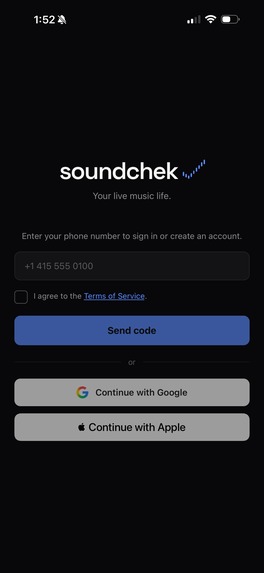
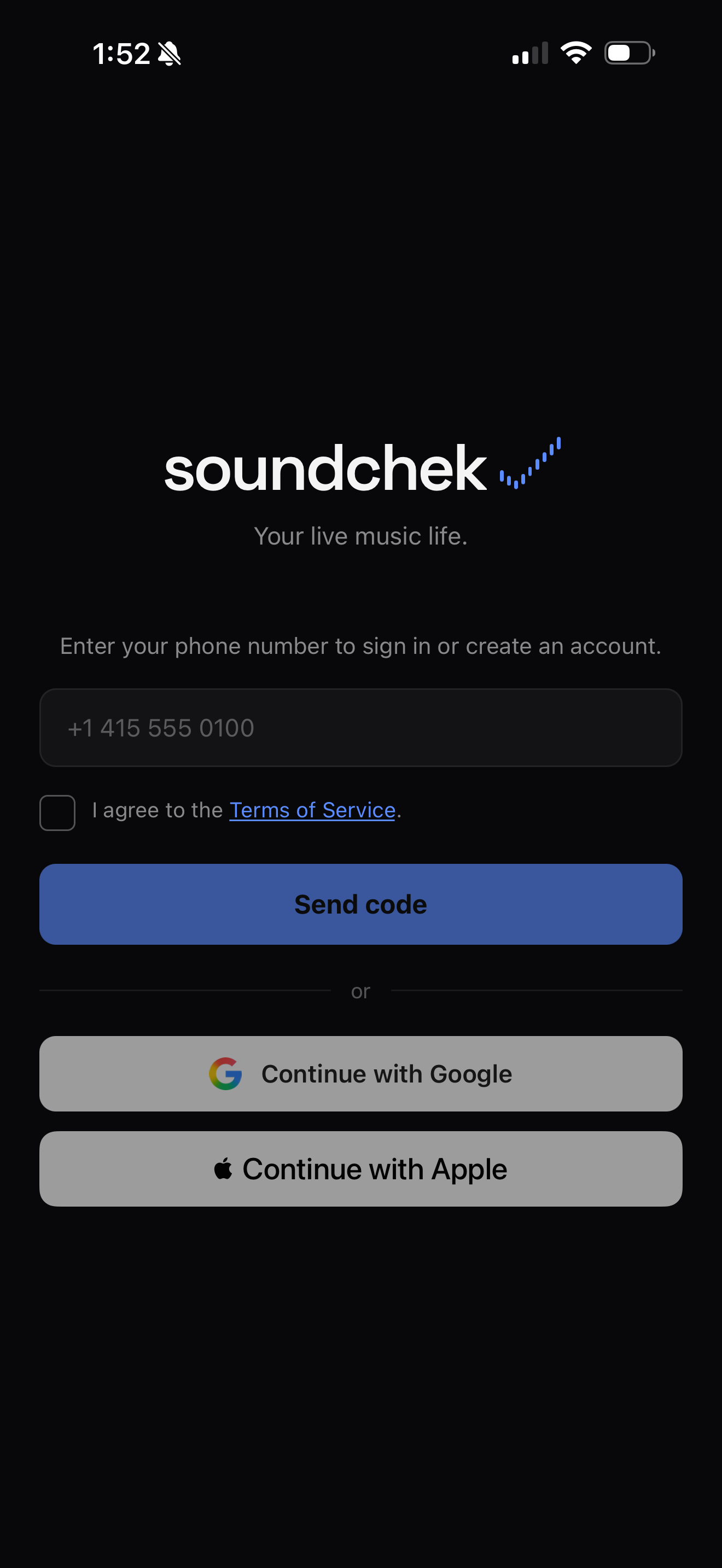
Login Page
-
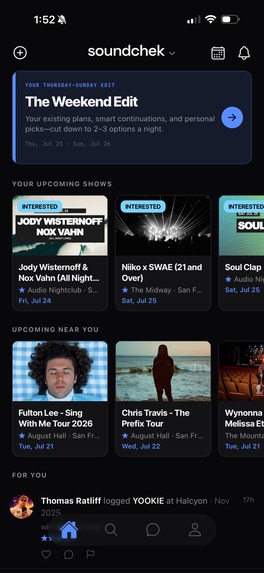
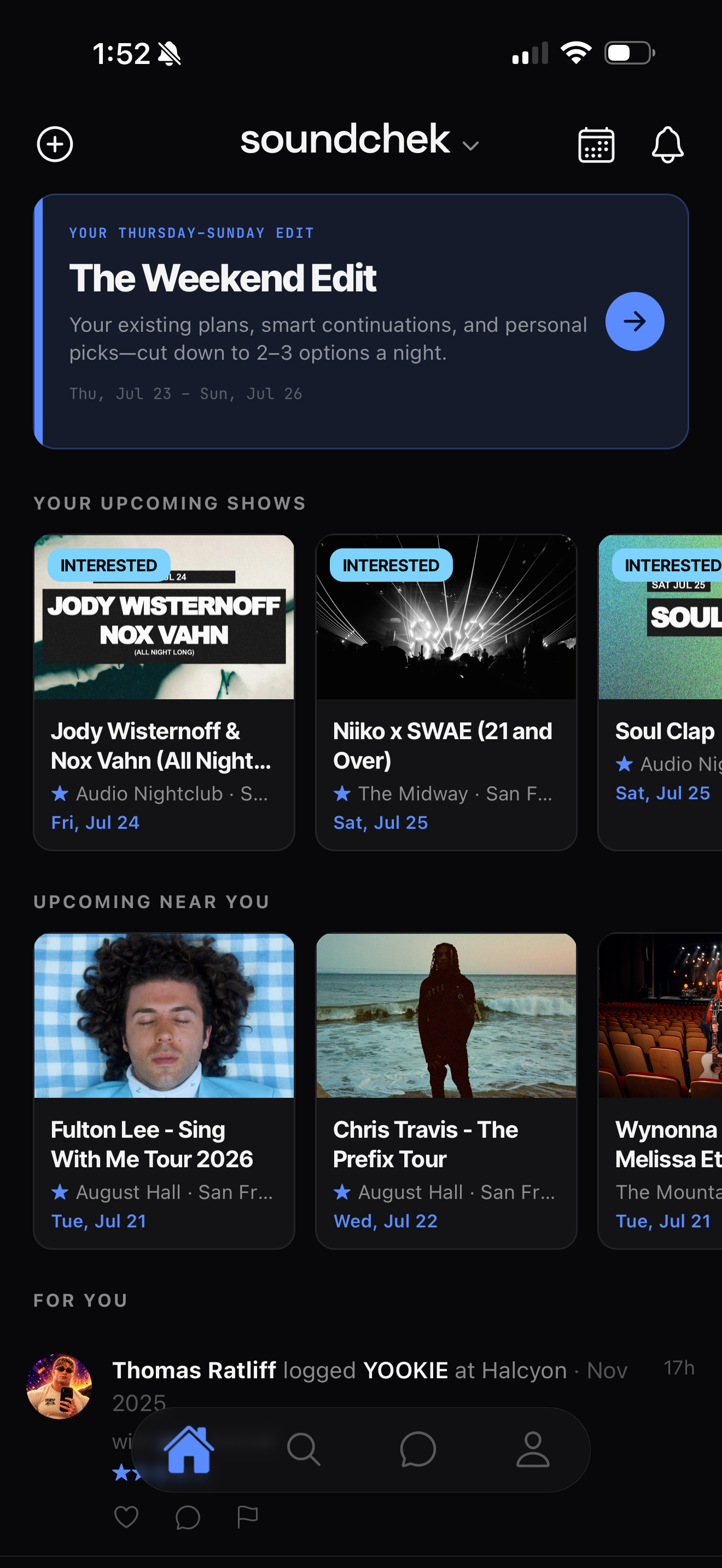
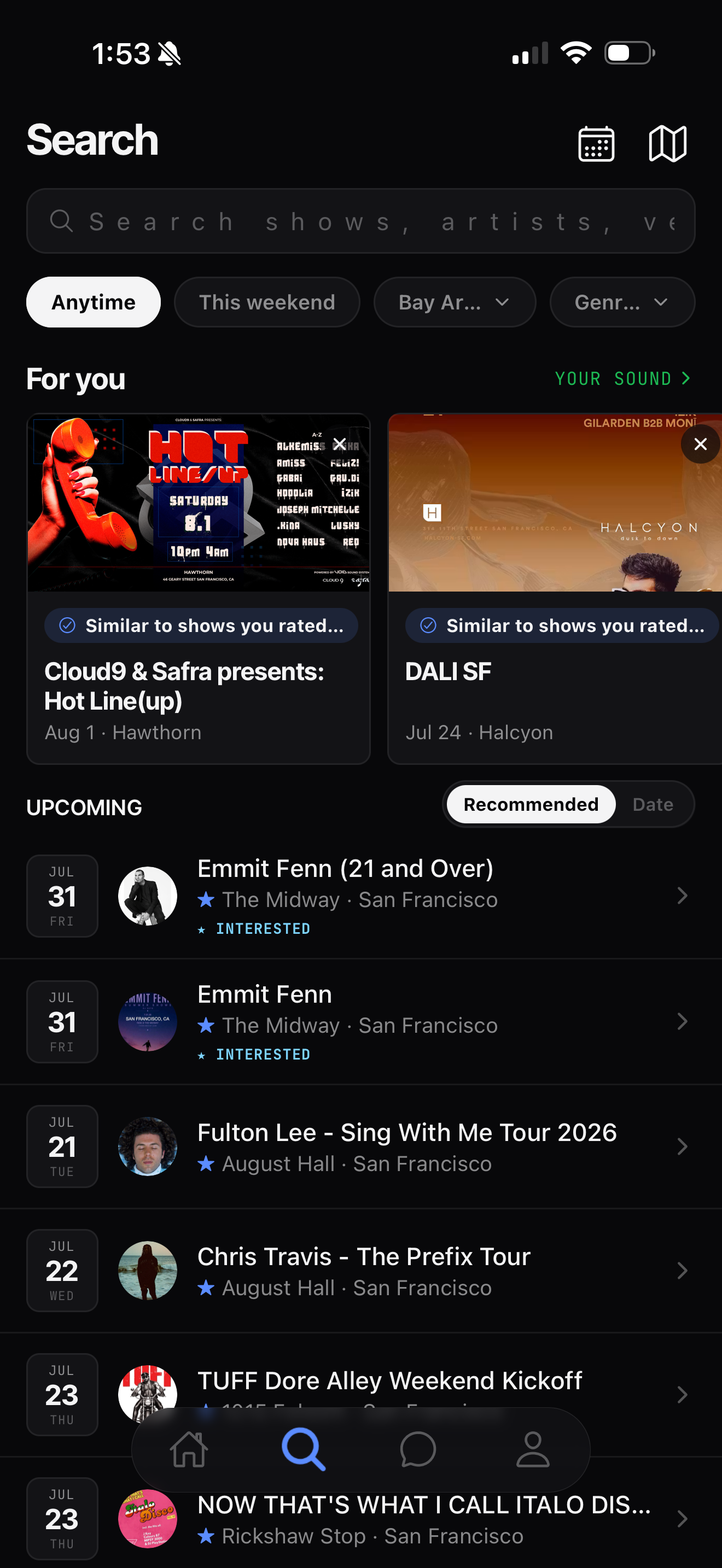
Home Page
-
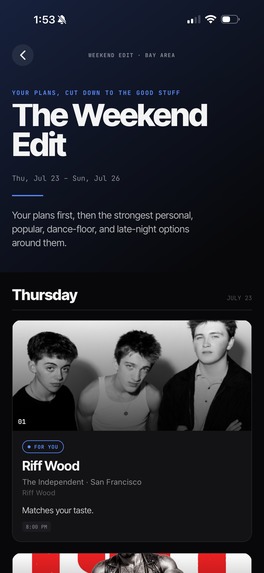
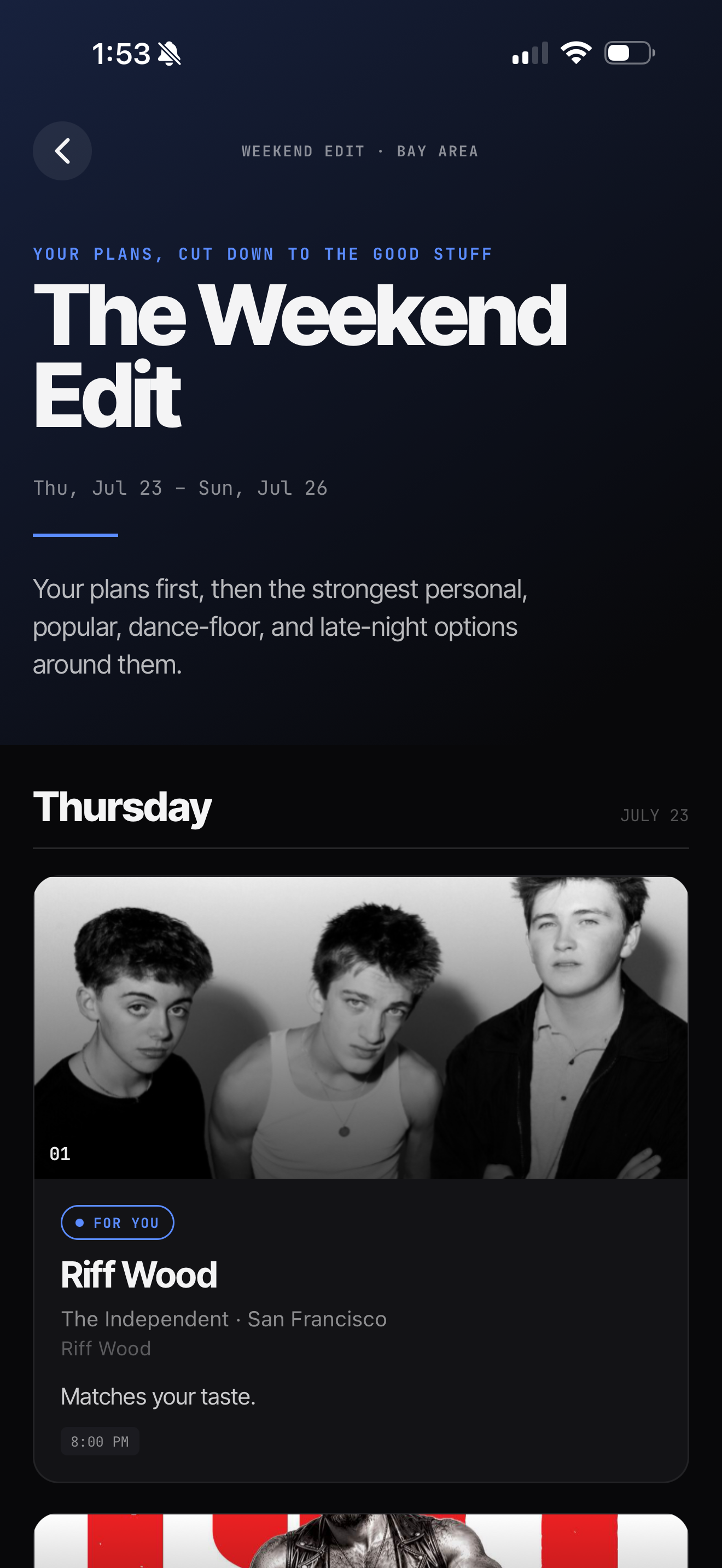
Weekend Editorial Recommendations
-
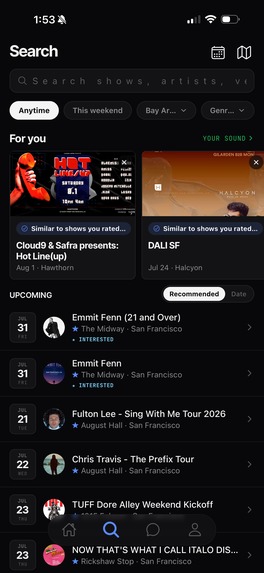
Discover Page
-
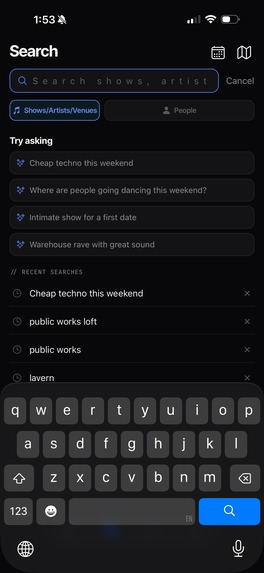
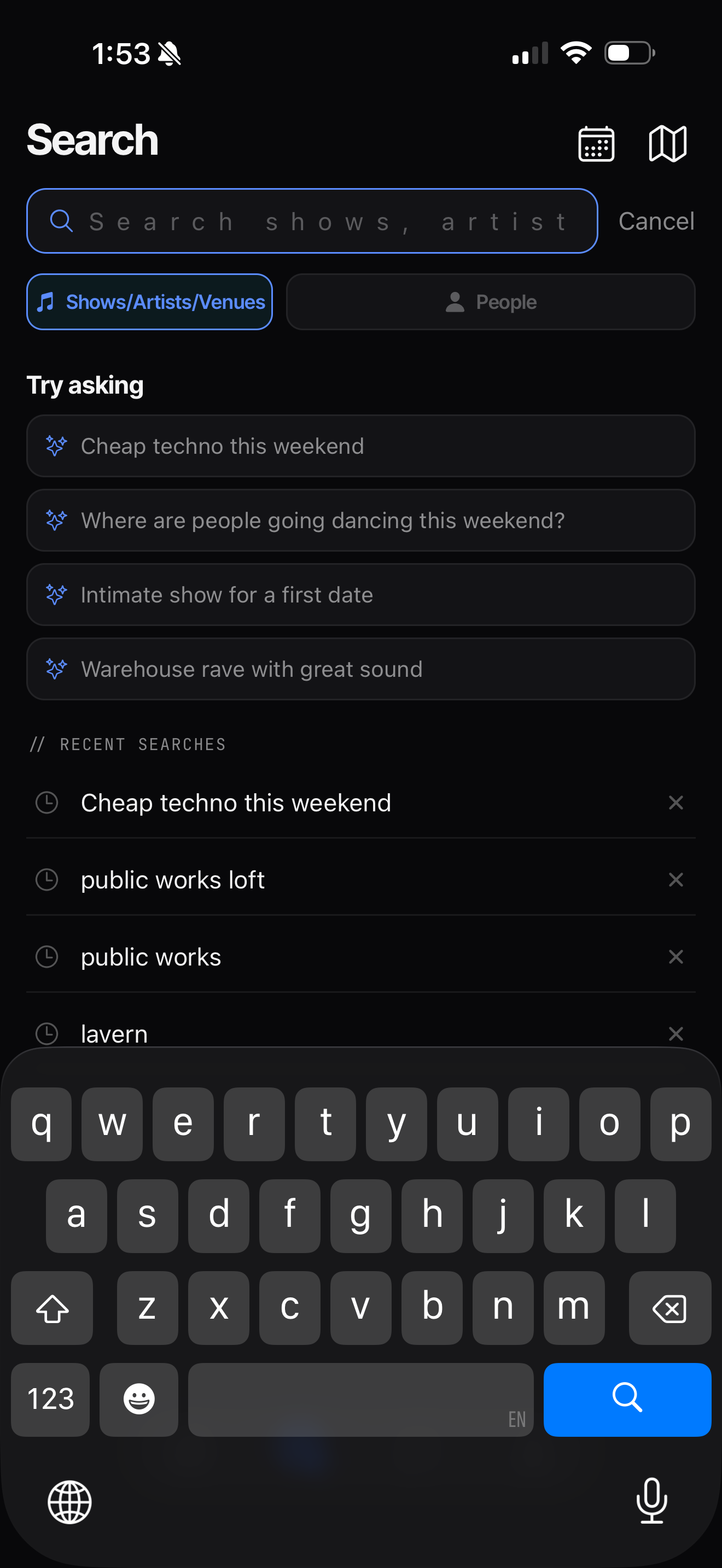
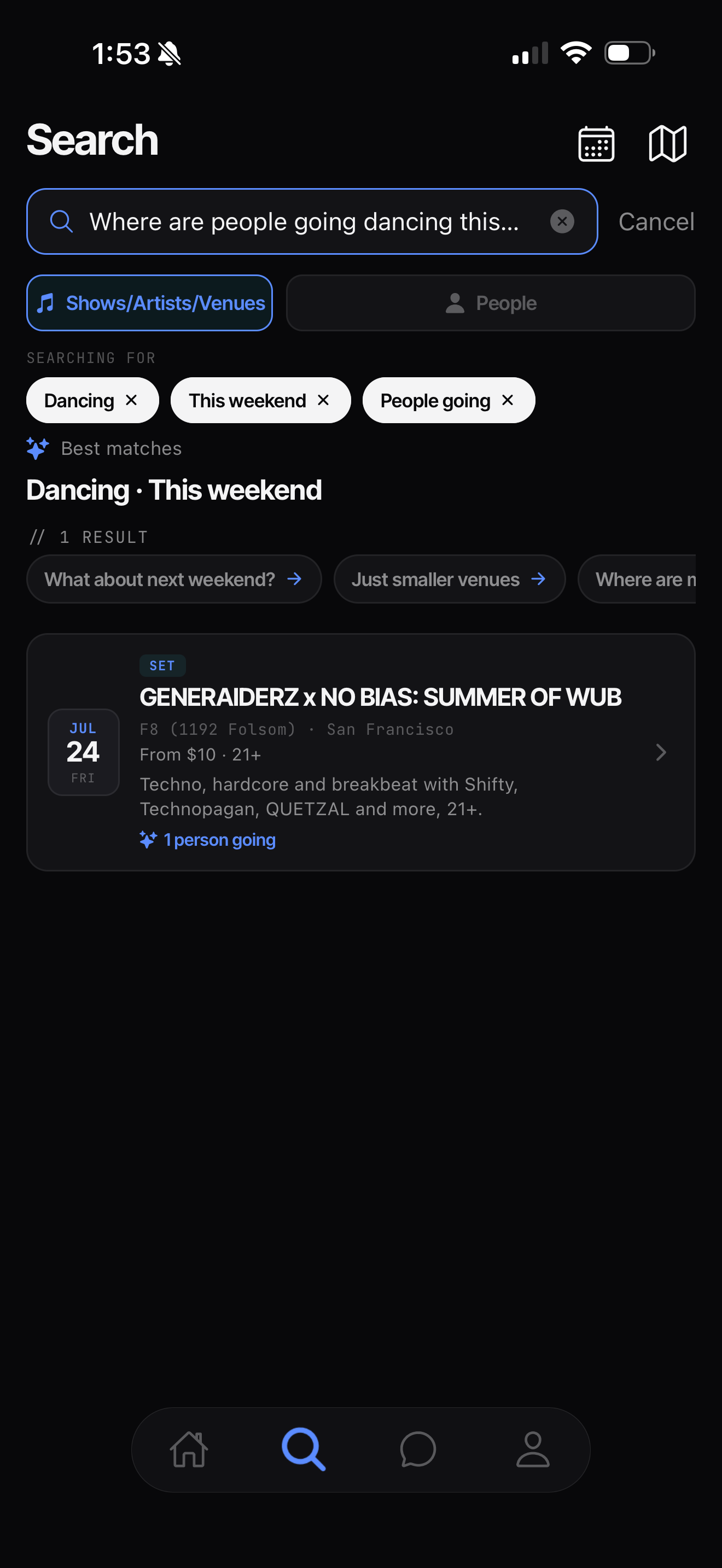
Smart Search
-
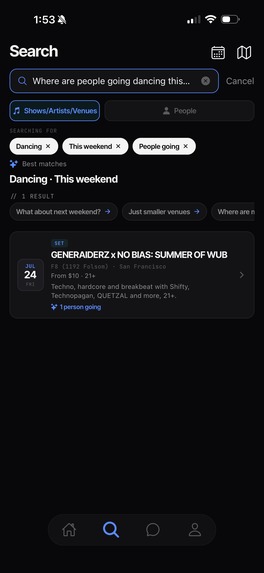
Smart Search
-
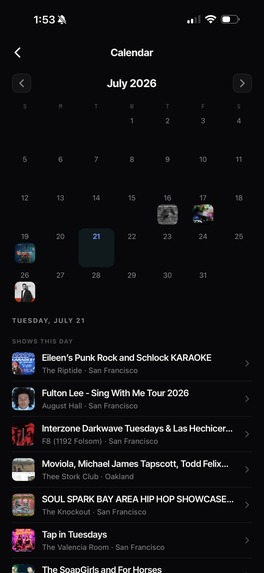
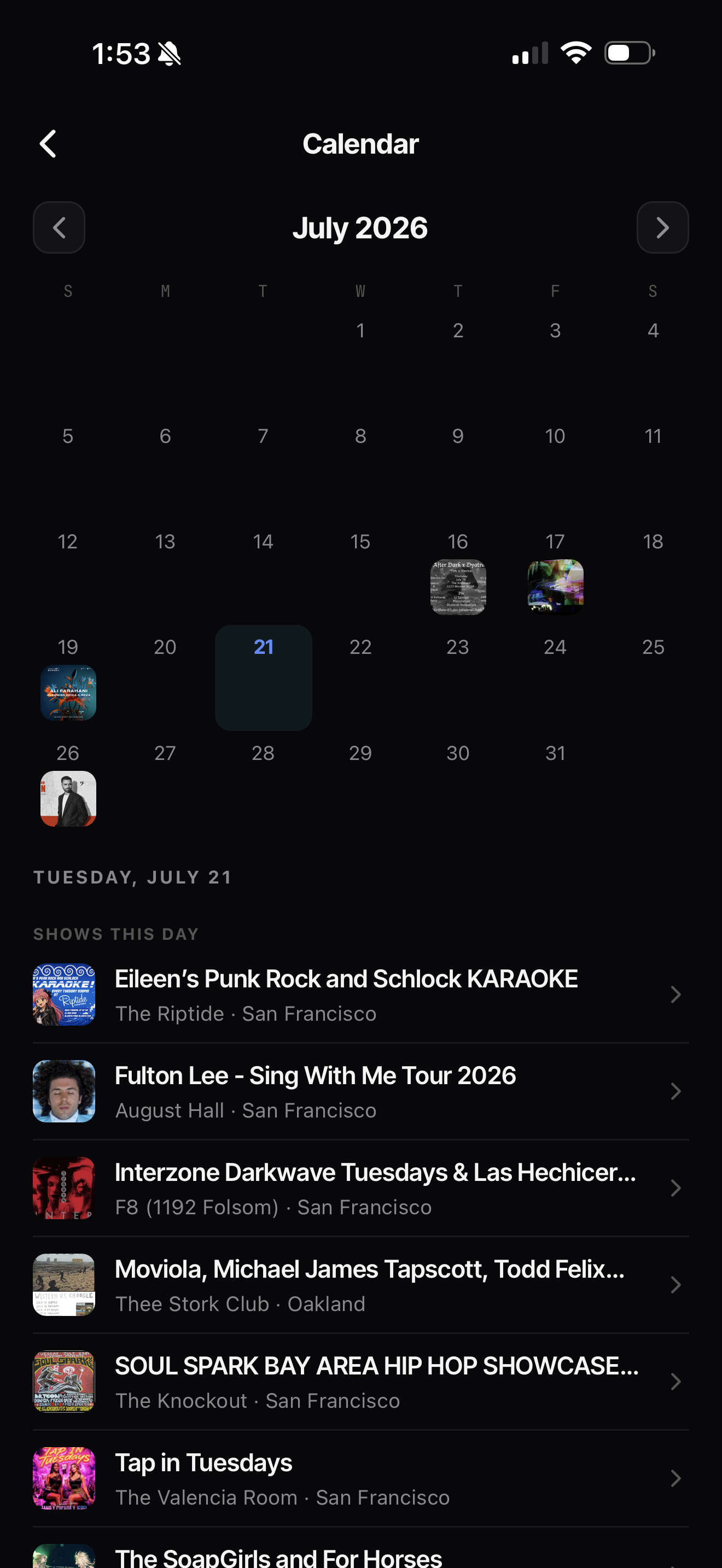
Calendar view
-
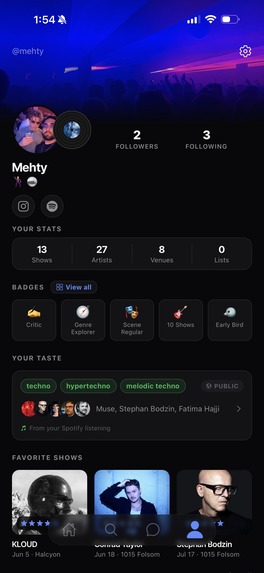
Profile Page
-
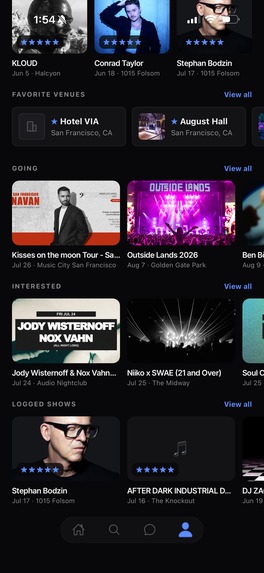
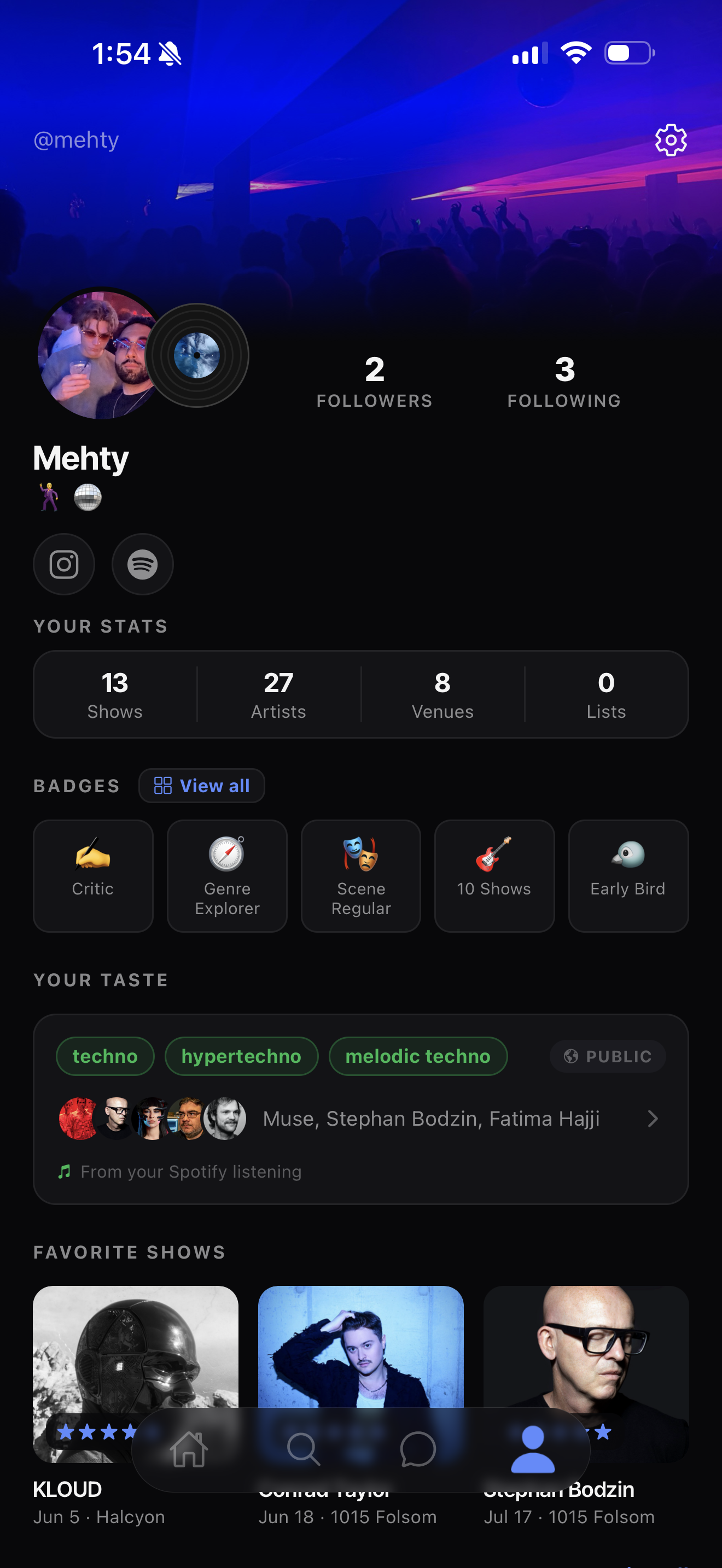
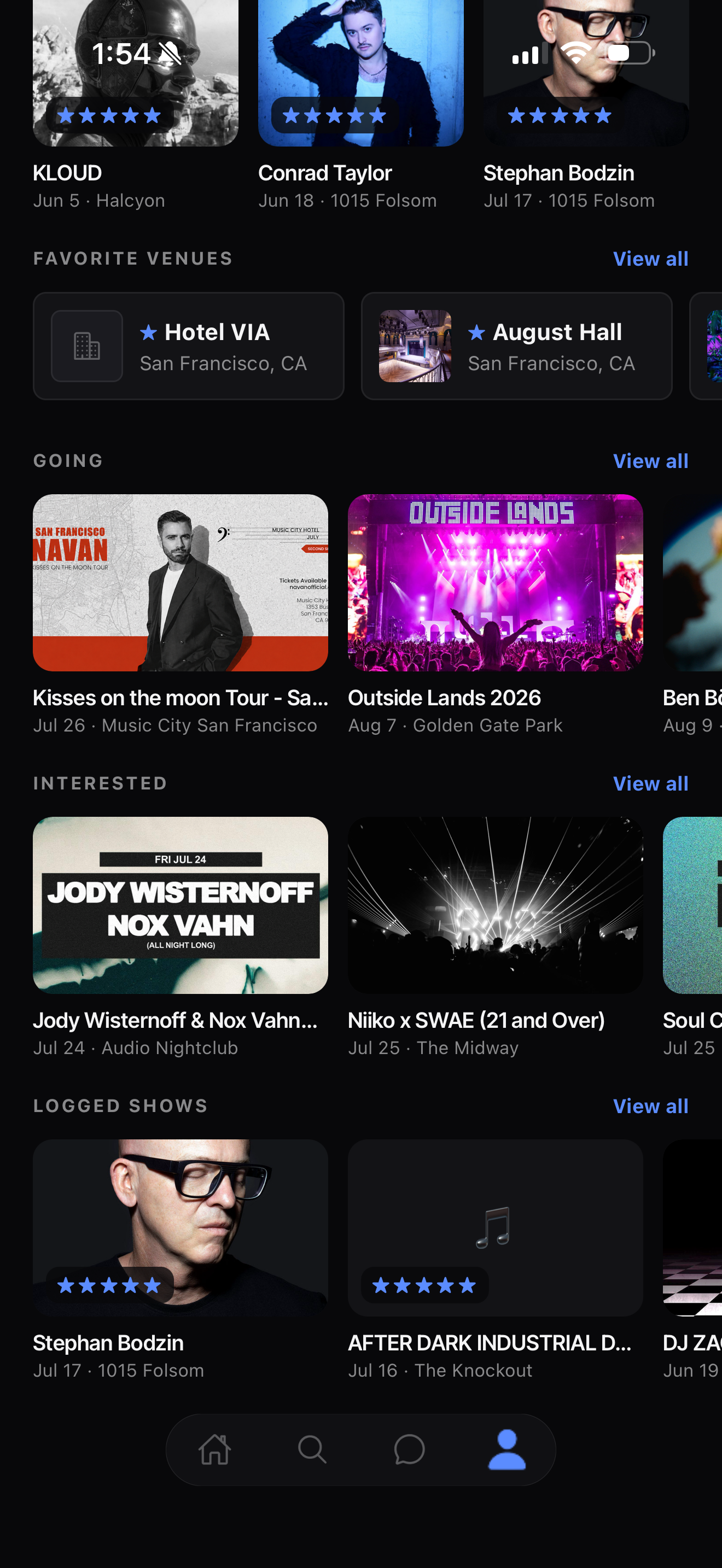
Profile Page
Inspiration
Live music is one of the most meaningful parts of our lives, but everything around it is fragmented. Discovery happens across ticketing apps, venue calendars, streaming profiles, and artist posts. Afterward, memories disappear into camera rolls and opinions stay in group chats.
We wanted one product built around the full life cycle of going to shows.
What Soundchek does
Soundchek is the social app for live music. It connects one continuous loop:
discover → attend → log → rate → share → discover better shows
Fans can:
- discover personalized concerts, DJ sets, and festivals;
- use fast keyword search or refined LLM-assisted smart search with contextual suggestions;
- understand why a show matches their taste;
- browse the Weekend Edit, a magazine-style shortlist of the best shows to consider this weekend;
- log and rate attended shows, including festivals and individual sets;
- keep a personal journal of artists, venues, notes, ratings, and media;
- share social posts or screenshots into Soundchek so the app can detect the show and add it to Interested or help log it;
- turn a completed log into one of five distinctive 9:16 Soundchek Stories.
How it works
Soundchek builds a personalized Sound Profile from onboarding choices and first-party behavior: artists and genres, show history, ratings, RSVPs, favorite venues, recommendation feedback, and optional Spotify taste import. Spotify can enrich the profile, but the core experience never depends on a streaming connection.
The recommendation system scores the live-event catalog against that profile, balances relevance with exploration and artist diversity, and surfaces understandable reasons. The Weekend Edit packages the strongest near-term options into a more useful editorial decision surface.
Our normalized catalog combines concerts, club nights, and festivals from Ticketmaster, Resident Advisor, DICE, Eventbrite, TicketWeb, See Tickets, and setlist.fm. Share to Soundchek applies extraction and matching to social content or screenshots, then routes upcoming shows to Interested and past shows to logging.
How we built it
The client uses Expo, React Native, TypeScript, and Expo Router. Supabase provides authentication, PostgreSQL, storage, and backend functions. Node.js ingestion jobs and scheduled GitHub Actions maintain and enrich the event catalog.
How we used ChatGPT, Codex, and GPT-5.6
ChatGPT and Codex formed our end-to-end product-development loop. We brainstormed user problems and feature directions with GPT-5.6 in ChatGPT, turned the strongest ideas into detailed design documents, and then used Codex locally or through cloud tasks to implement, test, integrate, and ship them.
The provider-neutral recommendation redesign is the clearest example. We learned that Spotify could be integrated cleanly, but its developer-mode cap of five connected users could not scale to Soundchek. From a phone, we brainstormed a stronger alternative with GPT-5.6: make Spotify an optional importer and let Soundchek build its own durable taste profile from first-party signals. We triggered a Codex cloud task to implement the architecture, then continued locally to integrate, test, refine, and harden it.
This workflow helped us ship hybrid smart search, optimized onboarding, the provider-neutral recommendation system, optional Spotify taste import, the Weekend Edit, Share to Soundchek, outgoing Soundchek Stories, event-data improvements, and launch-readiness work.
Codex is also integrated into our day-to-day engineering system. Slack and GitHub integrations let us trigger tasks from team conversations and automatically review and test pull requests. During local development, we used computer control extensively to validate changes end to end against the hosted web preview. GitHub Issues remained our source of truth for scope, decisions, progress, and follow-up work, preserving useful context across Codex sessions.
We retained ownership of the consequential choices: what to build, how to resolve product constraints, which competing implementation to keep, what belonged in the demo, and when the work was ready to ship.
Challenges
Live-event data is messy. The same show appears differently across sources, DJ sets are underrepresented by mainstream APIs, and venue calendars often contain incomplete lineups. Matching and enrichment had to be resilient without inventing data.
We also had to design beyond Spotify. Treating it as an optional importer rather than the foundation produced a more scalable and ultimately stronger recommendation system.
Finally, incoming social content can be ambiguous or incomplete, so Share to Soundchek needs to extract clues, match conservatively, and give the user a recovery path instead of silently choosing the wrong show.
Accomplishments
Soundchek now feels like a connected consumer product instead of a collection of screens. It combines personalized discovery, weekend planning, search, attendance, memory, rating, and sharing in one coherent loop backed by a real event catalog.
What we learned
Codex was most effective when paired with clear product context, concrete design documents, explicit edge cases, and required validation. The biggest product constraint of the week: Spotify’s limited developer access, became the catalyst for a better first-party recommendation design.
What’s next
Next we will expand event coverage beyond the Bay Area, deepen first-party taste signals, improve recommendation evaluation, refine show detection from shared content, and make it easier for fans to bring their existing live-music history into Soundchek.
Built With
- chatgpt
- codex
- expo.io
- github-actions
- gpt-5.6
- node.js
- postgresql
- react-native
- supabase
- typescript