Inspiration
I’ve... always struggled with explaining how I feel in clear, neat words. Emotions don’t usually show up one at a time—they overlap, contradict each other, or feel too heavy to describe accurately. When mental health tools ask me to pick a label or rate my mood on a scale, it often feels like I’m simplifying something that isn’t simple at all.
its a hurricane of emotions but people ask me to rate it on a number scale...
I wanted to build something that doesn’t ask people—especially teens and students like me—to perform emotional clarity they don’t have yet. SoulScape was inspired by the idea that feelings can exist without being fully explained, analyzed, or judged. Sometimes, it’s enough to see them reflected back in a way that feels gentle and honest.
What It Does
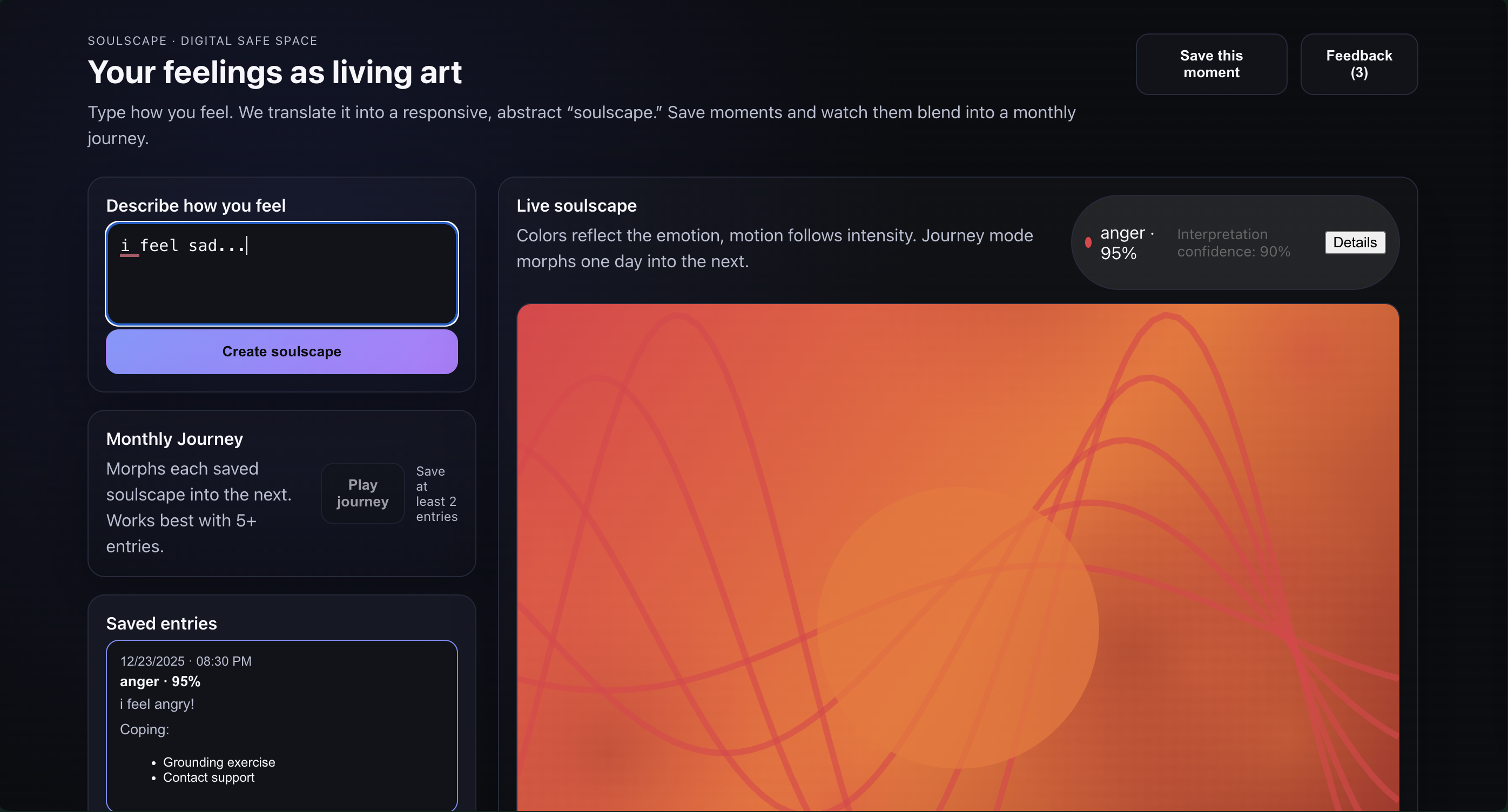
SoulScape is a digital safe space that turns emotions into living, abstract art.
Users type how they feel in their own words—messy, uncertain, or mixed—and SoulScape translates that input into a responsive visual environment called a soulscape. The visuals change based on emotional tone and intensity:
- Color reflects emotional tone
- Motion reflects intensity
- Visual cohesion reflects emotional stability
Users can save moments and later replay them in Journey Mode, where soulscapes morph into one another over time. This creates a visual record of emotional change without scores, streaks, or judgment.
SoulScape also offers optional, non-clinical coping suggestions like grounding exercises. These are meant to support—not instruct or diagnose.
How I Built It
SoulScape is built as a lightweight, privacy-first web prototype designed to stay out of the way and let emotions speak visually.
At its core, the system listens to free-text input—whatever words the user has, even if they’re fragmented, uncertain, or contradictory. Instead of forcing those words into a single emotional label, SoulScape analyzes them for emotional signals and intensity cues, then blends multiple emotional states together.
Behind the scenes, it works by:
- Parsing user-written text for emotion-related language and intensity modifiers
- Allowing multiple emotions to coexist instead of collapsing them into one
- Translating those blended emotional states into visual parameters—color palettes, motion speed, fluidity, and cohesion
- Rendering the result in real time as an abstract, responsive soulscape using browser-based graphics
- Storing entries locally on the user’s device so moments can be revisited without accounts or servers
- Using React to manage state, interaction, and smooth visual transitions—especially for Journey Mode, where saved soulscapes morph into one another over time
Everything runs entirely in the browser. There are no logins, no analytics, and no data leaving the device. That decision was intentional—emotional honesty feels safer when it isn’t being watched, stored, or scored.
The goal wasn’t technical spectacle. It was building a system quiet enough to hold something fragile.
Challenges I Faced
One of the biggest challenges was balancing emotional sensitivity with technical clarity. I was careful not to present SoulScape as a diagnostic or therapeutic tool, while still making it feel meaningful and supportive.
Another challenge was designing coping suggestions that don’t feel preachy or overwhelming. I kept them short, optional, and grounded in widely used techniques so users can engage only when they want to.
Visually, I also had to make sure the soulscapes felt expressive without becoming chaotic or overstimulating.
What I Learned
This project taught me that mental health technology doesn’t need to be complex or clinical to be effective. Small design decisions—like allowing emotional ambiguity or avoiding rigid labels—can make tools feel safer and more accessible.
I also learned how important ethical framing is when building tools that interact with people’s emotions, especially for young users.
Impact & Future Potential
SoulScape helps normalize emotional expression by allowing feelings to exist as they are, without pressure to explain or fix them. It’s especially accessible for youth, neurodiverse users, and people from cultures where talking openly about mental health can be difficult.
In the future, SoulScape could expand with:
- Longer-term emotional pattern insights
- Personalized visual styles
- Optional, consent-based sharing
- Expanded emotion models that better reflect cultural differences
SoulScape is not a replacement for professional support. It’s a place to pause, reflect, and begin understanding yourself.
Built With
- api
- browser
- css
- express.js
- javascript
- node.js
- react
- vscode


Log in or sign up for Devpost to join the conversation.