-
-
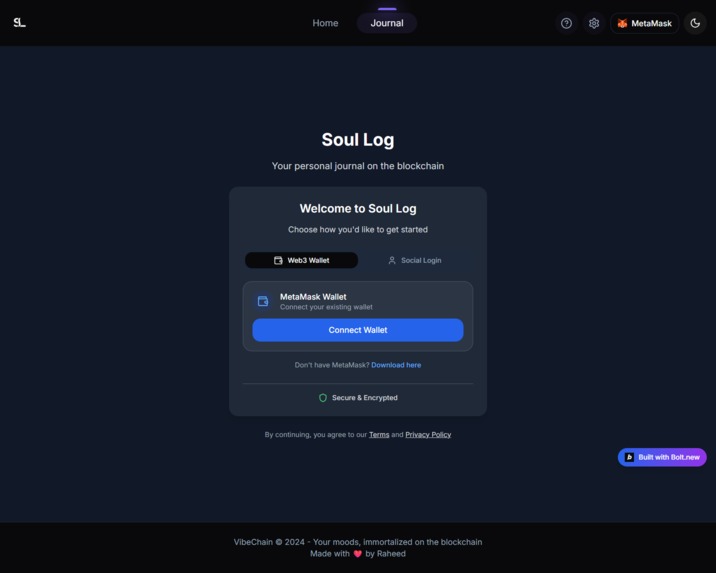
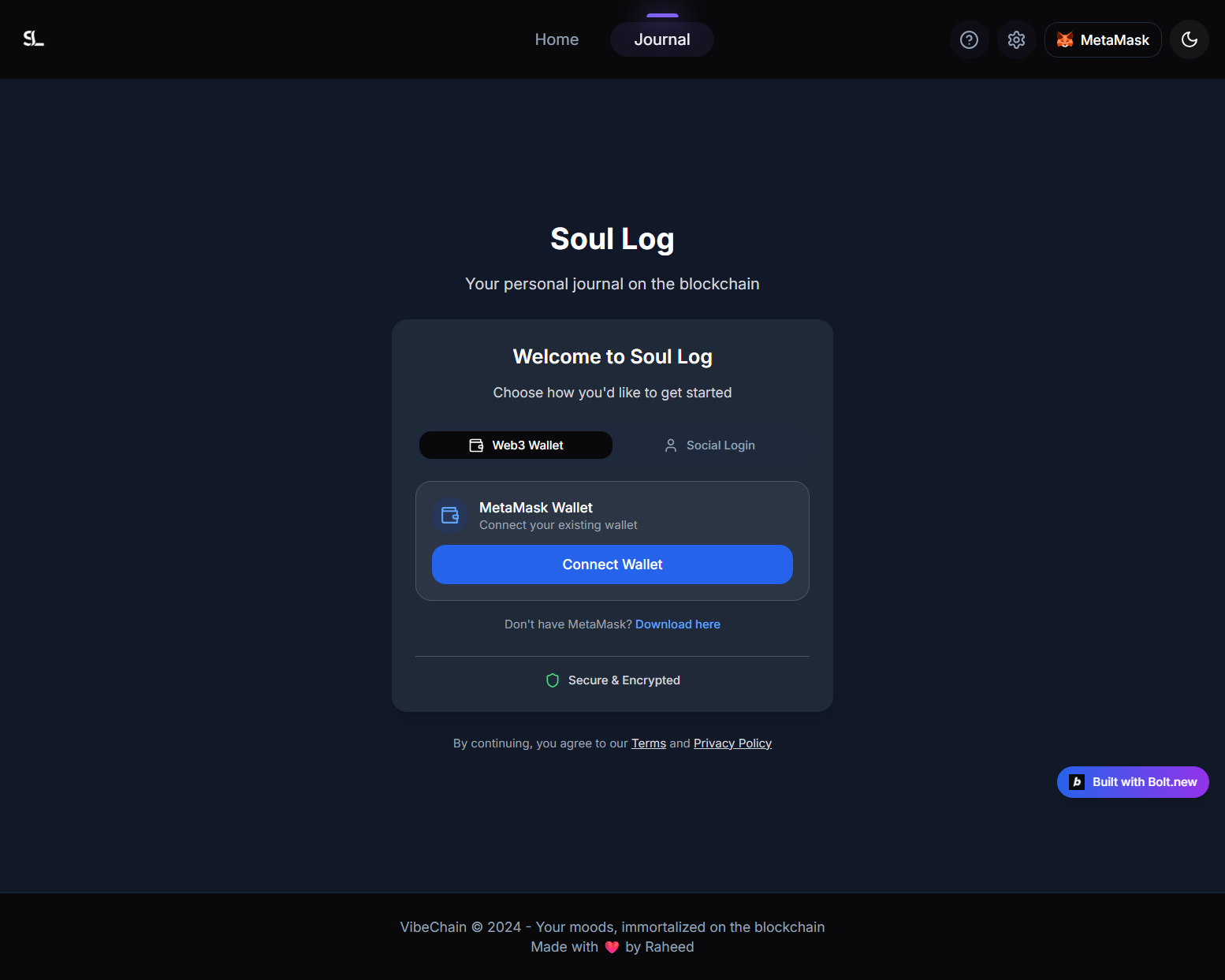
Login Page
-
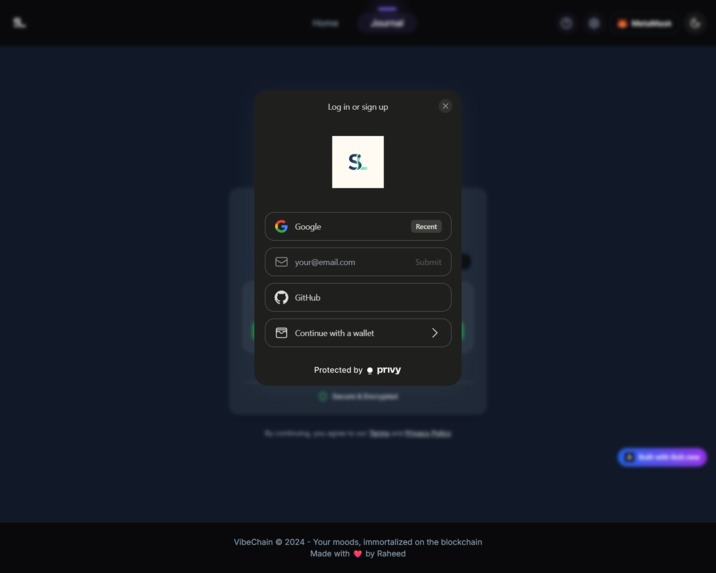
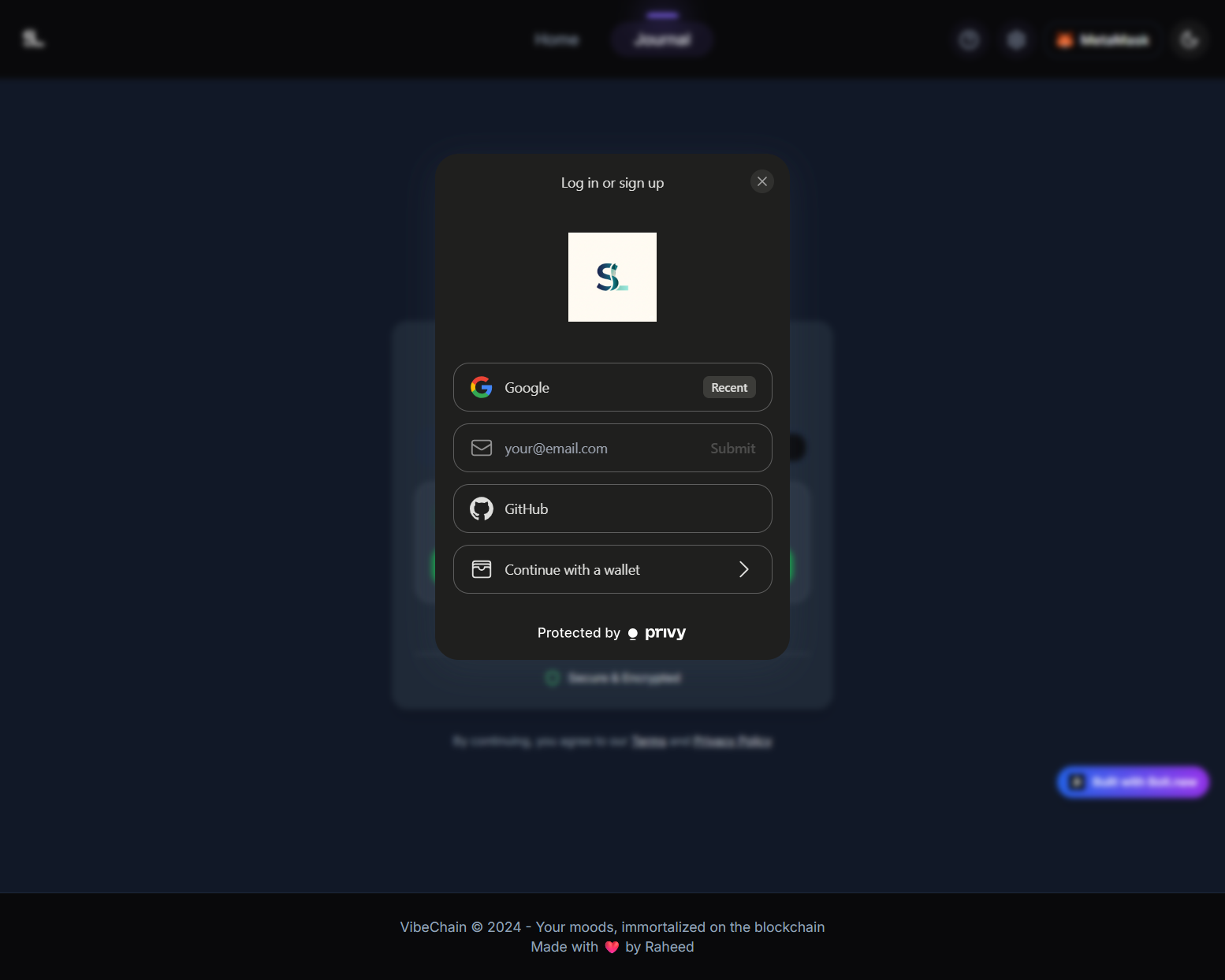
Login Page
-
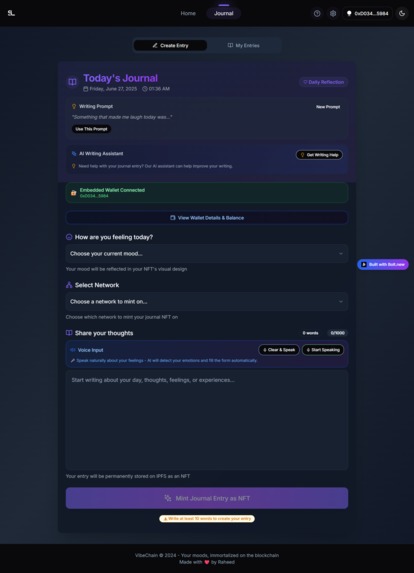
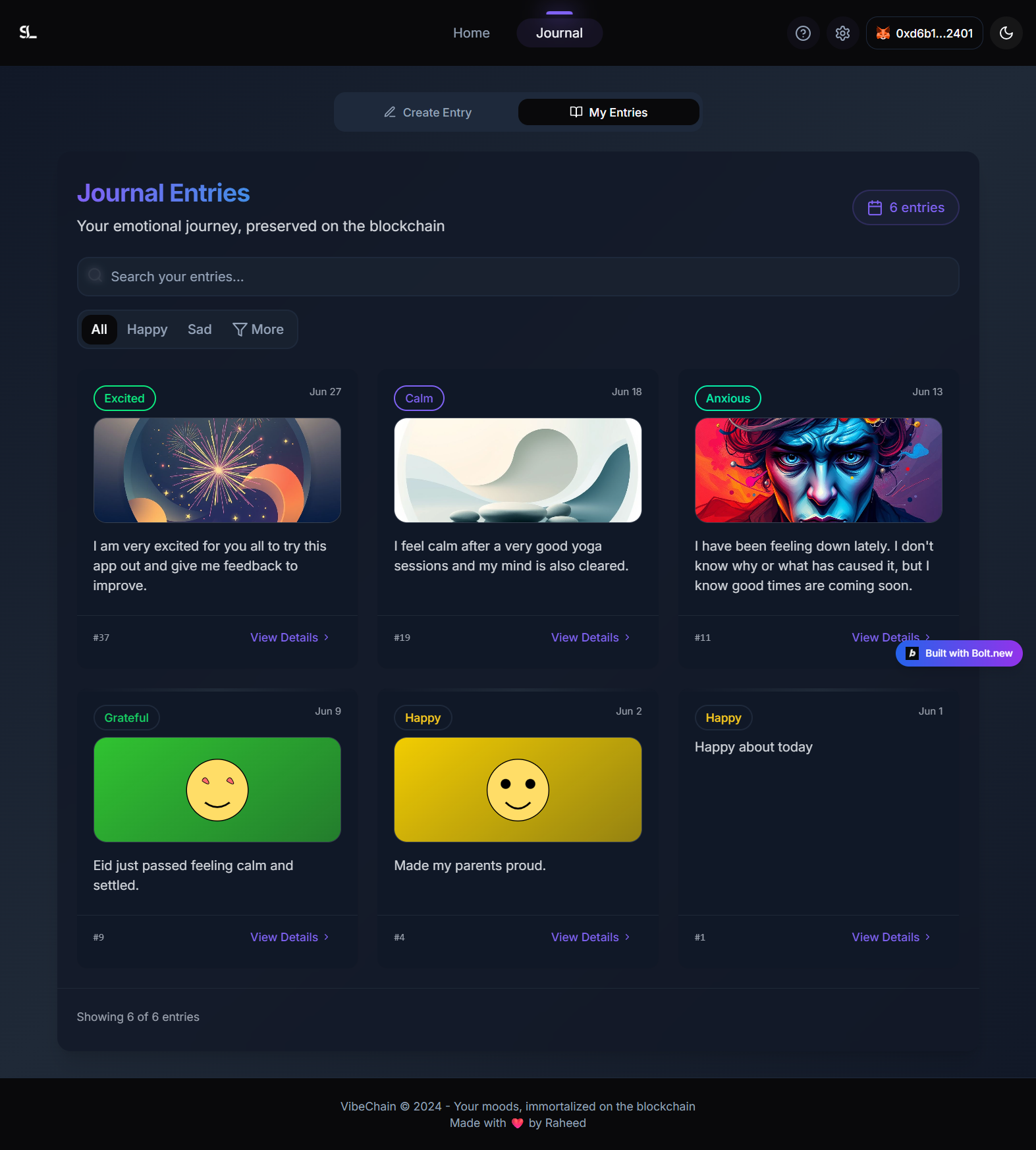
Journal Page after Login in
-

-
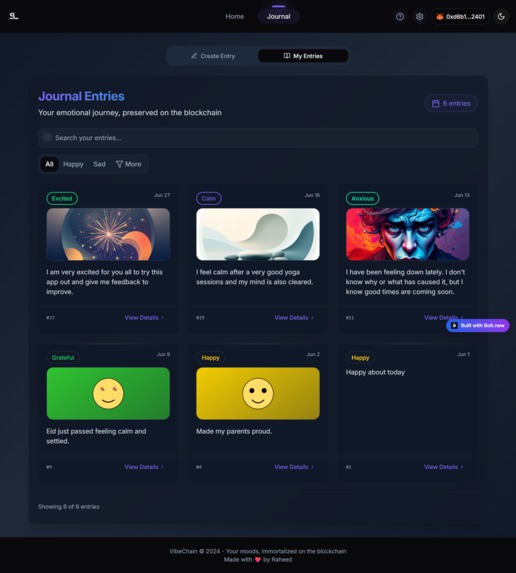
Journal Entires (Minted in the blockchain)
-
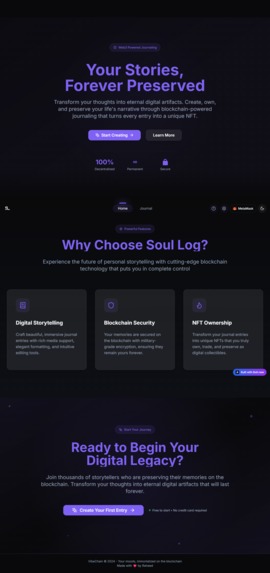
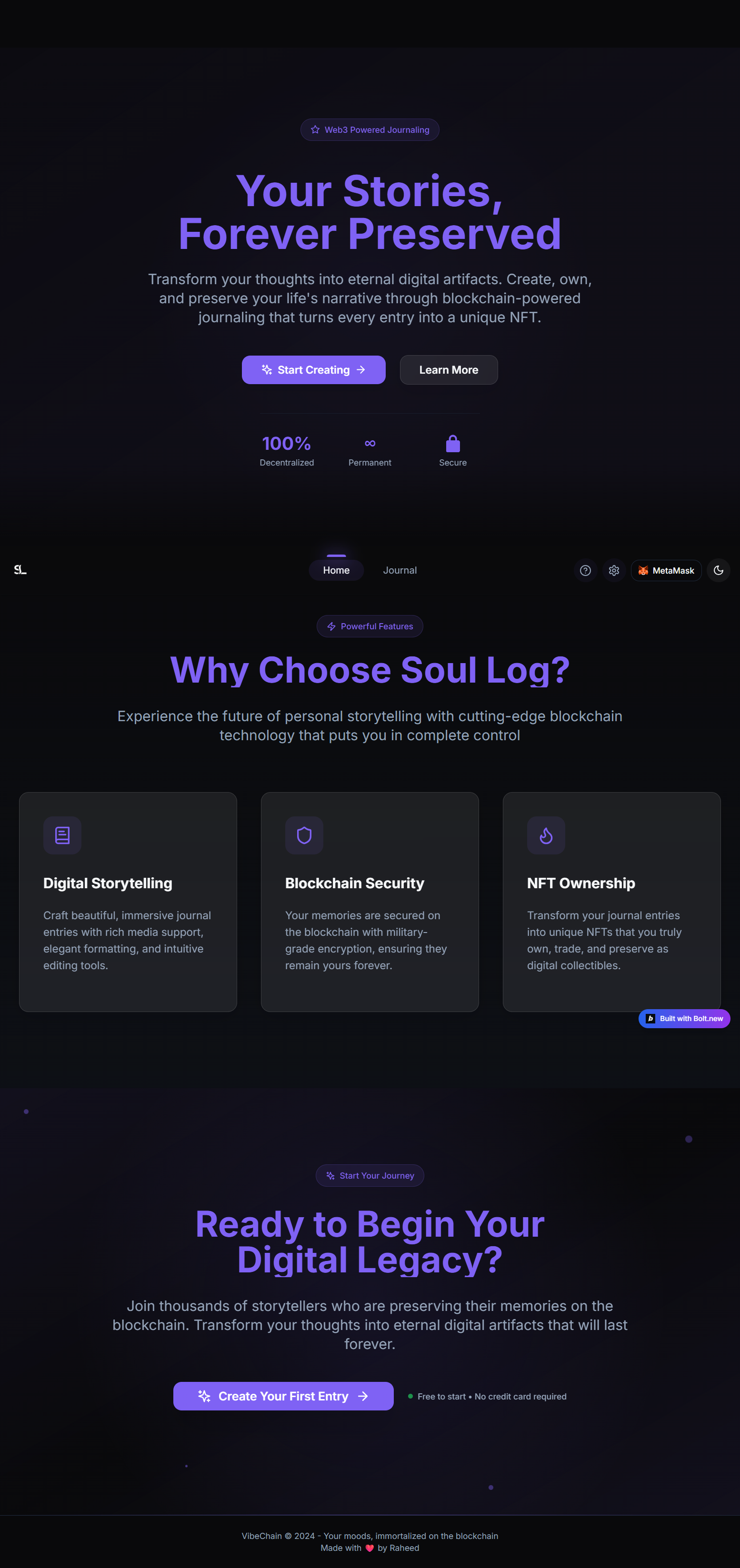
Entire Homescreen Layout


VibeChain - Mood-Based NFT Journal 🌟
What Inspired This Project
The idea for VibeChain came from the intersection of three powerful concepts: the therapeutic value of journaling, the permanence of blockchain technology, and the creative potential of AI. We wanted to create something that wasn't just another Web3 application, but a meaningful tool that could help people preserve their thoughts and emotions in a truly unique way.
The inspiration struck when we realized that our daily thoughts and feelings are often ephemeral - lost to time unless we make a conscious effort to preserve them. What if we could combine the ancient practice of journaling with cutting-edge technology to create something that's both deeply personal and technologically innovative?
What We Learned
Building VibeChain was an incredible learning journey that touched on multiple cutting-edge technologies:
Blockchain Development
- Implemented soulbound NFTs using Solidity and OpenZeppelin contracts
- Created a daily entry limitation system to prevent spam while encouraging consistent journaling
- Learned about gas optimization and smart contract security best practices ### AI Integration
- Integrated Hugging Face models for sentiment analysis and text enhancement
- Implemented AI-generated imagery using Replicate's FLUX model
- Built content moderation systems using OpenAI's moderation API
- Developed voice-to-text functionality for accessibility ### Web3 Authentication
- Mastered dual authentication systems combining traditional OAuth with wallet connections
- Implemented Privy for seamless Web3 onboarding
- Built wallet management with WagmiConfig and MetaMask integration ### Full-Stack Architecture
- Designed a robust Next.js 14 application with TypeScript
- Implemented Supabase for database management and authentication
- Created responsive UI with Tailwind CSS and shadcn/ui components
- Built serverless functions for AI processing and blockchain interactions ## How We Built VibeChain ### Architecture Overview VibeChain follows a modern full-stack architecture:
// Core Technology Stack
Frontend: Next.js 14 +
TypeScript + Tailwind CSS
Authentication: Supabase
Auth + Privy + Wallet Connect
Database: Supabase PostgreSQL
Blockchain: Ethereum +
Solidity + ethers.js
AI Services: Hugging Face +
Replicate + OpenAI
Deployment: Netlify +
Serverless Functions
Smart Contract Design
Our VibeChainNFT contract implements soulbound tokens with unique features:
contract VibeChainNFT is
ERC721URIStorage,
ERC721Enumerable, Ownable {
    // Prevents multiple
    entries per day
    mapping(address =>
    mapping(uint256 =>
    uint256)) private
    _dailyEntries;

    function mintJournalEntry
    (string memory tokenURI)
    public returns (uint256)
    {
        uint256 today =
        block.timestamp /
        86400;
        require(_dailyEntries
        [msg.sender][today]
        == 0, "Already
        created an entry
        today");
        // ... minting logic
    }
}
AI-Powered Features
- Sentiment Analysis : Real-time emotion detection using Hugging Face transformers
- Text Enhancement : AI-powered writing suggestions and improvements
- Image Generation : Custom artwork created for each journal entry
- Content Moderation : Automated filtering to ensure quality content ### User Experience Flow
- Authentication : Users can connect via Google/GitHub OAuth or Web3 wallets
- Journal Creation : Write entries with AI assistance and voice input
- NFT Minting : Transform entries into permanent blockchain records
- Gallery View : Browse and manage your NFT journal collection
- Admin Dashboard : Comprehensive analytics and user management ## Challenges We Faced ### 1. Dual Authentication System Challenge : Integrating traditional OAuth with Web3 wallet authentication while maintaining a seamless user experience.
Solution : We built a sophisticated context system that handles both authentication methods:
// Unified authentication
approach
const { user } = useAuth
(); // Traditional auth
const { address } = useWallet
(); // Web3 auth
const {
isPrivyAuthenticated } =
usePrivyAuth(); // Hybrid
auth
2. Smart Contract Gas Optimization
Challenge : Minimizing gas costs while maintaining functionality and security.
Solution : Implemented efficient storage patterns and daily entry limitations:
- Used timestamp-based daily tracking instead of complex date calculations
- Optimized storage with mappings instead of arrays
- Implemented batch operations where possible ### 3. AI Service Integration Challenge : Coordinating multiple AI services (sentiment analysis, text enhancement, image generation) while handling rate limits and failures gracefully.
Solution : Built a robust serverless architecture with fallback mechanisms:
// Graceful AI service
handling
try {
  const sentiment = await
  analyzeSentiment(content);
  const enhancedText = await
  enhanceText(content);
  const imageUrl = await
  generateImage(prompt);
} catch (error) {
  // Fallback to basic
  functionality
  console.warn('AI service
  unavailable, using
  fallback');
}
4. Real-time User Experience
Challenge : Providing immediate feedback while blockchain transactions are processing.
Solution : Implemented optimistic UI updates with transaction tracking:
- Show immediate visual feedback
- Track transaction status in real-time
- Provide clear error handling and retry mechanisms ### 5. Cross-Platform Compatibility Challenge : Ensuring the application works seamlessly across different devices and wallet providers.
Solution : Built responsive design with progressive enhancement:
- Mobile-first responsive design
- Multiple wallet provider support
- Graceful degradation for unsupported features ## Technical Innovations ### Soulbound NFT Implementation Our NFTs are designed to be non-transferable, creating a permanent, personal record:
// Override transfer
functions to make tokens
soulbound
function _beforeTokenTransfer
(address from, address to,
uint256 tokenId)
    internal override {
    require(from == address
    (0) || to == address(0),
        "Soulbound tokens
        cannot be
        transferred");
    super.
    _beforeTokenTransfer
    (from, to, tokenId);
}
AI-Enhanced Journaling
Integrated multiple AI services for a rich writing experience:
- Real-time sentiment analysis for emotional insights
- Writing enhancement suggestions for better expression
- Custom image generation based on journal content
Voice input processing for accessibility
Hybrid Authentication Architecture
Built a flexible system supporting multiple authentication methods:
Traditional OAuth (Google, GitHub)
Web3 wallet connections (MetaMask, WalletConnect)
Privy integration for seamless onboarding
Impact and Future Vision
VibeChain represents more than just a technical achievement - it's a new way to think about digital memory and personal expression. By combining the permanence of blockchain with the creativity of AI, we've created a platform that:
Preserves memories permanently on the blockchain
Enhances self-reflection through AI-powered insights
Creates unique digital art for each personal moment
Builds a decentralized community of journal keepers
What's Next
Social features : Share selected entries with friends
Advanced AI : More sophisticated sentiment analysis and writing assistance
Cross-chain support : Expand to multiple blockchain networks
Mobile app : Native iOS and Android applications
Community features : Public galleries and collaborative journaling VibeChain isn't just an application - it's a new paradigm for digital self-expression that bridges the gap between traditional journaling and the decentralized future. Every entry becomes a permanent piece of digital art, every emotion becomes data, and every thought becomes part of an immutable personal history.
Built With
- axios
- crypto-js
- date-fns
- erc-721
- eslint
- ethereum
- ethers.js
- framer-motion
- git
- hugging-face
- ipfs
- lucide-react
- metamask
- netlify
- next.js
- node.js
- npm
- openai-api
- openzeppelin
- pinata
- postcss
- postgresql
- privy
- react
- react-hook-form
- replicate
- shadcn/ui
- solidity
- sonner
- supabase
- tailwind-css
- tanstack-query
- typescript
- wagmiconfig
- walletconnect
- zod

Log in or sign up for Devpost to join the conversation.