-
-
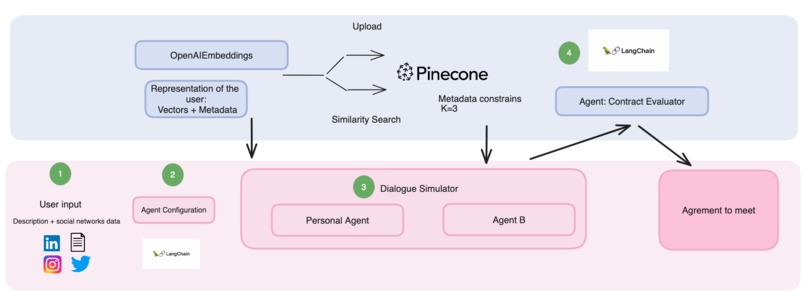
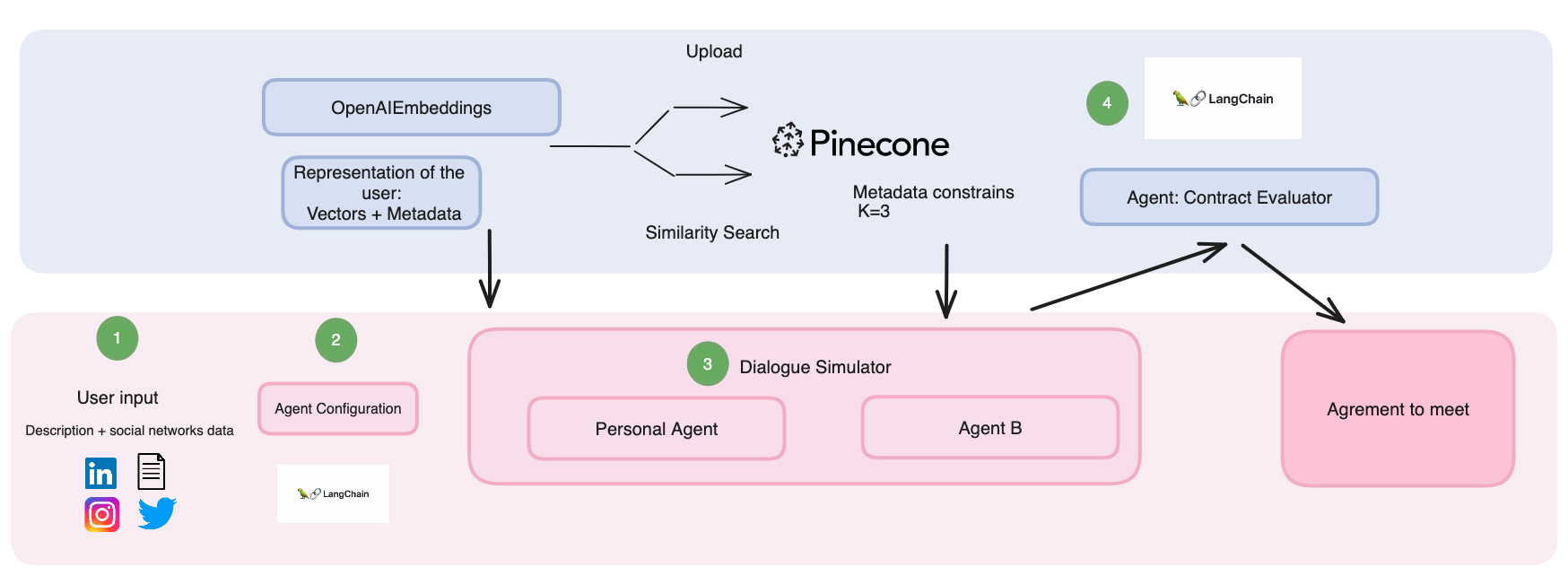
workflow
Inspiration
The inspiration behind Mindfinder came from a simple but powerful need: authentic human connection. In our busy, technologically-driven lives, we observed that people often struggled to find meaningful relationships - whether for love, friendship, or fruitful professional collaboration. Additionally, privacy concerns, fear of rejection, or simply the hassle of repetitive small talk with multiple matches could make the process draining. We wanted to devise a solution that would make the search for genuine connections efficient, enjoyable, and safe.
How we built it
Mindfinder uses cutting-edge AI and machine learning techniques to facilitate the connection between people based on shared interests, compatibility, and personal preferences. It allows users to create an in-depth profile, which serves as a blueprint for their personalized AI agent. These AI agents then engage in simulated conversations with other agents in the database to determine compatibility. This model ensures privacy as no personal data is shared without the consent of the user. After a successful match, the agents coordinate a meeting or exchange of contact information, depending on the users' preferences.
The final output is a contract between agents, presenting users with a proposed connection, which they can either accept or decline. For instance, a contract might propose a coffee date on Wednesday to discuss jazz music and share insights on musical history.
We utilized advanced machine learning and AI technologies to build Mindfinder. Pinecone, a scalable vector search engine, was integral in finding similar profiles within the database. We created AI agents and a separate evaluation system using Natural Language Processing (NLP) models to simulate and assess the interactions between these agents, ensuring compatibility and a genuine connection. User privacy was maintained by encrypting personal data and ensuring it was only shared with explicit user consent.
Challenges we ran into
Creating a realistic simulation of human conversation between AI agents was a considerable challenge. We also had to ensure the matching algorithm was accurate, as inappropriately matched profiles would diminish user trust in the system. Additionally, securing the privacy of users' data while also making it accessible for matching was a delicate balance to maintain.
Accomplishments that we're proud of
We're proud of our unique approach to facilitating meaningful connections. Through the simulation of interactions between AI agents, we've made the matchmaking process more personalized and less invasive. Our focus on user privacy is another achievement that sets us apart from other platforms in the field. Most of all, we take pride in creating a platform that empowers individuals to build authentic relationships in an increasingly disconnected world.
What we learned
Building Mindfinder taught us the immense potential and challenges in the intersection of AI, privacy, and human relationships. It reinforced the necessity of privacy and security in the era of big data and personalized AI. Also, it helped us understand the subtleties and complexities of human interaction and how technology can aid in mirroring these aspects.
What's next for Mindfinder
Looking ahead, we plan to evolve Mindfinder by implementing a robust feedback system. Our intent is to evaluate the accuracy of the real-world interactions and the expectations outlined in the agent contract. The insights gained from this feedback will allow us to enhance our matching algorithms, leading to improved accuracy of our AI simulations. However, this is merely the starting point for Mindfinder. Our unwavering dedication to continuous improvement and development fuels our mission to streamline and enrich the search for meaningful connections.
Transitioning to our second application, we have ventured into the domain of job search. We have carefully crafted agents for both recruiters and prospective job candidates, integrating detailed descriptions and individual preference-based constraints. Our goal is to alleviate common complications experienced during initial interviews, such as missed calls or divergent objectives. The recruiter agent is designed to assess the candidate's skill set, problem-solving capabilities, communication skills, and cultural alignment, ensuring a harmonious match with both the job opening and the overarching company goals. Conversely, the candidate agent is dedicated to providing truthful responses to the queries raised by the recruiter's agent. A successful agreement between these two agents paves the way for further steps in the hiring process, demonstrating our commitment to simplifying and humanizing the job search journey.
Built With
- amazon-web-services
- javascript
- langchain
- openai
- pinecone
- python


Log in or sign up for Devpost to join the conversation.