-
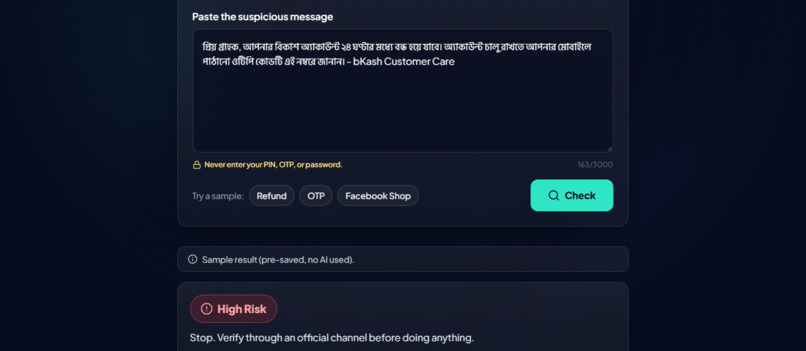
sample
-
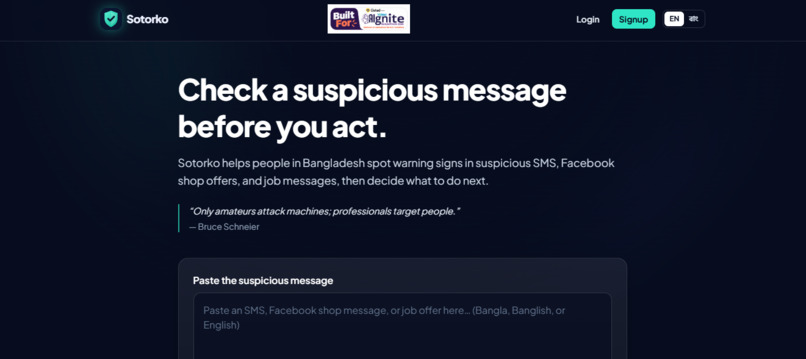
home page
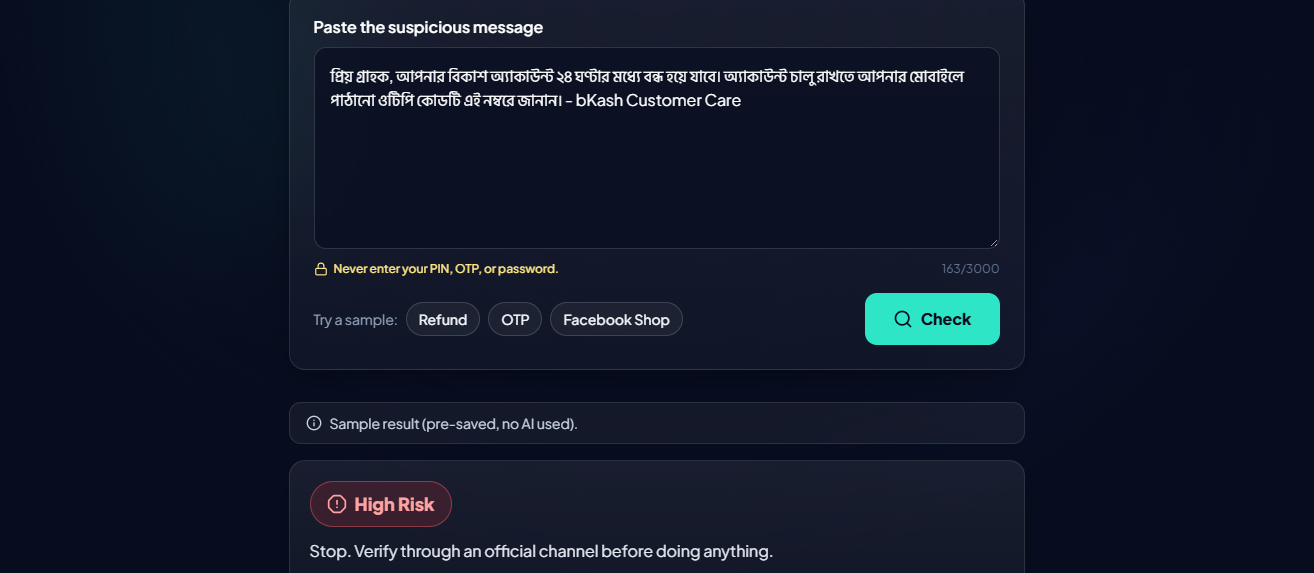
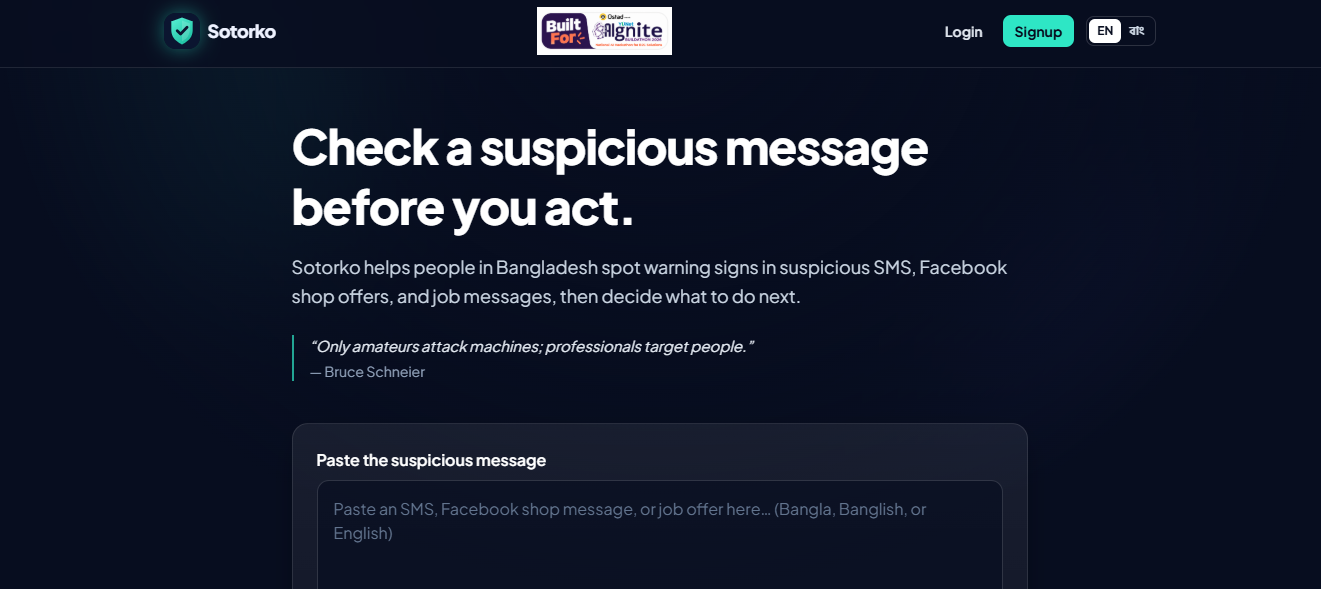
Try it: Select a sample for an instant demo, or paste a message for live AI analysis, which may take 8–12 seconds or sometimes longer.
Inspiration
Digital payments and online shopping have made everyday life easier in Bangladesh, but they have also given scammers new ways to reach people. A message claiming money was sent by mistake, a request for an OTP, or a Facebook shop demanding advance payment can look convincing, especially when someone is rushed or unsure.
The wider consumer protection problem also stood out. The government reported 58,720 complaints against e-commerce platforms, with claims of nearly Tk 3,869 crore (Dhaka Tribune). A survey across 45 districts also found that about one-third of mobile financial service fraud complaints were never resolved (The Financial Express).
These figures do not measure every everyday scam, but they show why people need help before they send money or share private information. I built Sotorko to give them a simple way to pause and check.
What it does
Sotorko is an AI-powered scam checker for people in Bangladesh. Users can paste a suspicious SMS, Facebook shop offer, or job message and get a clear report, with no account required. Login and signup are planned for a future version.
Each report includes:
- A risk level: High Risk, Suspicious, or No Obvious Red Flags
- The likely scam type and confidence level: A quick summary of what the message may be
- Warning signs: The suspicious phrases from the message and why they matter
- Next steps: What to do now and what to avoid
- A family warning: A short message that can be copied and shared
Sotorko accepts Bangla, Banglish, and English messages, and its reports can be viewed in Bangla or English. Three saved samples let anyone see a result instantly. The app never declares a message safe, because a scam may not show obvious warning signs.
How we built it
I built Sotorko as a mobile-first web app using Next.js, TypeScript, and Tailwind CSS, with Framer Motion for animations. It is deployed on Vercel. AI coding tools helped me build and test it quickly.
When a user submits a message, a server-side API route masks OTP-like codes and phone numbers before sending the text to the Gemini API. The prompt tells the model to treat the message as data rather than instructions. The app then validates the JSON response and removes any quoted phrase that does not appear in the submitted message.
If Gemini is overloaded or times out, the app retries with a lighter backup model. If that also fails, a keyword-based check provides a basic result and clearly says that AI is temporarily unavailable.
Challenges we ran into
- Understanding mixed language: Scam messages can combine Bangla, English, and Banglish, so keyword matching alone is not enough.
- Avoiding false reassurance: Telling someone a message is safe could cause real harm, so the app uses careful risk labels and encourages official verification.
- Protecting private information: Users may paste sensitive details, so the app warns them and masks common patterns before analysis.
- Keeping AI output reliable: The app needed a strict response format, validation, and checks that quoted warning signs came from the original message.
- Handling AI delays and outages: Live checks can take several seconds, and AI services can become overloaded. I added instant samples, a backup model, and a keyword-based fallback.
- Building under time pressure: I focused on one complete user journey instead of adding many unfinished features.
Accomplishments that we're proud of
- Built and deployed a working product within a tight deadline
- Turned AI analysis into practical next steps instead of only a score
- Designed the experience around scam patterns and languages relevant to Bangladesh
- Made the app easy to try immediately, without creating an account
- Kept uncertainty visible by never telling users that a message is guaranteed to be safe
What we learned
I learned that a useful AI product needs more than a good model response. Clear wording, privacy protections, error handling, and honesty about uncertainty all affect whether people can trust and use it.
I also learned how important it is to reduce a project to the features that solve the main problem, and to plan for the moments when an AI service is slow or unavailable.
What's next for Sotorko
- Add screenshot uploads for suspicious messages
- Add complaint drafts and verified reporting guidance
- Add optional accounts so users can save their past checks
- Test the app with real users, including older adults and first-time mobile wallet users
- Improve detection using more Bangla and Banglish examples
- Measure false alarms and missed scams
Built With
- framer-motion
- gemini-api
- lucide-react
- next.js
- tailwindcss
- typescript
- vercel
