-

NAME
-
Introduction
-

future of Soteria


Inspiration
Our inspiration came from the now defunct Shinigami Eyes project, which aimed to achieve something similar. Due to recent complications with the mentioned project, the shield that once stood for users has been crippled. We aim to not only replace Shinigami Eyes, but make it better and solve the fundamental issues that the original project has.
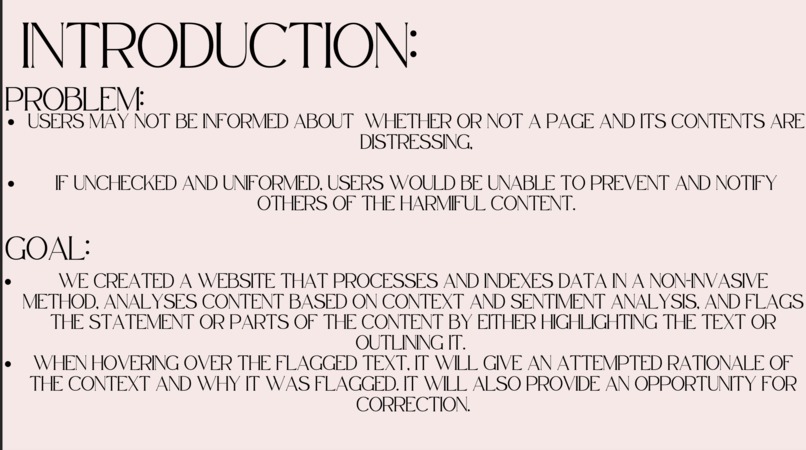
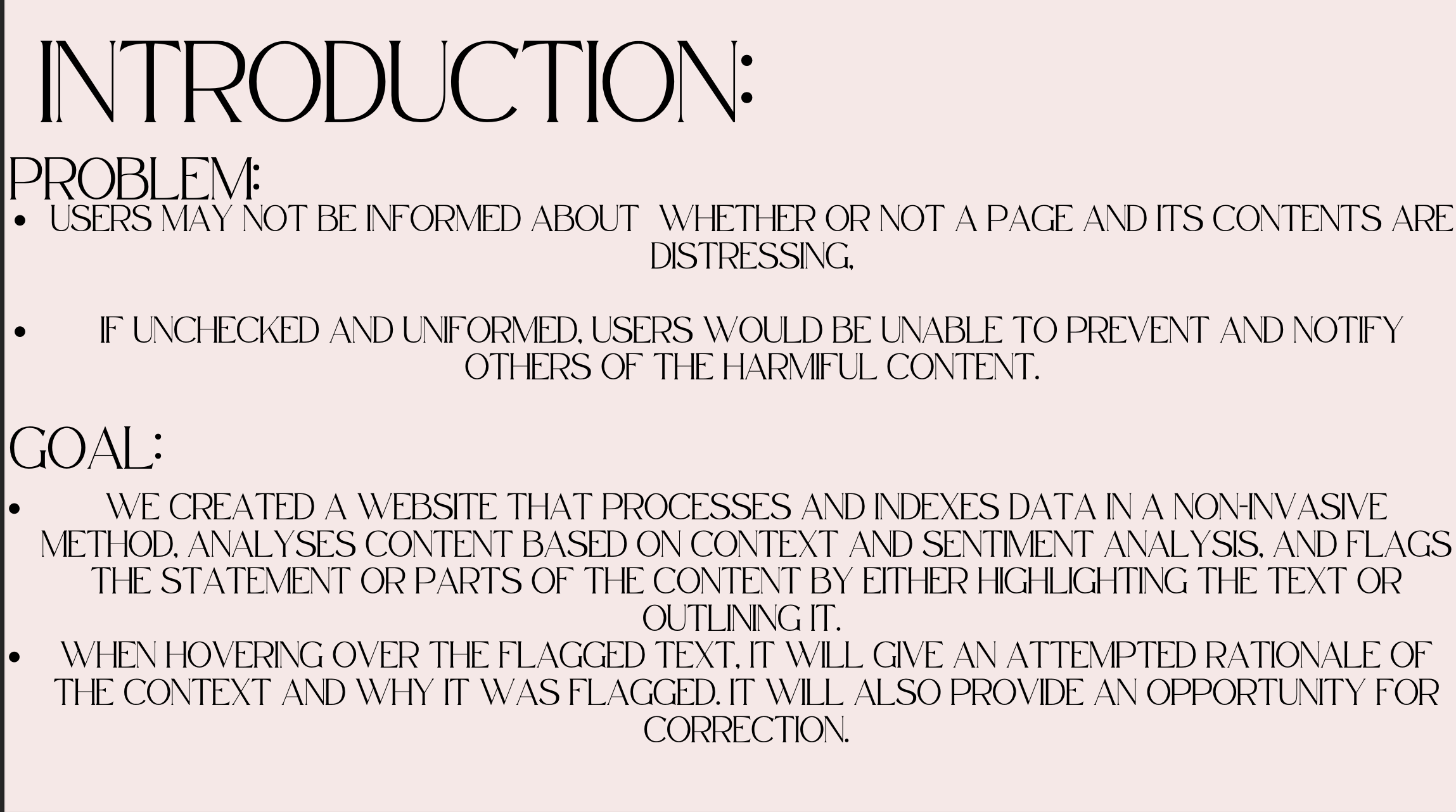
Users may not be informed on whether a page and its contents are distressing. If unchecked and uninformed, users won't be able to prevent and notify others of the harmful content.
What it does
Soteria aims to inform users whether a page and its contents are potentially distressing. With a website that serves as the gateway to Soteria, the server processes and indexes data in a non-invasive method, analyses content based on context and sentiment analysis, and flags the statement or parts of the content by outlining the proposed assertion from a hue of red to light green; with bright red representing flagged statements, and light green to those that are safe to visit. When hovering over the flagged text, it will give an attempted rationale of the context and why it was flagged. it will also provide an opportunity for correction.
How we built it
Our frontend is built using React and FastAPI; both being used by giants such as Netflix and Microsoft in addition to the tens of millions of backers. Contrary to previous hackathons, we initially planned to use Altas, which is backed by Siemens, and others. Turns out, we never had to use the database (which uses PostgreSQL), at all because of our need to not store any data. This allowed us to reiterate our backend rapidly, with a strong emphasis on our RabbitMQ and Redis task broker system. In practice, the technologies we choose to use can be directly scaled into production.
Challenges we ran into
The majority of us were absolute beginners and never heard of most of the tools used, but under the leadership of Noelle, we were able to navigate the tasks assigned to us and were introduced to many technologies for future use. The biggest challenge was even starting to begin with, as when we first started this hackathon, the majority did not know what React was in the first place.
Accomplishments that we're proud of
The Beginners on the team got to learn how to use technological tools like Figma, React, etc. We also managed to tie our front end and back end all together in under 24 hours. In addition, we learned so much, especially with the help of our gracious mentors.
What we learned
We learned many valuable lessons during the AthenaHacks competition. First, when facing technical challenges, we deeply realized the importance of problem decomposition. Initially, facing the complex system architecture and unfinished API endpoints, we felt a bit clueless. However, through teamwork, we broke down the big problems into small tasks and gradually conquered each subsystem. Second, teamwork was the key to the success of the project. Each member played his or her own expertise, from front-end design to back-end development to optimization of machine learning models, we worked closely together to ensure the smooth progress of the project. The most valuable concept we learned how to work efficiently within a limited time frame, allocate tasks wisely and iterate quickly to ensure visible progress at every stage.
What's next for Soteria
If given more time, we would have outlined the words flagged as anti with red colour, green for pro, and we would also outline the page title. We would also display the percentage of anti and pro words. For the future of Soteria, we plan to further improve the core functionality of the system. Such as optimize the accuracy and reliability of our machine learning model to ensure it can identify misleading content more accurately, or expand the application scenarios such as supporting more types of web content and languages, and even exploring the possibility of mobile applications. All in all, We believe that Soteria will be able to provide valuable information filtering services to more people in the future!
Built With
- celery
- docker
- fatsapi
- figma
- gemini
- github
- huggingface
- ky
- openai
- postgresql
- python
- rabbitmq
- react
- redis
- shadcn/ui
- tailwindcss
- typescript
- vite
- wxt


Log in or sign up for Devpost to join the conversation.