Inspiration
The big floods in 2025 have left us all in confusion about how people have to go online and make a post while the storms are raging upon their heads. We dug into the real depth of reasons and found out heartbreaking stories, which have led us to build SOS Now.
What it does
SOS Now have many use cases:
- An AI agent that can quickly respond to thousands of calls at the same time.
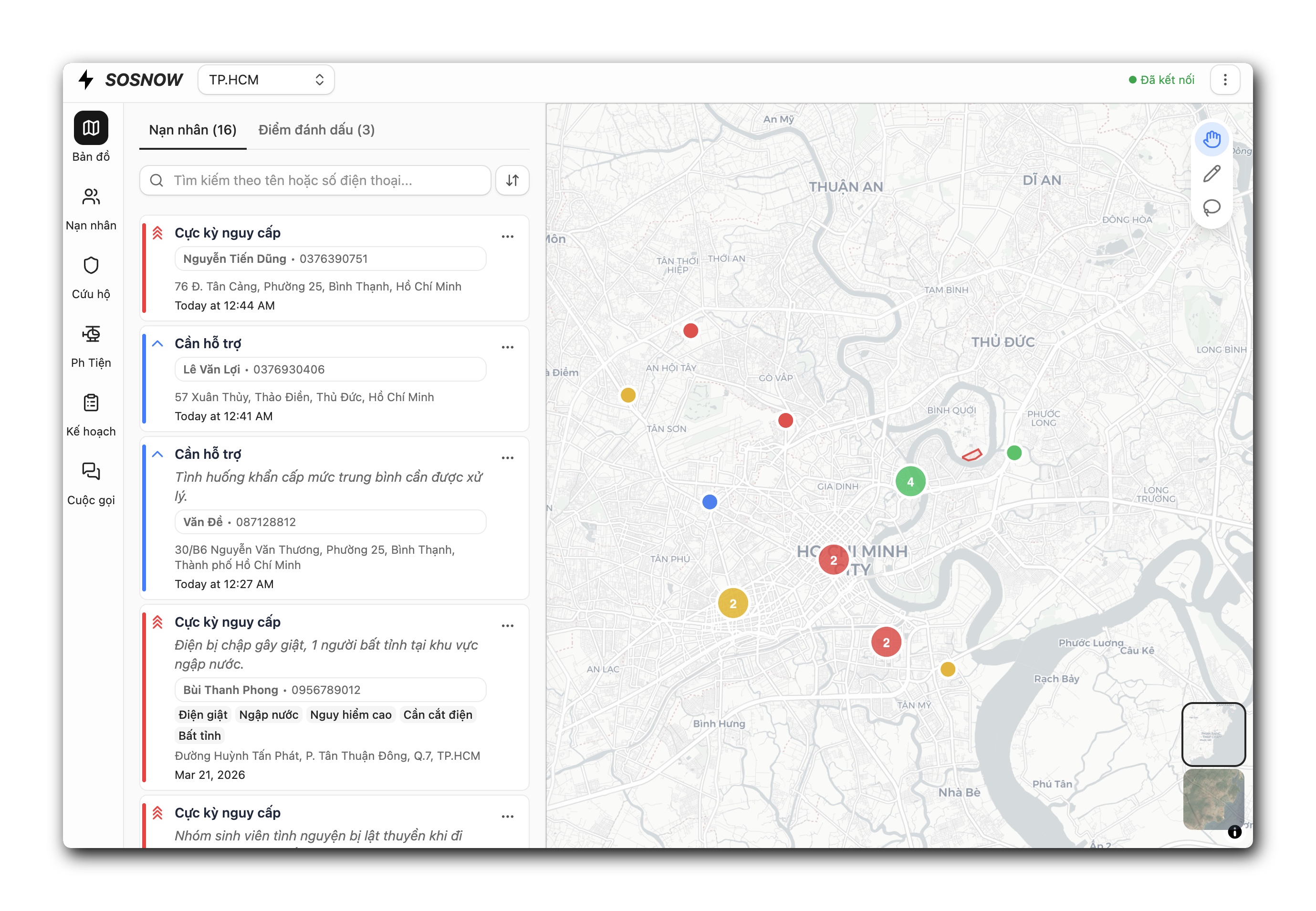
- Another AI to summarize calls, victims' insight, prioritize and visualize them onto a map to give operators/rescuers a good look at the whole picture.
- Allows operators to group victims and quickly assign a team to the rescue!
- Allows operators to manage resources, including: rescuer teams, equipment, vehicles, and rescue campaigns.
How we built it
- We use ElevenLabs API to create such a human-like AI agent, who surprisingly can understand even one of Vietnam's strongest accents; collect victims’ data, record calls, and prioritize them based on severity.
- To summarize information and smartly suggest rescue planning/campaign, we use the OpenAI API.
Challenges we ran into
We started the hackathon exploring mobility ideas for the Tasco track. Hours in, nothing felt right. Then someone brought up the 2025 Vietnam floods, and it hit close to home for all of us. We pivoted and started fresh, which meant we'd already burned a chunk of our 36 hours. From that point, we had to be ruthless about scope - constantly narrowing down to only the features that made the core experience work, and saying no to everything else.
Accomplishments that we're proud of
Before writing any code, our PMs surveyed around 30 flood survivors. That research shaped the entire product - we learned that call centers get overwhelmed during disasters, that many survivors don't even know who to call, and that when WiFi and mobile data go down, people are left posting on social media and hoping for the best. Our team split (2 devs, 2 PMs) meant nobody waited on anyone for the entire hackathon. PMs ran research and built the pitch while devs shipped the system in parallel. The end result actually works: an AI agent picks up, talks to the victim, extracts their situation, and drops a marker on the operator's map in real time. We didn't build a demo - we built something we'd want to exist the next time a typhoon hits Vietnam.
What we learned
Even a quick survey completely changes how you build. The survivor interviews told us things we wouldn't have guessed - like how noisy and chaotic the environment is during a flood, or that people often can't describe their location clearly. Those details shaped how we designed the AI agent's conversation flow. We also learned that designing for the worst-case scenario (no internet, no app, just a phone signal) actually simplifies your decisions instead of complicating them. And on the team side, agreeing early on who owns what - PMs own the story, devs own the system - meant we moved fast without stepping on each other.
What's next for SOSNOW
Since our solution is inspired and driven by humanity and technology, we are looking forward, and hopefully, to being a part of Vietnam's National Committee for Search and Rescue (VINASARCOM).
Built With
- codex
- elevenlabs
- openai


Log in or sign up for Devpost to join the conversation.