-
-
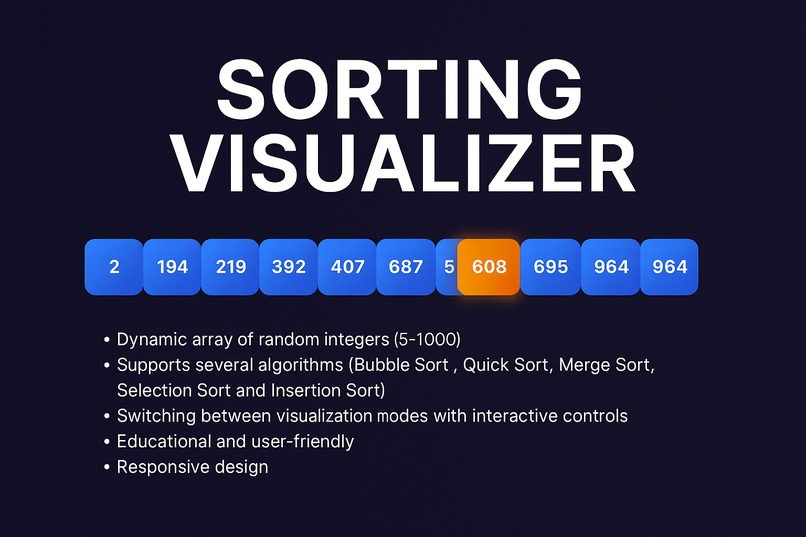
Thummail
-
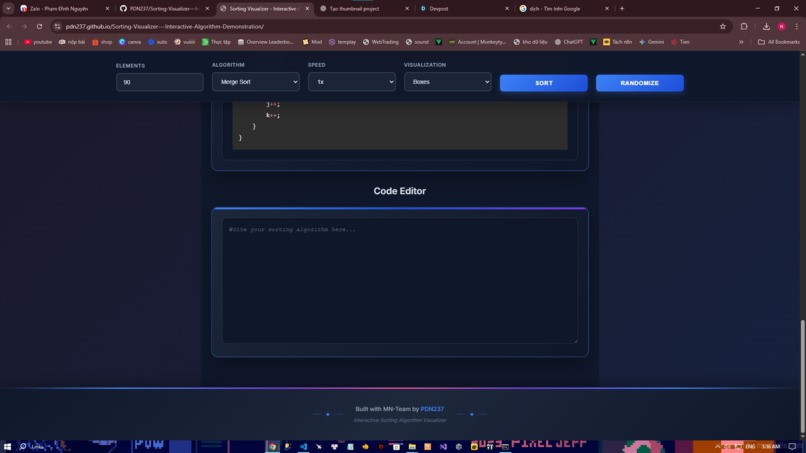
Code, sort, and learn — all in one interactive web app!
-
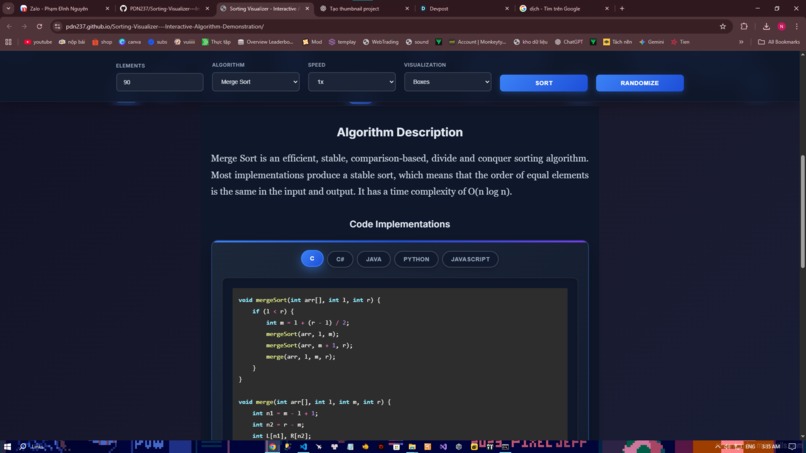
Learn how algorithms sort step by step through stunning visuals!
-
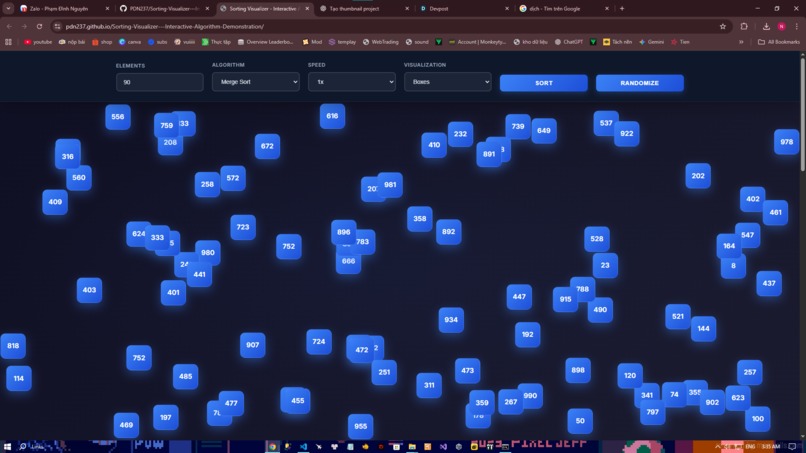
Visualize sorting in action — fast, interactive, and educational!
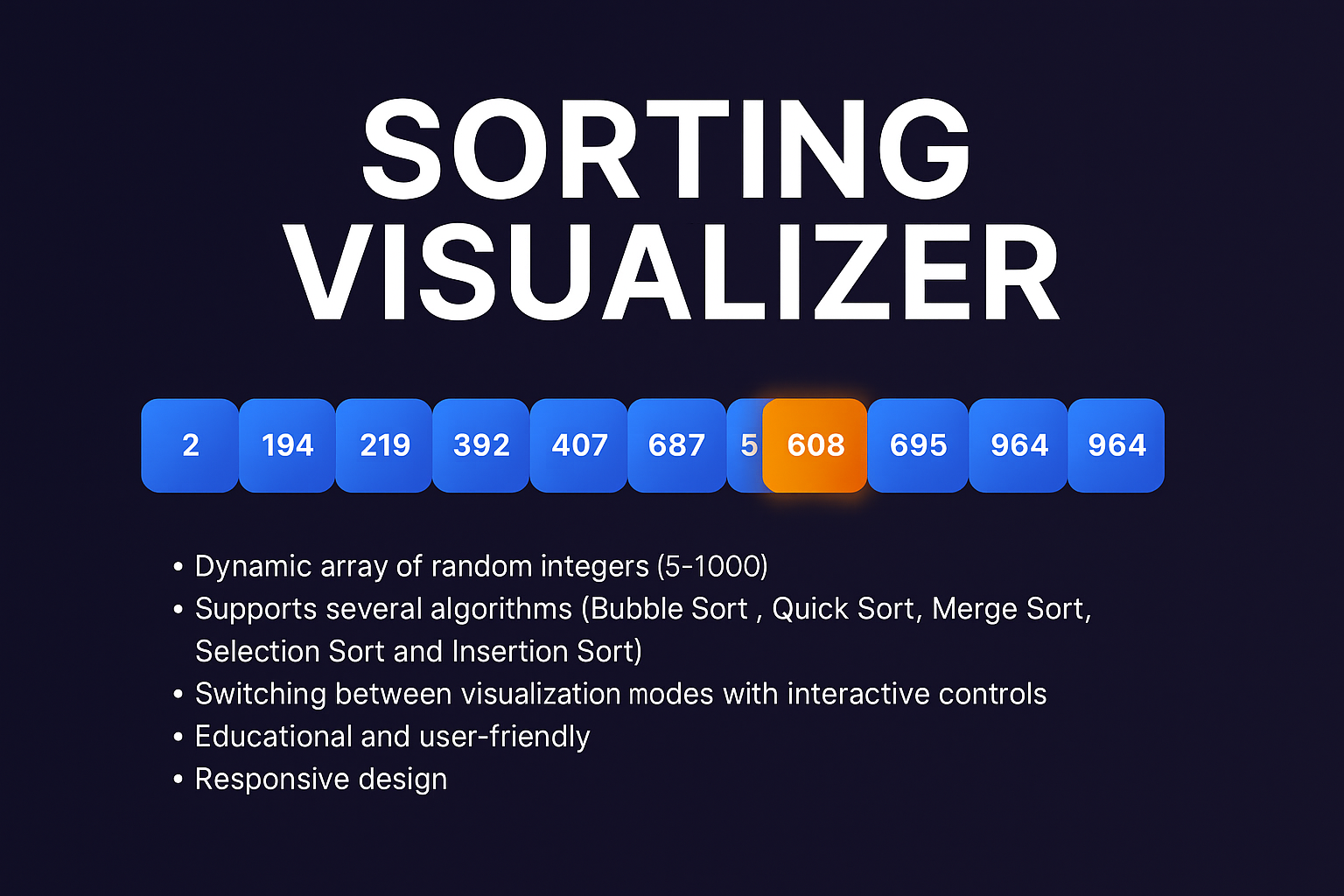
Sorting Visualizer
Inspiration
In a world increasingly driven by algorithms, we believe everyone deserves to understand the invisible forces shaping our digital lives. Picture this: a student late at night, textbooks open, staring blankly at pseudocode that might as well be written in ancient hieroglyphs. Or a developer trying to optimize performance, knowing that choosing the right sorting algorithm could mean the difference between milliseconds and minutes. We saw this struggle, felt this frustration, and decided to do something radical – to democratize algorithm education through pure visual poetry.
Sorting Visualizer wasn't born from a coding challenge or a class assignment. It emerged from a deep-seated belief that computer science should be accessible, beautiful, and inspiring. What if the complex dance of data could be witnessed, not just theorized? What if the elegance of Quick Sort's divide-and-conquer strategy could be seen unfolding like a perfectly choreographed ballet? What if the brute-force determination of Bubble Sort could be appreciated for its honest, step-by-step perseverance?
This project represents our commitment to making computer science not just understandable, but utterly captivating. We envision a world where algorithms aren't feared as complex beasts, but embraced as elegant solutions to real-world problems. Where students don't just memorize Big O notation, but feel the visceral difference between O(n²) and O(n log n). Where developers don't just implement sorting functions, but truly comprehend their inner workings.
What it does
Sorting Visualizer transcends traditional educational tools by creating an immersive learning environment where algorithms become living, breathing entities. At its core, it's a digital canvas where mathematical concepts manifest as visual stories – tales of transformation from disorder to harmony.
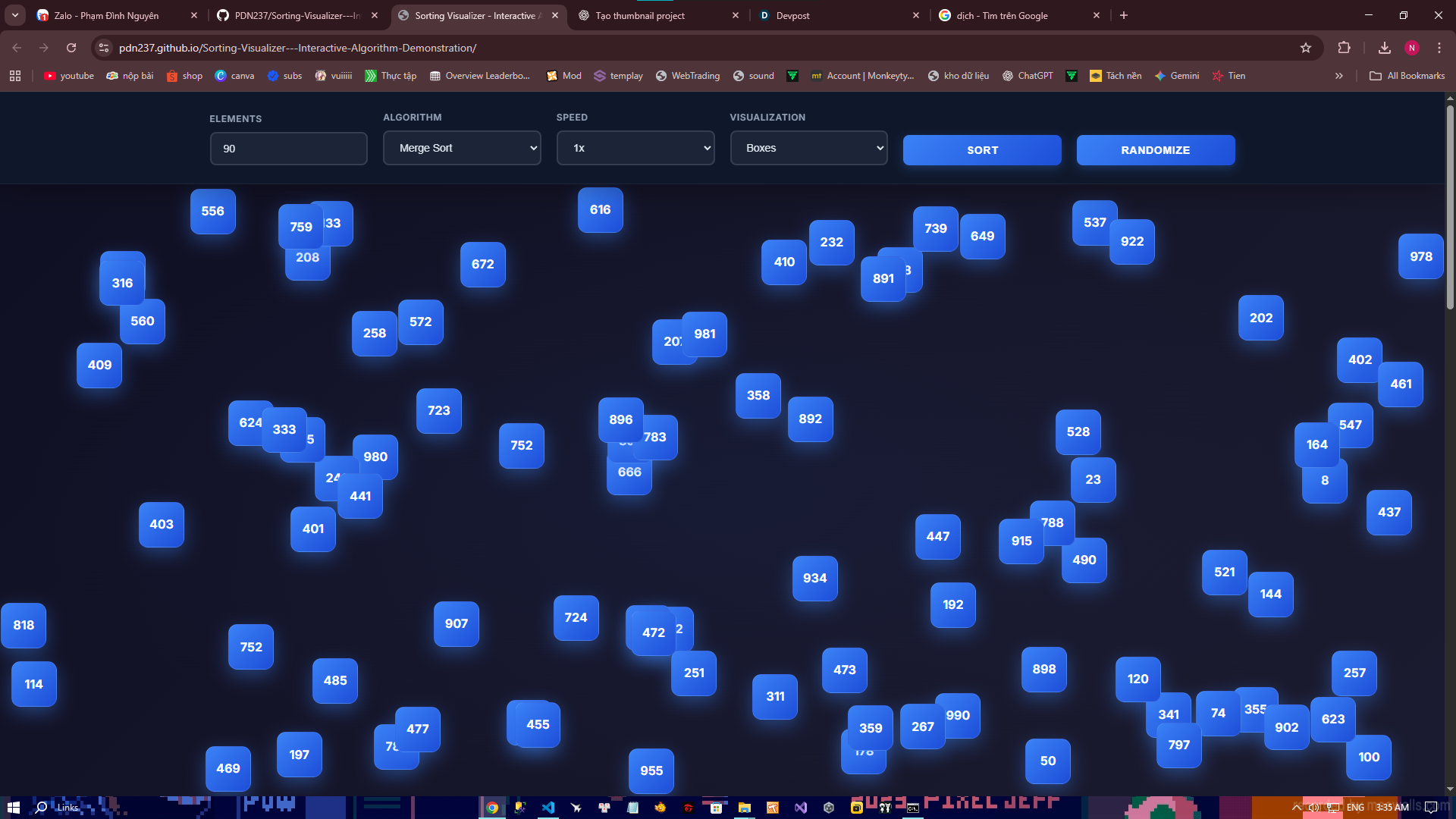
Imagine generating an array of 50 elements, scattered randomly across your screen like stars in a chaotic constellation. With a single click, you unleash Bubble Sort: watch as elements patiently compare themselves, swapping positions with graceful determination. Each comparison lights up in red, each swap glows orange, and as order emerges, elements transition to a triumphant green. It's not just animation – it's the algorithm's thought process made visible.
But the magic deepens. Switch to Quick Sort, and witness the lightning-fast partitioning, the recursive elegance, the way elements seem to teleport into their rightful positions. Merge Sort reveals its divide-and-conquer wisdom through cascading visual hierarchies. Each algorithm tells its own story, with its own rhythm and personality.
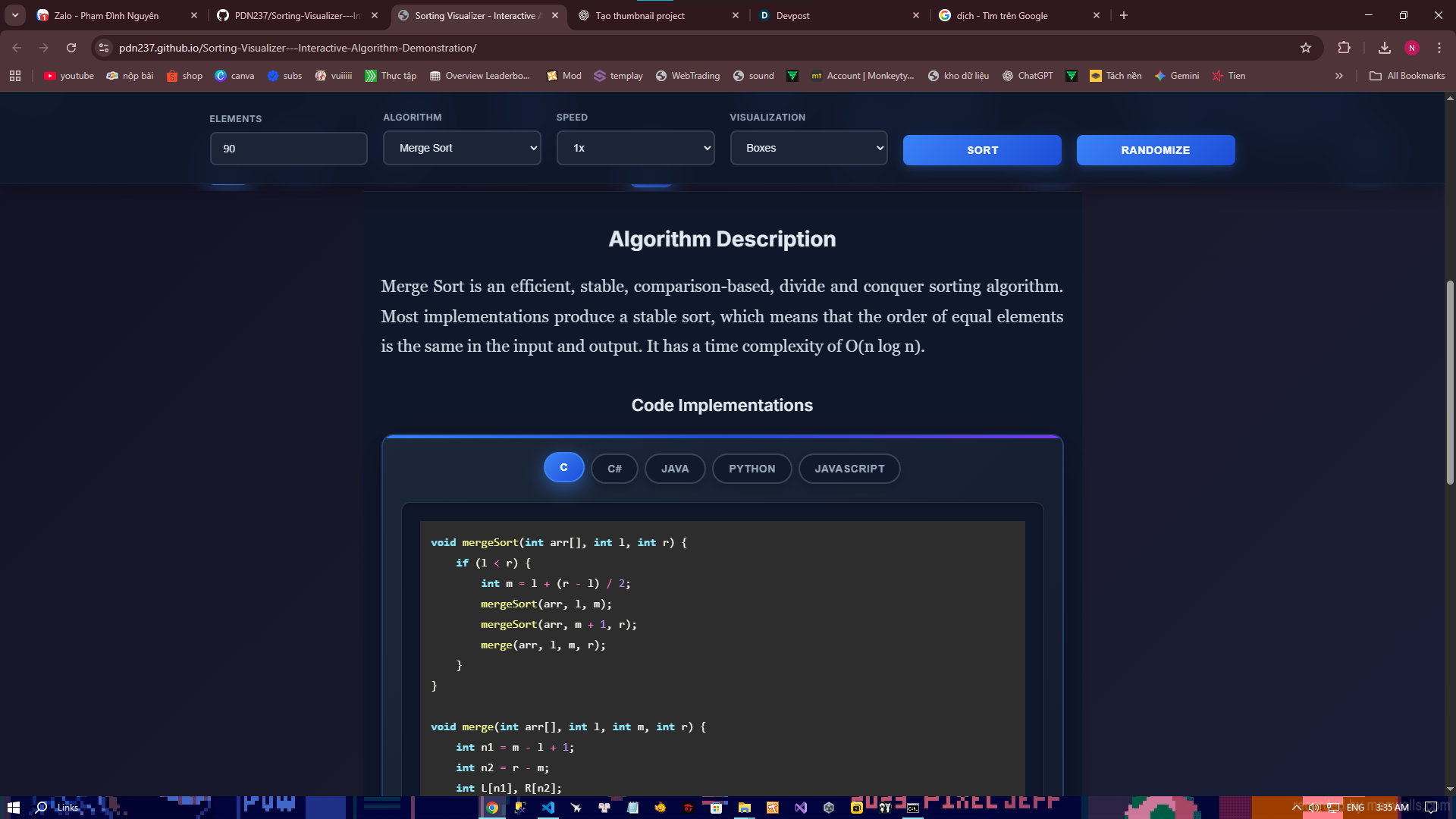
The true power lies in the interactivity: pause mid-sort to examine the current state, adjust speeds from contemplative slow-motion to exhilarating fast-forward, switch between visualization modes – traditional boxes, minimalist bars, or size-representative squares. Dive into the code viewer to see implementations in C, Java, Python, and JavaScript, each with syntax highlighting that makes the logic sing.
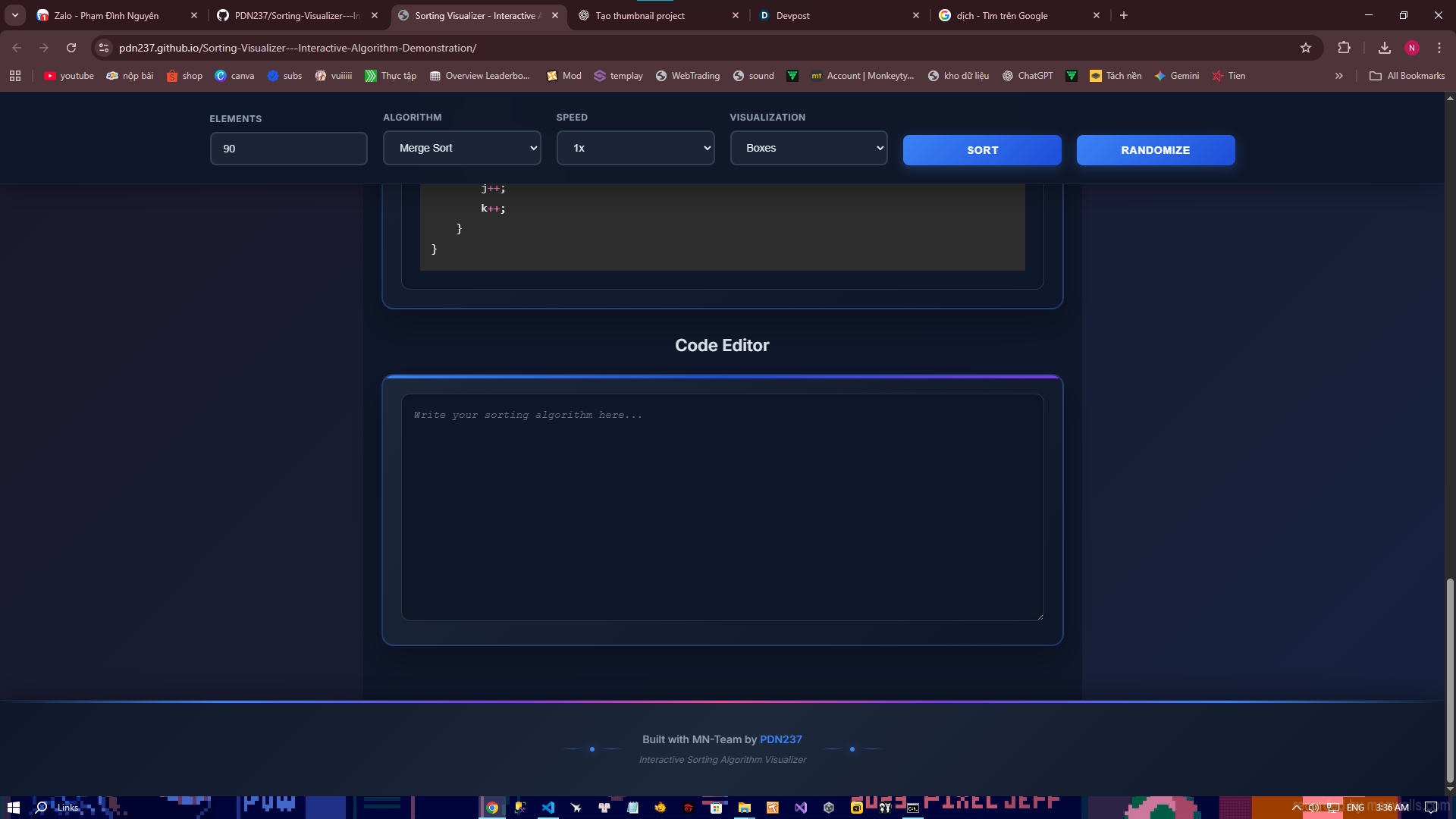
And then there's the code editor – our boldest statement yet. "Don't just consume knowledge," it whispers. "Create it." Experiment with custom sorting logic, watch your creations animate in real-time, learn through playful iteration. This isn't just an educational tool; it's a laboratory for algorithmic creativity, a sandbox where "what if" questions lead to visual discoveries.
How we built it
In an era of bloated frameworks and endless dependencies, we chose radical simplicity. Sorting Visualizer stands as a testament to the raw power of web fundamentals – HTML, CSS, and JavaScript in their purest forms. No React, no Vue, no Angular. No webpack, no npm scripts. Just three technologies, working in perfect harmony to create something greater than their sum.
The architecture reflects our philosophy: clean separation of concerns with surgical precision. HTML provides the semantic skeleton – accessible, semantic, ready for screen readers and search engines alike. CSS orchestrates the visual symphony – a dark gradient theme that feels both modern and timeless, glassmorphism effects that add depth without distraction, and animations so smooth they seem to defy the laws of physics.
JavaScript handles the algorithmic heavy lifting with modern elegance. We embraced async/await not as a trendy syntax, but as a fundamental rethinking of animation control. No more callback hell or setTimeout chains – just clean, sequential code that mirrors the algorithms themselves. The visualization engine is a marvel of modularity: each sorting algorithm lives in its own class, easily extensible, easily testable.
Performance was paramount. Every DOM manipulation is optimized, every animation frame purposeful. We integrated Prism.js for syntax highlighting, but only loaded it when needed. The entire application runs client-side, making it fast, offline-capable, and deployment-simple.
Our design philosophy? "Less is more" elevated to an art form. No unnecessary features, no feature creep, no bloat. Just pure, focused functionality that lets the algorithms – not the framework – take center stage.
The challenges we faced
Building Sorting Visualizer tested our limits across multiple fronts. Animation timing proved our first major hurdle – perfecting those critical milliseconds between comparisons and swaps required endless iterations of CSS transitions and easing functions. Performance optimization became an ongoing battle, as DOM manipulation at scale revealed browser limitations when handling smooth 60fps animations with large arrays.
Visualizing complex algorithms like Merge Sort's recursion and Quick Sort's partitioning demanded creative solutions to avoid overwhelming users while maintaining algorithmic clarity. JavaScript's async nature brought debugging challenges with race conditions and timing-dependent bugs, teaching us defensive programming. Responsive design and accessibility became core principles rather than afterthoughts.
Each challenge ultimately became a teacher, deepening our technical understanding and refining our vision for what educational software could achieve.
What we're proud of
Sorting Visualizer represents more than code – it embodies our deepest values about education, accessibility, and the transformative power of technology. We're profoundly proud of how it captures the essence of algorithmic thinking: that moment when abstract concepts crystallize into visual understanding, when confusion gives way to clarity, when intimidation transforms into inspiration.
The "chaos to order" narrative isn't merely a visual gimmick; it's a metaphor for learning itself. Watching scattered elements find their rightful places mirrors the journey of every student grappling with complex ideas. The emotional resonance of that transformation – the quiet satisfaction of seeing order emerge from disorder – is what makes this project special.
Accessibility stands as our proudest achievement. Semantic HTML ensures screen readers can narrate the algorithmic ballet. Keyboard navigation allows users with motor disabilities to conduct the visual symphony. Mobile optimization means anyone, anywhere, can witness computational beauty. We built this not for the privileged few, but for the curious many.
The code itself reflects our commitment to excellence: clean, modular, extensible. We didn't just build an application; we built a foundation for future innovation. The built-in code editor represents our belief in active learning – knowledge isn't passively received, it's actively created.
Most profoundly, we're proud of staying true to our vision. In a world of framework fatigue and dependency hell, we proved that pure web technologies can create experiences of breathtaking beauty and educational depth. Sorting Visualizer stands as a quiet revolution: proof that sometimes, the most powerful tools are also the simplest.
What we learned
This project became our masterclass in technology, education, and human psychology. Implementing sorting algorithms from scratch transformed theoretical knowledge into practical wisdom – Big O notation became tangible performance realities. JavaScript's async capabilities proved essential for smooth animations, while CSS evolved from styling to storytelling. Modular architecture taught scalable design principles.
The deepest lessons came from UX design: balancing information density with cognitive load, making complex concepts approachable, and creating tools that inspire curiosity. Iteration proved our greatest teacher – each prototype brought us closer to elegance. Most importantly, we discovered the power of passion-driven development in making computer science accessible and beautiful.
What's next for Sorting Visualizer
Our vision extends far beyond the current form – we see Sorting Visualizer as the foundation for a comprehensive algorithmic education ecosystem. Real-time collaboration features will transform solitary learning into communal discovery, with multiple users watching algorithms animate simultaneously and discussing strategies in real-time chat.
Algorithm expansion will broaden educational scope with Heap Sort, Radix Sort, and specialized algorithms like Timsort. Integration with educational platforms will amplify reach through interactive modules on Codecademy or Coursera. Augmented reality versions will bridge digital and physical learning, while machine learning integration will personalize experiences based on user interaction patterns.
The ultimate vision: a comprehensive algorithm visualization suite covering searching algorithms, graph traversals, dynamic programming, and beyond – all maintaining our commitment to clarity, interactivity, and educational depth.

Log in or sign up for Devpost to join the conversation.