Inspiration
What it does
How we built it
Challenges we ran into
Accomplishments that we're proud of
What we learned
What's next for sortcell
The waste problem (Theme track: Rethinking Waste)
At single-stream recycling facilities, value is lost in two places on the sorting line: contaminants end up in the bales, which lowers their value or gets them rejected, and recyclable bottles and cans slip past the sorters into the residue that goes to landfill. sortcell targets both. Its primary purpose is to raise bin purity (the share of a bin that is the right material) and recovery (the share of each recyclable that actually reaches its bin). On a real line we would measure it the way facilities already audit: weigh bale samples by material for purity, weigh the recyclables found in a residue sample for lost recovery, and log picks per minute and missed picks from the robot controller, which this code already reports for every run.
Inspiration
Robotic pickers are being added to recycling lines, but whether a robot actually helps depends on things that are hard to see from a spec sheet: can the vision tell PET from HDPE, does the robot waste time chasing items it can no longer catch, and when does one robot simply run out of time? I wanted a way to answer those questions with numbers before anyone bolts hardware to a belt.
What it does
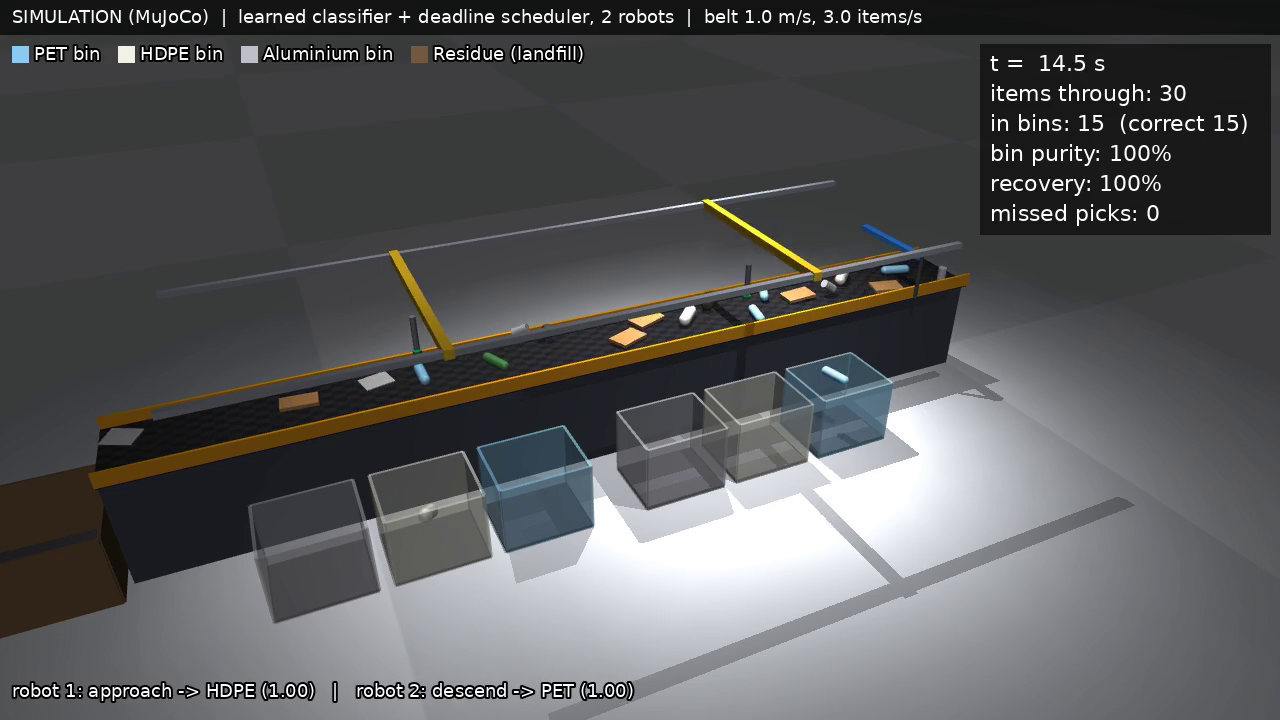
- Simulates a sorting cell in MuJoCo: a conveyor with a mixed stream (PET, HDPE, aluminium, cardboard, film, glass, food-soiled residue), a sensor bar, a gantry with a suction cup, and PET / HDPE / aluminium bins. Anything not picked falls into a residue bin.
- Each item gets a synthetic 16-band reading plus weight and footprint, including the things that make real sorting hard: black plastics, soiling, shrink sleeves, crushed items.
- A learned classifier (scikit-learn) decides the material; a colour-only baseline shows what an RGB camera alone gets.
- A deadline-aware scheduler predicts where each item will be when the cup can reach it, skips items it cannot catch, and picks the one whose window closes soonest. A FIFO scheduler is the baseline.
- Robots can be chained along the belt to answer "how many robots does this line need?".
- Every run reports purity, recovery, deposits per minute, missed picks, contaminants in bins and recyclables lost.
How we built it
- Python, MuJoCo (physics + headless EGL rendering), NumPy, scikit-learn, Matplotlib, Pillow, FFmpeg.
- The bin an item ends in is read from where it physically comes to rest, so drops and bounce-outs count.
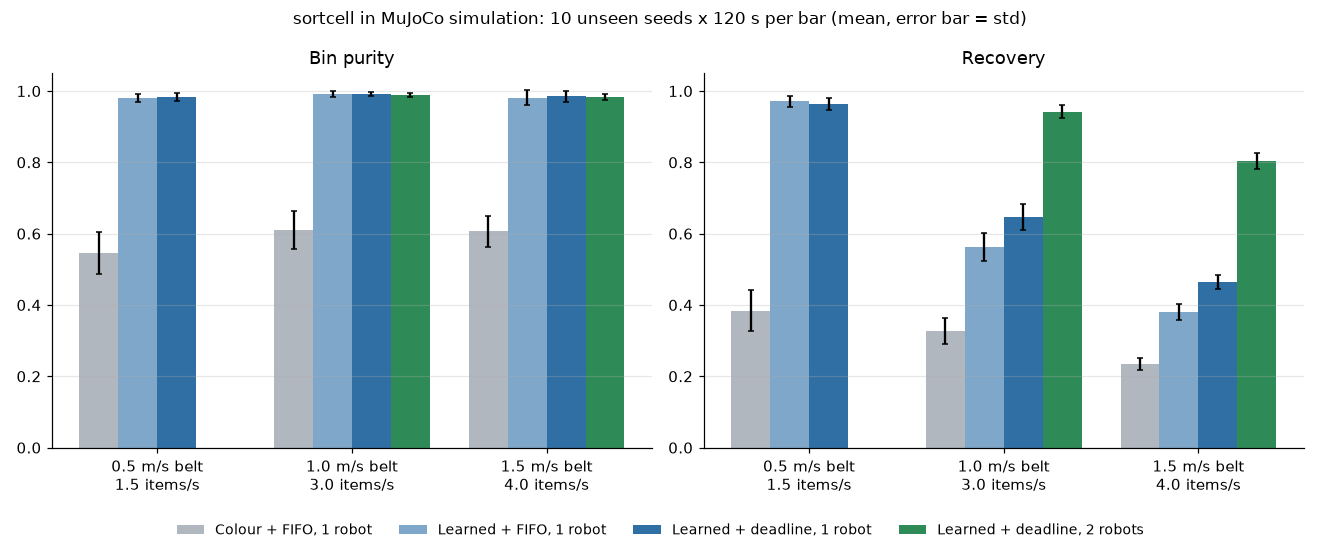
- The classifier is trained only on seed 1000; all results use seeds 0 to 9 it never saw.
- A benchmark script runs 3 controllers x 3 belt loads x 10 seeds (120 s each), and a second sweep runs 1 to 3 robots.
- Built with Claude Code (an AI coding agent) directed by me; every number was produced by running the code.
Results (simulation, mean over 10 unseen seeds)
- Colour-only camera: bin purity 0.55 to 0.61. Learned classifier: 0.98 to 0.99 (the synthetic sensor makes this the easy part; a real sensor will be harder).
- At 0.5 m/s and 1.5 items/s one robot keeps up (recovery 0.96 to 0.97) and the scheduler makes no difference.
- At 1.0 m/s and 3 items/s the robot saturates near 52 deposits/min: recovery 0.56 with FIFO, 0.65 with the deadline scheduler (missed picks 55.6 to 0), 0.94 with two robots, 0.98 with three.
- At 1.5 m/s and 4 items/s: 0.38 FIFO, 0.46 deadline, 0.80 with two robots, 0.94 with three.
Challenges we ran into
- Items slid off the side of the belt and new items spawned on top of each other at the infeed; fixed with skirt boards and an infeed clear check, then re-verified that no item ends on the floor.
- scikit-learn spawned many threads for single-item predictions, which made the benchmark slow and loaded the laptop; pinning one thread made it much faster.
- Keeping the claims honest: the sensor is synthetic, so the project is framed around system behaviour (timing, missed picks, robot count), not classifier accuracy.
Accomplishments that we're proud of
- An end-to-end loop where every number comes from physics, not from a formula.
- A clear, reproducible answer to "when does a better scheduler help and when do you need another robot".
What we learned
- Below saturation, scheduling barely matters; above it, wasted trips are the main loss, and after that only more robot time helps.
- Measuring the right things (purity and recovery, not accuracy) changes which fix looks best.
What's next for sortcell
- Calibrate the sensor model against real NIR spectra and real robot cycle times.
- Add a cost model (robot price vs value of recovered material) to choose 1, 2 or 3 robots.
- Plug the controller into a real conveyor test rig.
Disclosure
Simulation only, clearly labelled in the video and README; the sensor readings are synthetic. Built solo by Ferbin with Claude Code (an AI coding agent) directed by me. Libraries credited in the README; code MIT licensed.
Links
- Code: https://github.com/FERBIN12/sortcell
- Demo video: https://youtu.be/dOfvtosYCMI
Built With
- ffmpeg
- matplotlib
- mujoco
- numpy
- pillow
- python
- scikit-learn
