Inspiration
There are many unsorted arrays and searching in unsorted arrays takes linear time complexity which can be optimised by sorting the array before searching. Searching in an sorted array takes logarithmic time complexity.
What it does
It sorts the array in increasing order.
How we built it
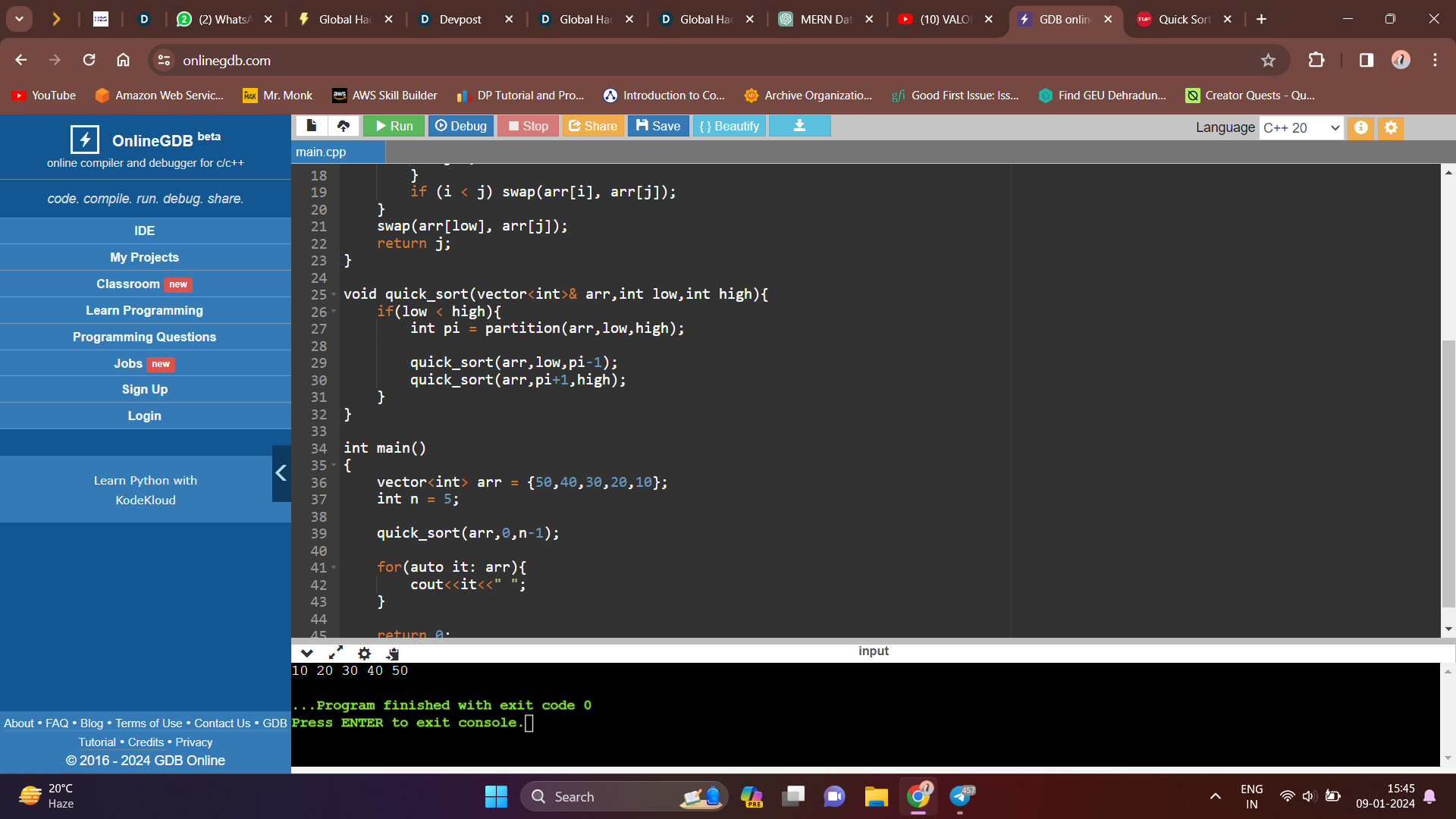
#include <iostream>
#include <vector>

using namespace std;

int partition(vector<int>& arr,int low,int high){
    int pivot = arr[low];
    int i = low;
    int j = high;

    while (i < j) {
        while (arr[i] <= pivot && i <= high - 1) {
            i++;
        }

        while (arr[j] > pivot && j >= low + 1) {
            j--;
        }
        if (i < j) swap(arr[i], arr[j]);
    }
    swap(arr[low], arr[j]);
    return j;
}

void quick_sort(vector<int>& arr,int low,int high){
    if(low < high){
        int pi = partition(arr,low,high);

        quick_sort(arr,low,pi-1);
        quick_sort(arr,pi+1,high);
    }
}

int main()
{
    vector<int> arr = {50,40,30,20,10};
    int n = 5;

    quick_sort(arr,0,n-1);

    for(auto it: arr){
        cout<<it<<" ";
    }

    return 0;
}
Challenges we ran into
Optimising the time complexity for sorting
Accomplishments that we're proud of
Achieving the optimised time complexity i.e. O(NlogN)
What we learned
Sorting an array

Log in or sign up for Devpost to join the conversation.