-
-
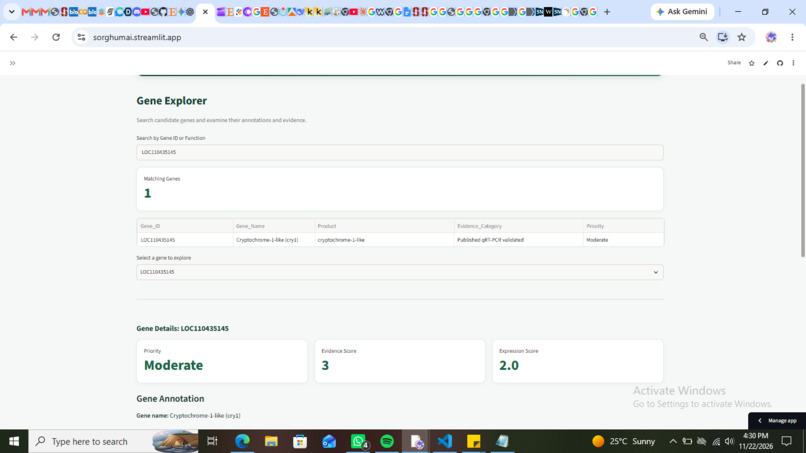
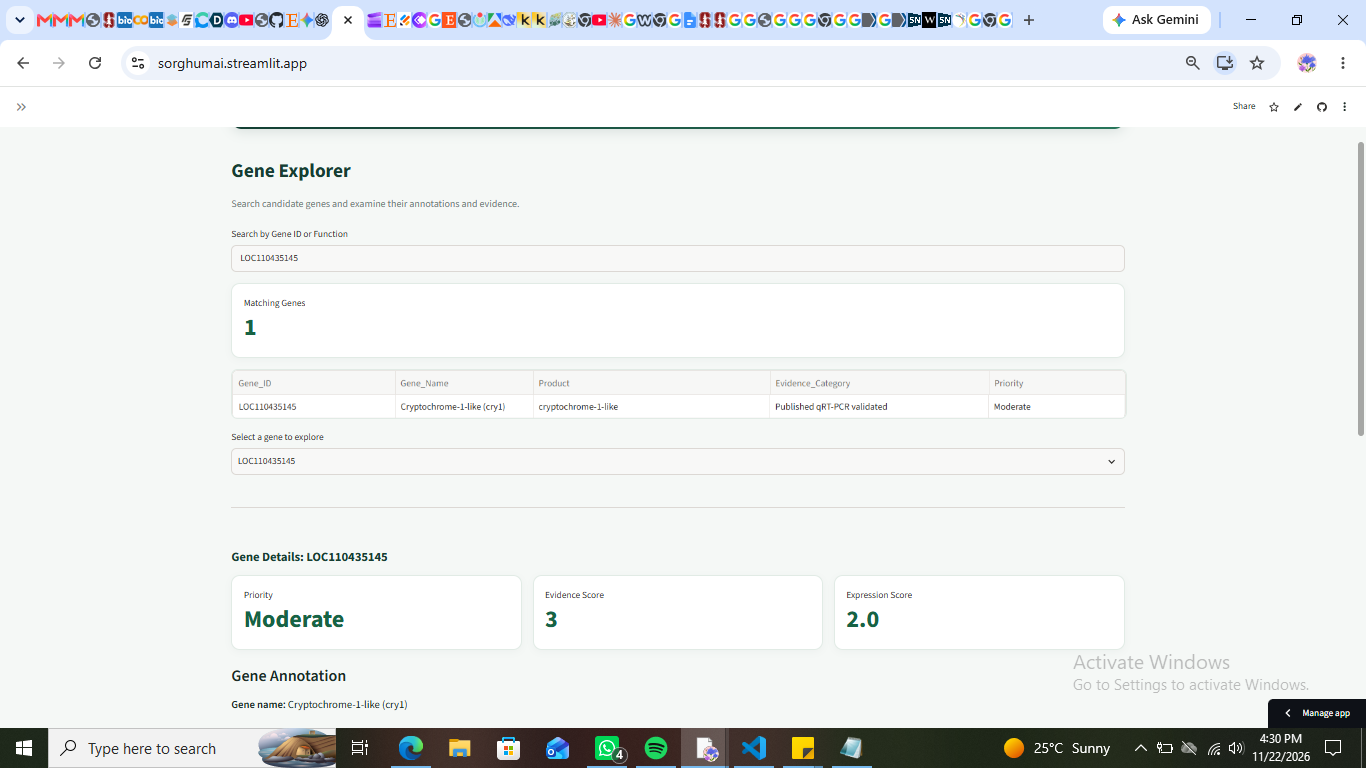
Gene explorer
-
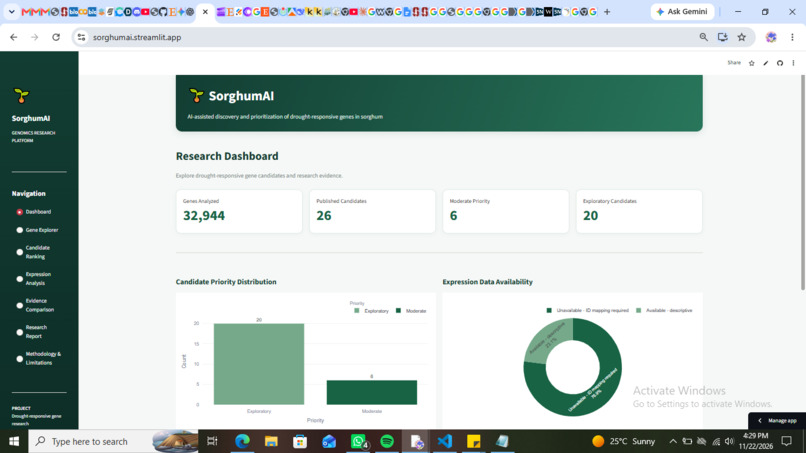
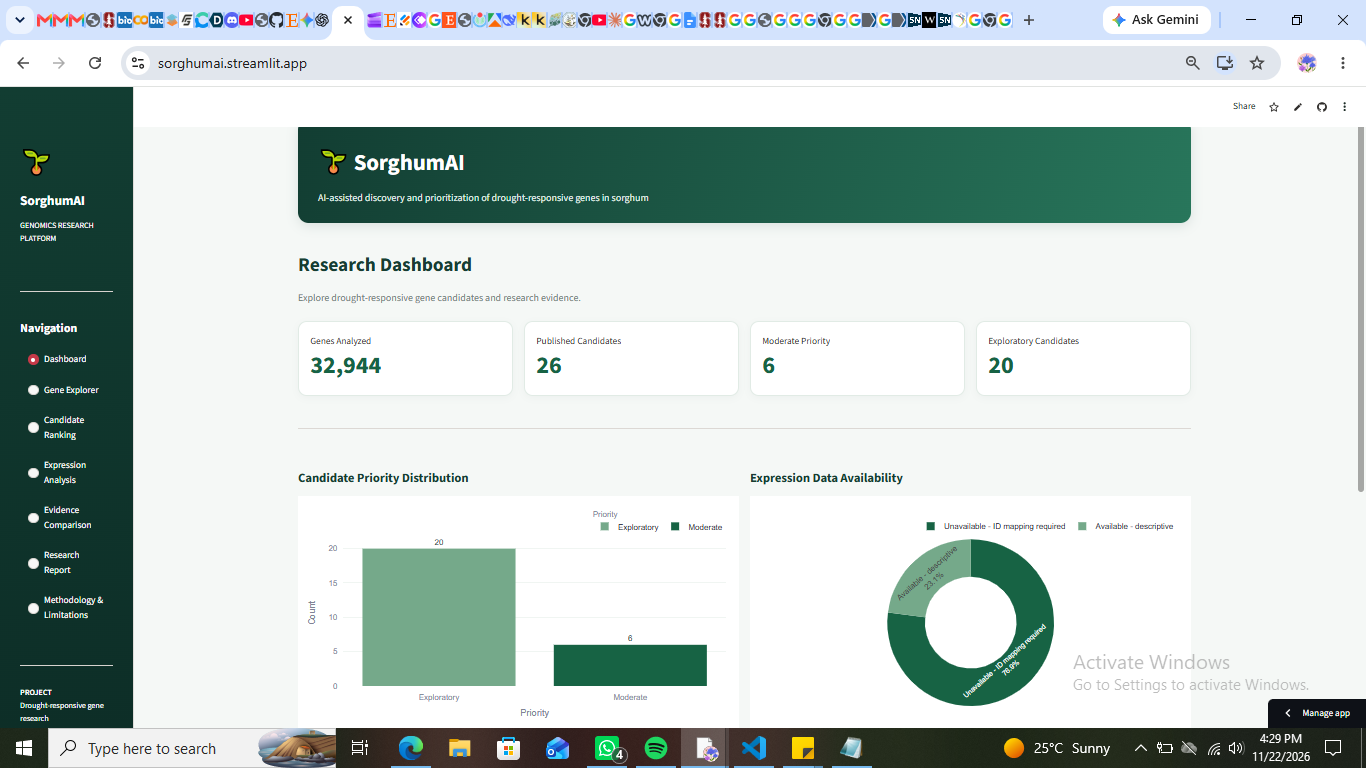
Dashboard
-
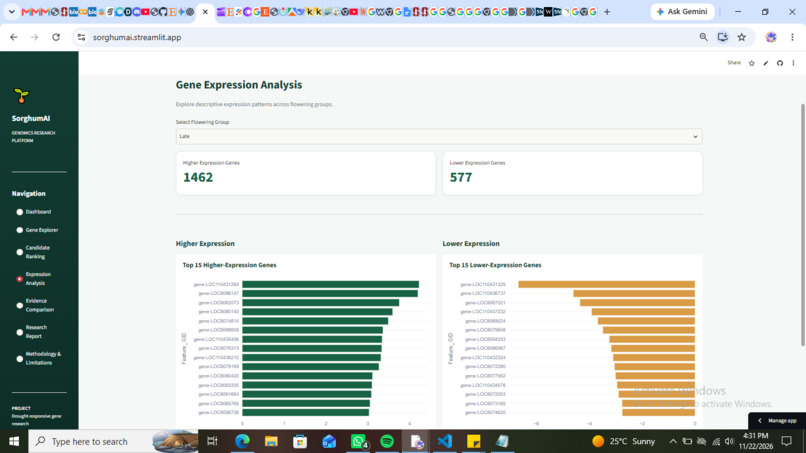
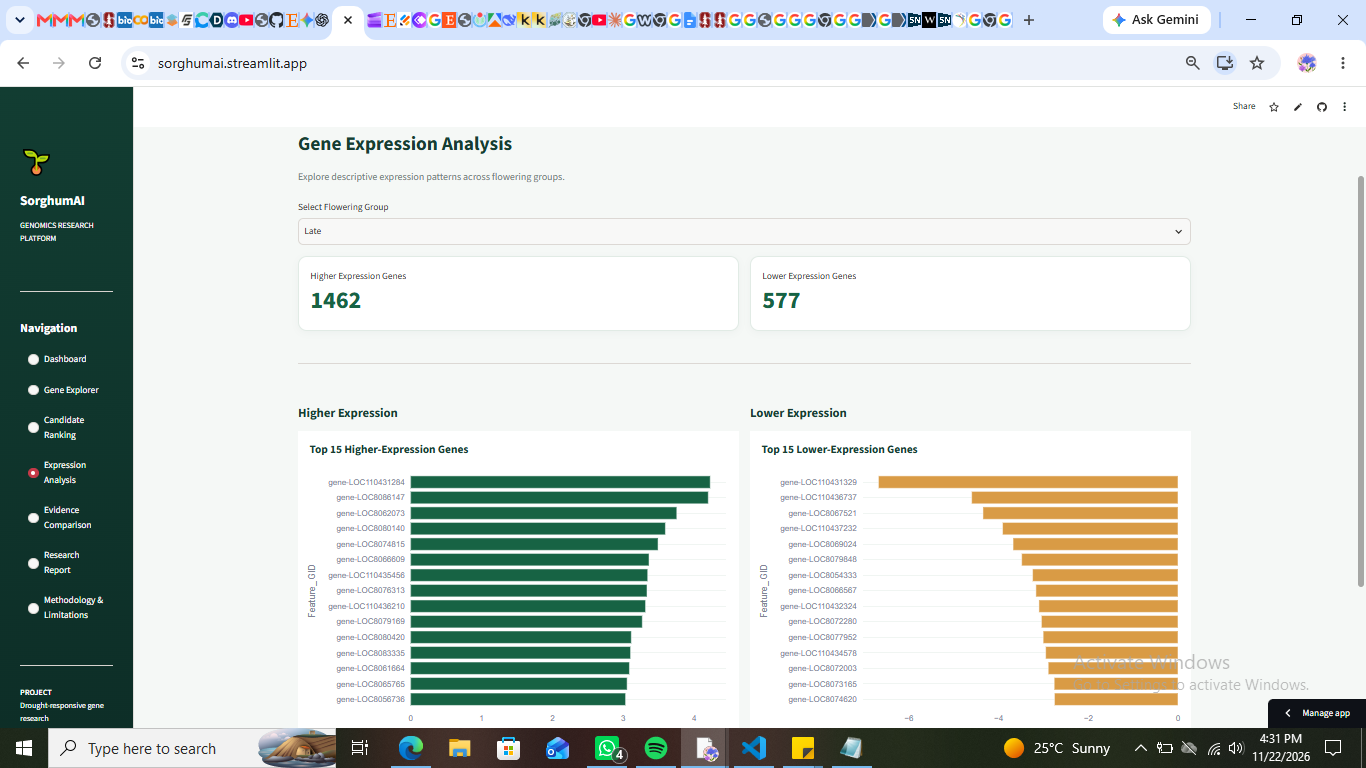
Expression analysis
-
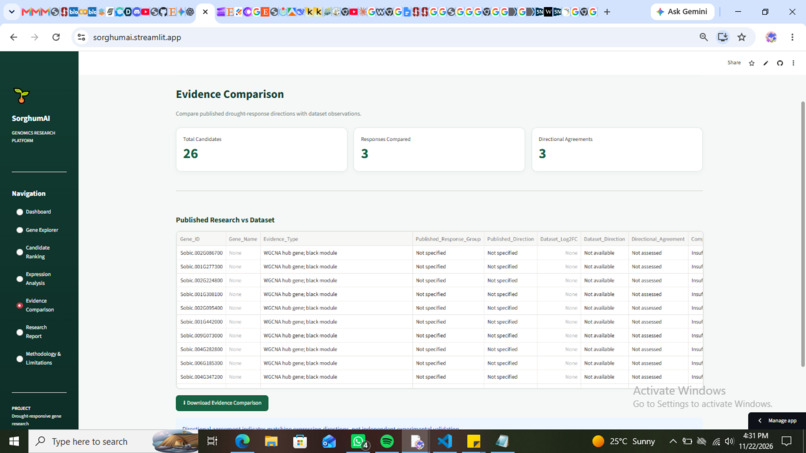
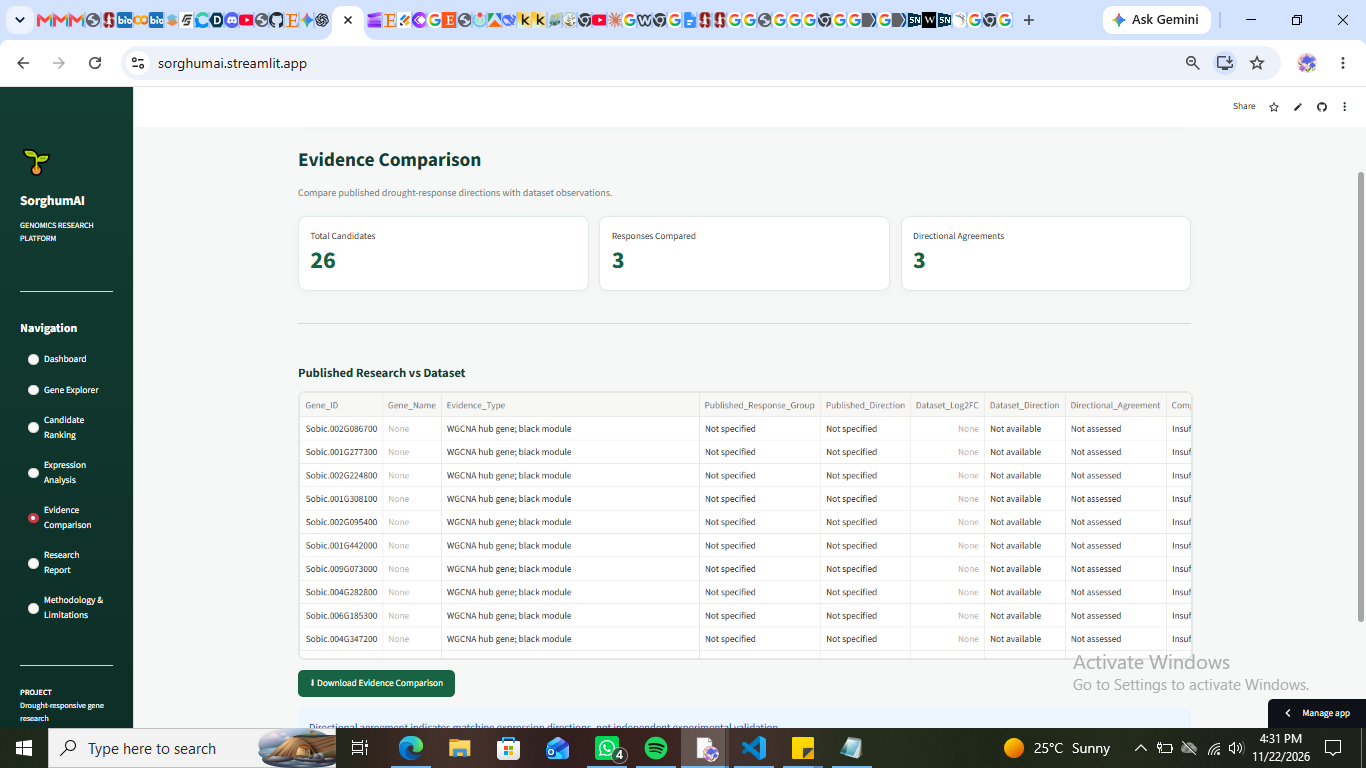
Evidence Comparison
Inspiration
Drought is a major environmental stress that affects crop growth, productivity, and food security. Sorghum (Sorghum bicolor) is an important climate-resilient crop, but understanding the genes involved in its drought-response mechanisms remains an important research challenge. We were inspired to build a tool that could make published scientific evidence and gene-expression information easier to explore. Our goal was to help researchers identify and prioritize potential drought-responsive genes in sorghum through an accessible, interactive research platform.
What it does
SorghumAI is an interactive, AI-assisted research and decision-support prototype that combines gene-expression data with evidence from published studies to help explore and prioritize potential drought-responsive genes. The application includes seven modules:
- Dashboard: Provides an overview of the dataset, candidate genes, evidence categories, and candidate priorities.
- Gene Explorer: Allows users to search and inspect candidate genes, annotations, expression patterns, and supporting evidence.
- Candidate Ranking: Ranks 26 research candidates using a transparent, evidence-based scoring approach.
- Expression Analysis: Explores descriptive drought-versus-control expression patterns across early, intermediate, and late flowering groups.
- Evidence Comparison: Compares available expression patterns with reported responses from published qRT-PCR research.
- Research Report: Provides downloadable analysis tables for further exploration.
- Methodology & Limitations: Explains the data sources, analysis workflow, scoring criteria, and scientific limitations.
How we built it
We developed SorghumAI using Python and Streamlit, with Pandas for data processing and Plotly for interactive visualizations. Our workflow combined gene-expression information from the NCBI Gene Expression Omnibus dataset GSE274752 with candidate-gene evidence from published research.
We assembled 26 candidate genes from two evidence sources:
- Six qRT-PCR-validated candidates reported in published research.
- Twenty WGCNA hub-gene candidates reported in a separate study. We then checked gene identifiers against the expression dataset. Six candidates could be matched to the current expression data, while the remaining twenty require additional identifier mapping before expression comparisons can be made. For the matched candidates, we calculated descriptive log2 fold changes across three flowering groups using: [ \log_2\left(\frac{\text{Drought TPM}+1}{\text{Control TPM}+1}\right) ] We also implemented a transparent heuristic ranking system that combines published evidence with available expression evidence. The scoring weights and thresholds are documented in the application and methodology file.
Challenges we faced
One of our main challenges was matching gene identifiers across different research studies and genome annotation systems. Some published candidate identifiers did not directly match the identifiers in our expression dataset. Rather than forcing uncertain matches, we kept these candidates separate and clearly marked their expression evidence as unavailable pending further mapping. We also encountered an annotation inconsistency for one candidate, LOC110436666, which we flagged for further review. Another important challenge was interpreting expression values responsibly. The available data did not provide biological replicates for the group-level comparisons used in this prototype. Therefore, we present descriptive expression patterns rather than claiming statistical significance or experimentally confirmed drought tolerance.
What we learned
Through this project, we gained practical experience in data processing, gene identifier verification, expression analysis, evidence integration, scientific visualization, and Streamlit application development. We also learned that a useful research tool should not only present results but should make its methodology, assumptions, and limitations transparent. Missing evidence should not automatically be interpreted as negative evidence.
What's next
Future improvements include verifying additional gene identifiers, integrating more publicly available expression datasets, adding independent functional evidence, and incorporating biological replicates and statistical analysis where suitable data are available. Our long-term goal is to develop SorghumAI into a more comprehensive research-support platform for exploring candidate genes associated with drought response and climate-resilient agriculture. SorghumAI is an exploratory research decision-support prototype. Its candidate scores are heuristic prioritization indicators, not probabilities or experimentally validated predictions.

