-
-
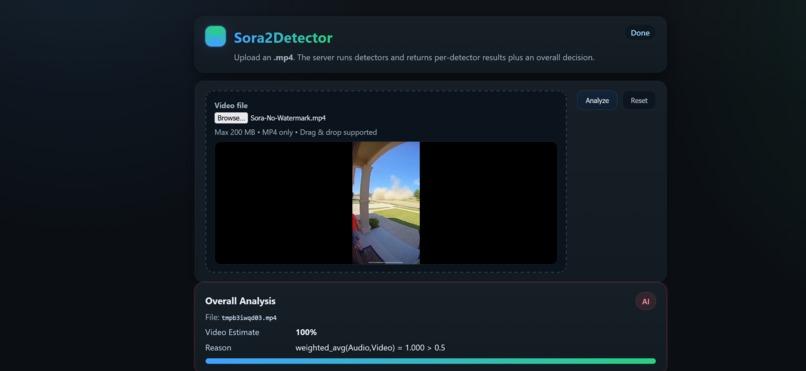
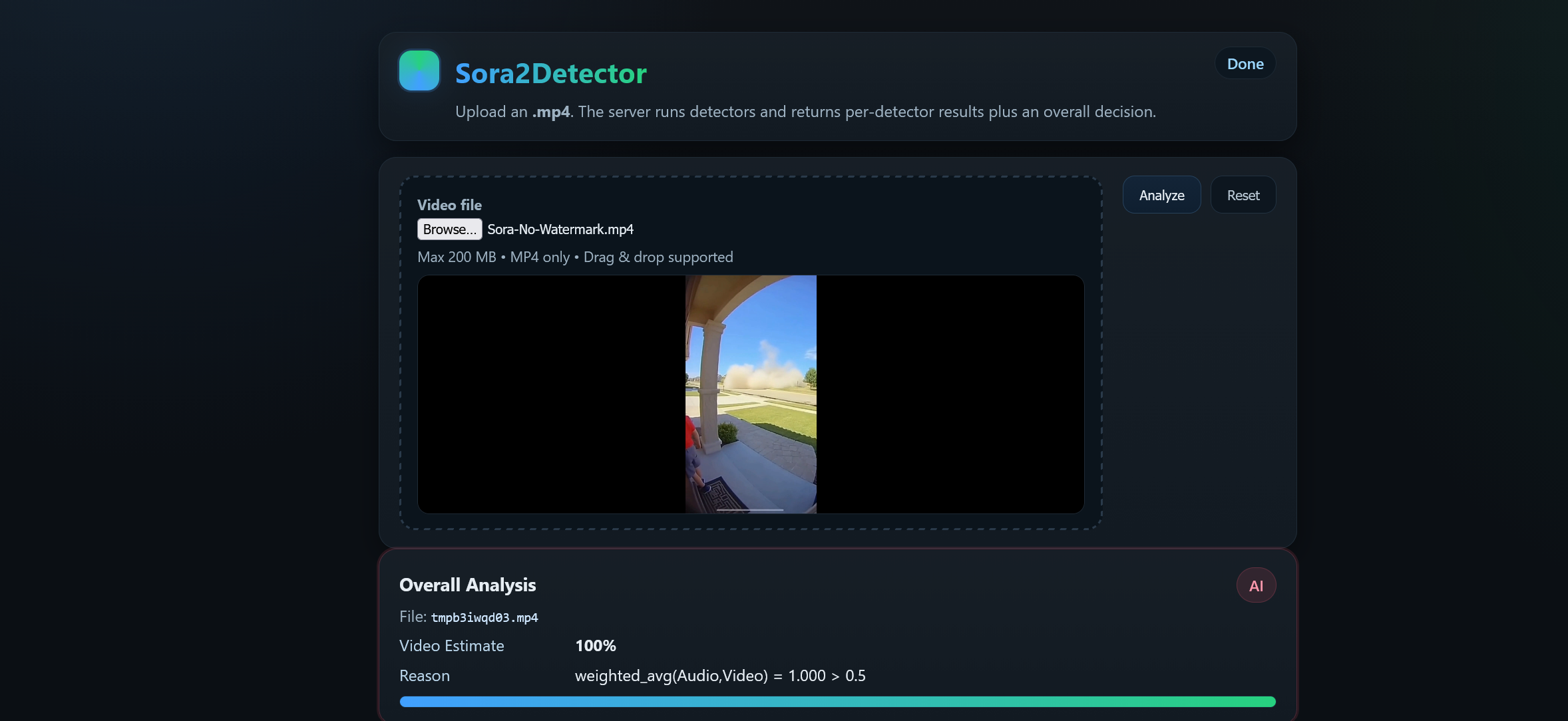
Example website picture
-

Example output video

Inspiration
With AI-generated media rapidly blurring the line between reality and fabrication, we wanted to create a system capable of restoring digital trust. Inspired by the recent rise of ultra-realistic Sora2 videos and the growing difficulty of verifying authentic content online, we built a multi-phase detector to reveal what’s real and what’s synthetic.
What it does
Sora2Detector analyzes uploaded video files through a four-phase AI authenticity pipeline:
- Metadata Forensics Parses MP4 hex data to detect hidden AI identifiers or watermark-like strings.
- Visual Layer Analysis Uses OpenCV to inspect color gradients, transparency shifts, and text watermark traces across frames.
- Audio Authenticity Modeling Trains an AI classifier on real vs. generated speech from datasets such as the UT Austin CHuG project and the DagsHub Audio Dataset, then analyzes extracted video audio for deepfake signatures.
- Key-Frame Intelligence Runs trained models on key visual frames to analyze visual consistency and used machine learning algorithms to train the detection of real videos vs SORA2 videos.
How we built it
We built Sora2Detector with Python, OpenCV, and custom AI detection models fine-tuned using data from OpenAI and public research corpora.
The web frontend was designed with modern HTML, CSS, and JavaScript, hosted via OnRender, while the backend was powered by a lightweight FastAPI server for inference and analysis orchestration.
Challenges we ran into
Integrating the frontend with the backend posed significant challenges, especially when hosting computation-heavy AI models on limited web infrastructure.
We also faced resource constraints when deploying real-time analysis across networked clients running GPU-intensive detection reliably over the internet proved to be a major bottleneck.
Accomplishments that we're proud of
We successfully implemented all four detection layers and achieved a 95% detection accuracy in our trained models a first-of-its-kind result for this kind of multi-phase AI authenticity system.
We’re also proud of bridging the gap between low-level video forensics and deep learning–based detection within one unified platform.
What we learned
Through Sora2Detector, we learned how to architect and connect AI-driven pipelines from backend logic to frontend visualization in a concise, modular way.
We deepened our understanding of multimedia forensics, OpenCV processing, and the practical training of AI models for real-world detection tasks.
What's next for Sora2Detector
We plan to:
- Expand dataset diversity to include multilingual and cross-domain audio/video.
- Integrate GPU acceleration across all layers for faster local analysis.
- Deploy mobile and desktop apps using the same AMD-compatible model architecture.
- Collaborate with research groups to strengthen transparency and detection standards for synthetic media worldwide.
\textbf{Sora2Detector} aims to become the standard for AI video authenticity — restoring trust in the age of generative media.


Log in or sign up for Devpost to join the conversation.