Inspiration
Every 40 seconds, someone suffers a stroke. In acute neurovascular care, there is a fundamental axiom: "Time is Brain." During a stroke, every minute of delayed treatment results in the irreversible loss of approximately 1.9 million cerebral neurons.
The inspiration for SonoStroke-AI stemmed from a devastating clinical bottleneck in pre-hospital emergency medicine. When an ambulance picks up a suspected stroke patient, Emergency Medical Technicians face an absolute diagnostic blind spot. They cannot differentiate between an ischemic stroke (a blood clot) and a hemorrhagic stroke (a ruptured vessel) through macroscopic clinical examination alone.
This creates a fatal paradox: administering thrombolytic agents like tissue plasminogen activator is the gold standard to dissolve clots in ischemic patients, but giving it to a hemorrhagic patient accelerates bleeding and causes rapid mortality. Because standard Computed Tomography scanners are too massive, expensive, and rigid for standard ambulances, patients lose critical hours in transit. We wanted to bridge this critical gap, turning dead transit time into life-saving treatment time.
What it does
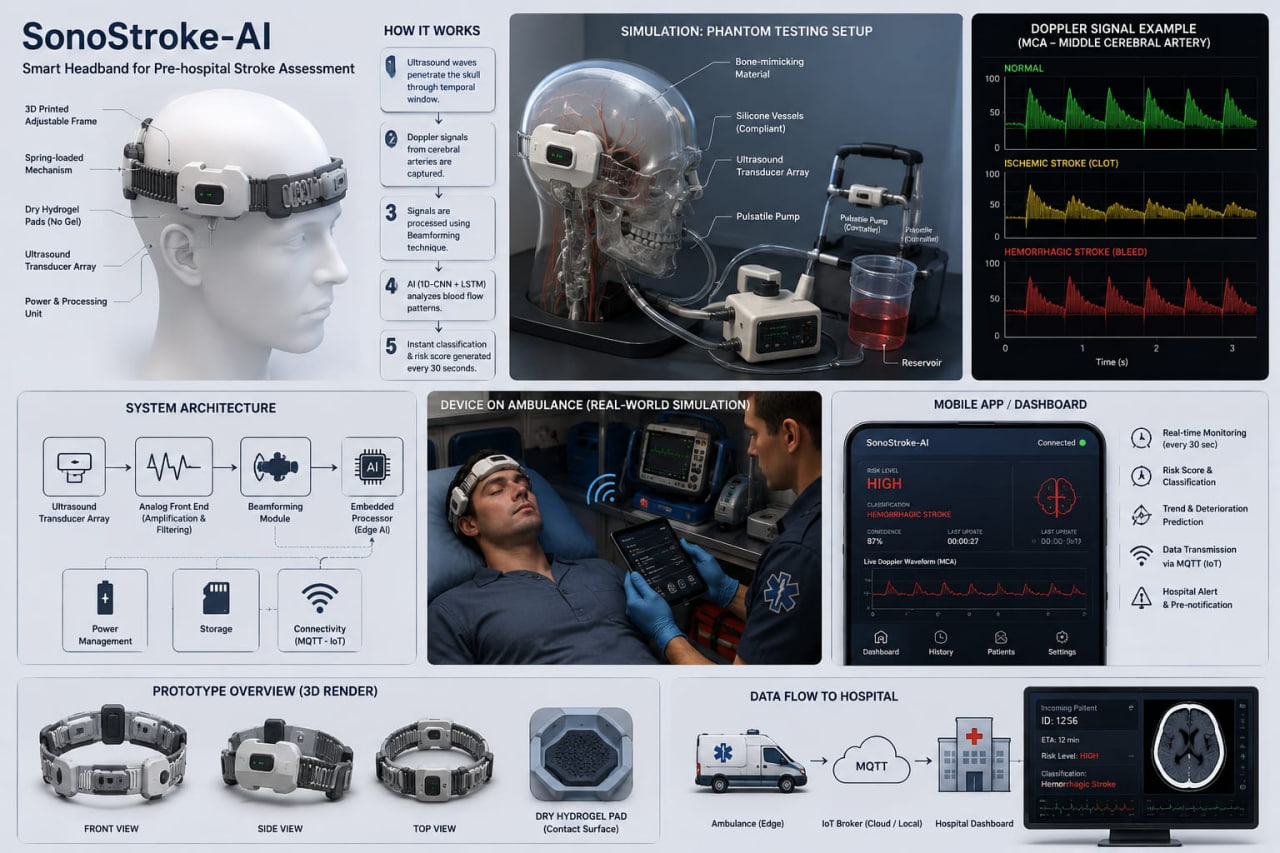
SonoStroke-AI is a low-cost, ultra-portable, wearable neurotechnological triage system designed for immediate, pre-hospital stroke screening. It is engineered as a Clinical Decision Support Tool rather than an autonomous diagnostic entity.
By shifting the clinical focus from complex structural neuroimaging to real-time temporal analysis of cerebral hemodynamics, the device allows emergency crews to scan the patient's brain blood flow directly inside the moving ambulance. It identifies anomalies in blood flow velocity profiles and instantly classifies whether the stroke topology is highly likely to be ischemic or hemorrhagic. This allows the ambulance crew to send pre-arrival notifications to regional stroke centers, enabling neurosurgical teams to prepare operating rooms well before the patient arrives.
How we built it
The architecture of SonoStroke-AI spans hardware engineering, digital signal processing, and hybrid deep learning:
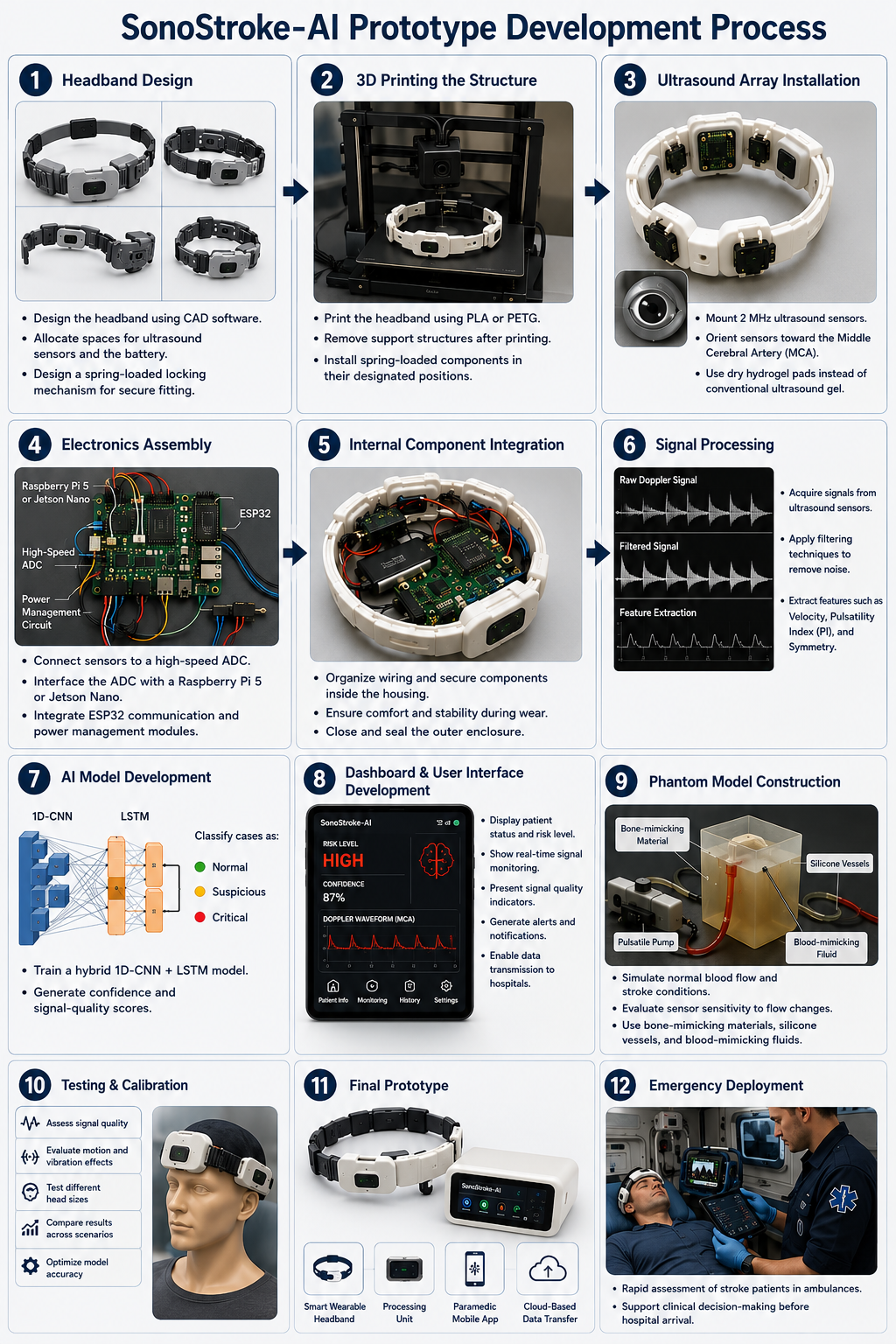
- The Hardware Component: We designed a 3D-printed ergonomic headband embedded with 2 MHz Transcranial Doppler ultrasonic transducers. This frequency is physically optimized to penetrate the thinnest region of the human skull—the temporal bone window—to target the Middle Cerebral Artery. To make it practical for chaotic emergencies, we integrated constant-force mechanical springs for self-stabilization and utilized Dry Hydrogel Acoustic Coupling pads to eliminate the need for messy liquid gels.
- Signal De-noising: To tackle ambulance vibrations, we housed an Inertial Measurement Unit in the headband. The IMU tracks 3-axis acceleration and gyroscope data, which is fed into an adaptive filtering algorithm that computationally subtracts vehicle-induced kinetic noise from the raw Doppler shift spectrum in real time.
- The Hybrid AI Pipeline: The de-noised time-series velocity waveforms are routed into a localized, hybrid neural network running on low-power microcontrollers. A 1D-CNN layer extracts morphological parameters directly from the 1-dimensional wave signal, such as Peak Systolic Velocity, End-Diastolic Velocity, Mean Velocity, and the Pulsatility Index. Then, an LSTM layer processes these extracted features sequentially to capture long-term temporal dependencies across multiple cardiac cycles. Finally, an Uncertainty-Aware layer maps the representations into a confidence-based inference distribution to account for signal degradation.
Challenges we ran into
Our biggest challenge was validating a biomedical device without access to real human clinical trials or live stroke patients. Transcranial Doppler signals are notorious for being highly sensitive to positioning, and human bone attenuates ultrasound waves drastically.
To overcome this without violating safety regulations, we had to engineer a highly sophisticated Cranial Vascular Phantom from scratch. We built a closed-loop system using a computer-controlled pulsatile pump to circulate a blood-mimicking fluid calibrated to match human blood viscosity. To simulate the skull's attenuation, we fabricated a solid composite acoustic plate using a precise ratio of polyurethane and calcium carbonate to mimic the density and acoustic impedance of the human temporal bone. Modeling the strokes using physical micro-valves to restrict fluid flow was mathematically challenging but allowed us to gather the clean synthetic dataset needed to train the mo Accomplishments that we're proud of
- True Interdisciplinary Integration: We successfully merged three distinct fields—Acoustic Physics, Embedded Hardware Engineering, and Deep Learning—into a single, cohesive wearable form factor.
- Massive Cost Reduction: Traditional clinical Transcranial Doppler workstations or specialized mobile CT ambulances cost tens or hundreds of thousands of dollars. By leveraging 3D-printing, single-frequency 2 MHz ultrasound components, and hyper-efficient neural networks, we estimated the manufacturing cost of SonoStroke-AI to be only around 300 dollars.
- Robust De-noising: Developing a working software-hardware cooperation loop where the IMU actively cancels out vehicular vibration noise, turning highly distorted mock signals into readable time-series data for the AI.
What we learned
This project was an intensive masterclass in Translational Bioinformatics and Computational Biology. We learned that building medical AI models requires far more than just standard hyperparameter tuning; it requires a deep, fundamental understanding of human pathophysiology.
We learned how hemodynamic waveforms alter drastically under localized intracranial pressure inflation. For instance, we discovered how an ischemic stroke physically manifests as a sharp drop in mean velocity coupled with high downstream resistance, while a hemorrhagic stroke produces distinctly turbulent, highly pulsatile waveforms. More importantly, we learned the importance of regulatory engineering and the boundaries between diagnostic machinery and pre-hospital triage aids.
What's next for SonoStroke-AI
SonoStroke-AI is currently an advanced, lab-validated proof-of-concept. The next immediate steps include:
- Hardware Refinement: Transitioning the prototype from 3D-printed material to medical-grade biocompatible polymers, and optimizing the array layout to automate multi-vessel scanning.
- Clinical Simulation Validation: Moving from our custom silicone phantoms to validated, high-fidelity medical simulators, followed by strictly controlled, peer-reviewed clinical trials under proper healthcare authorities.
- Edge-AI Deployment: Quantizing the hybrid model using TensorFlow Lite to optimize power efficiency on ultra-low-power microcontrollers, ensuring the headband can run for hours on a single battery charge.
- Global Democratization: Partnering with public healthcare infrastructures and developing nations to distribute this low-cost technology to standard emergency vehicles worldwide, genuinely turning transit time into treatment time.
Built With
- and
- hospital
- system-architecture-diagram-showing-tcd-and-imu-data-fusion
- the-hybrid-cnn-lstm-pipeline
- triage

Log in or sign up for Devpost to join the conversation.