-
-
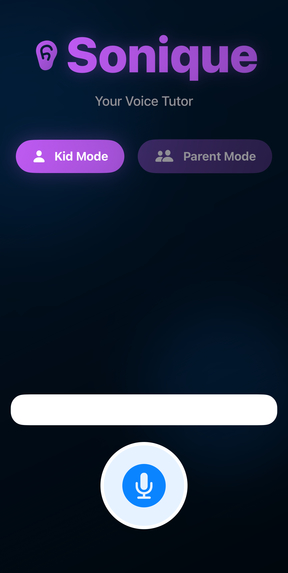
Voice Mode
-
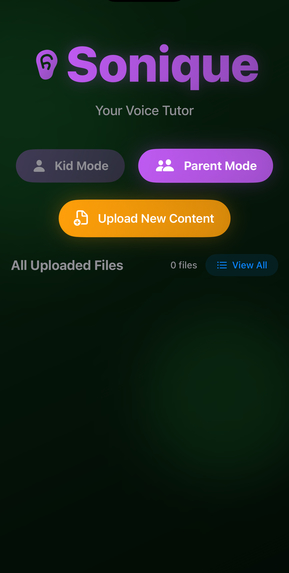
Upload Content
Inspiration
We envisioned a world where education is accessible to every child, regardless of their ability to see. Globally, approximately 1.4 million children are blind ,representing about 4% of the global blind population and with an estimated 500,000 children becoming blind each year, many struggle to learn with materials that rely heavily on visuals. Traditional classrooms and digital content often fail to address these unique challenges. Sonique was born from our desire to empower blind and differently-abled children through an inclusive, voice-driven learning experience that brings education to life through natural, conversational interactions.
What it does
Sonique is an AI learning companion that makes education accessible through audio. It transforms lessons into clear spoken words, so kids can learn using only their phone and voice.
Caregiver Upload Portal: Caregivers can easily add lesson materials, such as text or PDFs.
Conversational Content Reader: Sonique reads the lessons aloud in a friendly, easy-to-understand voice.
AI-Generated Practice Quizzes: Sonique automatically creates simple quizzes from the lesson material and provides immediate spoken feedback.
Voice Input and Response: Kids can answer questions or give commands by speaking, making the whole learning experience completely screen-free.
How we built it
Our development process integrated powerful AI with a keen emphasis on user experience:
Backend Infrastructure: Our backend is built in Python, handling content extraction and AI integration, with TinyDB serving as our database—all operated on local servers instead of cloud-based systems.
Voice Technology Integration: We enabled smooth, real-time conversational interactions by integrating speech-to-text and text-to-speech functionalities through the Gemini API.
AI-Driven Quiz Generation: Our system analyzes lesson materials to automatically create tailored quiz questions, making the learning experience interactive and reinforcing.
App Development: The iOS app was developed using Swift, while our web application was crafted with React.js to ensure a cohesive experience across devices.
Collaboration and Version Control: We leveraged GitHub for seamless collaboration and efficient codebase management among our team.
Inclusive Design Practices: Continuous testing with blind and differently-abled users was central to our process, ensuring that our platform remains both accessible and intuitive.
Challenges we ran into
Storing content and generating quizzes was really tough. We had to figure out how to pull information from different files and then automatically create engaging quizzes, which turned out to be way harder than we expected. The biggest challenge, though, was getting the iOS app to work with the Gemini API. We ran into serious security issues that stopped us from fully integrating them.
Accomplishments that we're proud of
We're incredibly proud of the prototype we've built, it’s not just a technical achievement but a heartfelt promise for the future of education for blind kids. Building this prototype was a journey where every technical breakthrough carried an emotional weight. On the technical side, we integrated speech-to-text, text-to-speech, and dynamic quiz generation into a cohesive system using Python and TinyDB. Our iOS app, crafted in Swift, even though we ran into security challenges with the Gemini API, demonstrated the potential of a seamless, voice-interactive experience.
But beyond the code and algorithms, our work represents a deep commitment to making learning accessible to every child.
What we learned
We learned that our passion to help students who don’t have easy access to educational tools drives every line of code we write. Seeing so many kids around us struggle with accessibility issues made us realize just how important this work is. On the technical side, integrating AI into our web and iOS apps was a steep learning curve, it challenged us to merge cutting-edge technology like speech-to-text, text-to-speech, and dynamic quiz generation into one seamless experience. Every bug we fixed and every hurdle we overcame not only made us better developers, but also reminded us of our mission: to make learning more accessible and inclusive. Ultimately, this project taught us that when you mix technology with a heartfelt mission, you can create something truly transformative.
What's next for SONIQUE
We're aiming for a fully integrated mobile experience, one that works seamlessly on both iOS and Android, so you won't need a separate web app. Our top priority is the offline mode, ensuring that kids can access lessons and quizzes anytime, even without an internet connection. More over :
Smart Glossary, where children can ask for word definitions mid-lesson and receive simplified explanations.
Audio Learning Reports for Caregivers that provide a brief audio summary of each session's progress.
Daily Learning Habit Tracker to encourage consistent learning with a simple streak-based system.
Voice-Based Mini Games offering interactive activities like rhyme matching, memory recall, and pronunciation practice.
Multilingual Support so SONIQUE can read or quiz in multiple languages, making it accessible for bilingual learners.
Tone-Aware Adjustments that detect signs of fatigue or frustration and switch to a lighter, more encouraging mode.

Log in or sign up for Devpost to join the conversation.