-
-
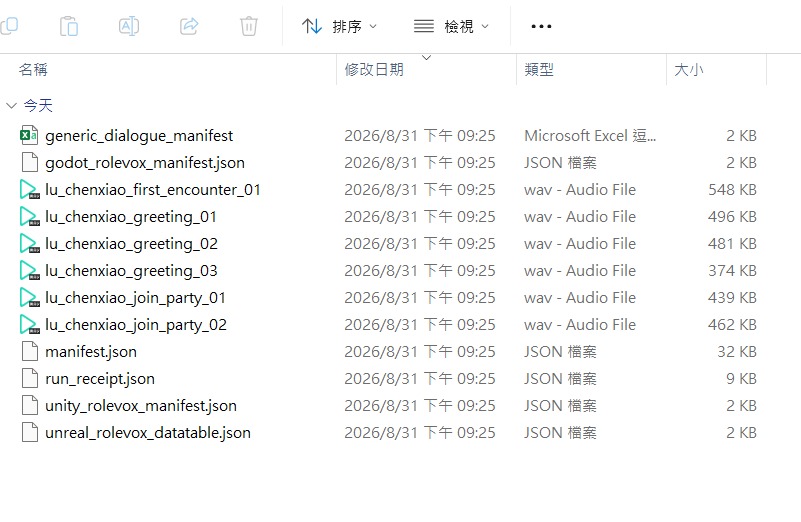
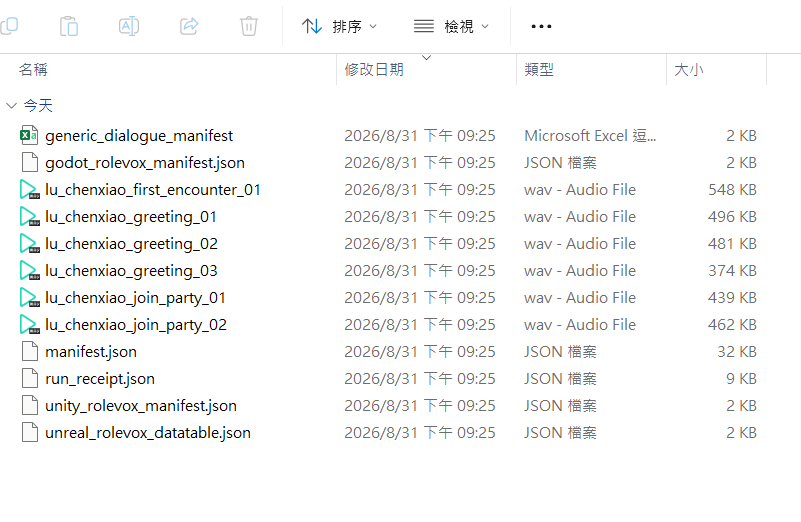
Export WAV audio and ready-to-use manifests for major game engines.
-
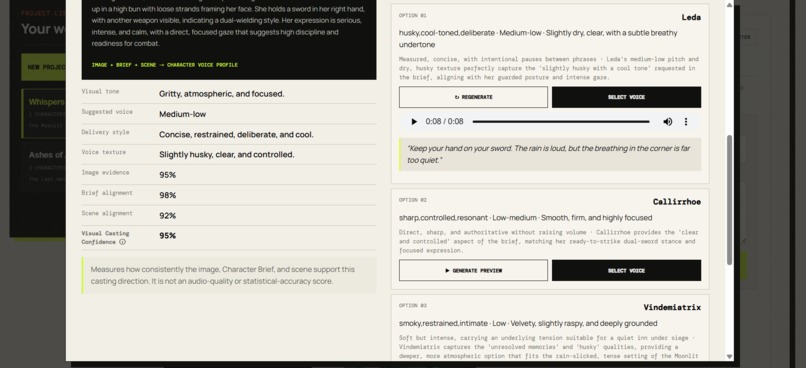
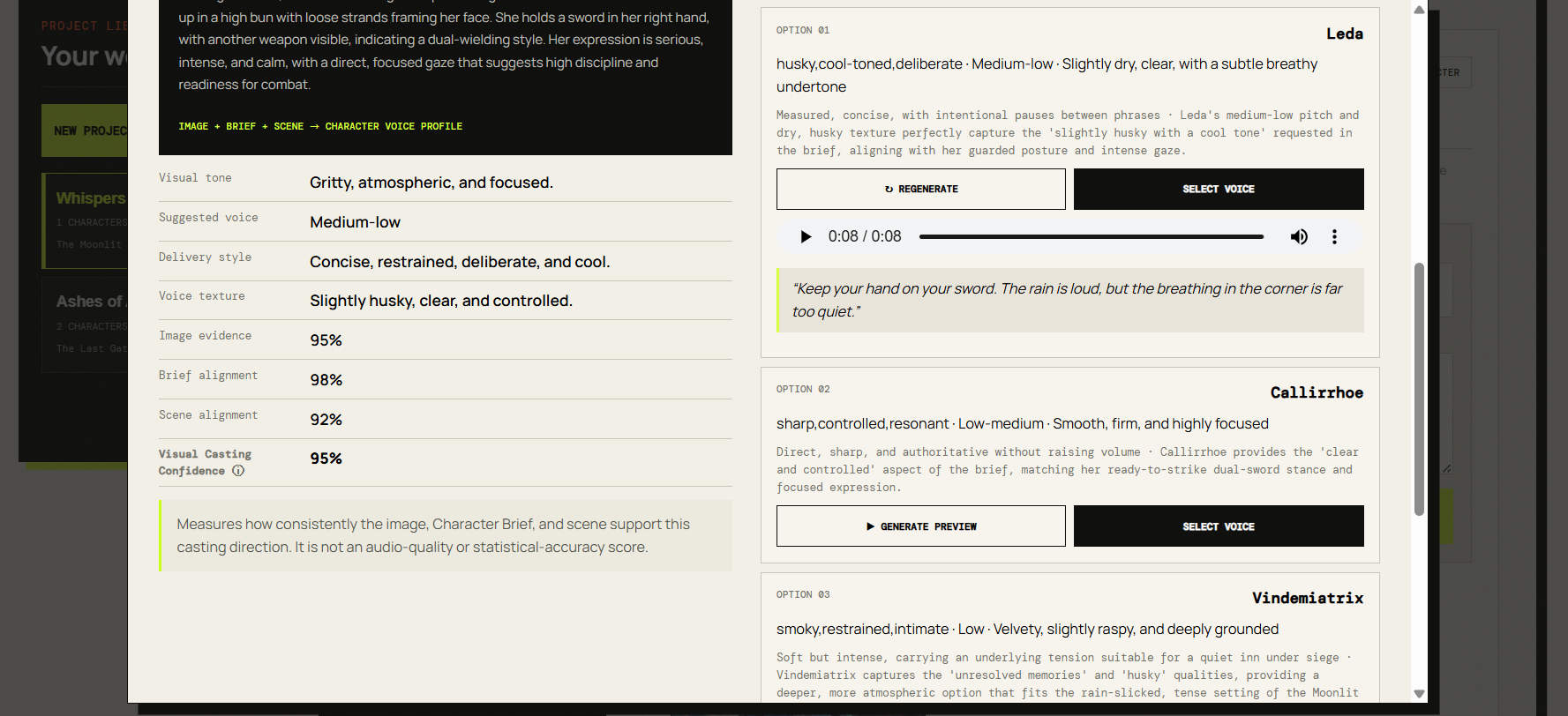
Compare AI-recommended voices and preview each casting option.
-
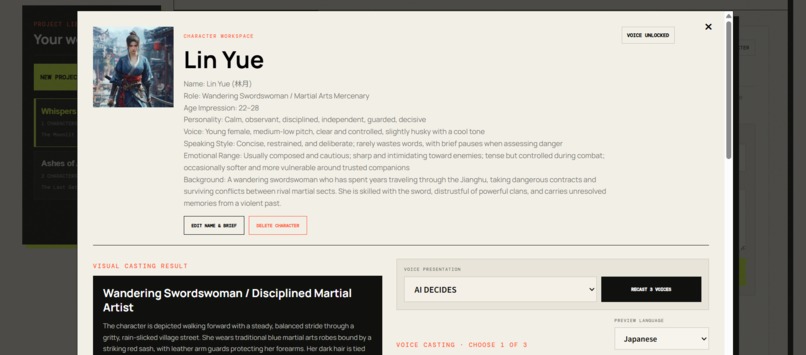
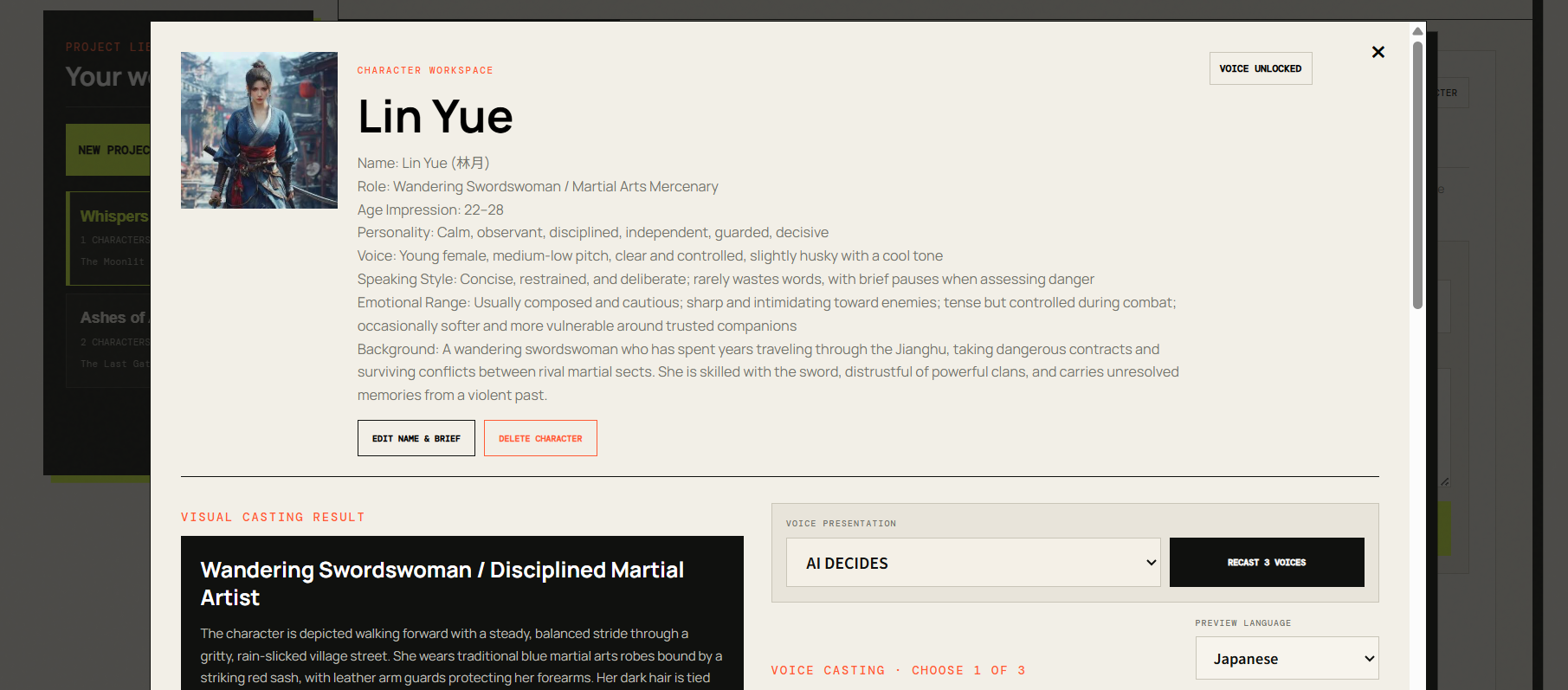
Build a detailed character profile from visual and narrative context.
-
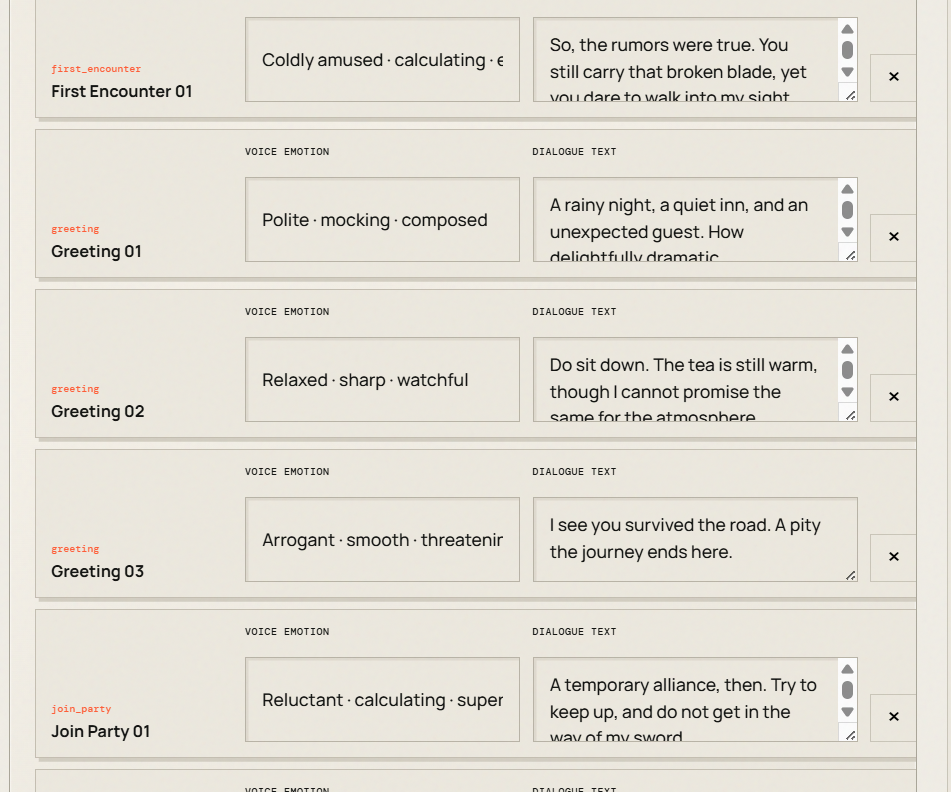
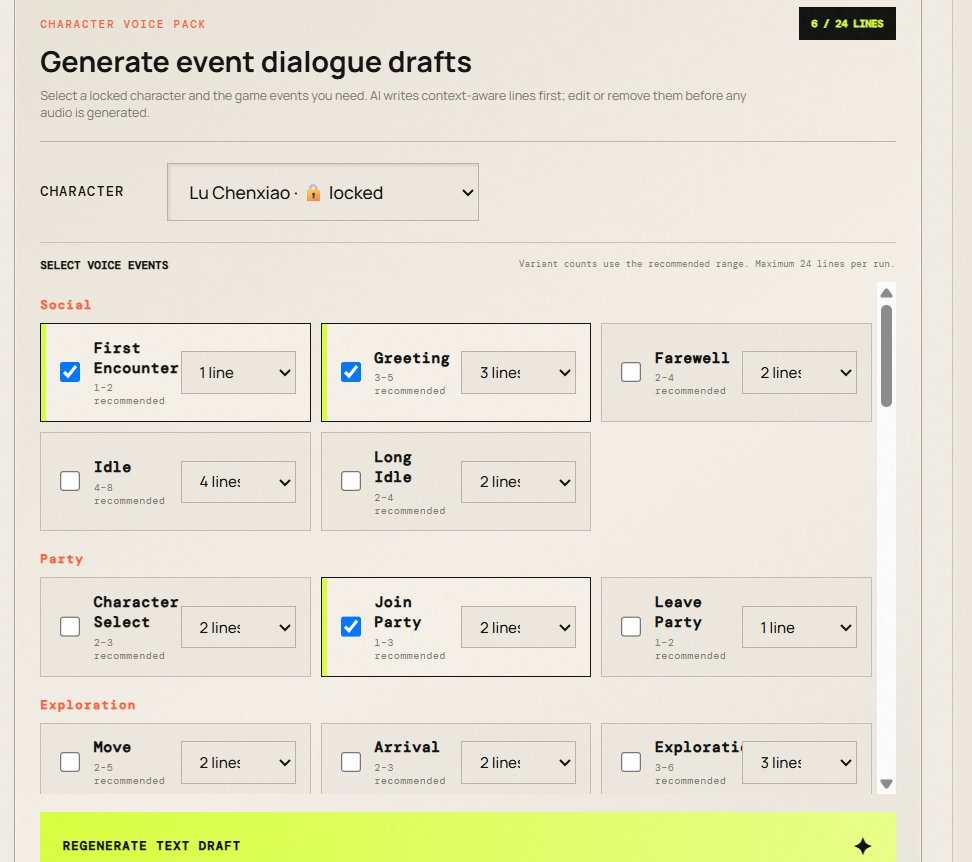
Select social, party, and exploration events for a character voice pack.
-
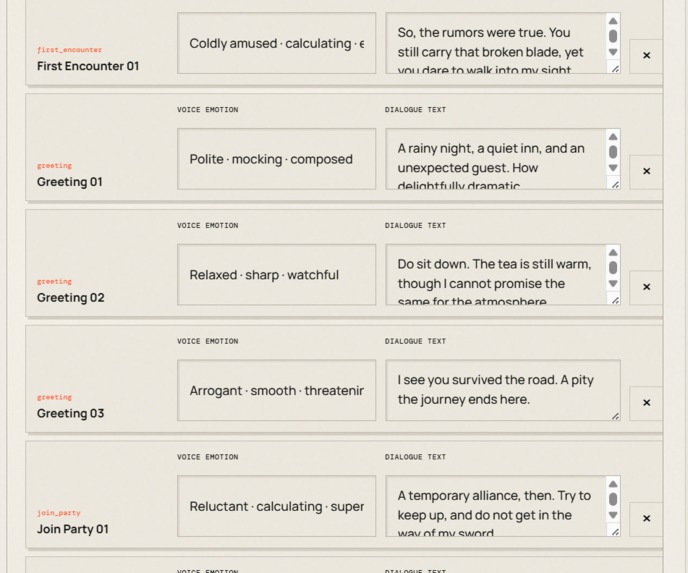
Review, edit, or remove AI-generated dialogue before production.
-
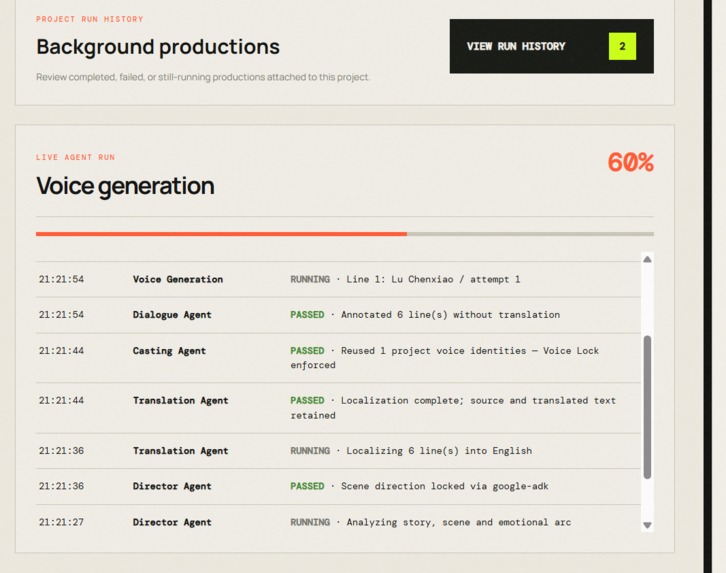
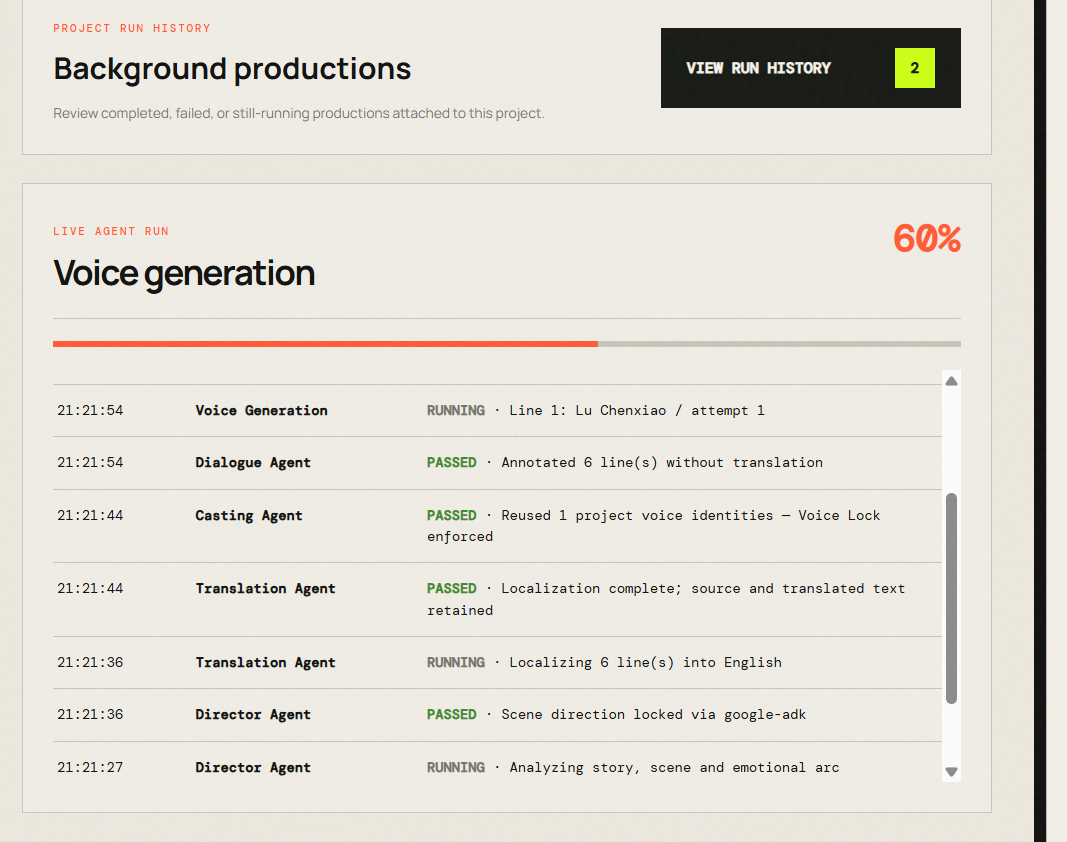
Follow the multi-agent voice production workflow in real time.
-
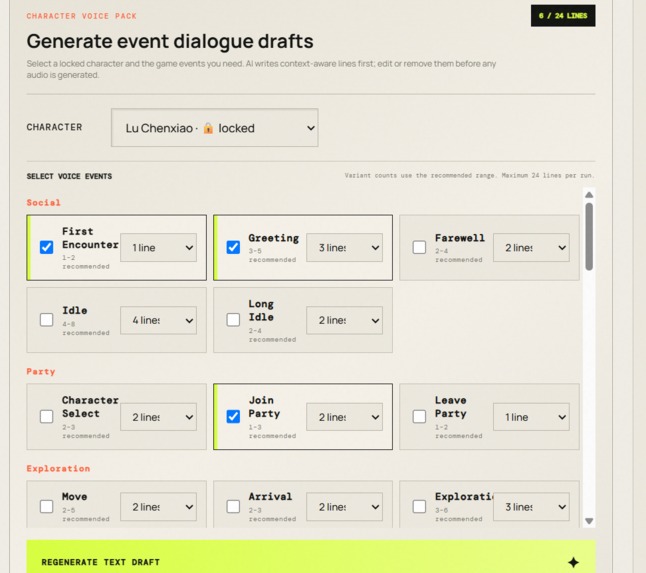
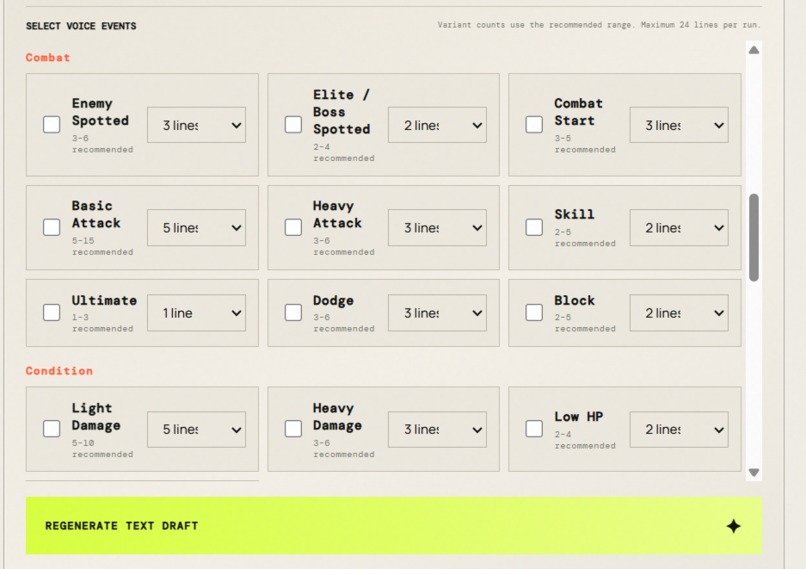
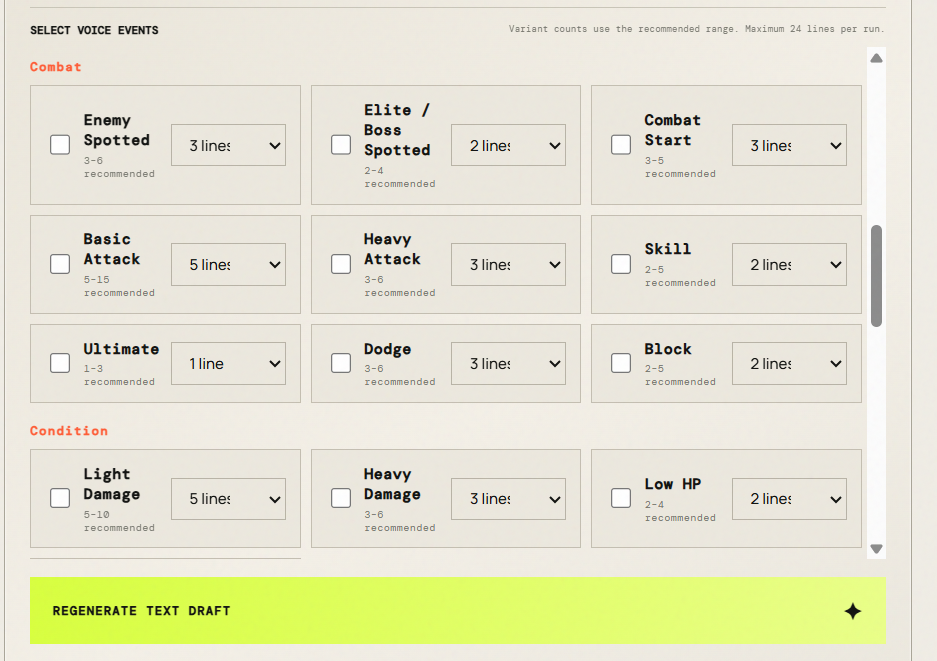
Customize combat voice events and the number of dialogue variations.
-
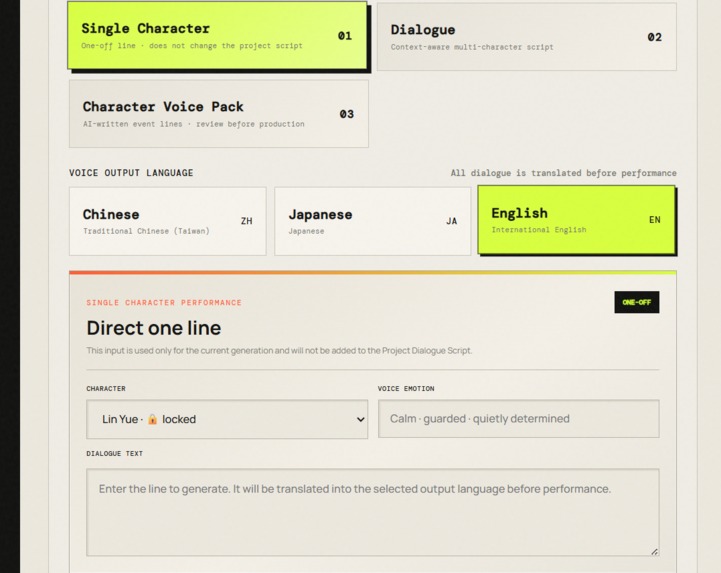
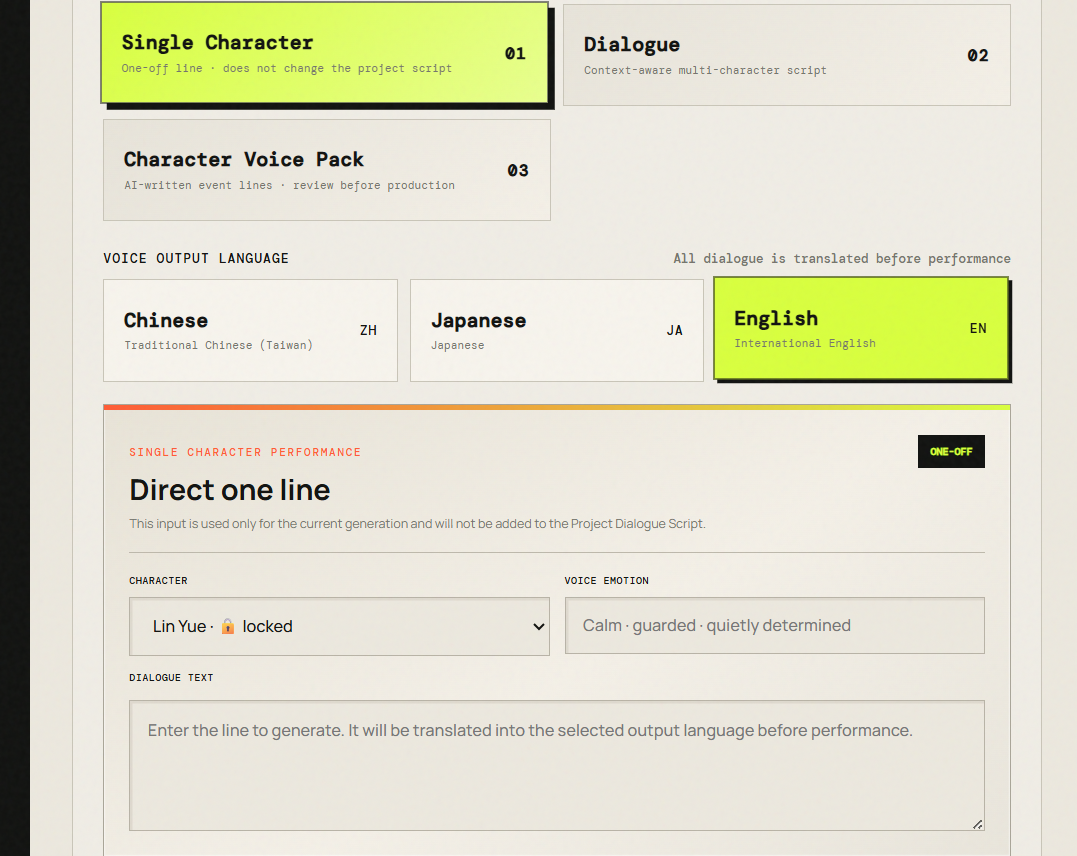
Generate a one-off line using a character’s locked voice identity.
-
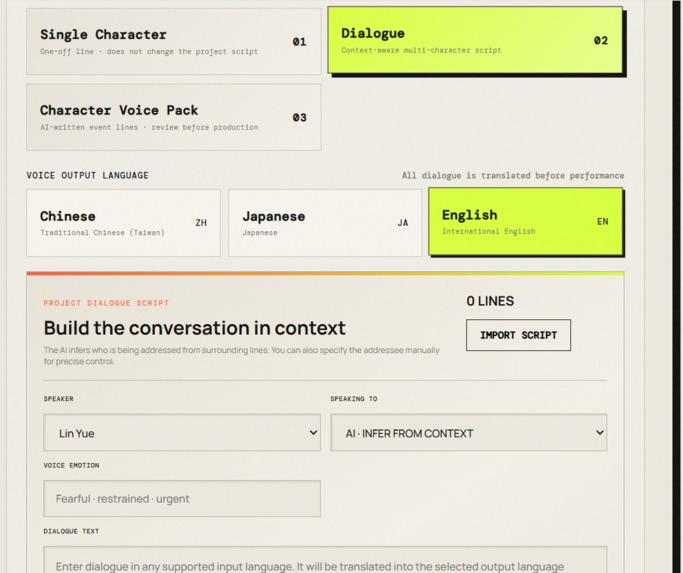
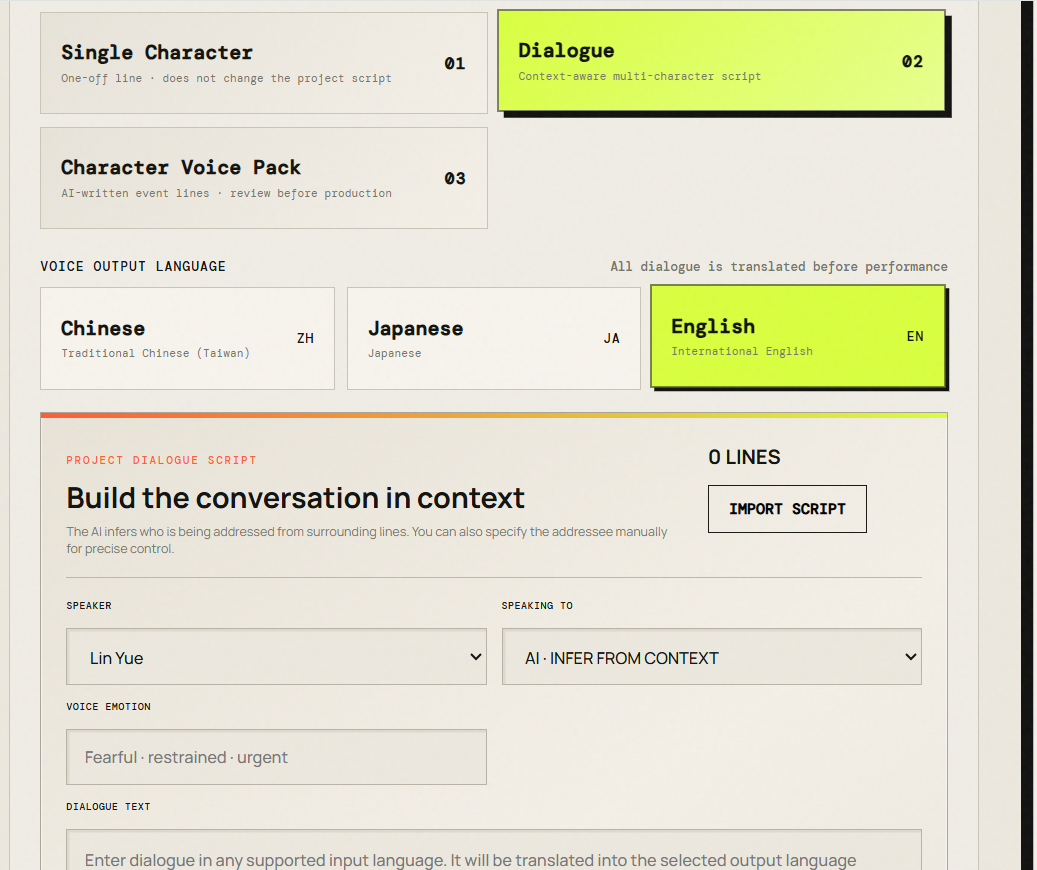
Import a multi-character script for context-aware dialogue production.
-
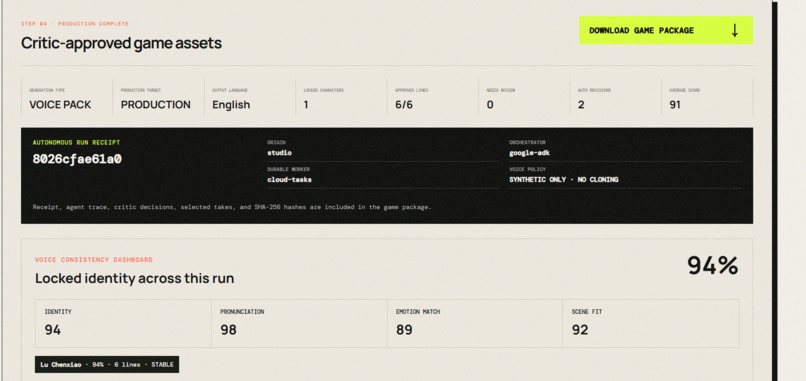
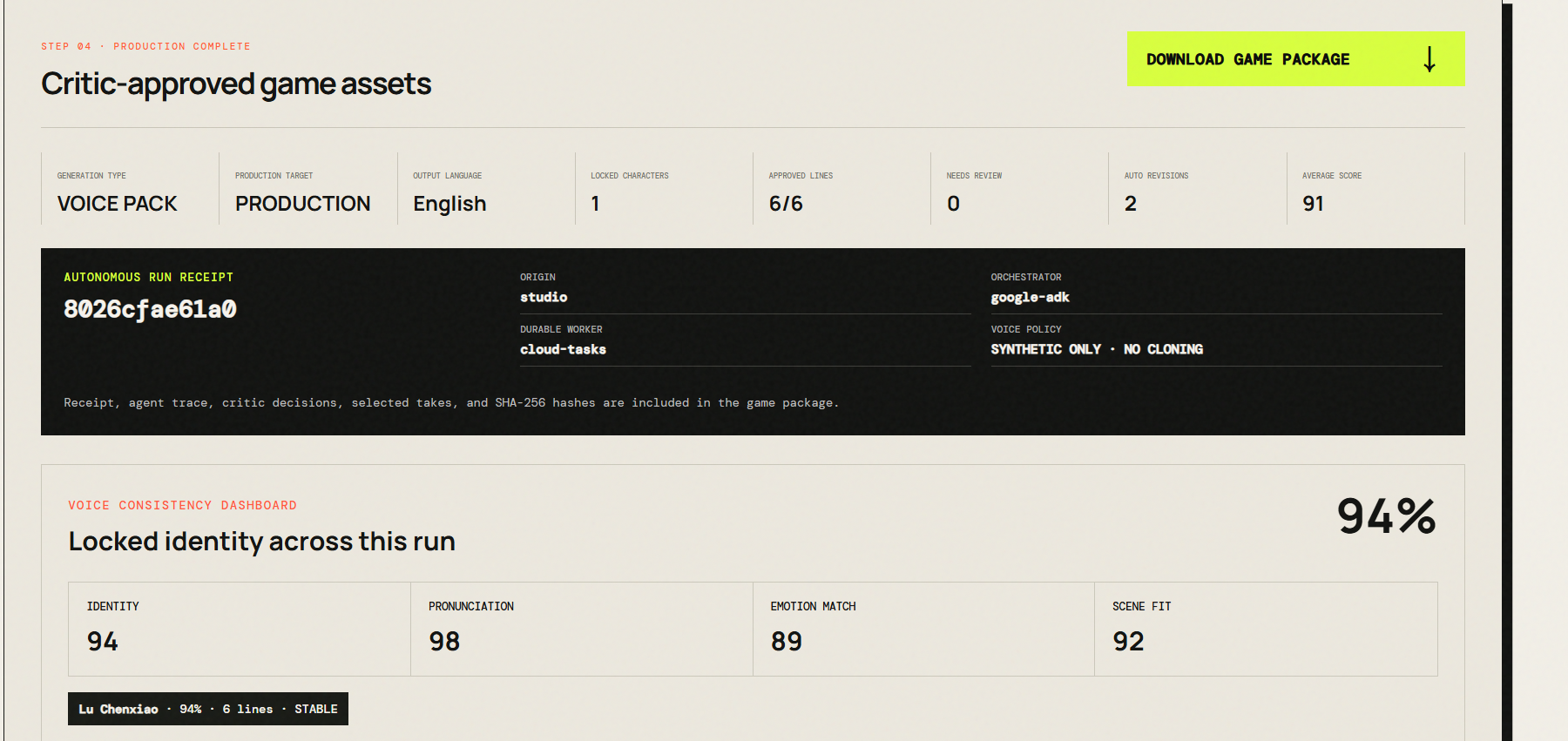
Review completed assets, production metrics, and voice consistency scores.
-
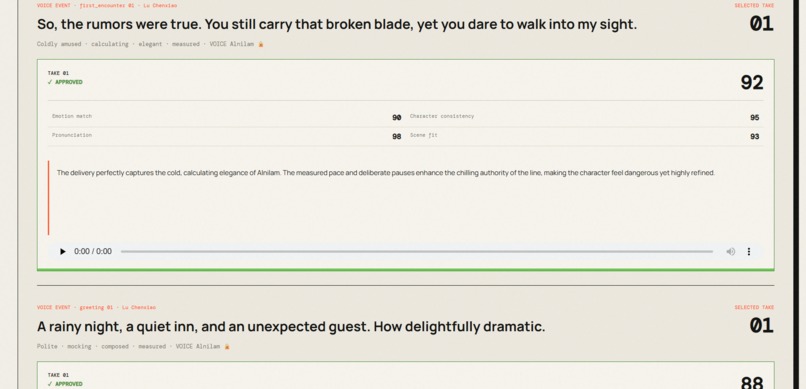
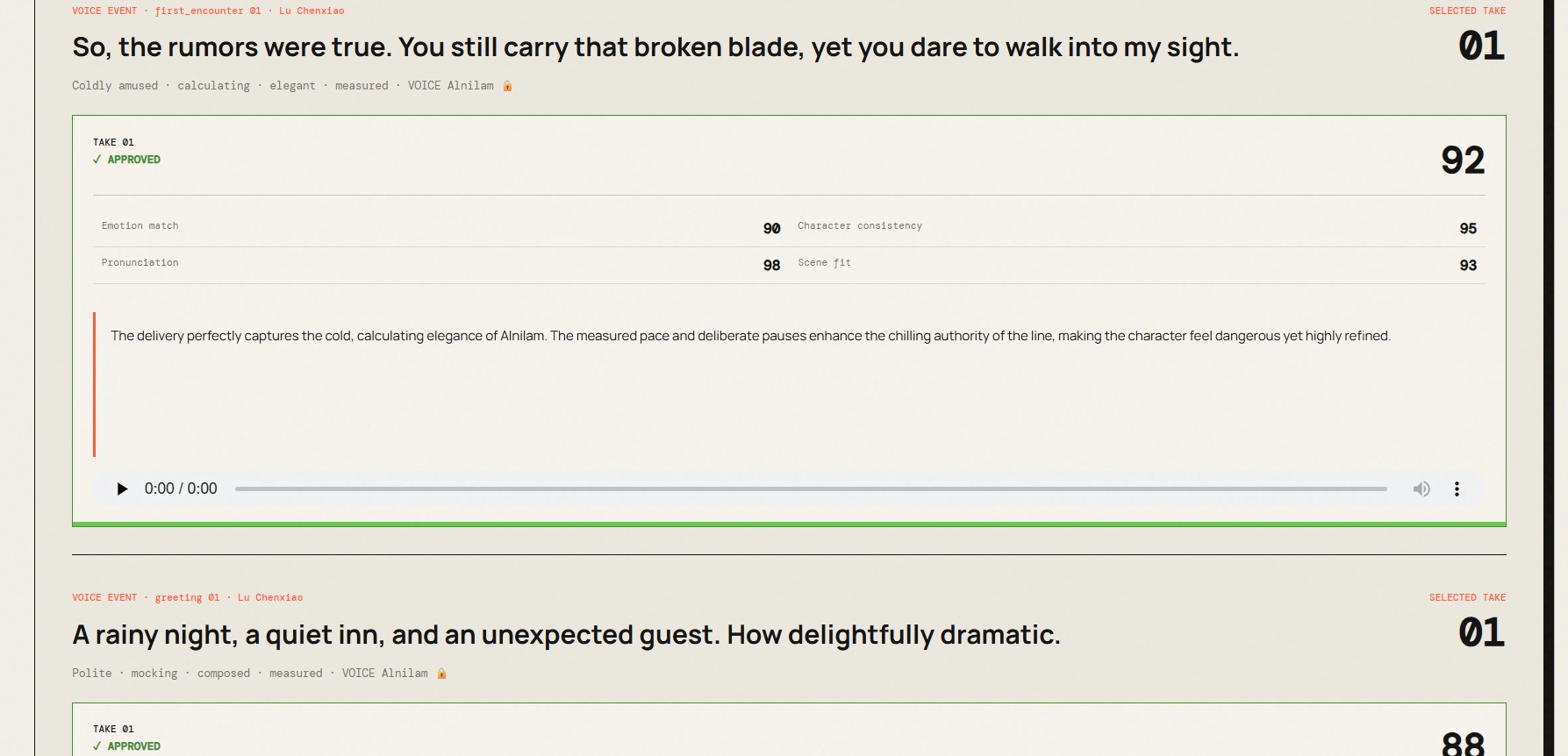
Inspect the selected take and its critic-generated quality scores.
-
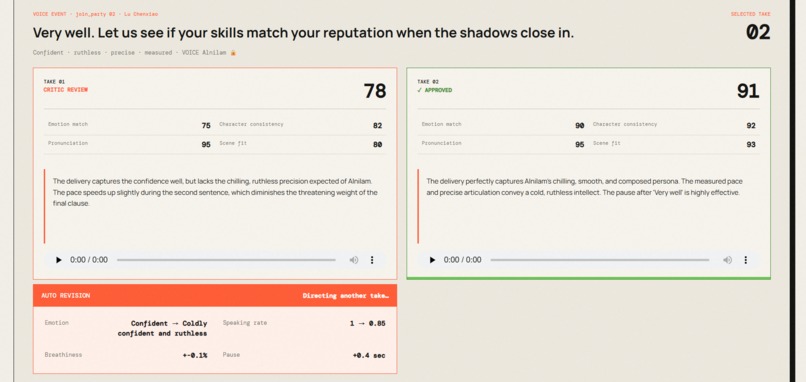
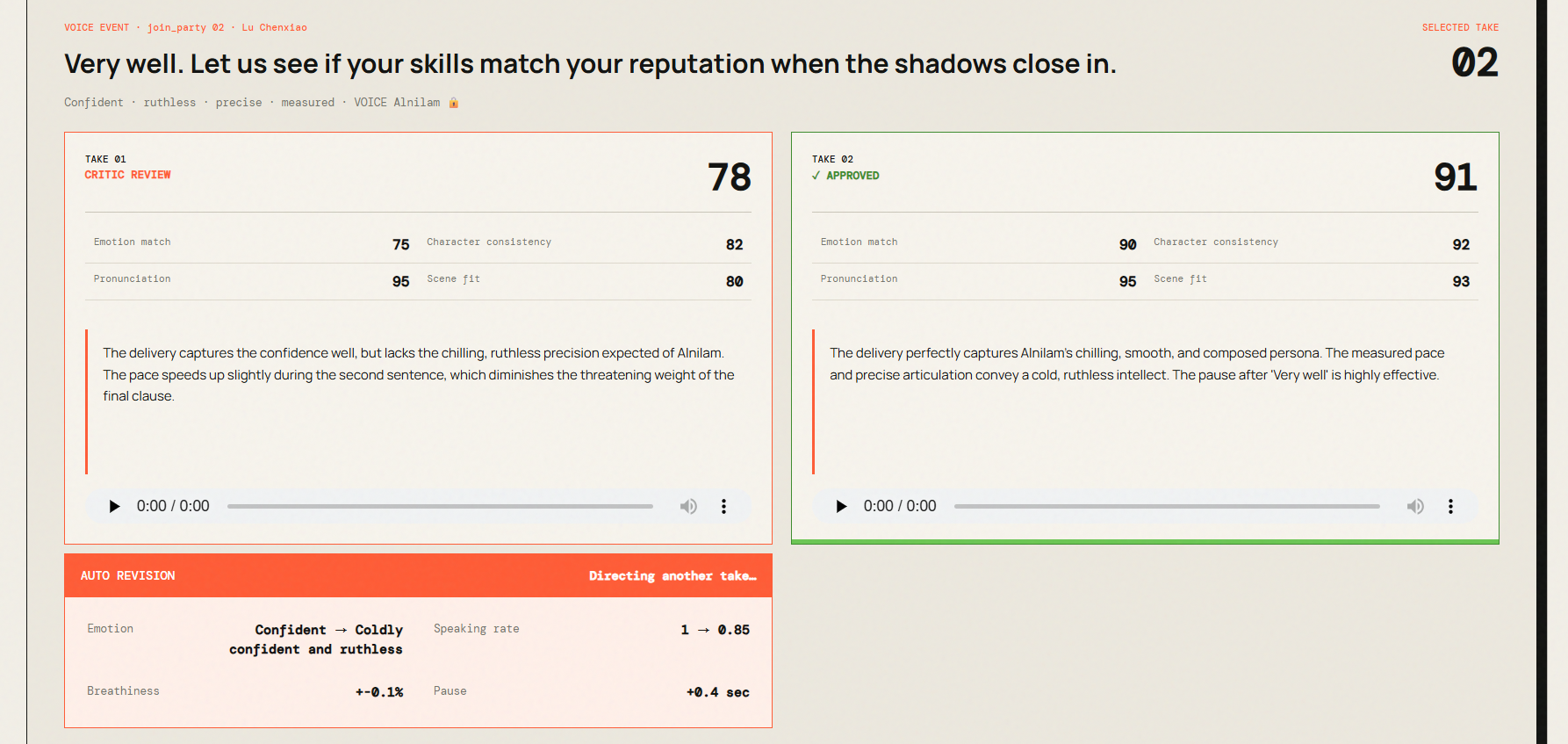
Compare takes and see how automatic revision improves the performance.
-
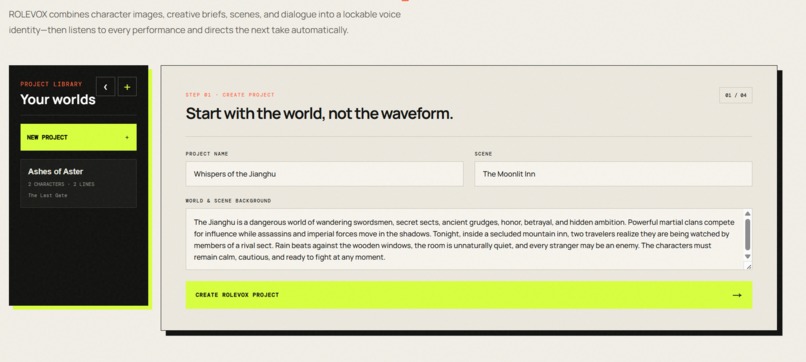
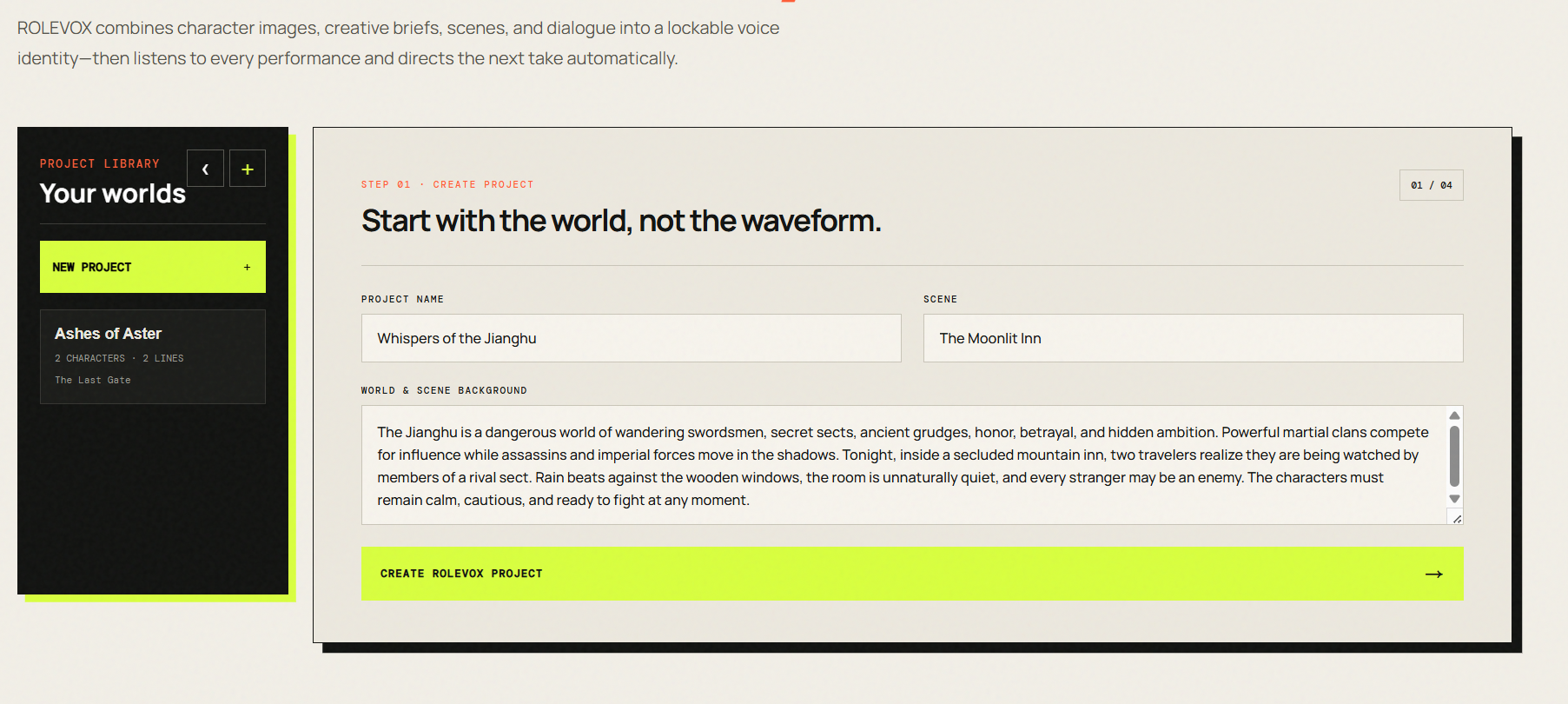
Create a story-driven voice production project with a defined world and scene.
-
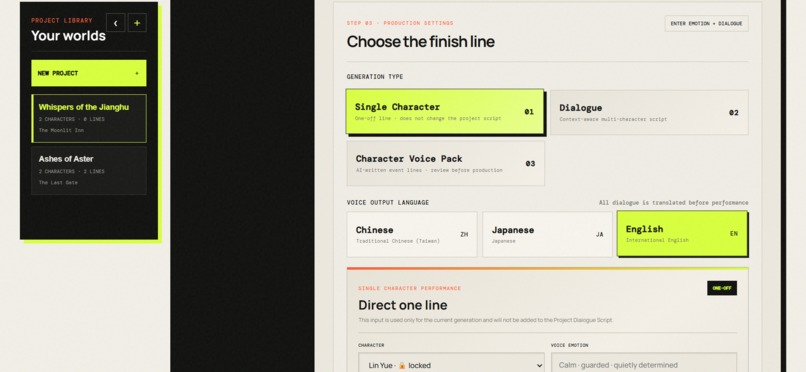
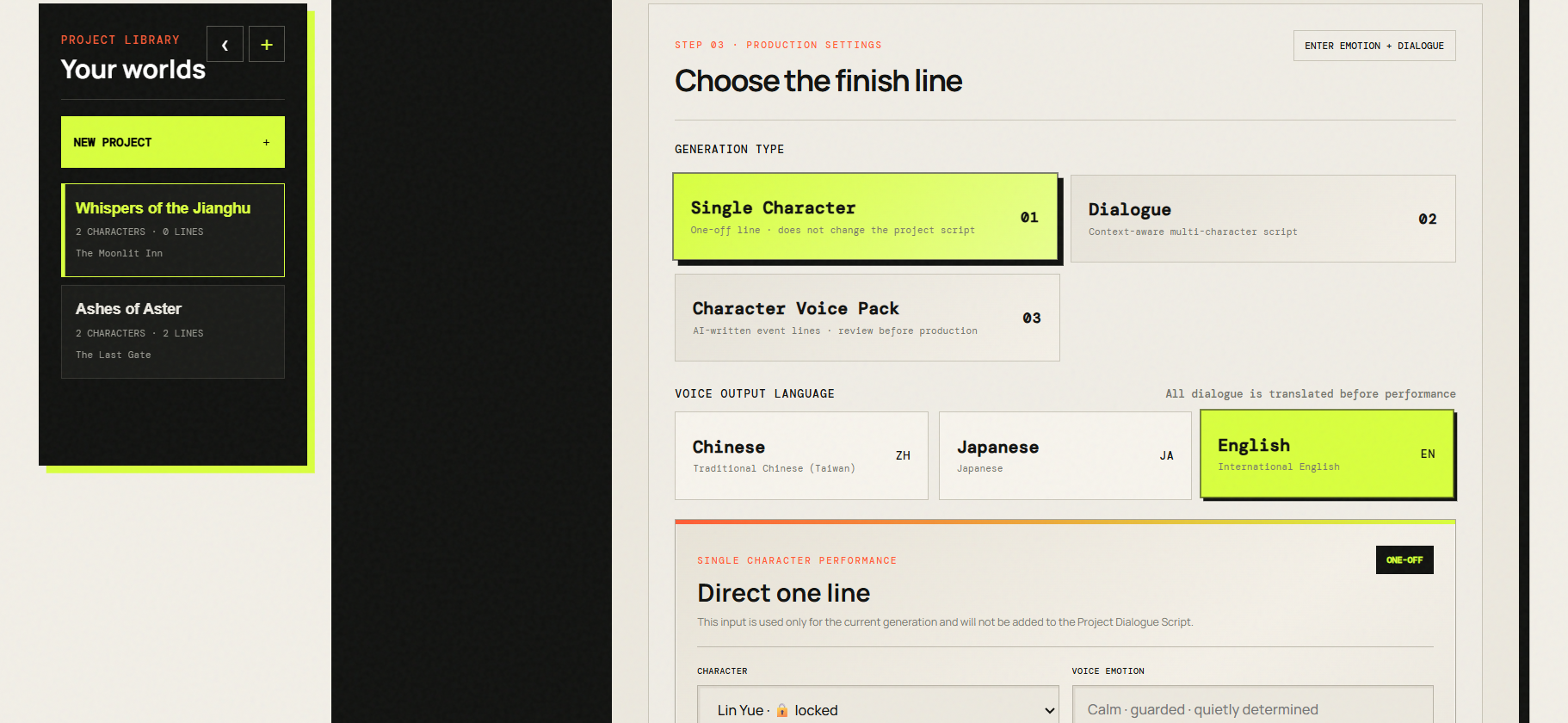
Choose a generation mode and target output language.
-
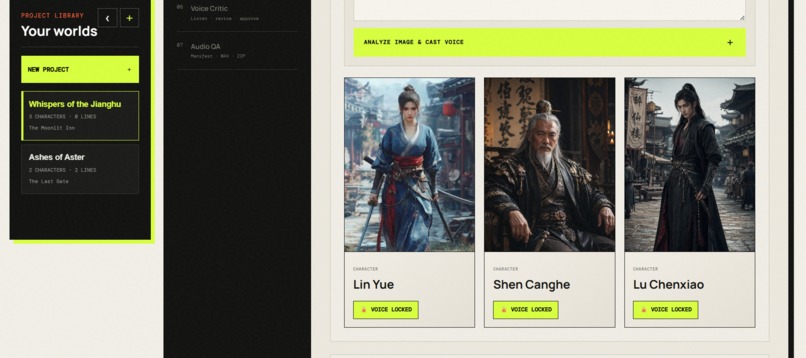
Manage multiple characters with consistent, locked voice identities.

Inspiration
Independent game developers often create memorable characters and stories but lack the time, budget, and production infrastructure required for consistent multilingual voice acting.
Traditional text-to-speech tools can read a line, but game dialogue production involves much more: interpreting the character, selecting a suitable voice, maintaining that identity across scenes, translating dialogue, directing emotion and pacing, reviewing takes, requesting revisions, organizing files, and preparing metadata for a game engine.
We built RoleVox to automate that operational work while keeping identity, intent, and final approval under human control. Our goal was not to build another TTS interface, but an autonomous voice-production system for game characters.
What it does
RoleVox transforms character art, creative briefs, story context, and multilingual scripts into directed, reviewed, game-ready voice assets.
A creator first defines the project world and scene, then creates a Character Card from an original image and written brief. Gemini analyzes the visual design, personality, speaking style, and scene context to produce an explainable casting direction and recommend three compatible Google synthetic voices.
The creator auditions these voices and explicitly selects one. This creates a reusable Voice Lock, ensuring that the character does not unexpectedly change voices between scenes or production runs.
RoleVox provides three workflows:
- Single Character generates a directed one-off line.
- Dialogue produces context-aware multi-character conversations and infers who each speaker is addressing.
- Character Voice Pack drafts editable variations for gameplay events such as greetings, exploration, combat, damage, quests, victory, and relationship moments.
Scripts can be entered manually or imported from CSV, JSON, XLSX, Ink, Yarn, and TXT files. RoleVox supports Traditional Chinese, English, and Japanese output while preserving both the source and translated dialogue.
Before production begins, Production Preflight shows the line count, quality target, revision limit, maximum takes, and bounded TTS-call range. During production, RoleVox directs each line, generates audio, critiques the performance, revises weak takes, and selects the strongest result.
Each completed run produces named WAV assets, multilingual metadata, QA results, SHA-256 hashes, an Autonomous Run Receipt, and export manifests for Unity, Unreal Engine, Godot, and generic pipelines.
How we built it
RoleVox uses Gemini 3.5 Flash on Vertex AI for scene direction, translation, multimodal Visual Casting, dialogue planning, voice-event drafting, and multimodal audio critique.
Gemini 3.1 Flash TTS Preview generates controllable synthetic speech. RoleVox uses only Google’s prebuilt voices and does not accept voice samples, clone voices, or imitate real people.
The production workflow is orchestrated through the Google Agent Development Kit. Specialized stages handle direction, translation, casting, dialogue performance, voice generation, critique, revision, Audio QA, and packaging.
The application runs on Cloud Run with a FastAPI backend and JavaScript interface. Long-running productions are dispatched through Cloud Tasks to an OIDC-authenticated worker. Firestore stores projects, Character Cards, Voice Locks, job state, progress, traces, and results, while private Cloud Storage holds character references and generated packages.
RoleVox also supports an autonomous Cloud Storage inbox. Uploading a validated production manifest triggers Eventarc, allowing the same idempotent workflow to run without an open browser.
Why it is agentic
RoleVox separates human constraints from autonomous execution.
Humans define the characters, story context, dialogue, output language, quality target, revision limit, and final Voice Lock. The agents interpret the scene, translate dialogue, infer addressees, plan each performance, generate takes, listen to the audio, score quality, create revision instructions, select the best take, and package the results.
The Voice Critic evaluates emotion match, character consistency, pronunciation, and scene fit. When a performance falls below the target, RoleVox converts the critique into explicit adjustments to emotion, speaking rate, breathiness, and pauses, then directs another bounded take.
This makes RoleVox a production agent rather than a conversational assistant: it creates operational assets, changes persistent project state, evaluates its own work, and leaves an inspectable record of its decisions.
Challenges we faced
One major challenge was the unpredictable capacity of preview TTS services. A request may fail even when the same voice and dialogue succeeded earlier. We implemented bounded recovery without silently switching a locked character to another voice. If an earlier take succeeds but a later revision fails, RoleVox preserves the strongest successful result and marks it as Best Available · Needs Review.
Another challenge was durable execution. Cloud Run cannot be treated like a persistent local process after an HTTP response finishes. We moved production work to Cloud Tasks and stored every stage in Firestore, allowing users to close the browser and later resume the live view through Project Run History.
Event-driven execution also introduced duplicate-delivery risk. RoleVox creates an idempotency key from the Cloud Storage bucket, object name, and object generation so repeated Eventarc deliveries cannot create duplicate productions.
Finally, autonomous decisions needed to remain understandable. RoleVox exposes the agent trace, Critic feedback, revision parameters, selected takes, consistency summaries, receipts, and file hashes instead of presenting only a final WAV.
What we learned
We learned that reliable agent systems require more than effective prompts. They need explicit state, bounded authority, idempotency, retry policies, identity enforcement, cost limits, and inspectable outputs.
We also learned that creative automation works best when humans control identity and intent while agents handle repetitive execution. Voice Lock became the central boundary between those responsibilities.
Most importantly, generation is only the beginning. A useful autonomous production system must evaluate its output, respond safely to failure, and explain how the final result was selected.
Accomplishments we are proud of
- A complete background production workflow rather than a TTS wrapper
- Explainable multimodal Visual Casting and project-wide Voice Lock
- A Voice Critic that listens, scores, and automatically directs revisions
- Durable Cloud Tasks execution with recoverable persistent state
- Traceable receipts, hashes, QA results, and game-engine-ready exports
- A 26-test regression suite covering the production workflow
- A verified Google Cloud deployment with bounded cost controls
What’s next
Future work includes authenticated team workspaces, stronger per-user isolation, pronunciation dictionaries, timeline-based audio review, direct Unity and Unreal editor plugins, and consent-controlled custom voices when the required Google Voice Replication access and safeguards are available.


Log in or sign up for Devpost to join the conversation.