-
-
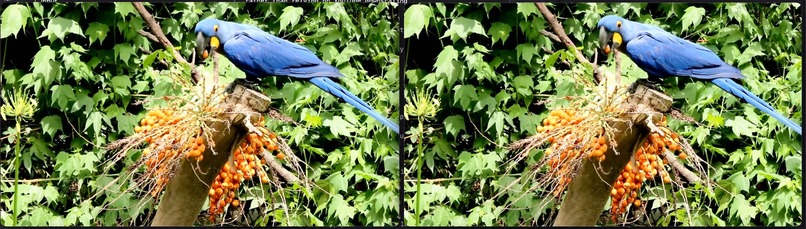
One video is the cover, whereas the other has 60mb of files embedded inside of it. Guess which is which
-
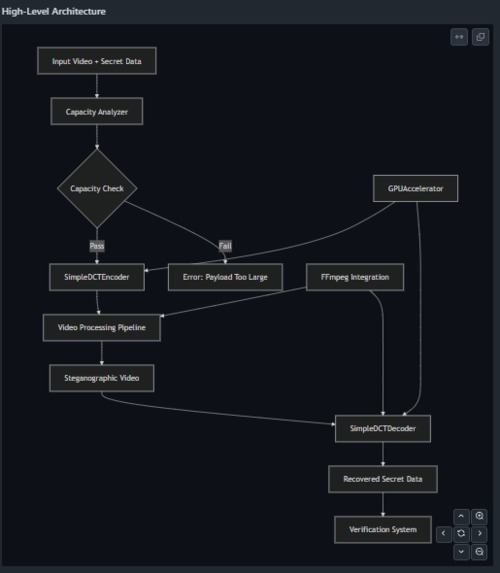
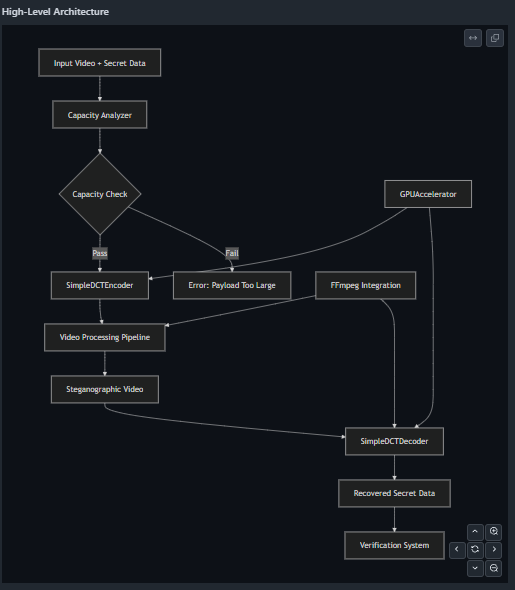
High Level Architecture
-
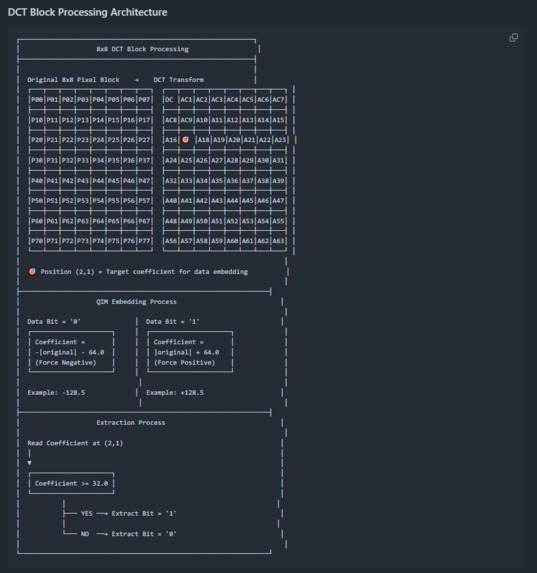
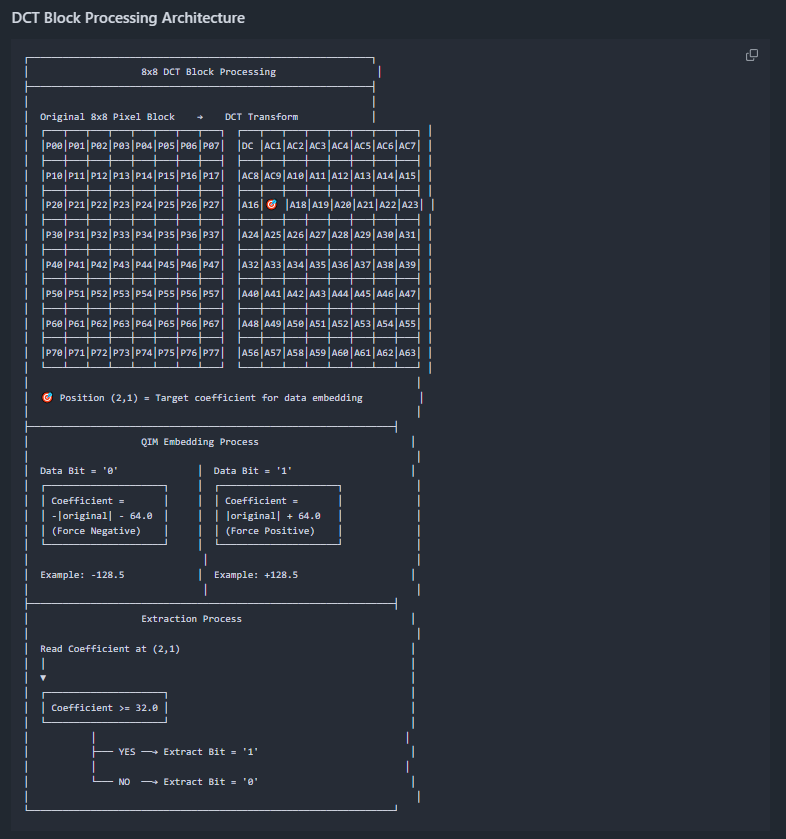
DCT Block Processing Architecture
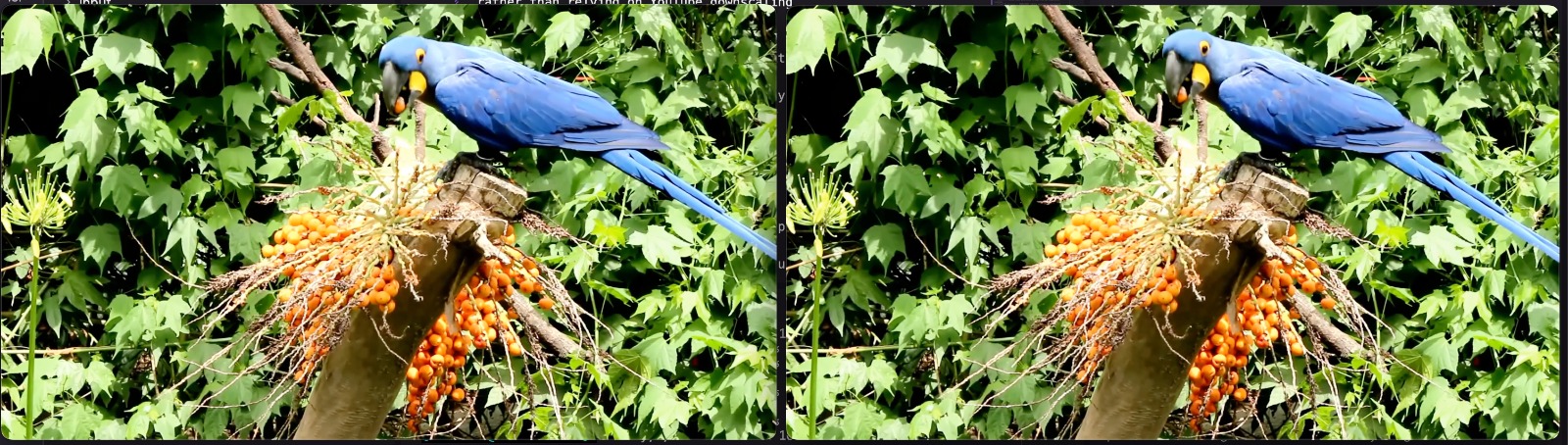
Songbird - "When the bird sings, its song carries more than melody."
Demo Notes
The video is 5:30; however, that's to encompass the full run-through in one single recording (that's been sped up in parts). These time skips (16x speed) are clearly stated in the video (1:15 to 2:15 and 3:15 to 3:45). The audio was also captured via the device microphone. The only other note is that you'll also see some grey boxes. These have been added to preserve the privacy of the device ID and Username.
Project Overview
Songbird represents a production-ready DCT-based video steganography system developed by Panopticon Industries for conservation efforts. The system embeds secret data into video files using Discrete Cosine Transform (DCT) coefficients with Quantisation Index Modulation (QIM), enabling secure archival of sensitive ecological field data.
The inspiration for Songbird originated from the urgent requirement to protect location data, population surveys, and behavioural studies of endangered species. Traditional data transmission methods posed significant security risks, as intercepted communications could reveal critical information about protected wildlife locations to malicious actors. Video steganography offered a solution that could hide conservation data within seemingly innocuous video content, ensuring that sensitive research findings remain accessible to legitimate researchers while remaining invisible to potential threats.
This approach provides imperceptibility to unauthorised observers, making it ideal for covert data transmission in conservation contexts. The system includes password-based encryption using SHA-256 hashing with salt, meaning that even if the video containing the data is discovered, unauthorised parties still cannot access the sensitive information.
This represents the first publicly available production-ready implementation of DCT+QIM video steganography. While this approach has been theorised in academic papers (usually within MATLAB), publicly available code for video steganography typically utilises the "LSB" (Least Significant Bit) approach. The existing DCT steganography code that is available is only for image steganography, making Songbird a pioneering implementation for video applications.
How It Works
The system operates by transforming video frames into 8×8 pixel blocks and applying a DCT to isolate frequency components. A single mid-band coefficient at position (2,1) is then adjusted using QIM to encode binary payload data. Because this coefficient corresponds to visually less critical information, the modifications are not apparent to viewers.
Embedding Process
- Capacity Analysis — calculates maximum payload based on video dimensions and frame count
- Bitstream Creation — converts payload to binary with header (marker + length field)
- DCT Processing — applies DCT to 8×8 grayscale blocks from each frame
- QIM Embedding — modifies coefficient at position (2,1) using quantisation step of 64.0:
- Bit '0': Coefficient = -|original| - 64.0 (forced negative)
- Bit '1': Coefficient = |original| + 64.0 (forced positive)
- Video Reconstruction — applies inverse DCT and preserves audio using FFmpeg
Extraction Process
Extraction reverses this process, applying DCT again and interpreting the coefficient signs to recover the payload:
- Negative coefficient → bit '0'
- Positive coefficient → bit '1'
The system then parses the header, extracts the payload, and verifies integrity using MD5 hash comparison, achieving 100% bit-for-bit accuracy.
Technical Achievements
Core System Features
- DCT-based embedding with 8x8 block processing for compression resistance
- Perfect data recovery with 100% bit-for-bit accuracy verified by MD5 hashing
- Numba JIT acceleration providing 10-100x performance speedup
- Automatic fallback for systems without Numba acceleration
- Password-based encryption using SHA-256 hashing with salt
- Audio preservation maintaining original audio tracks
- Lossless H.264 MP4 output for universal compatibility
Performance Characteristics
- Encoding: Under 10 seconds for typical videos (with Numba acceleration)
- Decoding: Under 30 seconds for data extraction (50-100x speedup)
- Memory usage: Optimised to stay under 2GB with automatic cleanup
- Capacity: Approximately 1 bit per 8x8 DCT block across all frames
Capacity Considerations
The usable payload size is determined by three principal factors: spatial resolution, frame rate, and total duration. The capacity formula is:
Capacity = (width ÷ 8) × (height ÷ 8) × total_frames × 1 bit ÷ 8 bytes
Practical Examples
4K Documentary (3840×2160, 60fps, 1 minute = 3,638 frames):
- Blocks per frame: 480 × 270 = 129,600
- Total capacity: 129,600 × 3,638 = 471.5M bits ≈ 58.94 MB
- Usable capacity: 58.79 MB (after minimal header overhead)
HD Nature Recording (1920×1080, 30fps, 1 minute = 1,800 frames):
- Total capacity: 32,400 × 1,800 = 58.32M bits ≈ 7.29 MB
- Usable capacity: 7.29 MB
Development Methodology & Architecture
Production-Ready Implementation
The system follows a monolithic architecture designed for reliability and ease of deployment:
Core Components:
- SimpleDCTEncoder: Embeds secret data using DCT coefficient modification
- SimpleDCTDecoder: Extracts and reconstructs secret data with perfect fidelity
- Numba Acceleration: JIT compilation for 10-100x performance improvement
- Memory Optimization: Explicit cleanup preventing performance cliffs
- FFmpeg Integration: Handles video I/O and audio preservation
Technical Implementation Highlights
Quantisation Index Modulation (QIM):
# Embedding: Modify DCT coefficients using QIM
def embed_bit_in_block(block, bit, quantization_step):
    dct_block = cv2.dct(block.astype(np.float32))
    coeff = dct_block[2, 1]  # Position (2,1)

    if bit == '0':
        new_coeff = -abs(coeff) - quantization_step
    else:
        new_coeff = abs(coeff) + quantization_step

    dct_block[2, 1] = new_coeff
    return cv2.idct(dct_block)
Robust Extraction:
# Extraction: Distance-based decoding for reliability
def extract_bit_from_block(block, threshold=32.0):
    dct_block = cv2.dct(block.astype(np.float32))
    coeff = dct_block[2, 1]
    return '1' if coeff >= threshold else '0'
Known Issues
- Windows H.264 codec behaviour differs from Mac, causing visual degradation
- Data extraction works perfectly on both platforms
- Demo recordings performed on macOS for optimal results
Conservation Applications
Real-World Use Cases
- Secure archival of endangered species documentation
- Protection of sensitive nesting location data
- Covert distribution of conservation research findings
- Long-term storage of field recordings with embedded metadata
Security Features
- Imperceptible embedding in frequency domain coefficients
- Password protection with SHA-256 encryption and salt
- Perfect data recovery verified by cryptographic hashing
- Compression resistance through DCT-based approach
Technical Innovation
Mathematical Foundations
The system employs sophisticated mathematical techniques:
DCT Theory: Converts spatial domain pixels into frequency coefficients for robust embedding
Quantisation Index Modulation: Ensures data survival through lossy compression
Distance-Based Decoding: Provides immunity to floating-point precision errors
Mathematical Precision
The most crucial learning was understanding numerical stability in digital signal processing:
\begin{align} \text{For coefficient } c \text{ and quantization step } q: \ \text{Unstable: } \text{bit} &= c \bmod q \ \text{Robust: } \text{bit} &= \arg\min_{b \in {0,1}} |c - \text{nearest_state}(b)| \end{align}
Instead of using exact mathematical operations that fail due to tiny rounding errors in video processing, the breakthrough is switching to a distance-based approach that determines which valid data state each coefficient is closest to, creating a robust "safety zone" for reliable data extraction. This mathematical insight was the key breakthrough for perfect data recovery even with floating-point approximation noise from DCT/IDCT operations.
Performance Optimisation
Numba JIT Compilation: Accelerates DCT operations by 10-100x
Memory Management: Prevents performance cliffs during large video processing
Batch Processing: Optimises multiple block operations simultaneously
Research Impact
Academic Contributions
- First production-ready DCT+QIM video steganography implementation
- Demonstrates practical application of theoretical steganographic concepts
- Provides an open-source foundation for conservation technology research
- Validates DCT-based approaches for real-world deployment
Conservation Technology Advancement
- Enables secure field data collection and transmission
- Protects sensitive wildlife location information
- Supports covert conservation research operations
- Provides a robust archival solution for ecological documentation
System Validation
Comprehensive Testing
- 100% data recovery verified across multiple test cases
- Performance benchmarking demonstrating significant speedup improvements
- Capacity validation for various video formats and sizes
Production Readiness
- Monolithic architecture for simplified deployment
- Comprehensive error handling with graceful failure modes
- Detailed documentation including installation and troubleshooting guides
- Open-source availability for community validation and improvement
Research Opportunities
- Compression robustness testing against various video codecs
- Capacity optimisation techniques for higher data density
- Detection resistance analysis against steganalysis tools
- Performance scaling for ultra-high-definition video formats
Conclusion
Project Songbird represents a significant advancement in conservation technology, providing the first production-ready DCT-based video steganography system specifically designed for protecting sensitive ecological data. The system combines rigorous mathematical foundations with practical engineering solutions, delivering a robust tool for secure conservation data transmission.
The project demonstrates that sophisticated steganographic techniques can be successfully implemented for real-world applications, providing conservation researchers with a powerful tool for protecting sensitive wildlife information while maintaining the accessibility and usability of their research data.
Through its open-source availability and comprehensive documentation, Songbird establishes a foundation for future conservation technology development and serves as a practical example of how advanced cryptographic techniques can be applied to environmental protection efforts.
Built With
- 8x8-block-processing
- apple-silicon-metal-performance-shaders
- automatic-fallback-systems
- cross-platform-compatibility-(windows/macos/linux)
- cryptography
- cuda
- dct-(discrete-cosine-transform)
- ffmpeg
- ffprobe
- ffv1-codec
- git
- hardware-acceleration
- jit-compilation
- lossless-video-compression
- md5-hashing
- mkv-container
- numba
- numpy
- object-oriented-programming
- opencv
- python-3.8+
- qim-(quantization-index-modulation)
- reed-solomon
- scipy
- sha-256
- simd-instructions
- virtual-environments


Log in or sign up for Devpost to join the conversation.