Inspiration
For a long time, hearing someone’s voice has been a way to recognize and trust who is behind a call. However, with the rise of AI-generated and cloned voices, hearing a voice that sounds human is no longer always enough.
This led us to ask one question:
What if we used artificial intelligence to solve a problem created by artificial intelligence?
A person can listen to a call and think it sounds completely real, but a system can analyze audio characteristics that are difficult for us to perceive.
After 36 hours of work during the hackathon, that question became SONDA.
Our goal is to help Altur add an extra layer of security and trust to every call.
What it does
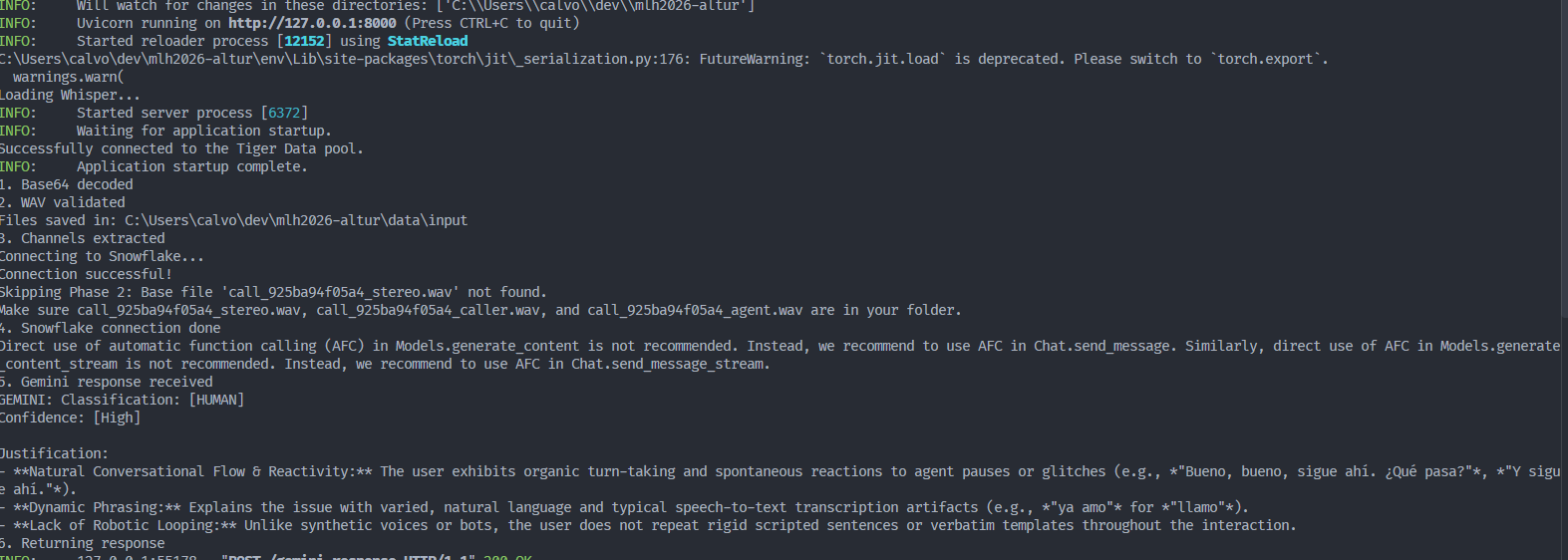
SONDA analyzes call audio to detect whether a voice is likely human or shows signs of being synthetic.
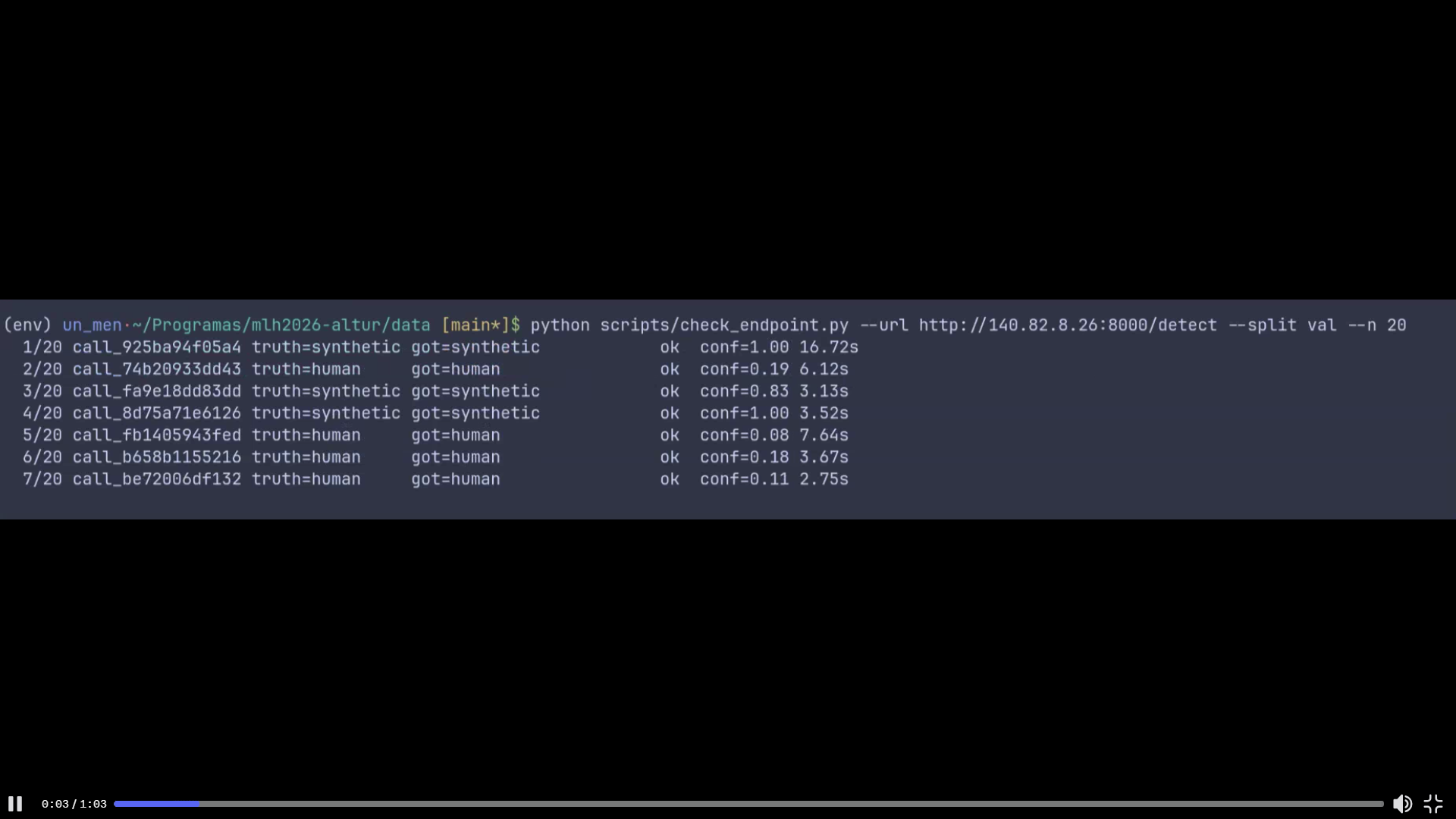
Users can upload one or multiple audio files to our platform. SONDA analyzes each file and displays its result individually, including the prediction and the probability that the voice is synthetic.
We wanted the result to be more than just a technical number. Our goal was to present the information in a simple and understandable way, helping users quickly identify calls that may require additional attention.
To develop our solution, we worked with the 300 calls provided by Altur, using artificial intelligence to identify signals that may be difficult to detect with the human ear alone.
SONDA is not meant to be just another AI voice detector. We want it to become an additional layer of trust for companies that rely on voice interactions.
How we built it
We divided SONDA into two main parts: audio analysis and user experience.
For the analysis, we worked with the audio provided by Altur and developed a system capable of evaluating each recording to estimate the probability of a voice being human or synthetic.
For the platform, we developed a web interface using React and TypeScript. Users can upload multiple audio files, send them for analysis, and review the result of each call individually.
The interface communicates with our analysis system through an API, allowing us to receive and display the prediction, synthetic voice probability, and status generated for each audio file.
We focused not only on making the technology work, but also on making the results easy to understand and useful for Altur.
Challenges we ran into
One of our biggest challenges was transforming a complex artificial intelligence analysis into information that could actually be useful and easy to understand.
Detecting a synthetic voice is not simply about deciding whether something "sounds real." AI-generated voices can imitate many of the characteristics that we normally associate with human speech.
Another important challenge was connecting the different parts of our project. We had to integrate the audio analysis system with our web platform, process multiple audio files, and display individual results in a simple and intuitive way.
And we had one major limitation: we only had 36 hours to turn our idea into a functional prototype.
Accomplishments that we're proud of
We are proud that SONDA went from being an idea to becoming a functional prototype during the hackathon.
In only 36 hours, we were able to connect AI-powered audio analysis with a platform designed around a real-world use case.
We also had the opportunity to work with the 300 calls provided by Altur, allowing us to develop our solution around the actual problem presented in the challenge.
But one of our biggest accomplishments was changing the way we approached artificial intelligence. Instead of only asking what AI can generate, we asked:
How can we use AI to detect what was also generated by AI?
What we learned
This project taught us that solving a problem with artificial intelligence requires much more than developing a model.
We learned about audio analysis, synthetic voice detection, API integration, frontend development, and how different technical areas need to work together to create a complete product.
We also learned how important user experience is. A probability or prediction alone is not enough; the information needs to be presented in a way that helps someone quickly understand what is happening.
Most importantly, we learned how much a team with different skills can accomplish when working toward the same goal in only 36 hours.
What's next for SONDA
We hope SONDA does not remain only a project developed during these 36 hours.
Our goal is for Altur to consider SONDA as a solution with the potential to be implemented and further developed within its processes, helping create greater security and trust in its calls.
We know there is still a lot to improve and develop. With the support of sponsors, technology partners, or even Altur itself, we hope SONDA can continue growing beyond the hackathon and eventually become a tool that can be implemented in a real-world environment.
For us, these 36 hours were only the beginning.
Built With
- css
- elevenlabs
- geminiapi
- github
- htlm
- javascript
- jupyternotebook
- python
- snowflake
- tigerdata
- typescript
- vscode
- vultr

Log in or sign up for Devpost to join the conversation.