Inspiration
Every engineer who has ever carried an on-call pager knows the 3:17 AM feeling.
Your phone screams with PagerDuty alerts. You're half-asleep, stumbling in the dark, squinting at a bright laptop screen through bloodshot eyes. Or worse: you’re Away From Keyboard (AFK)—stuck in traffic, cooking dinner, or taking care of your family—and a critical severity alarm fires.
We asked ourselves a simple question: Why are voice assistants still treated as glorified kitchen timers and music shufflers, when engineers need hands-free situational awareness the most?
When we started researching existing voice-devops tools, we immediately saw why they fail in production:
They are unlistenable: An AI dumping 40 lines of JSON logs, UUIDs, or raw stack traces over an Echo speaker causes immediate acoustic fatigue. The human ear simply cannot parse raw terminal output.
They chase symptoms instead of causes: When an incident strikes, a naive tool reports: "Checkout API is throwing 504 errors." But an experienced Site Reliability Engineer knows that's just a downstream casualty—the actual fire started elsewhere.
They are terrifyingly dangerous: If an engineer tells a voice assistant "Roll back the deployment" or "Restart the cluster", any background acoustic noise, radio chatter, or speech recognition glitch could trigger a catastrophic, irreversible outage.
We built SonarOps to solve these three real-world realities: bringing the rigor of modern Site Reliability Engineering (SRE) to Alexa+ through ear-optimized acoustic triage, causal graph topology analysis, and an air-traffic-control style Two-Phase Voice Commit safety protocol.
⚙️ What It Does SonarOps turns Alexa+ into an autonomous Incident Commander that operates as a calm, disciplined co-pilot during high-stress cloud outages:
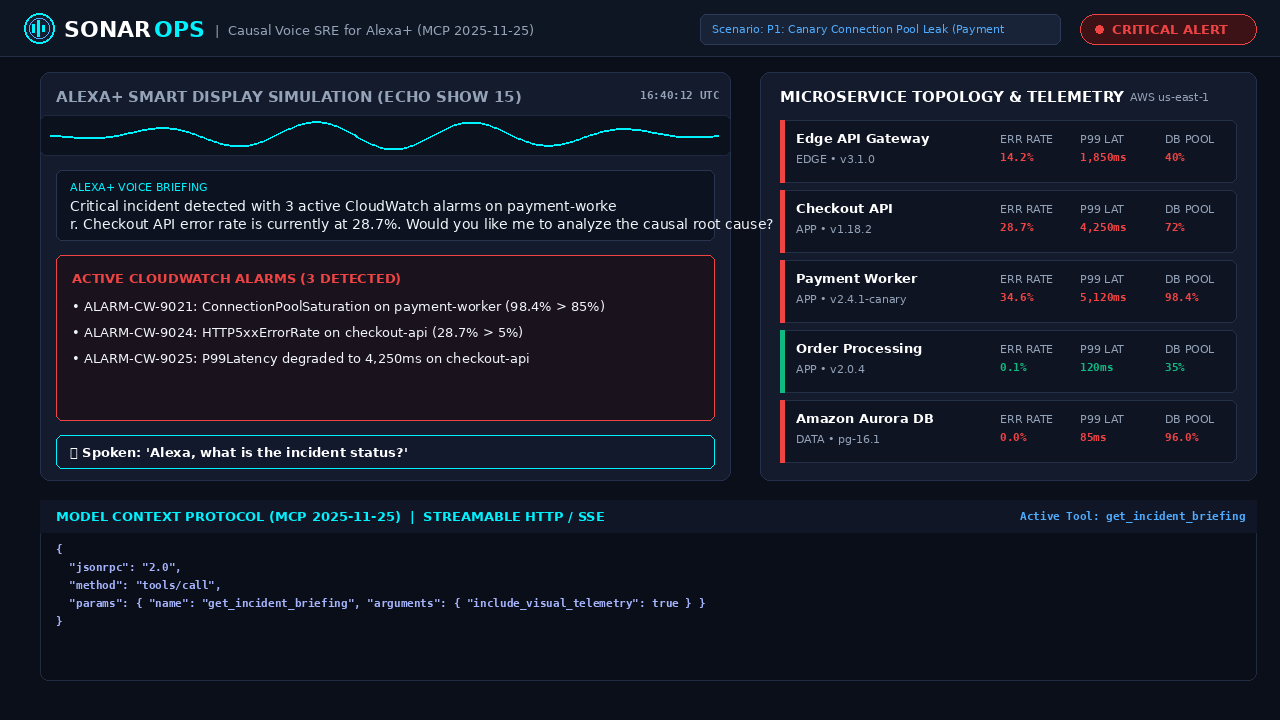
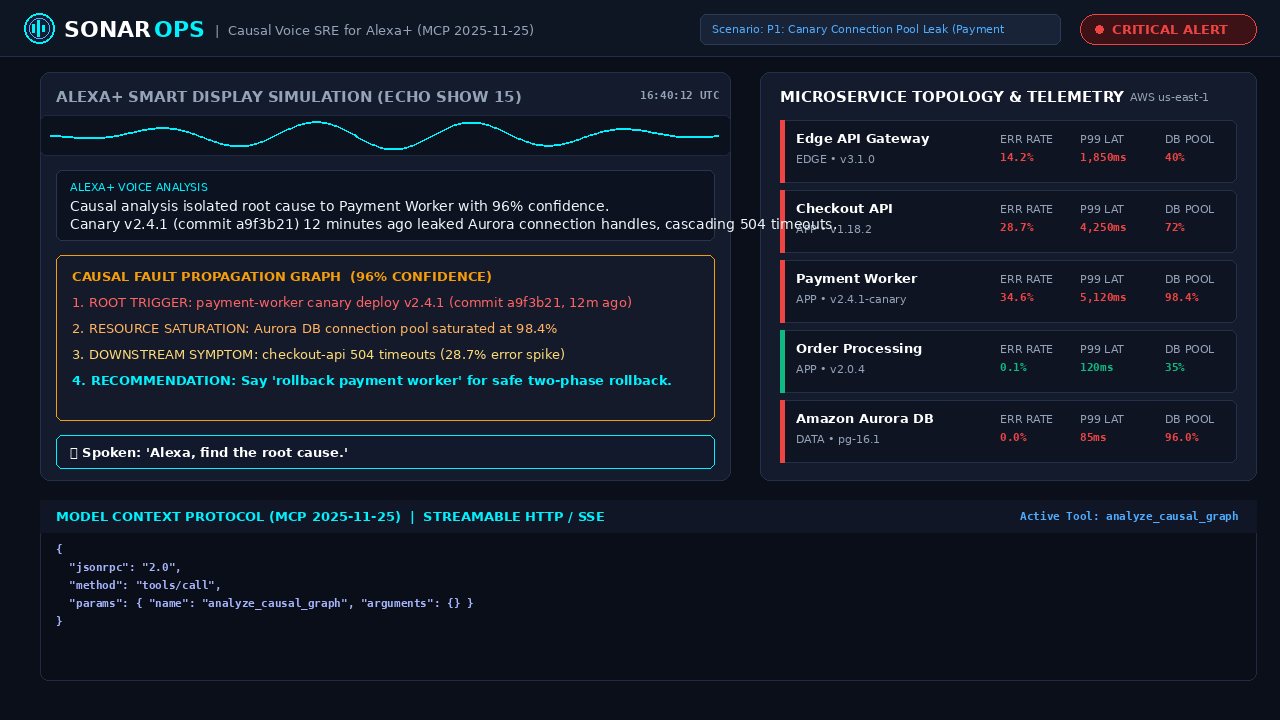
Acoustic-First Incident Briefings: Rather than bombarding the engineer with raw logs, SonarOps dispatches the get_incident_briefing MCP tool to deliver a concise, natural-language executive summary over voice, while concurrently projecting rich visual telemetry cards and latency sparklines onto smart displays like the Echo Show 15.
Causal Graph & Root-Cause Traversal: When you ask "Alexa, find the root cause", the analyze_causal_graph tool doesn't just read CloudWatch alarms. It traverses the microservice dependency topology, cross-referencing alarm timestamps with recent container task revisions and git commits. It pinpoints the exact failure trigger (e.g., "Canary deployment v2.4.1 of Payment Worker leaked database connection handles 12 minutes ago") and maps the downstream blast radius.
Two-Phase Voice Commit Safety Guardrail: To eliminate accidental executions, SonarOps enforces a strict two-phase protocol:
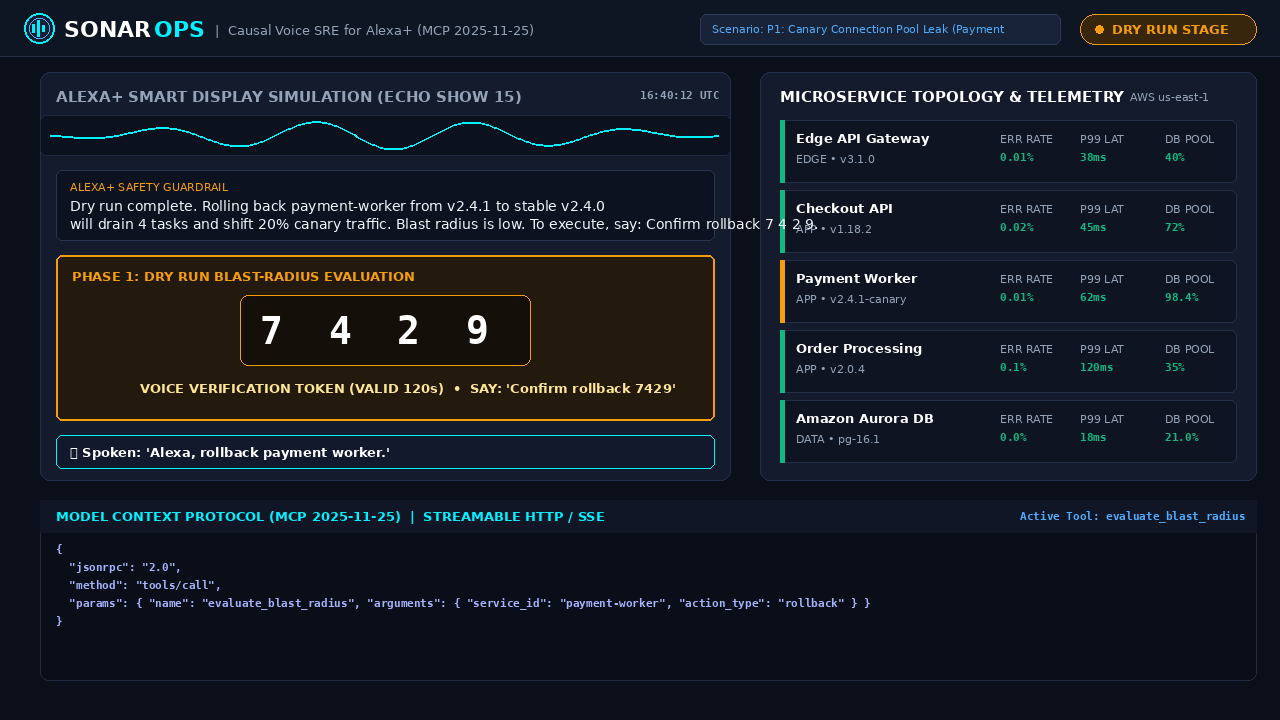
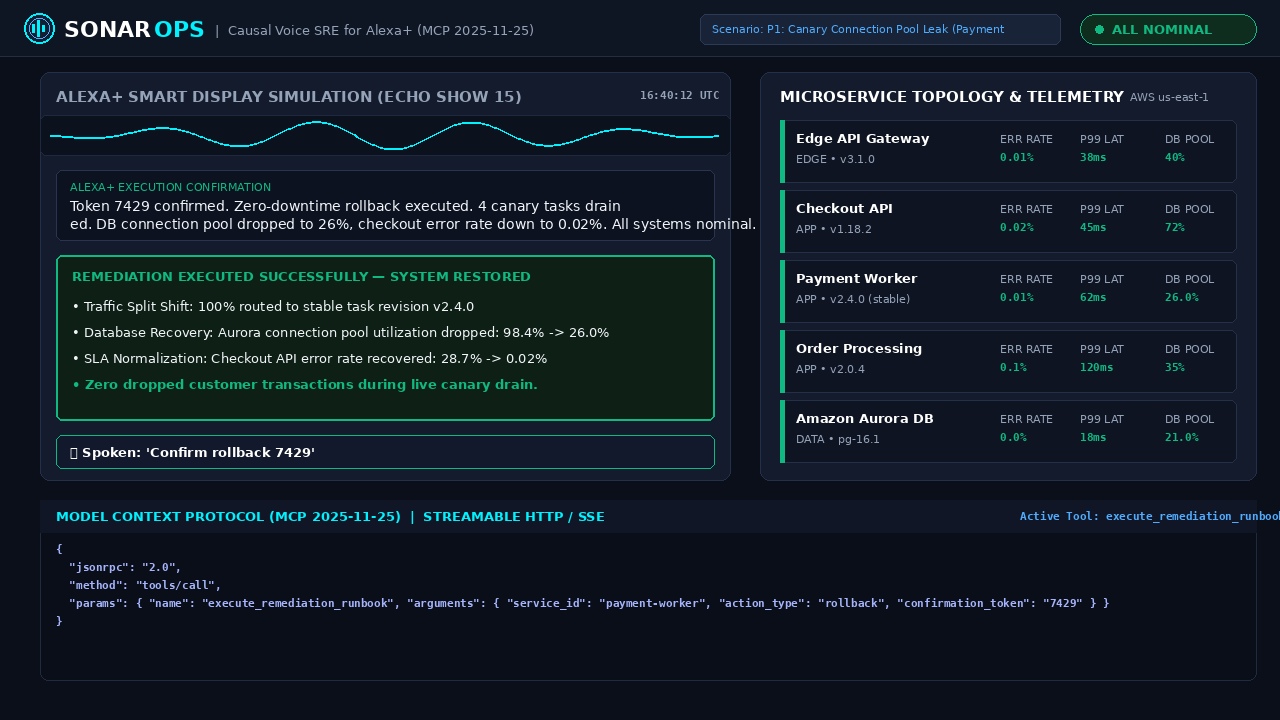
Phase 1 (Dry Run): The evaluate_blast_radius tool simulates the action, calculates downtime and drained tasks, and generates an ephemeral, cryptographically bound 4-digit token (e.g., 7429).
Phase 2 (Verified Commit): The remediation (execute_remediation_runbook) will only proceed when the engineer explicitly confirms the spoken token ("Confirm rollback 7429").
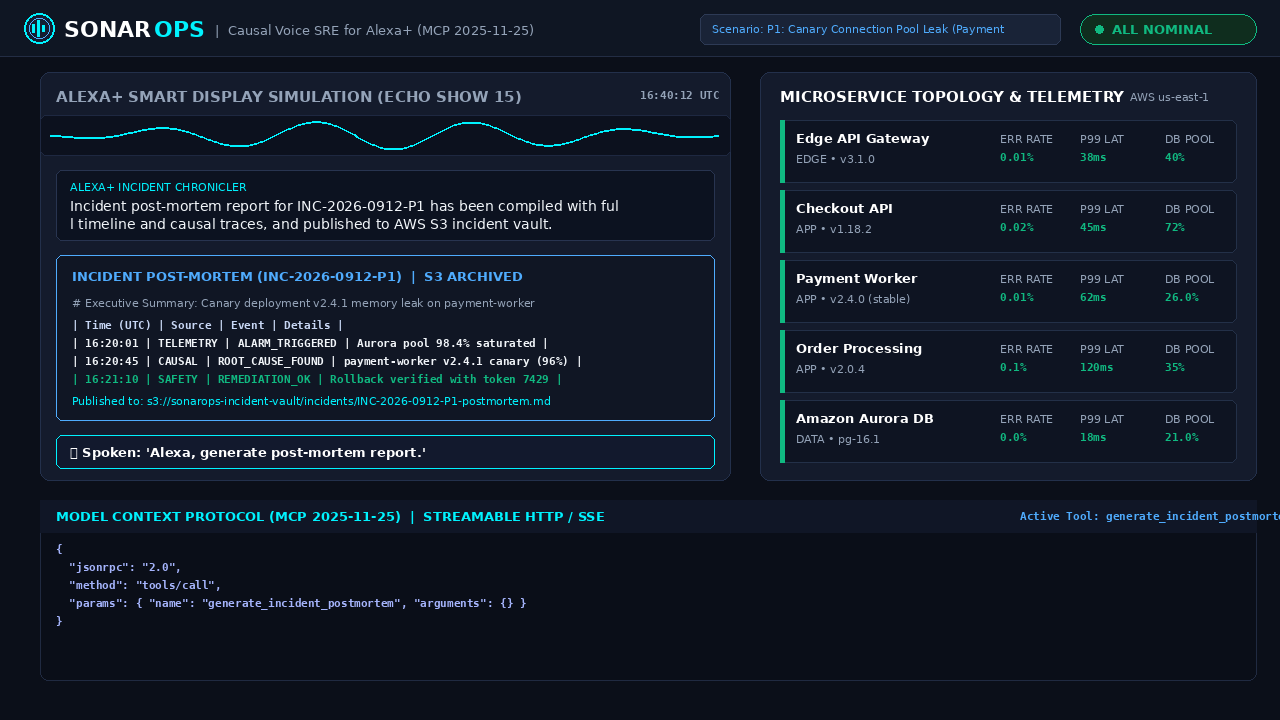
Autonomous Incident Chronicler & SRE Post-Mortem: Every voice interaction, telemetry shift, and operational change is immutably recorded into an SRE-compliant post-mortem report ready for automated archival to Amazon S3.
Multi-Modal Smart Display Simulation: A standalone, responsive web experience replicating an Echo Show device, featuring an animated HTML5 Canvas audio waveform, live microservice status badges, CloudWatch alarm drawers, and an inspectable JSON-RPC 2.0 / SSE stream monitor.
🛠️ How We Built It We engineered SonarOps from the ground up as a native Model Context Protocol (MCP) server adhering strictly to the 2025-11-25 Streamable HTTP specification:
Backend & MCP Transport: Implemented in Python using FastAPI and Pydantic. We built both standard JSON-RPC 2.0 HTTP endpoints (/mcp/v1/call, /mcp/v1/tools) and a persistent Server-Sent Events (SSE) stream (/mcp/v1/stream) to deliver real-time agent thoughts and telemetry updates.
Causal Inference Engine: Built a directed dependency graph model representing modern enterprise cloud architecture (Edge API Gateway, Checkout API, Payment Worker, Order Engine, and Amazon Aurora PostgreSQL). It computes correlation coefficients between deployment event timestamps and metric inflection points to produce a confidence score (e.g., 96%).
Cryptographic Safety Guard: Designed VoiceSafetyGuard, an in-memory verification engine that generates random 4-digit tokens with a 120-second TTL. It enforces one-time consumption to prevent replay attacks and binds tokens to specific service IDs.
AWS Integration Architecture: Built client adapters for AWS CloudWatch (metrics and alarms), Amazon Aurora (connection pool telemetry), and Amazon S3 (post-mortem Markdown publishing), complete with realistic offline telemetry providers so anyone can test the system without requiring active AWS billing credentials.
Multi-Modal Frontend: Handcrafted an obsidian-and-cyan glassmorphism interface with zero heavy frontend framework dependencies. It utilizes the browser's native Web Speech API for hands-free microphone listening and audio speech synthesis, paired with an HTML5 Canvas sine-wave visualizer.
🚧 Challenges We Ran Into The "Voice Usability vs. Telemetry Density" Dilemma:
In distributed cloud systems, an incident generates hundreds of metric points. Trying to verbalize all of them sounded robotic and unintelligible. We solved this by designing dual-channel payloads: the MCP server formats an ear-friendly 2-sentence conversational summary for Alexa's voice channel, while attaching high-density structured JSON payloads to drive visual charts on the Echo Show screen.
Preventing Voice Token False-Positives:
In early prototypes, if an engineer asked "What is the status of port 8080?", our regex parser would detect four digits and accidentally attempt to trigger a token commit! We re-architected the intent router in mcp/server.py to enforce strict discrimination: the commit phase now requires explicit confirmation keywords ("confirm", "approve", "proceed") or a standalone token utterance, while dynamically verifying the target service from VoiceSafetyGuard metadata.
Building Reliable Streamable HTTP (SSE) in Python:
Implementing the MCP 2025-11-25 specification required handling long-lived Server-Sent Events connections with proper client disconnect detection, heartbeat frames, and JSON-RPC message framing without blocking the async event loop.
🏆 Accomplishments That We're Proud Of 100% Specification Conformance: Built a clean, fully compliant Model Context Protocol server matching the MCP 2025-11-25 Streamable HTTP standard.
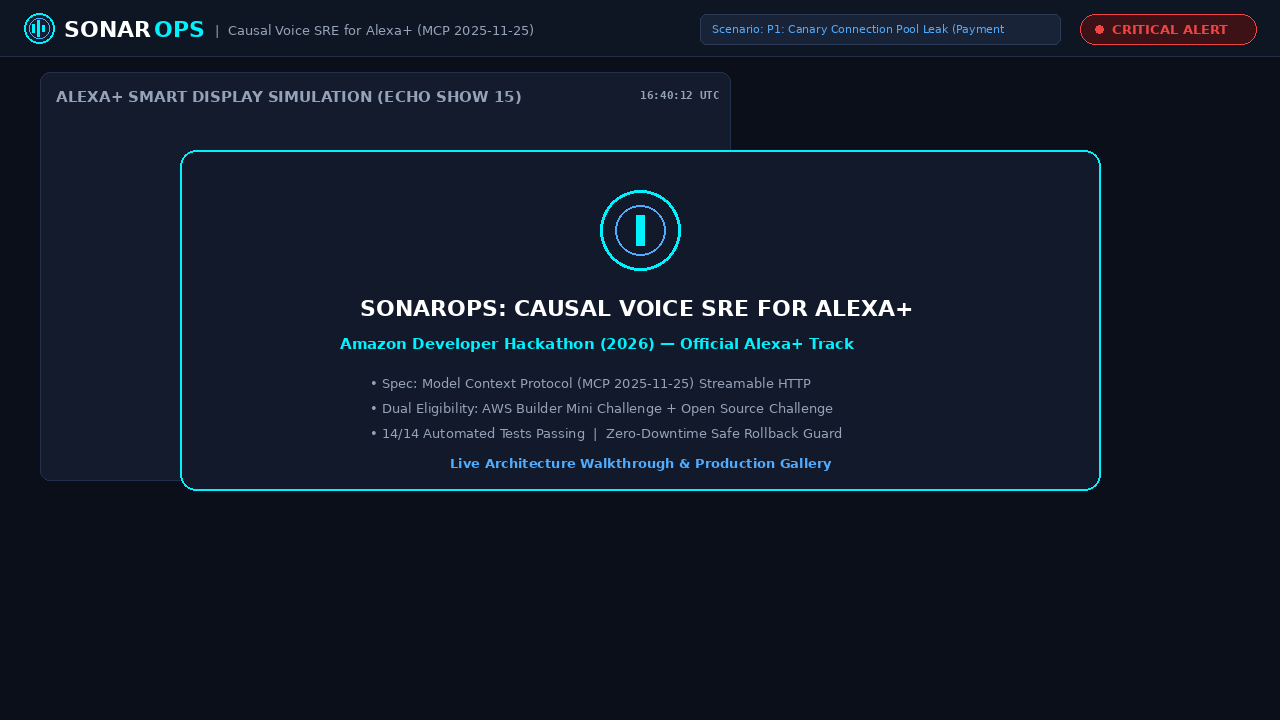
14/14 Automated Tests Passing: Created a comprehensive test suite covering protocol schemas, causal graph analysis, safety token replay prevention, and end-to-end API lifecycles, running in under 0.4 seconds.
Multi-Scenario Simulation Engine: Built instant switching between 4 distinct cloud states: P1 Canary Leak, P1 Auth Gateway Timeout, P2 Aurora DB Saturation, and Nominal SLA.
Zero External Binary Bloat: The entire frontend runs with native Web APIs and embedded SVG assets—no bulky node_modules or external CDNs required.
📚 What We Learned Voice requires strict operational guardrails: In cloud infrastructure, convenience cannot come at the expense of safety. The Two-Phase Commit protocol proved to be an intuitive mechanism that gives engineers complete peace of mind when issuing voice commands.
MCP is the future of agentic tools: Moving from proprietary webhook glue to the Model Context Protocol standard dramatically simplified tool discovery, parameter schema validation, and multi-modal feedback loops.
🔮 What's Next for SonarOps Live Infrastructure Runbooks: Adding automated execution plugins for AWS Systems Manager (SSM) and AWS CDK deployment rollbacks.
Biometric Voiceprint Verification: Integrating voice biometrics so only authorized on-call engineers can speak confirmation tokens for production-tier changes.
Official Alexa+ Skill Publishing: Packaging the MCP server as an enterprise-certified Alexa+ Agent Skill in the Amazon Developer Console.
🧰 Built With (Tags) python, fastapi, model-context-protocol, mcp-2025-11-25, streamable-http, sse, aws-cloudwatch, aws-aurora, aws-s3, alexa-plus, html5-canvas, web-speech-api, docker, mit-license
🔗 Project Links GitHub Repository: https://github.com/pactender/sonarops
Video Demonstration (MP4): SonarOps Demo Video Walkthrough
Full Source Code (ZIP): SonarOps Project Source Code v2
Hackathon Portal: Build, Ship, Shape: Amazon Developer Hackathon on Devpost
