-
-
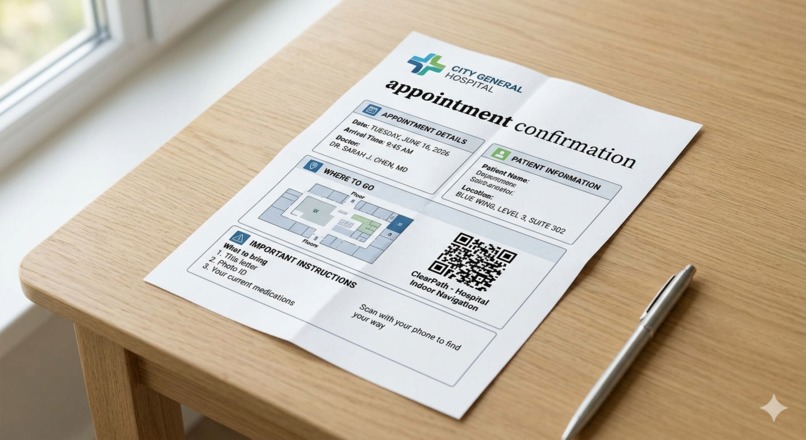
What an appointment slip might look like in the future with our service
Inspiration
Every year, hospitals lose millions of dollars in revenue from missed and late appointments — and a surprising percentage of those are caused by patients simply getting lost. We watched elderly visitors wandering hospital corridors, stressed families stopping nurses to ask for directions, and people with mobility limitations trying to navigate buildings that were never designed with them in mind. Existing solutions like BLE beacon systems and kiosk wayfinding cost hundreds of thousands of dollars to deploy and still require a native app download. We believed there had to be a simpler way — one that met patients exactly where they are, with the phone already in their hand.
What it does
ClearPath is a zero-infrastructure indoor navigation system for hospitals. A patient scans a QR code on the wall, photographs their appointment slip, and our AI extracts their destination and guides them turn-by-turn through the building — no app download, no Bluetooth hardware, no setup on the patient's part. Wheelchair users get step-free routes automatically. The map rotates as they walk. If a corridor closes mid-navigation, an admin updates it in a dashboard and every active session reroutes in real time. For hospital administrators, ClearPath also converts existing floor plan files into a fully navigable anchor graph, eliminating the manual mapping work that makes competing systems so expensive to deploy. How we built it
We built ClearPath as a Next.js web app deployed on Vercel, using Supabase for the database and real-time route update propagation. The patient-facing app is a mobile web experience that opens instantly from a QR scan — no install required. Google Gemini 1.5 Flash will handle appointment slip OCR, extracting destination, doctor, and floor information from a photo and returning structured JSON with per-field confidence scores. Routing runs server-side using Dijkstra's algorithm on an anchor graph stored in Supabase, with edge filters for accessibility constraints. Floor plan ingestion uses a pipeline of pdfplumber for vector PDF parsing, Gemini for semantic room label extraction, and scikit-image skeletonization to derive corridor centerlines and candidate anchor placements automatically.
Challenges we ran into
The hardest problem was indoor positioning without any hardware. GPS fails inside concrete buildings, and BLE beacons require physical installation. Our solution was to treat QR codes as the ground truth — each scan is an exact position fix — and use the phone's gyroscope and step detection to animate the position dot between scans. The result feels like a live map without any infrastructure beyond a printed sticker. Floor plan extraction was the other major challenge: hospital floor plans are wildly inconsistent across CAD systems and vintages, and distinguishing room labels from dimension annotations required a semantic layer that pure geometry parsing cannot provide. Feeding the extracted text into Gemini to disambiguate it was the insight that made the pipeline reliable.
Accomplishments that we're proud of
We're proud that the entire patient experience requires zero downloads, zero accounts, and zero prior knowledge of the system — a patient who has never heard of ClearPath can be navigating in under 30 seconds from their first QR scan. We're also proud of the accessibility architecture: step-free routing, large-text high-contrast UI, and a camera-based OCR flow that means patients never have to type anything. Building a system that works for an 80-year-old with shaky hands and a stressed parent carrying a child felt like the right design target, and we hit it.
What we learned
We learned that the hardest problems in this space are not technical — they're about trust and friction. A patient in a hospital is already stressed, and any moment of confusion in the app compounds that stress. Every design decision had to be evaluated against the question: what does this feel like at 9am when you're late to an oncology appointment and your hands are shaking? That constraint made us better engineers and better designers. We also learned that the QR-as-GPS model is more powerful than it initially appears — the simplicity of the anchoring system is what makes the whole product deployable without an IT team.
What's next for ClearPath
The immediate next step is a pilot with a real hospital — one wing, one floor, real patients. The data from that pilot tells us where the navigation breaks down and which OCR edge cases we haven't seen yet. Beyond that, the floor plan ingestion pipeline gets us to a world where a hospital can upload their CAD file on a Monday and have QR markers deployed by Friday, with no specialized expertise required. Longer term, the same anchor infrastructure supports blind users through real-time camera-based audio guidance, and the same routing engine scales directly to airports, university campuses, and convention centers — any large indoor space where people consistently get lost.

Log in or sign up for Devpost to join the conversation.