-
-
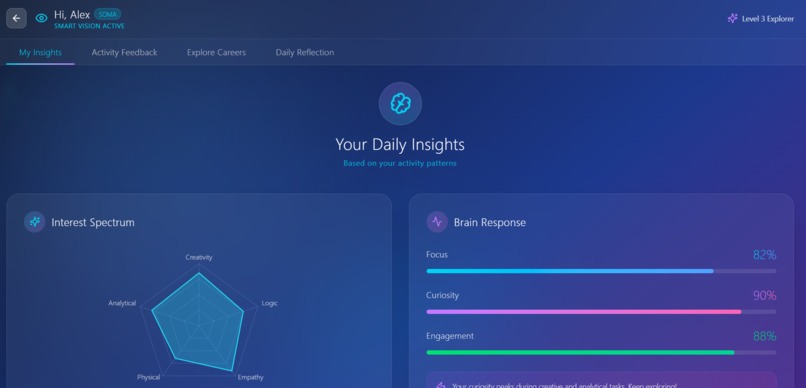
overview
-
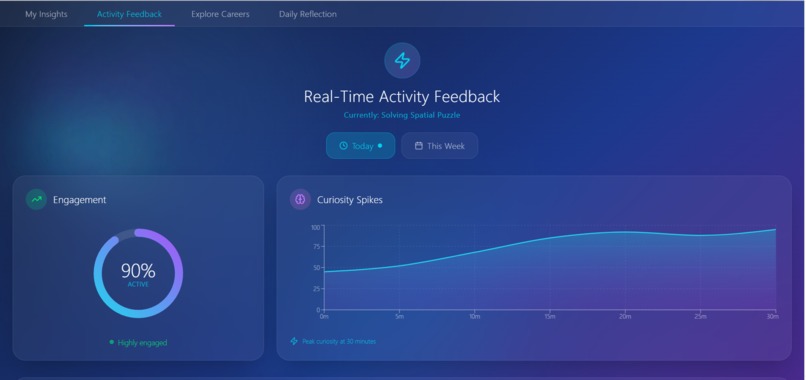
Activity feedback
-
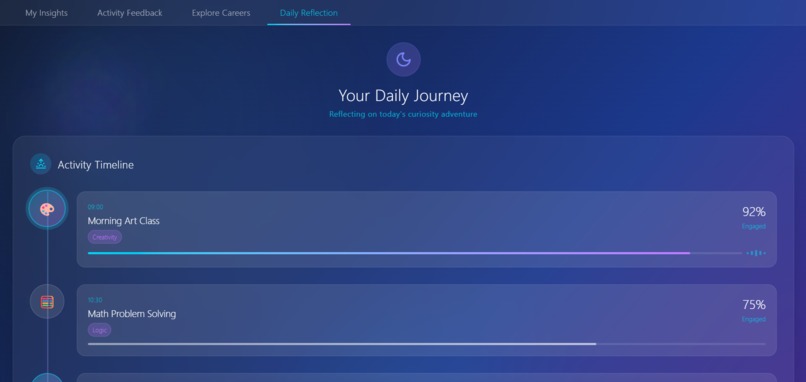
daily jouney
-
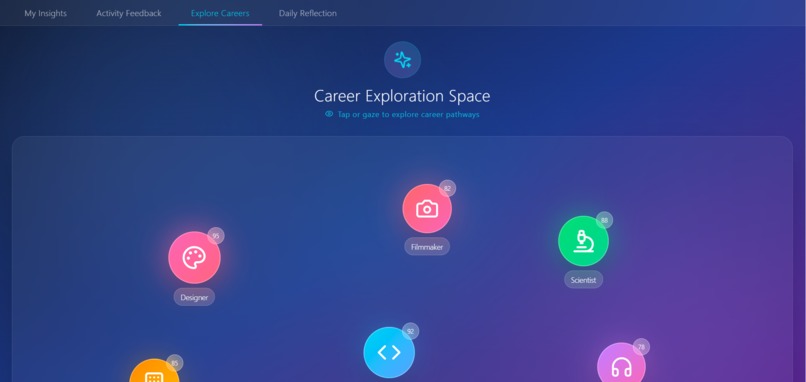
explore fields
-
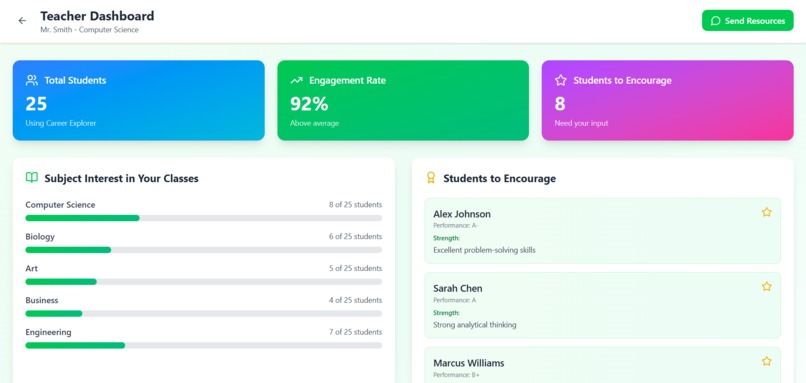
dashboard for teacher
-
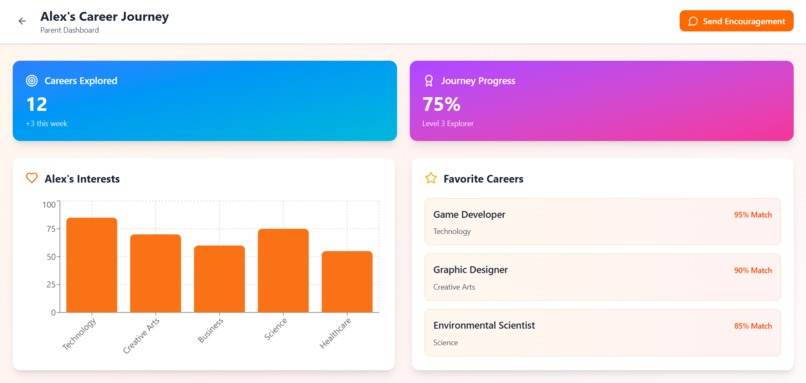
dachboard for parents


SOMA — Smart Observational Mentorship Assistance
A speculative AI-driven system for sensing student engagement and guiding career exploration*
Inspiration
The idea for SOMA emerged from reflecting on a common experience many students face:
The confusion of choosing a career path at a young age.
Students are often asked questions such as:
- What do you want to become?
- What subjects do you like?
- What are you good at?
However, at the age of 16 or 17, many students are still discovering their interests and strengths. Career counseling systems today often rely on questionnaires, aptitude tests, and interviews, which depend heavily on self-reported answers. These answers can be influenced by parents, teachers, social expectations, or limited exposure to different career possibilities.
This led me to a simple but powerful question: What if students didn’t have to explain their interests — what if their experiences could reveal them instead?
Humans constantly interact with the world through sensory responses. When we are engaged in an activity we enjoy, our attention increases, our focus deepens, and our curiosity becomes visible through our behavior and physiological responses.
This insight inspired SOMA, a speculative tool that observes these sensory interactions to help students better understand their natural inclinations.
What I Learned
Working on SOMA helped me explore ideas across several disciplines:
- Human Senses and Engagement Human interaction with activities is deeply connected to sensory responses such as:
- visual attention
- auditory engagement
- emotional response
- physical interaction with the environment These signals often reveal interest and curiosity more reliably than verbal responses.
The Role of AI in Interpretation AI can act as a pattern recognition system that processes large volumes of behavioral data. Instead of making decisions, AI can assist in interpreting patterns and presenting insights.
- Speculative Design SOMA is not just a product idea—it is a speculative design proposal. It imagines how future technology might transform career counseling by shifting from question-based evaluation to experiential observation.
How I Built the Project
The project was developed through several stages:
- Identifying the Problem I first analyzed the limitations of current career counseling systems:
- dependence on questionnaires
- lack of contextual behavioral data
- influence from external opinions
This helped frame the core design challenge: How might we observe and interpret a student’s natural engagement with activities?
- Concept Development
The idea evolved into SOMA — Smart Observational Mentorship Assistance, consisting of three main components:
Wearable Sensory Interface A temple-mounted wearable integrated into immersive glasses that collects signals related to attention, engagement, and sensory responses while students perform everyday activities.
- AI Interpretation System A trained AI assistant processes the collected signals and identifies patterns across different experiences.
- Immersive Insight Interface Students interact with SOMA through voice or touch commands, which display insights through an immersive interface showing:
- engagement patterns
- activities that trigger curiosity
- emerging interest areas
These insights can also be shared with parents and teachers, enabling more informed guidance.
- User Scenario Development
To communicate the concept clearly, I created a narrative scenario around a student named Alex, a 17-year-old exploring career choices.
This narrative helped demonstrate how SOMA could support students in understanding their interests through everyday experiences.
Challenges I Faced
- Translating Abstract Ideas into a Clear Concept
One of the biggest challenges was turning an abstract idea—observing sensory engagement—into a clear system design.
I had to think carefully about:
- what signals might realistically be captured
- how AI could interpret them
- how insights could be presented meaningfully.
Avoiding Deterministic Career Predictions Another challenge was ensuring that SOMA does not decide a student’s future. The goal is not prediction, but reflection and guidance. SOMA acts as a mentor-like system that helps students explore possibilities rather than prescribing a path.
- Ethical Considerations Since SOMA involves collecting behavioral data, it raised important questions about:
- privacy
- consent
- responsible data use
- transparency of AI interpretations
These considerations shaped the idea of SOMA as a supportive and collaborative tool, not a controlling system.
Conclusion
SOMA imagines a future where career guidance is not based solely on what students say about themselves, but on how they truly experience and engage with the world.
By combining:
- sensory observation
- AI-driven pattern recognition
- immersive visualization
SOMA helps students discover their interests through real-life experiences rather than assumptions.
Ultimately, the goal of SOMA is simple:
To help students understand themselves better before making decisions about their future.nspiration What it does How we built it Challenges we ran into Accomplishments that we're proud of What we learned What's next for SOMA: Smart Observation & Mentorship Assistant


Log in or sign up for Devpost to join the conversation.