-
-
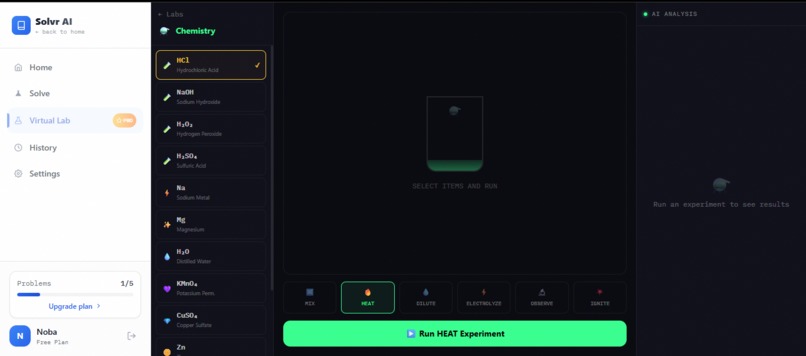
Virtual lab powered by claude
-
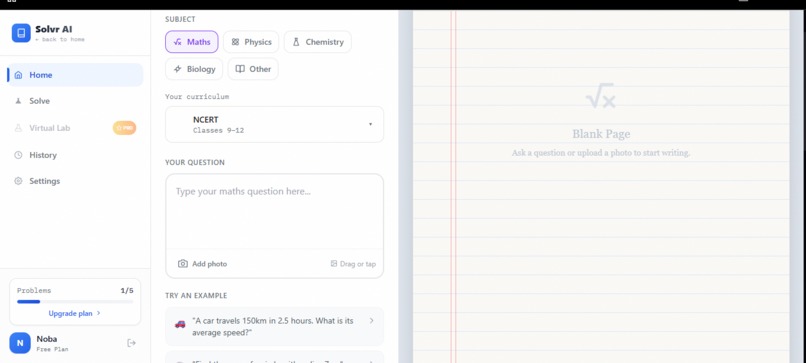
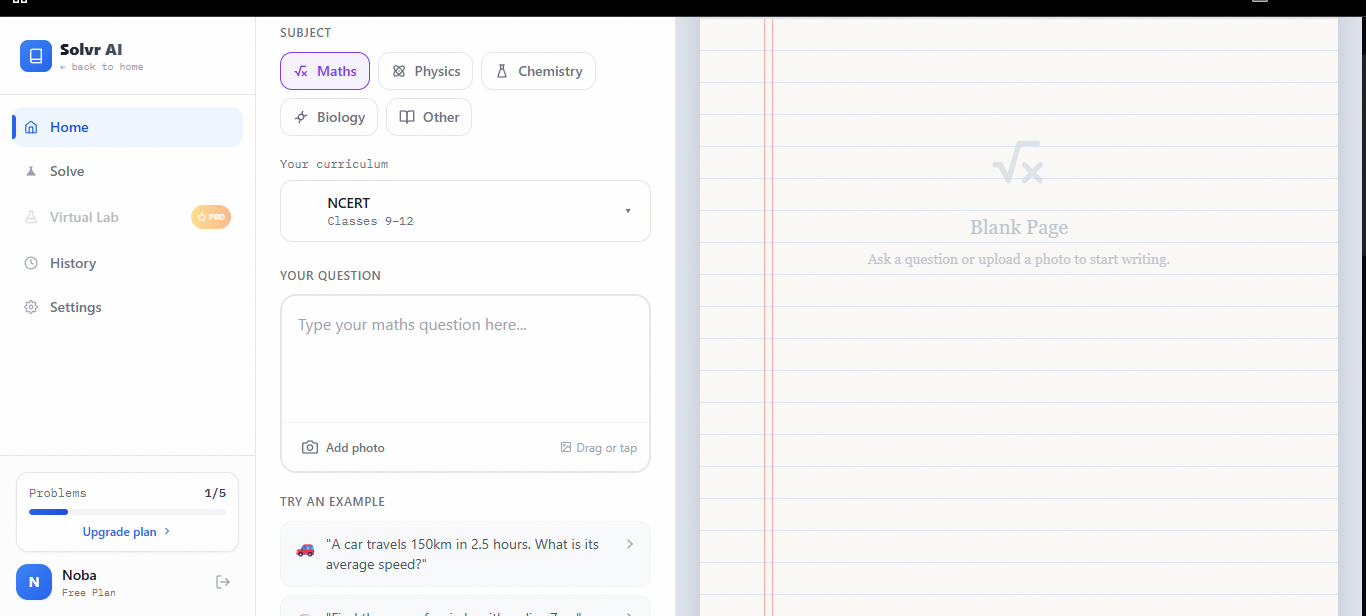
Interactive page for solutions
-
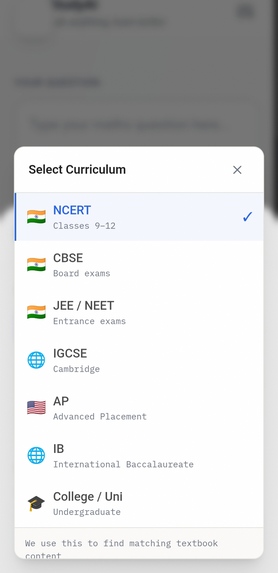
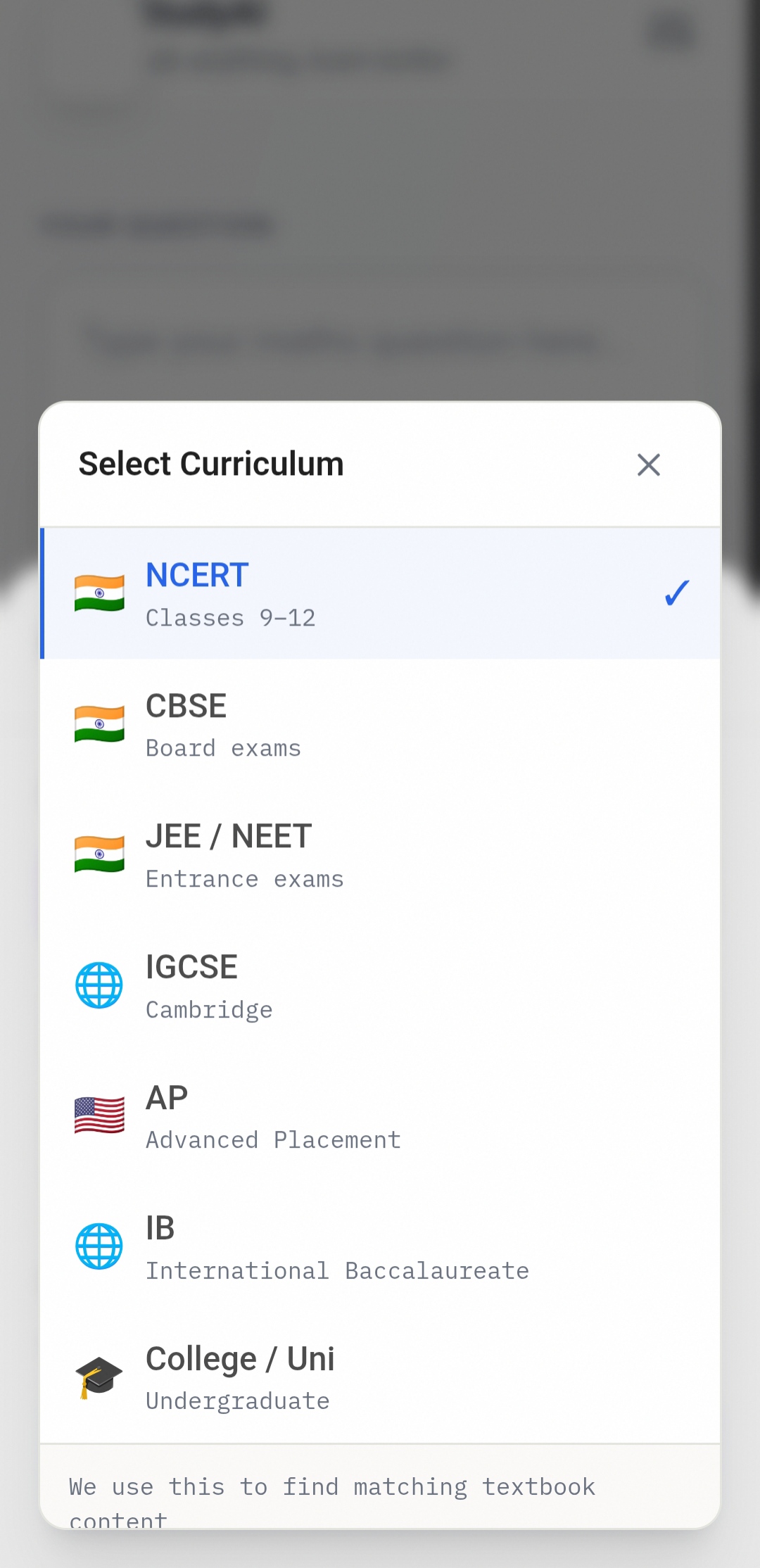
Solvr AI enable users to choose their boards
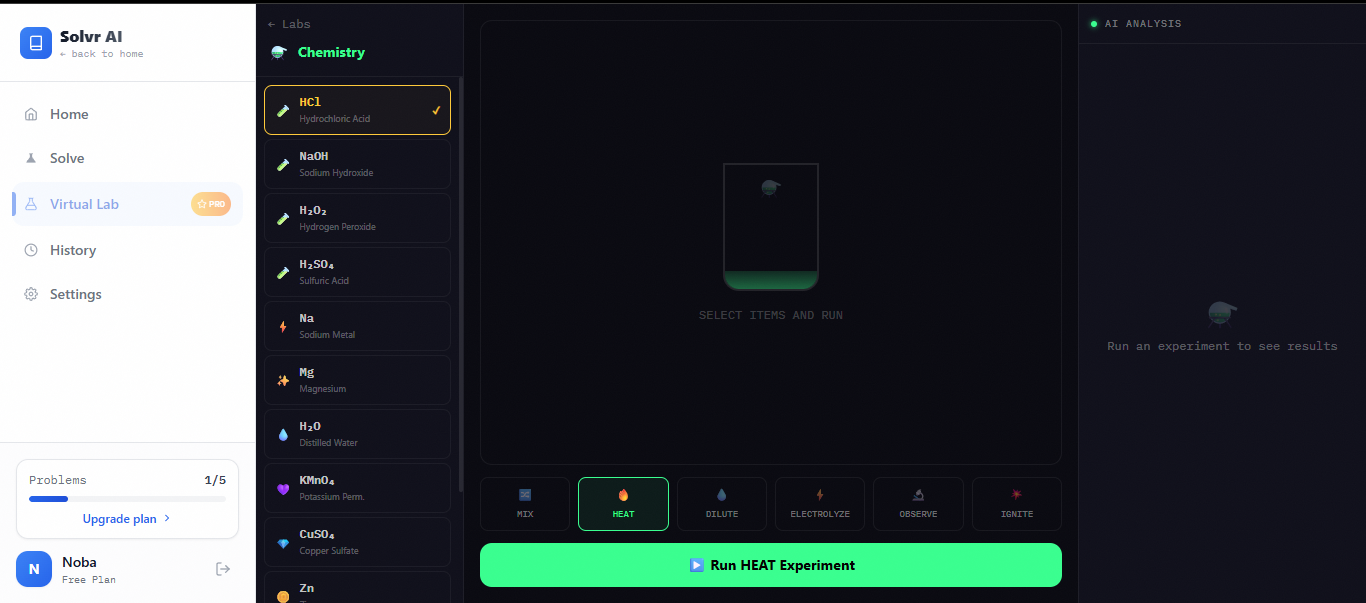
Inspiration
Growing up in Nagaland, I watched students around me struggle with Physics and Mathematics not because they lacked intelligence but because quality help simply was not available. A tutor costs ₹500–2000 per hour and is almost impossible to find outside major cities. At 10pm when you are stuck on a problem the night before an exam, there is nobody to call. I built Solvr AI because I believe every student deserves a patient, knowledgeable tutor available at any hour — not just students in Delhi or Mumbai.
What it does
Solvr AI lets students type or photograph any Physics, Mathematics, Chemistry, or Biology problem and receive a complete step-by-step solution in seconds. Unlike tools that just give the final answer, Solvr shows every step of the working in plain English with properly rendered mathematical equations, explains the underlying concept, and connects it to a real-world application. The platform includes a RAG knowledge system that grounds every answer in specific curriculum material — NCERT, CBSE, JEE, IGCSE, and AP — so solutions match what the student has actually been taught, not just a generic correct answer. A virtual interactive lab lets students simulate chemistry reactions, physics experiments, mathematical functions, and biology processes with animated visual feedback. The whole platform runs on a Free tier requiring no credit card, with paid plans unlocking photo upload and unlimited problems.
How we built it
The frontend is Next.js 14 with TypeScript, Tailwind CSS, and Framer Motion for animations. Mathematical equations are rendered using KaTeX — the same engine used by Khan Academy — so students see properly typeset equations rather than dollar signs and backslashes. Authentication, the PostgreSQL database, and file storage all run on Supabase with Row Level Security on every table. The AI solver uses Anthropic Claude via a streaming API, which means the student sees the first word of their solution within 1-2 seconds rather than waiting for the entire response. The RAG system uses OpenAI's text-embedding-3-small model to embed both textbook chunks and student questions, then performs cosine similarity search using pgvector directly inside Supabase — no separate vector database needed. Payments use Stripe with server-side webhook verification. The entire backend runs as Next.js API routes on Vercel serverless functions with a sliding window rate limiter and input validation on every endpoint.
Challenges we ran into
The hardest technical challenge was making the RAG system feel invisible to the student. Early versions would sometimes retrieve irrelevant textbook passages that confused Claude and produced worse answers than no context at all. Tuning the similarity threshold — too high and nothing retrieves, too low and garbage comes through — required building the admin retrieval tester so we could see exactly what was being fetched for any given question. The second challenge was streaming. Server-Sent Events work differently in Next.js App Router than in traditional Express, and getting the stream to survive the Vercel edge network without buffering required specific cache headers and response construction patterns. The third challenge was LaTeX rendering in a streaming context — KaTeX needs the complete expression to render, but the AI streams one token at a time, meaning dollar signs and backslashes appear mid-render before the equation closes. The MathRenderer component handles this gracefully by rendering what has arrived while the streaming cursor sits at the end.
Accomplishments that we are proud of
We are proud that the entire security architecture — JWT verification, rate limiting, Stripe webhook signature checking, input validation, atomic usage counters, and Row Level Security — was built without any security frameworks or shortcuts. Every protection was reasoned about and implemented deliberately. We are also proud of the RAG system costing $0.08 to load the entire NCERT curriculum into a searchable vector database — making curriculum-aligned AI tutoring economically viable at a price students in Nagaland can actually afford. Most of all we are proud that this was designed and built solo from Northeast India, proving that geography is not a barrier to building production-grade software.
What we learned
We learned that the hardest part of building an AI product is not the AI — it is everything around it. Rate limiting, streaming architecture, plan enforcement, webhook reliability, input validation, and graceful degradation when the AI returns unexpected output all took more time than the Claude integration itself. We also learned that RAG quality is more about what you retrieve than how you retrieve it. A well-structured formula sheet with 10 chunks beats a raw PDF with 400 poorly chunked pages every time. Curating the knowledge base matters as much as the vector search.
What is next for Solvr
The immediate next step is making the app fully mobile responsive — students in Nagaland are almost entirely on phones, and the current UI is desktop-first. After that we want to build a teacher dashboard where a teacher can assign problems, see which topics their students are consistently struggling with, and track progress over time. We also want to expand the RAG knowledge base to cover JEE Advanced past papers and NEET biology, which are the highest-value curriculum targets for the Indian market. Longer term the goal is school partnerships — licensing Solvr to coaching institutes and government schools in Northeast India as a supplement to classroom teaching, making the $9/month price point irrelevant by getting it funded institution
Built With
- claudeapi
- farmermotion
- nextjs14
- postgresql
- supabase
- tailwind
- typescript

Log in or sign up for Devpost to join the conversation.