-
-
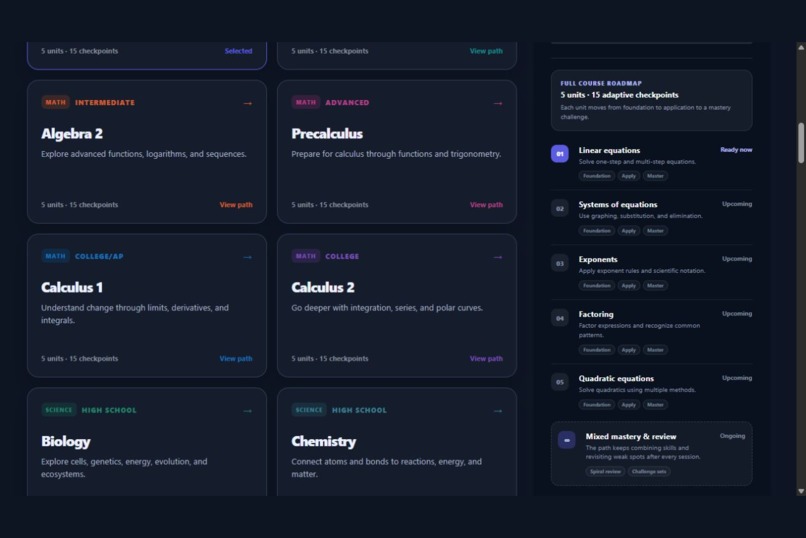
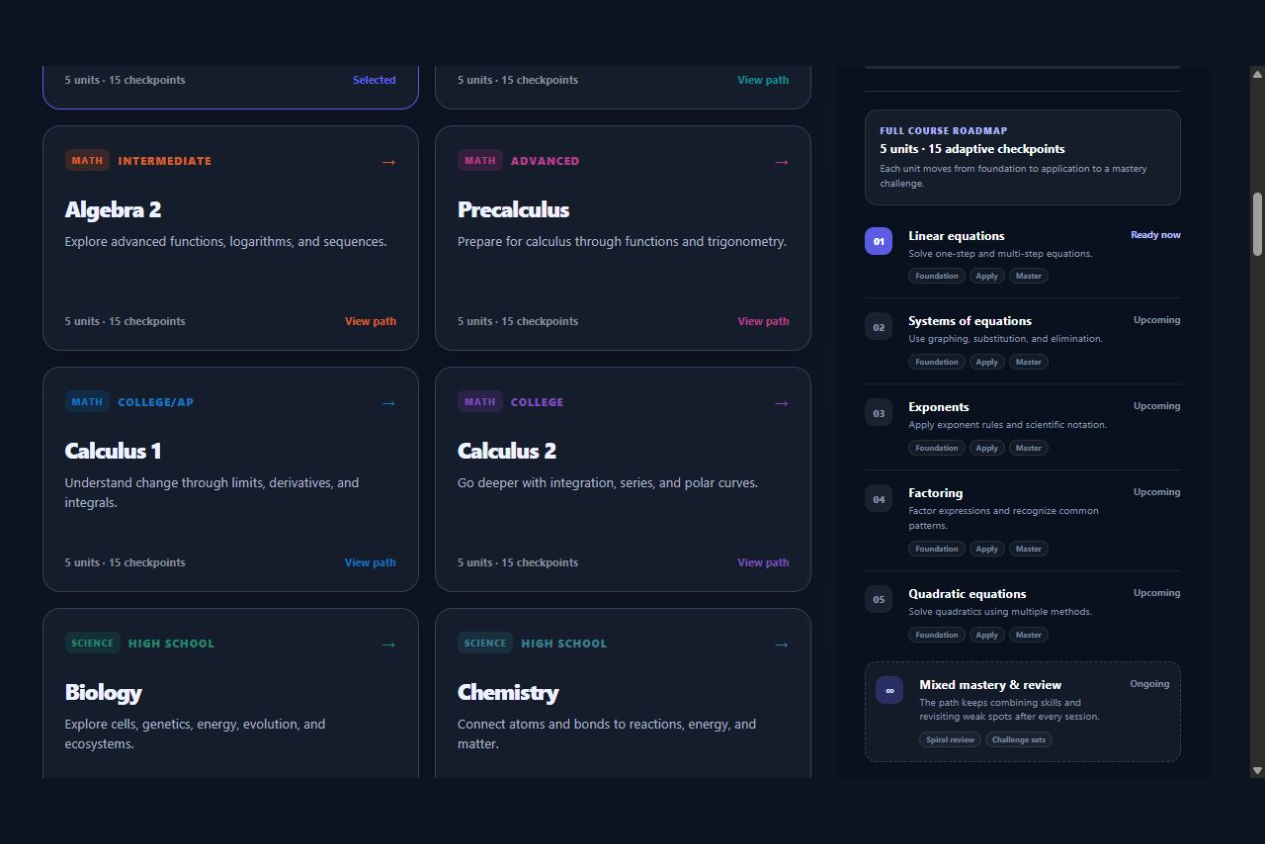
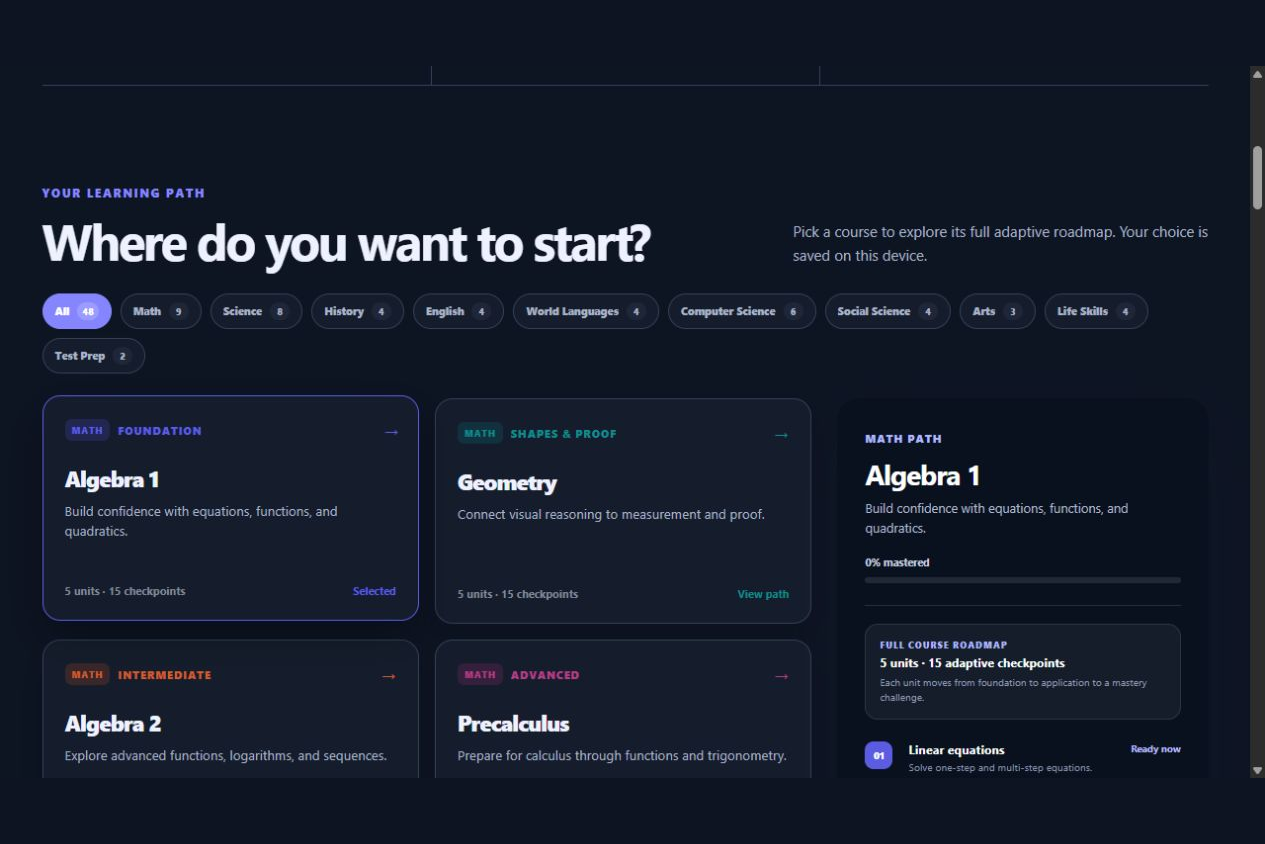
Each course includes five units, 15 checkpoints, and ongoing mixed-skill review.
-
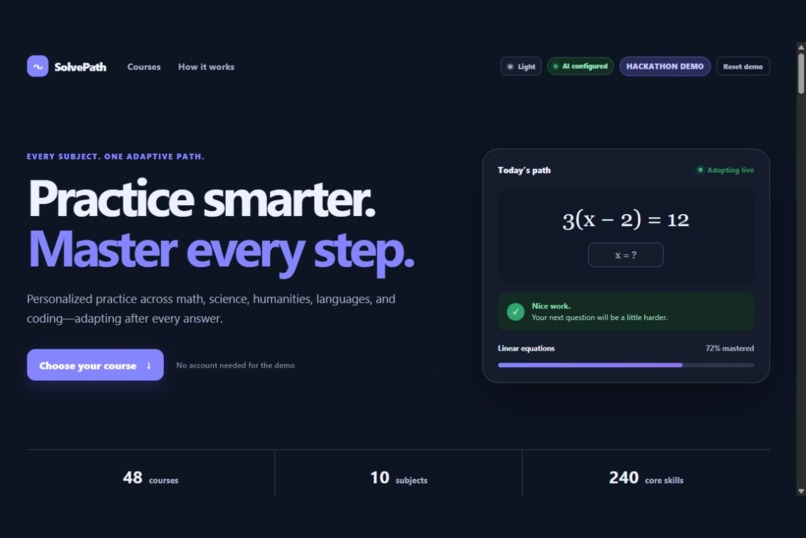
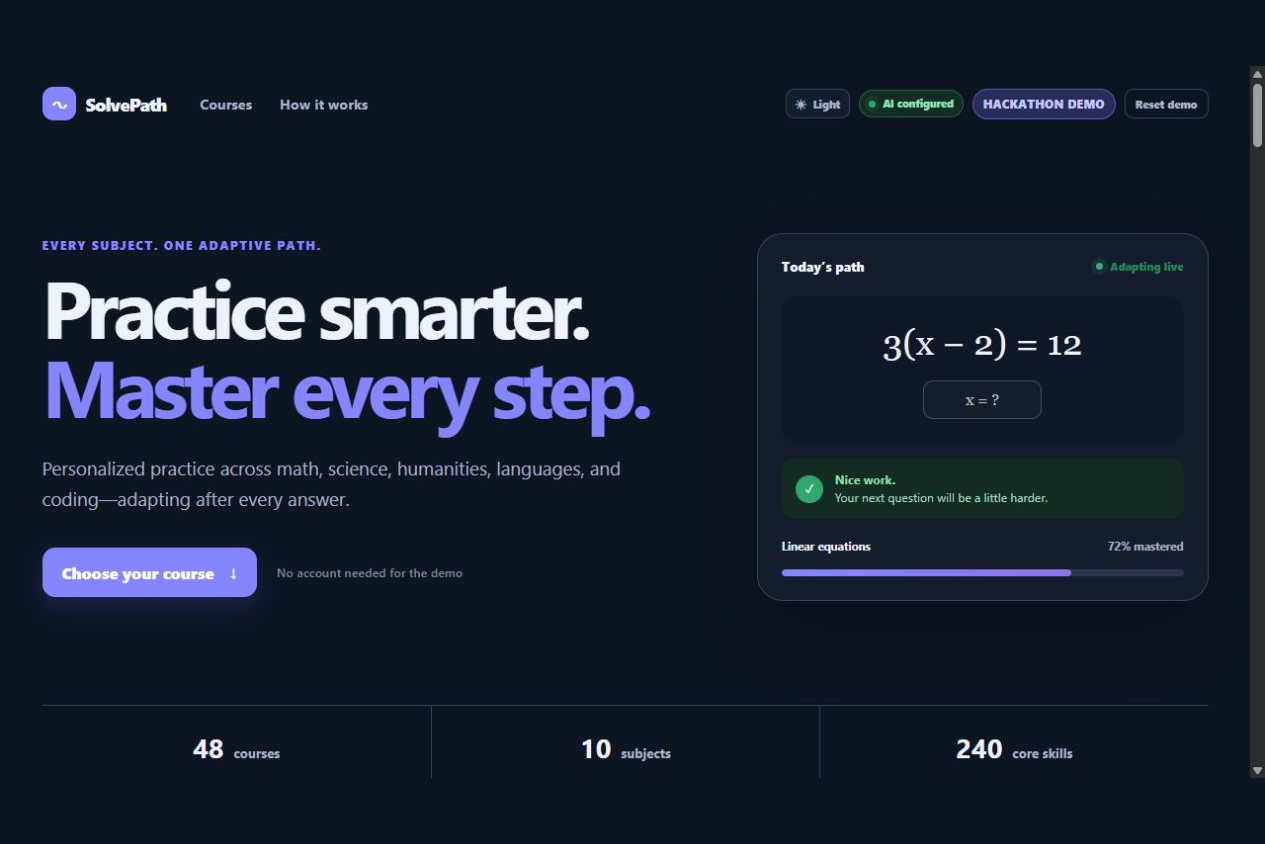
Adaptive practice across 48 courses, 10 subject areas, and 240 core skills.
-
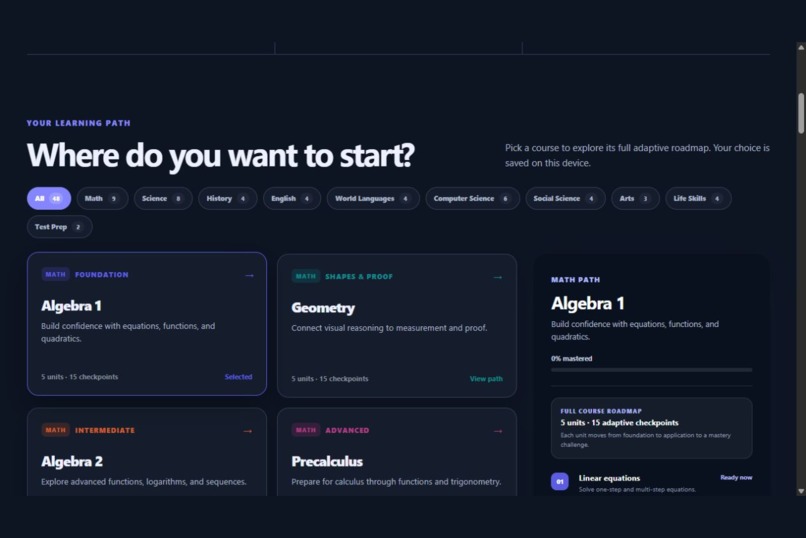
Explore learning paths across math, science, humanities, languages, coding, and more.
-
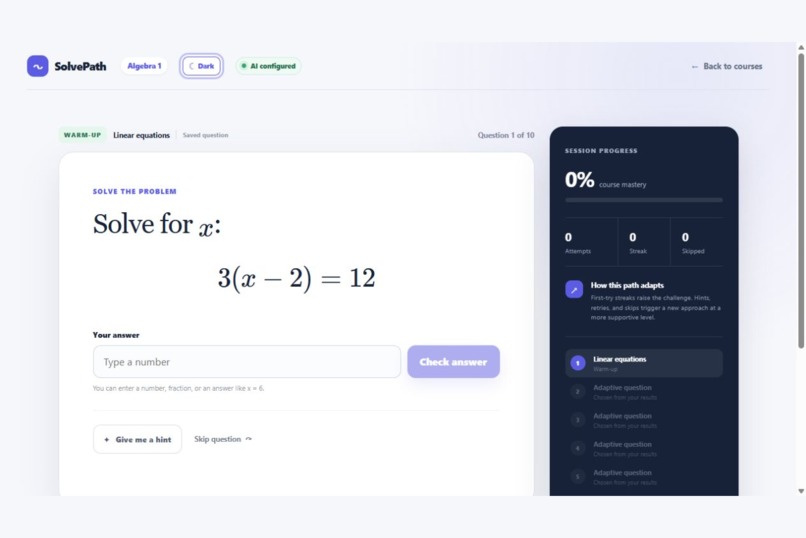
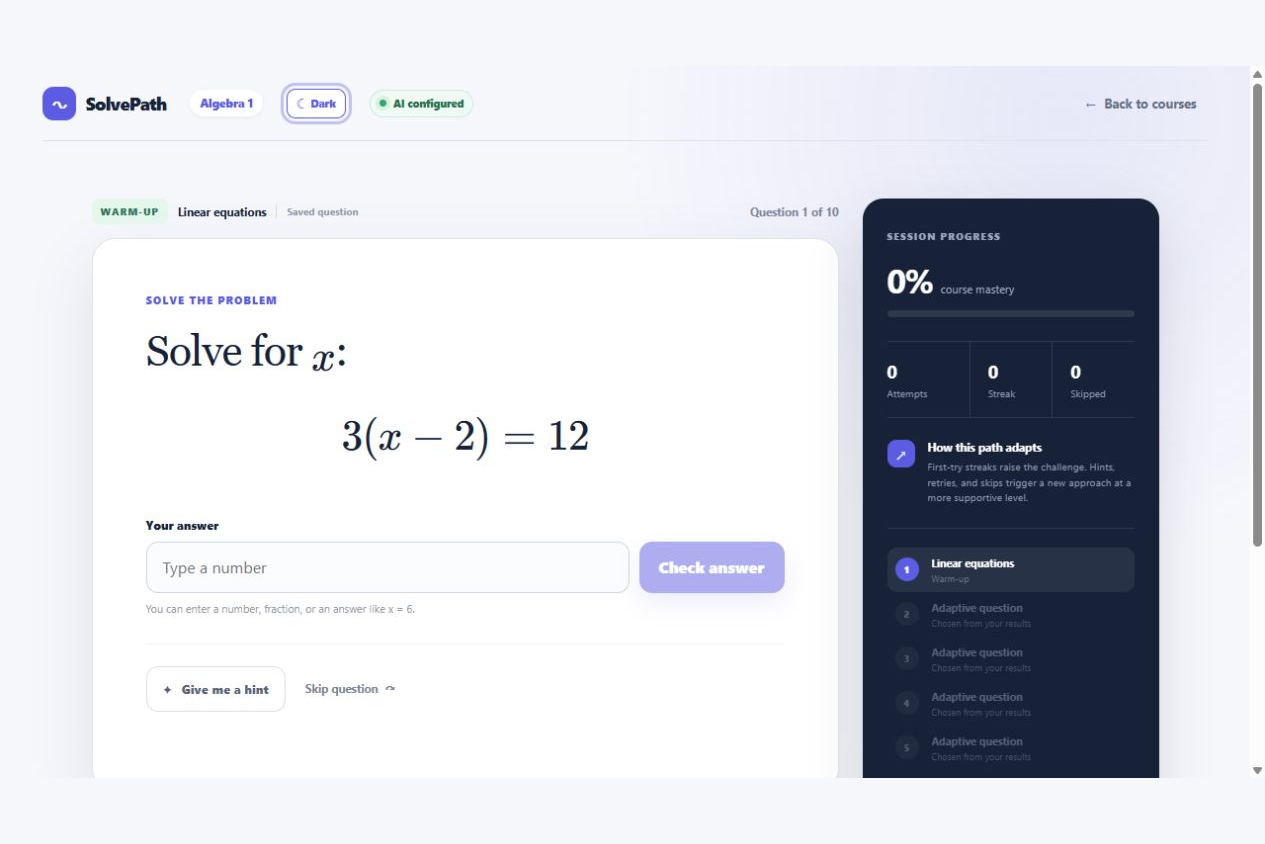
Accessible math practice with clear notation, progress tracking, hints, and skipping.
-
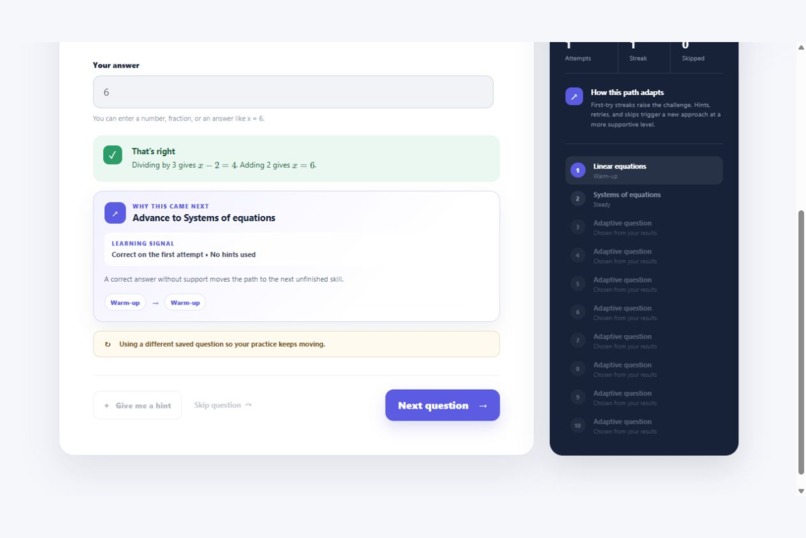
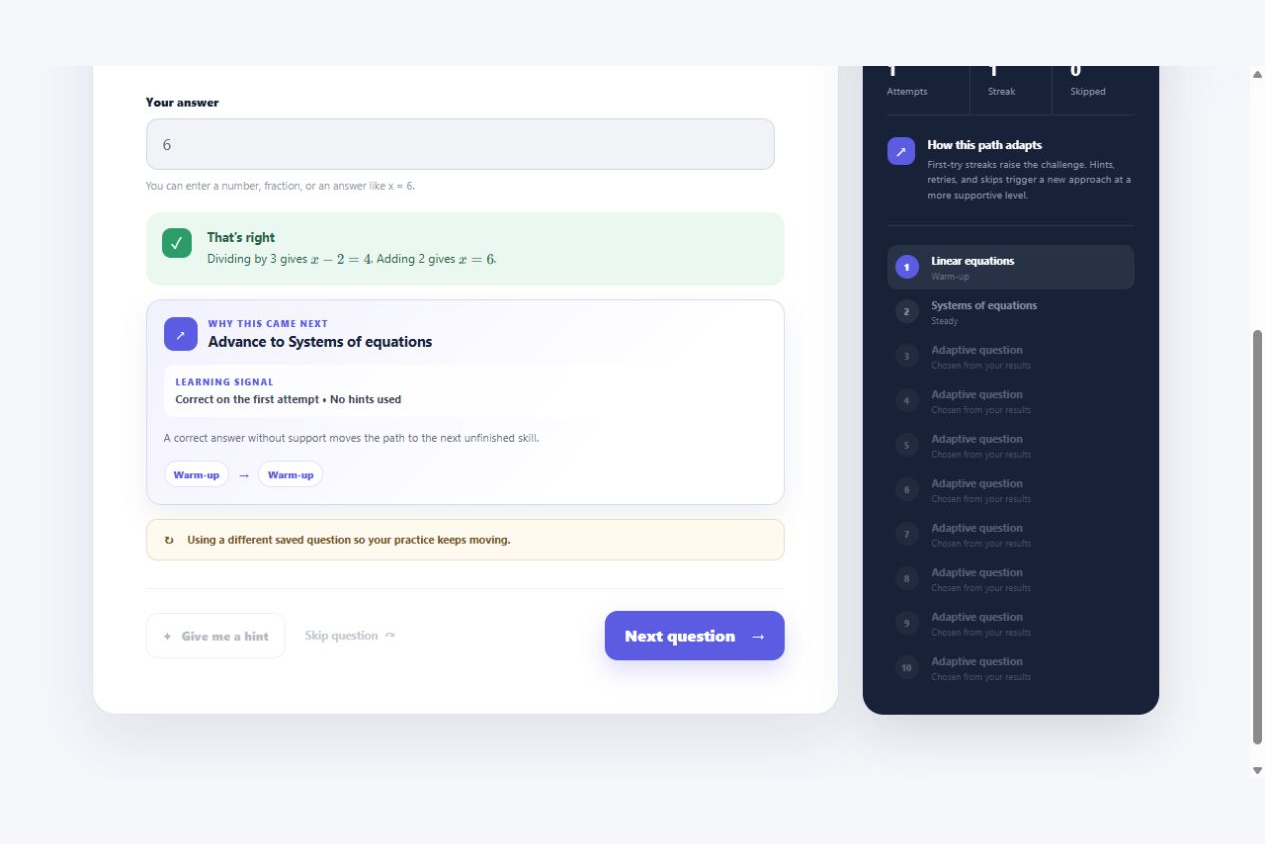
See how each answer, hint, retry, or skip shapes the student’s next question.
-
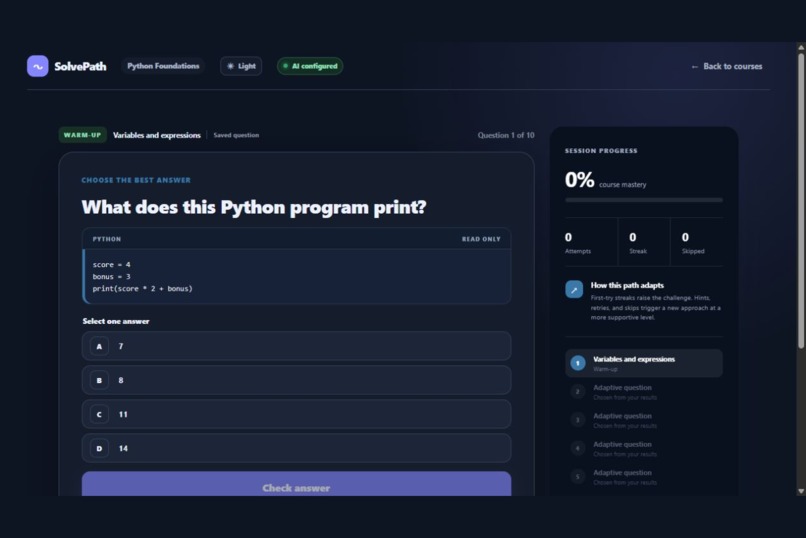
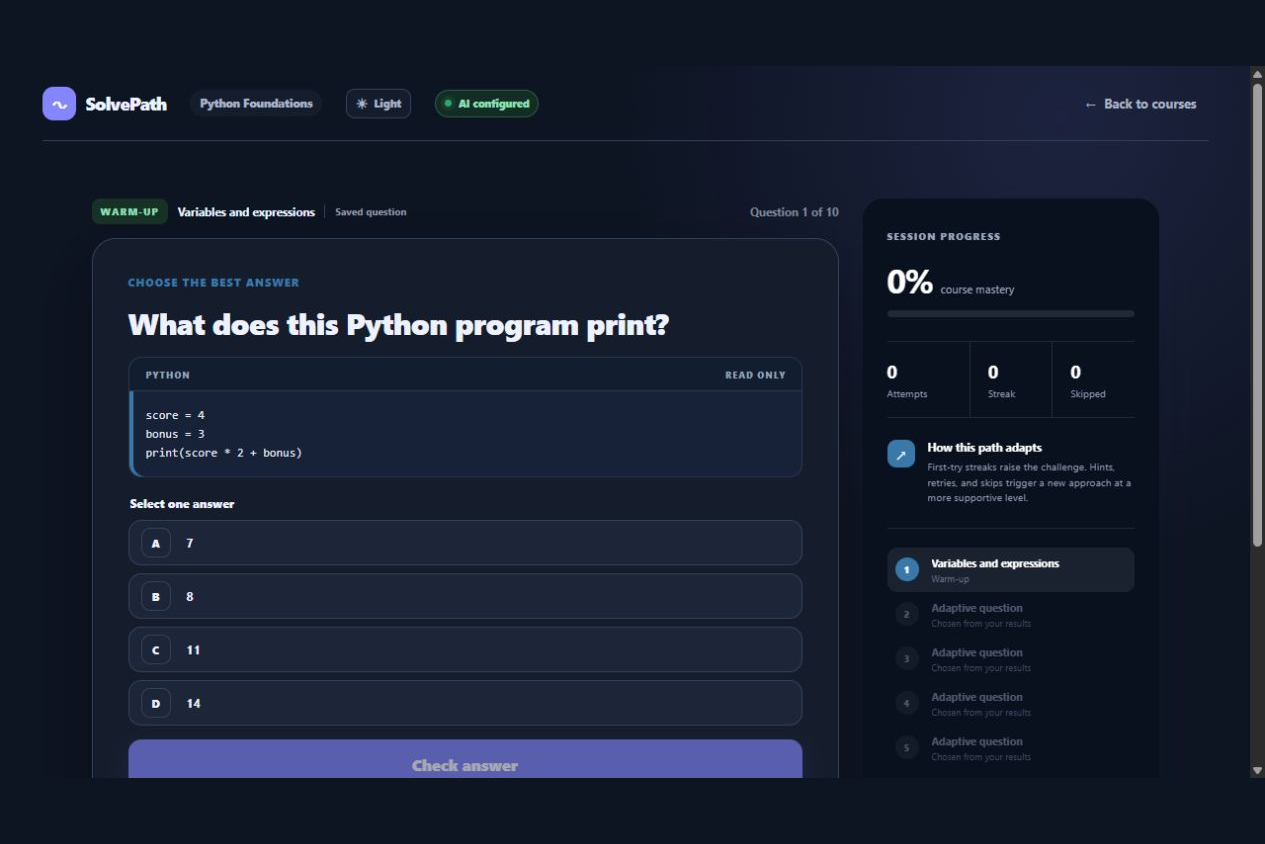
Coding practice preserves formatting while building tracing, debugging, and programming skills.
-
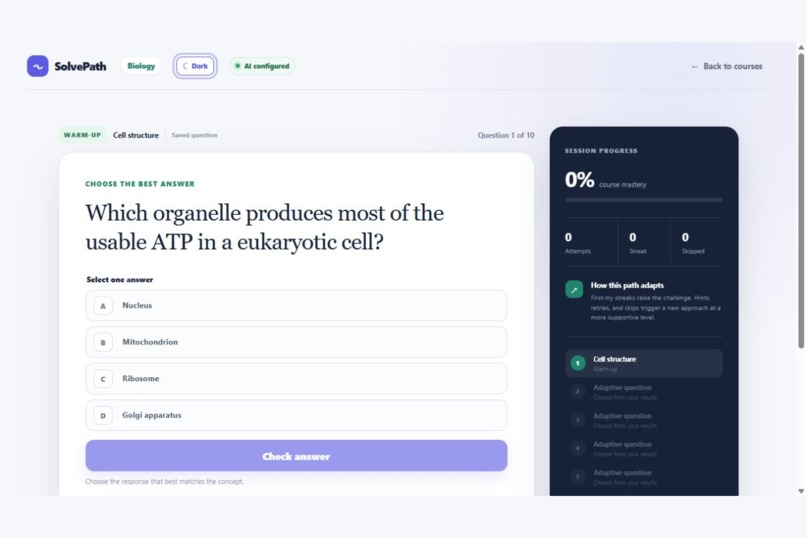
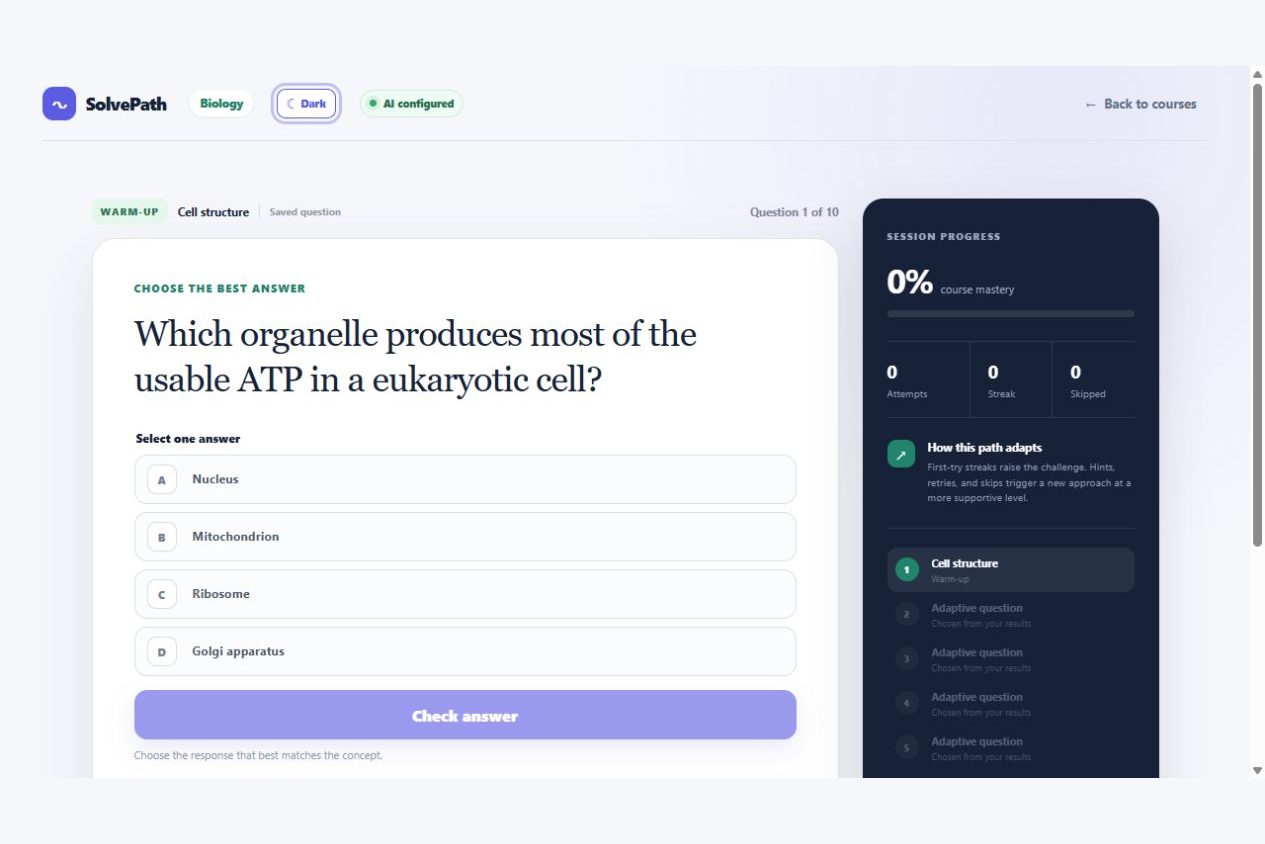
Biology brings adaptive questions, guided support, and skill tracking to science.
SolvePath
Inspiration
Students rarely learn at exactly the same pace. One student may understand linear equations immediately but need more support with quadratics, while another may have the opposite experience. Traditional worksheets usually give both students the same fixed sequence of questions.
We built SolvePath to explore a different approach: practice that changes after every answer. Our goal was to create an accessible learning experience that identifies when a student is ready to advance, needs another explanation, or would benefit from a more supportive example.
What it does
SolvePath is an adaptive learning web app covering 48 courses, 10 subject areas, and 240 core skills. Its catalog includes mathematics from Pre-Algebra through Calculus 2, Biology, Chemistry, Physics, history, English, world languages, social sciences, coding, AP Computer Science A, and more.
Each course is organized into five units with three checkpoints per skill:
- Foundation
- Apply
- Master
During a ten-question practice session, SolvePath responds to the student’s behavior:
- A correct first attempt advances their checkpoint progress and may introduce a new skill.
- A streak can increase the difficulty.
- A missed answer keeps the current concept active and provides feedback.
- Revealing hints signals that the student may need reinforcement.
- Skipping a question records low confidence without counting it as an incorrect answer.
- AI generates fresh questions based on the selected skill, difficulty, recent mistakes, and previous prompts.
Every adaptive decision is explained through a “Why this came next” panel, so the system does not feel like an unexplained black box.
How we built it
We built the frontend with React and Vite, using reusable components for the course catalog, skill roadmaps, practice sessions, adaptive feedback, AI status, and theme controls.
The local backend uses Node.js and Express, while the hosted version uses Vercel Functions. Both environments share the same server-side question-generation logic.
The backend connects to the OpenAI API and requests structured question data. Generated questions are validated and normalized before reaching the interface. This is especially important for coding questions, where the model may return Markdown fences, misplaced source code, or inconsistent indentation.
Mathematical notation is rendered with KaTeX, allowing expressions such as
$$ 3(x-2)=12 $$
to remain readable and accessible. The app also supports standard Unicode mathematics when full LaTeX is unnecessary.
Progress and theme preferences are saved with browser storage, allowing the demonstration to work without requiring accounts or a database.
To make the project dependable during judging, every course also contains saved fallback questions. If AI generation is unavailable, slow, or out of quota, the student can continue practicing.
Challenges we faced
One major challenge was balancing fresh AI content with hackathon reliability. API requests can take several seconds or fail because of configuration, network, or quota problems. We addressed this by preparing the likely next question while the student answers the current one and automatically switching to saved questions when necessary.
Another challenge was generated-content formatting. Coding prompts sometimes contained Markdown headings, backticks, duplicated code, or broken indentation. We created a normalization layer that extracts usable source code, removes unwanted Markdown, preserves whitespace, and safely renders inline identifiers.
Mathematical rendering introduced similar challenges. Preset and generated questions could use LaTeX, Unicode symbols, fractions, or ordinary text. We built a shared rendering system that detects mathematical segments while leaving normal prose readable.
We also discovered that our original progress percentage did not match the roadmap. One successful answer could incorrectly award 20% mastery even though the interface advertised fifteen checkpoints. We replaced this with a checkpoint-based model where each successful checkpoint represents one-fifteenth of the course.
Finally, we needed to support a large curriculum without making the app fragile. We added validation that guarantees every course has five distinct skills and reliable fallback coverage for each skill.
What we learned
We learned that adding AI to a product is only part of the work. A useful AI experience also requires validation, fallback behavior, understandable decisions, careful prompt design, and a user interface that handles unpredictable output.
We also learned how important perceived speed is. Preparing the next question in the background made the experience feel substantially faster without requiring a faster model.
Most importantly, we learned that adaptivity should be visible. Students should understand why the difficulty changed, why a concept is being repeated, and how their actions affect their learning path.
What we are proud of
We are proud that SolvePath is more than a static question generator. It maintains a learning path, reacts to multiple kinds of student signals, explains its decisions, and remains usable when AI is unavailable.
The final project includes:
- 48 courses
- 240 skills
- Fifteen checkpoints per course
- Ten-question adaptive sessions
- AI-generated and saved questions
- Guided hints and skipping
- Mathematical and coding-content rendering
- Local progress persistence
- Responsive light and dark themes
- A Vercel-ready deployment architecture
What is next
With more time, we would add student accounts, teacher dashboards, long-term mastery analytics, spaced repetition, accessibility testing on more devices, and richer subject-specific question formats. We would also add interactive coding execution and diagrams for geometry, physics, and chemistry.
Built With
- adaptive-learning
- artificial-intelligence
- css3
- edtech
- eslint
- express.js
- generative-ai
- git
- github
- html5
- javascript
- katex
- localstorage
- node.js
- npm
- openai-api
- react
- responsive-web-design
- rest-api
- test
- vercel
- vercel-functions
- vite
- zod


Log in or sign up for Devpost to join the conversation.