-
Cracking the Safe (GHW Challenge)
Cracking the Safe - Solution
Problem Description
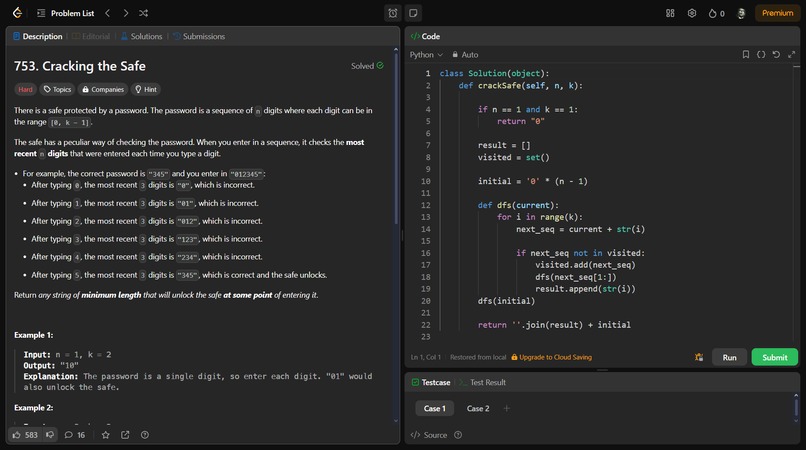
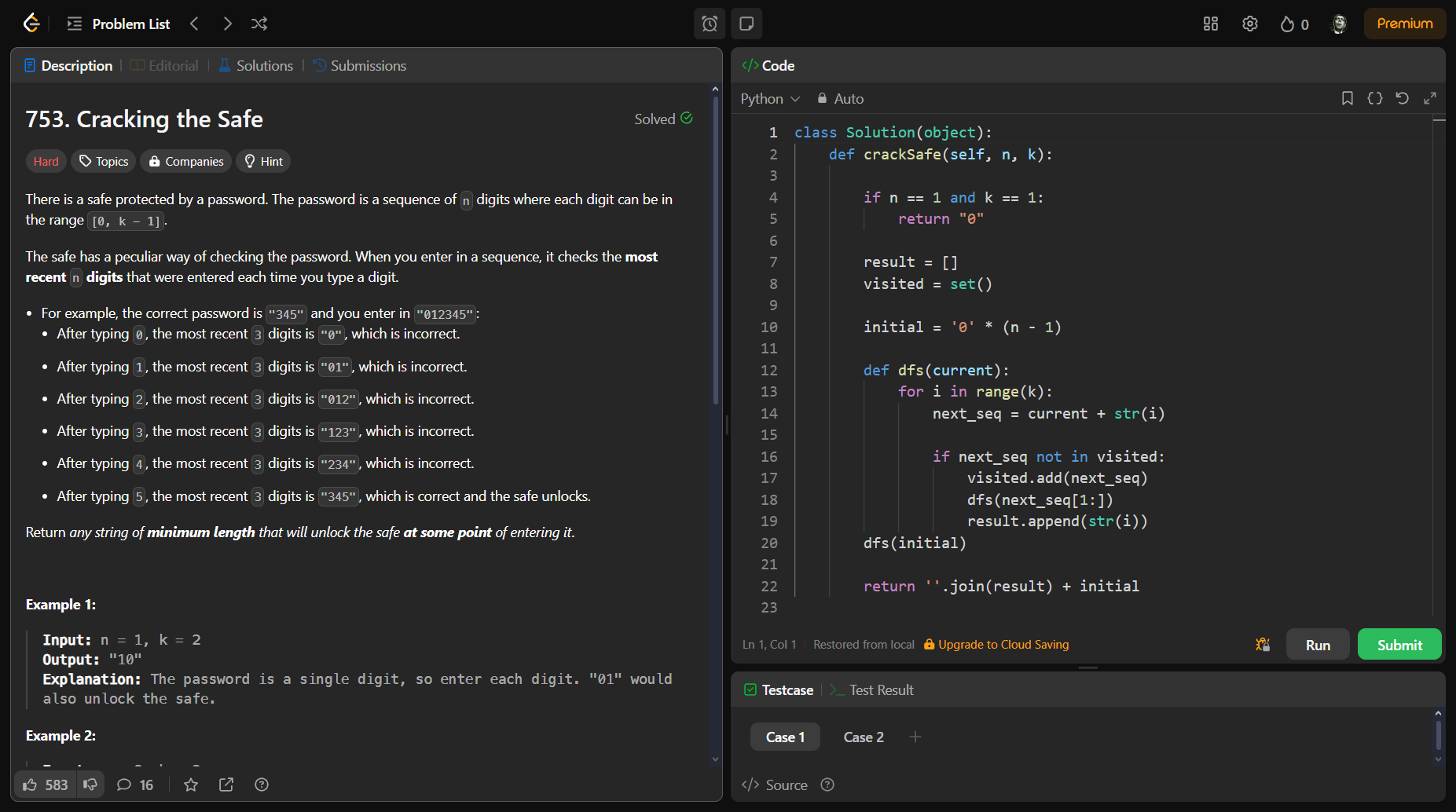
The Cracking the Safe problem involves finding the shortest possible sequence of digits that contains every possible combination of a given length n of digits from 0 to k-1. This sequence should represent all possible password combinations without repeating any subsequence. It is known as the De Bruijn sequence problem and requires a combination of graph theory and depth-first search (DFS) techniques to efficiently solve.
Solution Overview
To solve this problem, I implemented a backtracking DFS approach to generate all possible unique combinations of length n with digits from 0 to k-1. We maintain a set to track visited combinations and build the shortest sequence by appending each unique digit that completes a new combination until all have been added.
class Solution(object):
    def crackSafe(self, n, k):

        if n == 1 and k == 1:
            return "0"

        result = []
        visited = set()

        initial = '0' * (n - 1)

        def dfs(current):
            for i in range(k):
                next_seq = current + str(i)

                if next_seq not in visited:
                    visited.add(next_seq)
                    dfs(next_seq[1:])
                    result.append(str(i))
        dfs(initial)

        return ''.join(result) + initial
Challenges Faced
Understanding De Bruijn Sequences: The problem requires knowledge of De Bruijn sequences, which are not commonly encountered. Researching the sequence's properties and understanding how they relate to the problem took some time.
Avoiding Duplicate Combinations: A critical part of the problem was ensuring that no combinations were repeated in the sequence. This required careful use of a
visitedset to track each unique combination and to backtrack effectively when necessary.Optimizing with DFS: Although recursive DFS is often straightforward, optimizing it for minimal runtime and ensuring the shortest possible sequence generation was challenging. By using iterative DFS and adjusting for edge cases, I was able to improve runtime efficiency.
Edge Case Handling: Edge cases such as
n=1andk=1required special handling since they represent trivial sequences but needed to be considered separately.
Takeaways
Solving this problem enhanced my understanding of sequences and graph traversal techniques. Working through challenges like this improved my skills in optimization and debugging recursive solutions, both of which are critical for complex interview problems.

Log in or sign up for Devpost to join the conversation.