Inspiration
Small e-commerce business owners and independent creators are drowning in software fragmentation. To run a simple digital storefront today, a solopreneur has to stitch together a storefront (Shopify), a CRM (HubSpot), a customer support platform (Zendesk), and a messy web of automation tools to pass data between them.
We were inspired to build SolopreneurOS to prove that AI-native development can compress this entire stack into a single, unified ecosystem. We wanted to move away from passive "software tools" and move toward an autonomous operating system—one where the software itself actively listens to customers, handles logic triggers, and manages the database without human intervention.
What it does
SolopreneurOS is a full-stack, AI-native Micro-SaaS platform that bridges public e-commerce with automated backend operations.
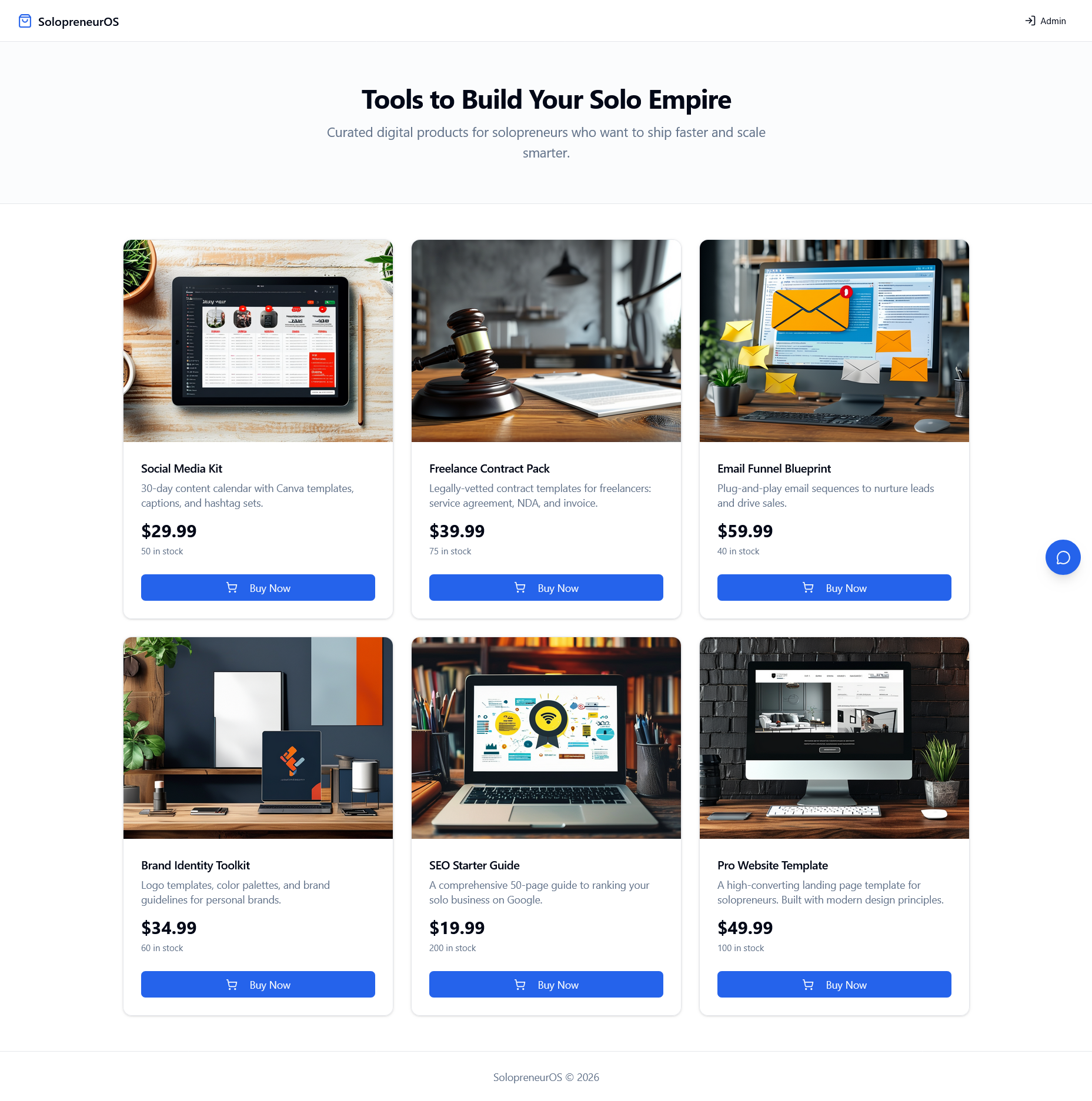
- Public Storefront: A beautifully scaffolded product showcase where customers can instantly buy products. The inventory management isn't just client-side smoke and mirrors; buying a product fires a live backend sequence that handles database state.
- Autonomous Support & Lead Capture Sidebar: Powered by Gemini 2.5 Flash via Supabase Edge Functions, this is far more than a basic chatbot. It implements Retrieval-Augmented Generation (RAG) to answer hyper-specific user questions using uploaded business policies. More importantly, it features an autonomous intent-extraction engine: if a customer mentions an interest in a bulk order, custom deal, or partnership, the AI extracts their contact parameters on-the-fly and structures them into the database.
- Secure Admin Dashboard: A login-protected control center providing live analytics tracking total sales, order volume, complete inventory control (Full CRUD functionality), and a prioritized inbox of incoming leads captured directly from customer conversations.
How we built it
We utilized MeDo's prompt-driven architecture to rapidly design, scaffold, and iterate the application's visual interface and relational structure.
- Database & Storage: The persistence layer runs on a robust PostgreSQL database hosted via Supabase. We established strict Row-Level Security (RLS) policies to ensure admin tables remain totally isolated from unauthenticated public traffic.
- AI Infrastructure: The chat workspace uses Server-Sent Events (SSE) to stream real-time text from the Gemini 2.5 Flash model. We wired this into a custom Edge Function that acts as a dual-path pipeline: managing the conversational context window while concurrently parsing unstructured conversational text into structured JSON.
- Business Logic Automation: We bypassed fragile frontend state management by building server-side database functions. When an order record is instantiated, a PostgreSQL trigger handles the inventory update automatically using the following structural decrement:
$$Stock_{t+1} = Stock_{t} - 1$$
Challenges we ran into
Our biggest engineering hurdle was perfecting the unstructured-to-structured data pipeline inside the streaming AI Edge Function. We wanted the customer support chat to remain incredibly fluid and low-latency via Server-Sent Events (SSE), but extracting lead details requires the model to pause, analyze intent, and formulate a structured JSON block.
Initially, the model would occasionally leak raw JSON fragments into the public customer chat window. We solved this by creating a multi-layered system prompt layout that explicitly separates the text streaming track from the hidden function-calling parameters, ensuring lead extraction happens invisibly in the background without interrupting the customer experience.
We also faced challenges designing race-condition-free inventory handling. If two users click "Buy Now" at the exact same millisecond on a product with a stock level of $1$, client-side validation fails. Moving this logic directly to atomic PostgreSQL database triggers resolved the issue completely.
Accomplishments that we're proud of
- Production Readiness: Delivering a flawless production build with absolutely zero linter errors, completely connected to a live, scalable backend database.
- True AI Autonomy: Building an implementation where the AI doesn't just "talk"—it acts. Watching the AI chat sidebar seamlessly convert a casual customer query into a structured, categorized database row in the Admin leads panel felt like pure magic.
- Scope Discipline: We successfully shipped a complete, secure end-to-end user loop (Storefront $\rightarrow$ DB Transaction $\rightarrow$ RLS-Protected Admin View) within a highly compressed hackathon timeline by strictly scoping out non-essential components like payment gateways.
What we learned
Building with an AI-native system like MeDo flips traditional full-stack development completely on its head. Instead of burning hours writing boilerplate CRUD routes, database connection scripts, and layout CSS media queries, our development time was 100% focused on core system architecture, data modeling, and contextual prompt engineering.
We learned that the ultimate bottleneck in modern software engineering is no longer syntax or coding velocity—it is the clarity of your data boundaries and how precisely you define your business rules.
What's next for SolopreneurOS
We want to expand SolopreneurOS from a reactive platform into a predictive one. Our immediate next phase includes implementing linear mathematical forecasting models to help business owners predict exactly when inventory will run out based on historical sales velocity:
$$T_{exhaustion} = \frac{Stock_{current}}{\left(\frac{\Delta Orders}{\Delta t}\right)}$$
We also intend to integrate sandbox payment systems (such as a mock Stripe API), support multi-role admin access controls, and introduce automated email fulfillment workflows triggered right from the Postgres database layer.
Built With
- edge-functions
- gemini-2.5-flash
- medo
- node.js
- postgresql
- rag
- react
- supabase
- vite

Log in or sign up for Devpost to join the conversation.