Inspiration Every developer has hit the same wall: staring at unfamiliar code, asking "why does this exist?" or "is it safe to touch this?" — and getting no answer, because that knowledge lives in someone's head, not the codebase. GitLab Orbit's knowledge graph already maps how a codebase fits together. We wanted to turn that raw graph into something a developer could actually talk to — and see, not just read. What it does SoloOrbit is a codebase intelligence agent built on GitLab Orbit. It operates in four modes:
Archaeologist — explains the history and reasoning behind a piece of code Oracle — predicts the blast radius of a proposed change, with a risk score Guardian — automatically flags risky merge requests by cross-referencing ownership data Mentor — generates a guided, step-by-step tour of a subsystem for onboarding
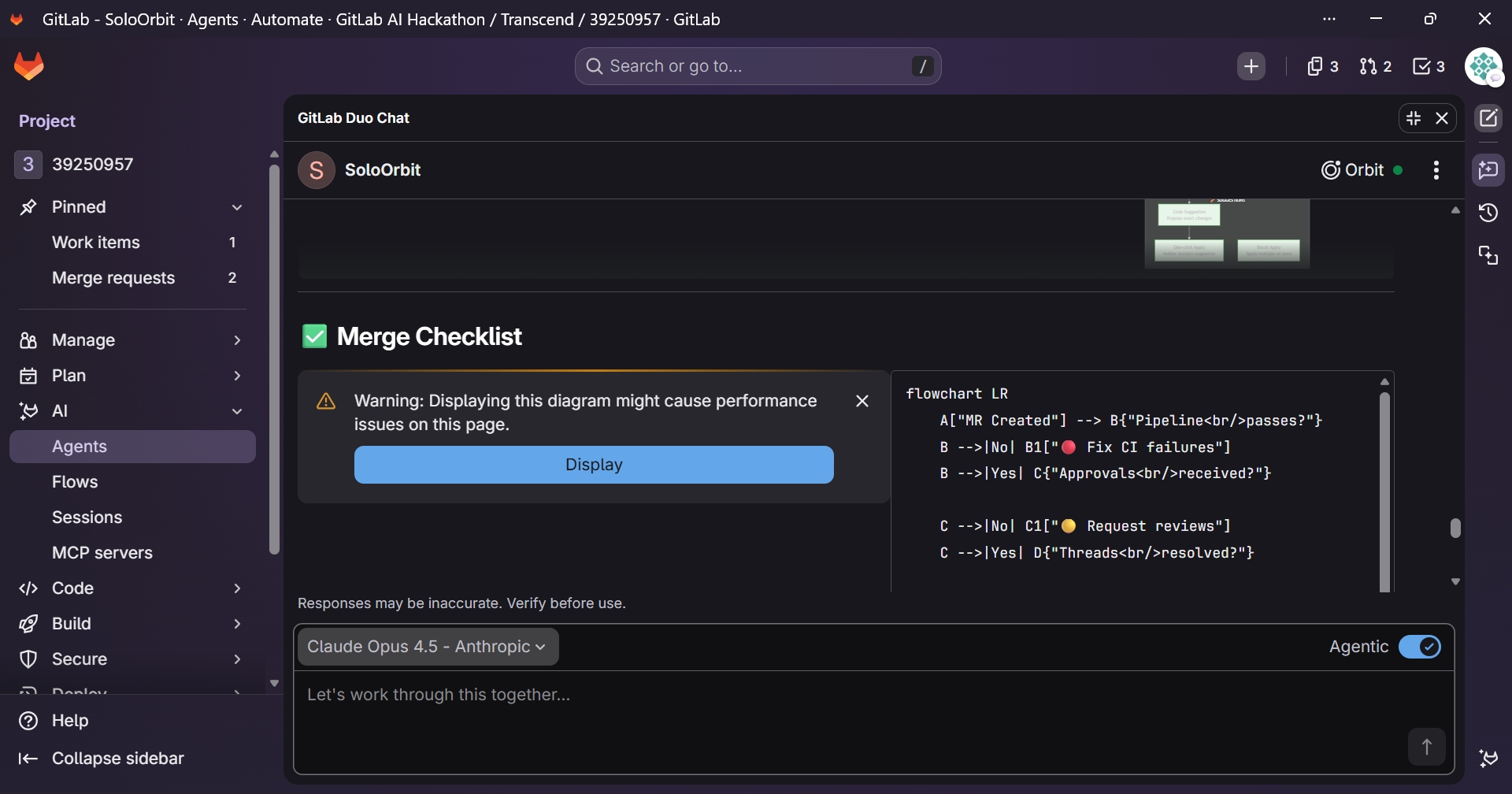
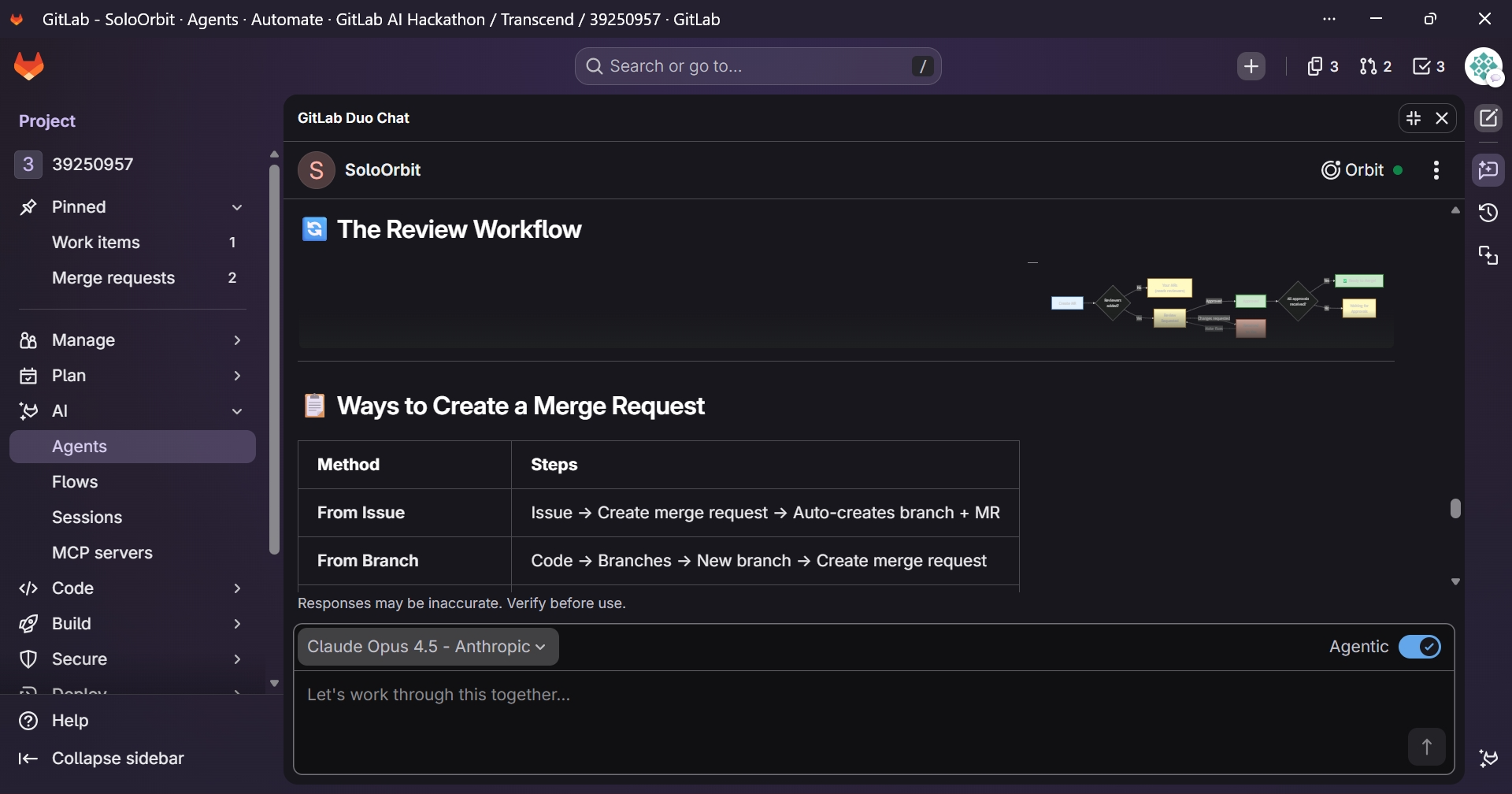
Every answer is backed by a Mermaid diagram generated directly from real Orbit graph data, with citations so developers can verify the reasoning behind every claim. How we built it SoloOrbit runs as a flow on GitLab's Duo Agent Platform. The core agent queries Orbit's knowledge graph API for entity relationships, ownership data, and history, then routes the request to the appropriate mode based on intent. Responses are formatted in Markdown with embedded Mermaid diagrams so they render natively inside GitLab merge requests and issues. The agent is also exposed as a project-level skill, triggerable via CLI or MR comments. Challenges we ran into Translating raw graph data into diagrams that are genuinely useful — not cluttered — took real iteration. We had to cap diagrams to the most relevant 8-12 nodes and add fallback summaries when a graph was too dense to visualize cleanly. Getting the agent to reason strictly from graph data, without filling gaps with assumptions, also required tightening the prompt to explicitly forbid invented relationships. Accomplishments that we're proud of Getting four genuinely distinct workflows to share one underlying graph query layer, rather than building four separate tools. We're also proud of the diagram-first design — most coding assistants answer in text only, and we think visual reasoning is a meaningfully better fit for understanding structure, which is what most codebase questions are really about. What we learned We learned a lot about how Orbit's graph models relationships and ownership, and how to keep an agent's output grounded and verifiable rather than confidently wrong. We also learned how much UX value comes from rendering directly inside GitLab's existing surfaces (MRs, issues) instead of requiring developers to leave their workflow. What's next for SoloOrbit We'd like to add a fifth mode — Sentinel — for proactive tech-debt detection across a whole repo, plus deeper Slack/IDE integration so Guardian-mode warnings reach developers before they even open a merge request. We're also exploring letting teams customize risk-scoring weights to match their own codebase's priorities.
Built With
- gitlab
- prompt
- skill

Log in or sign up for Devpost to join the conversation.