-
-
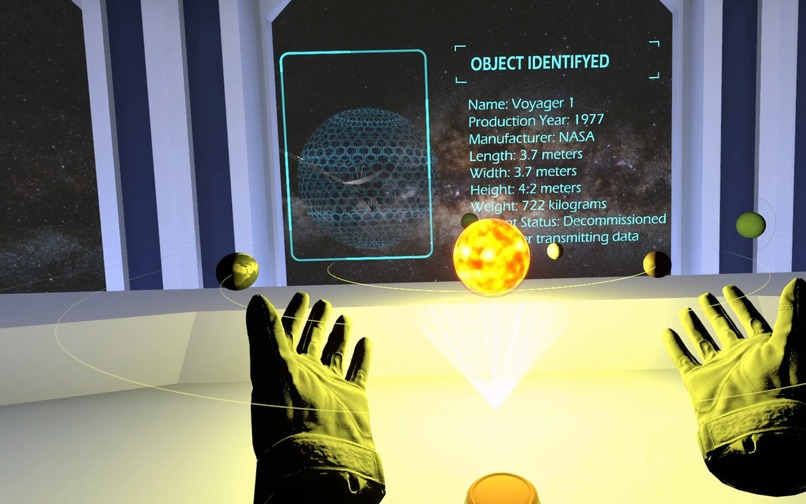
holographic solar system
-
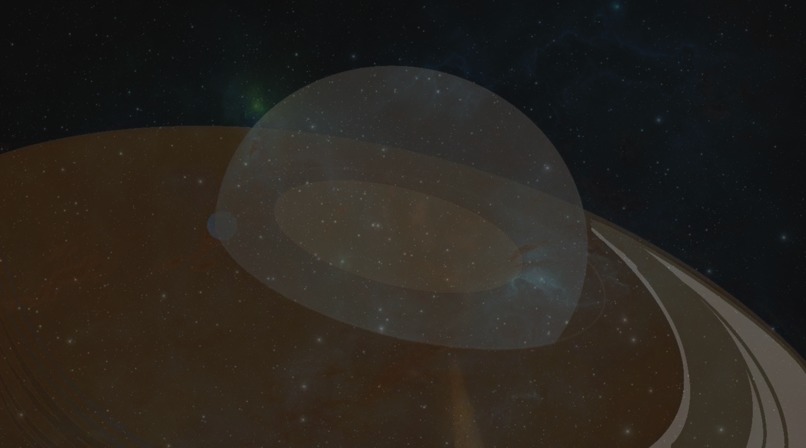
morph effect from the Ring of Saturn to the Golden Record
-
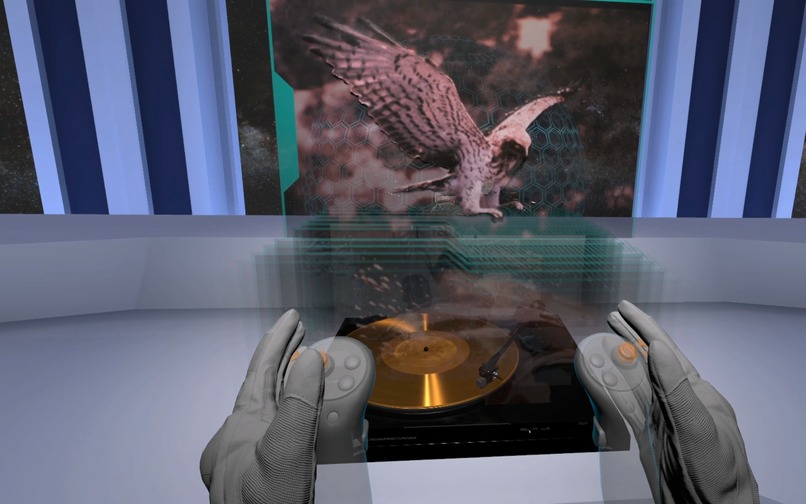
Decoding the audio surprisingly shows 115 images!
-
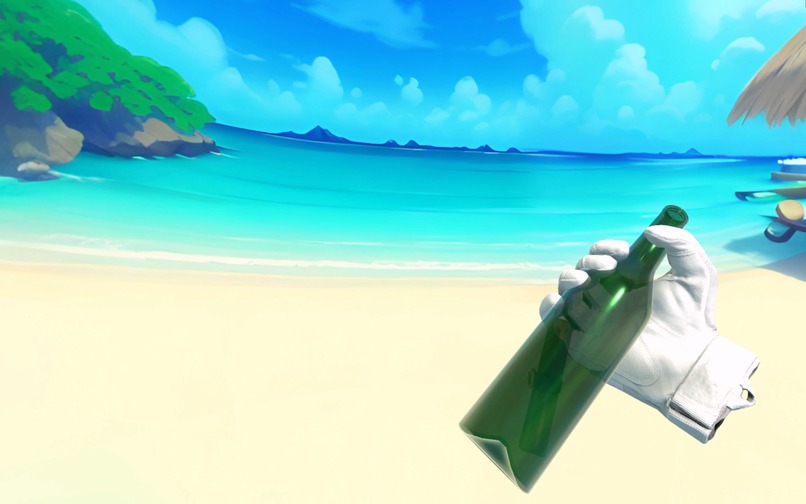
the Voyager carring the Goldren Record is a Message Bottle! Let's throw it into the sea of stars!
-
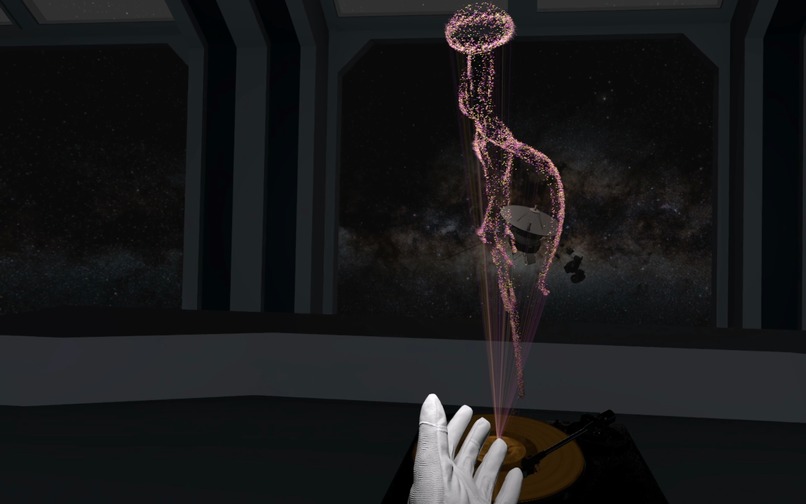
Particle System and the Sound of Earth
-
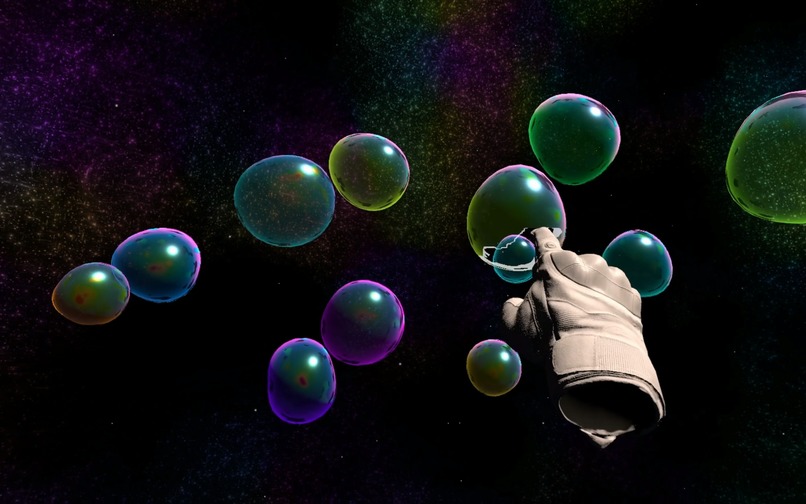
Pop it! There are more voices in the Golden Record trying to reach out to you!
-
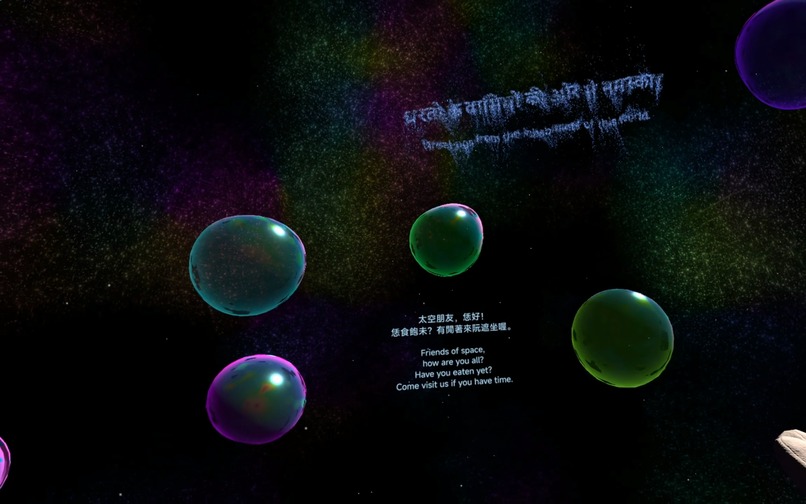
Greetings from 55 languages
-
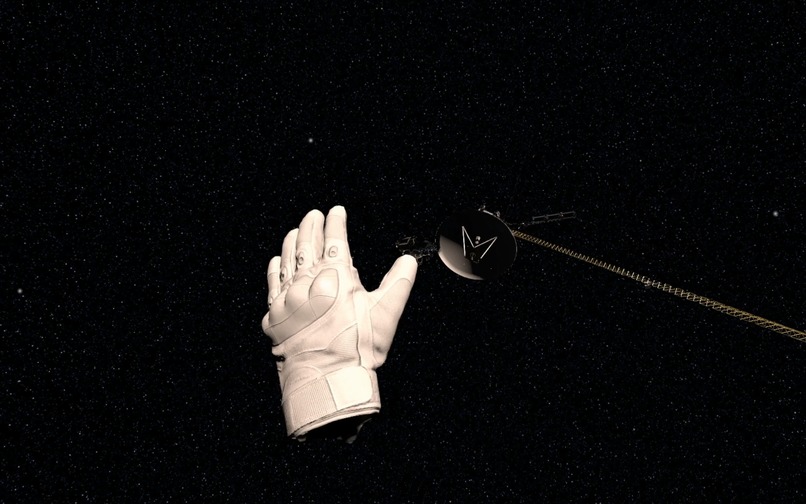
So long, Voyager. So long, the Earth. So long, the journey...
-
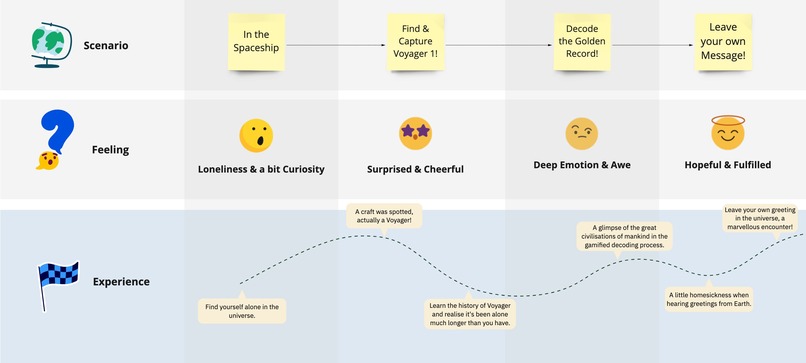
emotion map of this experience
-
logo_So Long


Inspiration
Our inspiration came from "The Pale Dot," a famous science book by Carl Sagan, unfolds from a photograph taken by the very Voyager 1 of Earth. From the BBC documentary "The Farthest," we learned that Voyager is expected to lose contact with us in the near 2025 due to the depletion of its plutonium generator, and from then on, its only mission will be to carry the Golden Record through the cosmos until it is captured. It may outlive Earth, and even when the solar system no longer exists, it will be the evidence in the universe that we were here. Meanwhile, we also learned that Voyager is not only a carrier of human aspirations to explore the universe and extraterrestrial civilisations but also a symbol of peace, as its launch rocket was converted from a Titan missile originally designed for intercontinental ballistic missiles.
Recent news has further ignited our creative desire. NASA announced that Voyager 1 has begun sending garbled messages composed of 0s and 1s, which humans cannot decode. Although there are many scientific, somewhat uninteresting ways to explain this phenomenon, such as chip wear and ageing or being hit by solar wind electrons, it also gives us unlimited imagination—does it really want to convey something to us? Anyway, it is certain that this phenomenon marks the day, Voyager 1 losing contact with us forever, is just around the corner. Over time, it will be forgotten in the dark space, adhering to its last mission with a long journey—to deliver Earth's legacy to the universe.
So, in places we can't see, when Voyager is captured as expected, and the swan song in the Golden Record resounds again, the tales of human civilisation are unravelled page by page, and what stories will it bring? We have collected materials from the California Institute of Technology Jet Propulsion Laboratory and contacted the producer of the Golden Record, found the audio and decoding method in the Golden Record, and am ready to restore it in a larger-scale VR scene.
In other perspectives, our team wanted to address the challenge of creating seamless immersive storytelling in VR. Inspired by the limitations of linear narratives in traditional media, we sought to blend interactive elements with compelling narrative design, making users both participants and storytellers in a science-fiction journey.
Furthermore, Inspired by the challenge about accessibility, our team designed this project to make VR not only a tool for immersive storytelling but also a medium for educational inclusivity. By integrating interactive learning experiences, we aim to make space exploration accessible and engaging for users of diverse abilities and backgrounds. At the time of Voyager 1's disconnection from humans, we wanted to reimagine this incredible milestone in human history for a new generation, leveraging VR technology to provide an immersive and educational experience, telling this scientifically meaningful history in a gamified way. Through this, we aim to inspire curiosity about space exploration and foster a deeper connection to humanity's shared heritage. We hope this project can be oriented to everyone who has left a footprint in human history, so that the history and significance of Voyager, as well as the civilisation and hope it carries, will never be forgotten.
What it does
Oops! You've captured Voyager 1! You are going to play the Golden Record in the depths of space, just like opening a drifting bottle contains human heritage. As decoding its stunning images, timeless music, natural sounds from the Earth, and greetings in 55 languages, you'll gradually uncover the forgotten saga story of Voyager, and leave your own message in this interstellar time capsule.
This project aims to unravel the exciting history of Voyager's past step by step by restoring the process of decoding the content from the Golden Record in VR. It also delves into humanity's quest for understanding and connection across the cosmic expanse. The central themes explore the legacy of human ingenuity, the existential reflections triggered by our interstellar endeavours, the cultural and scientific significance of the Voyager Golden Record, and the metaphor of Voyager as a messenger of peace in a universe vast and unknown.
How we built it
Our project was developed using XR Interaction Toolkit in Unity, leveraging advanced technologies such as spatial audio, VFX Graph, Shader Graph, and Diffusion-model-based depth estimation. The final deliverable is an executable file (EXE, with an APK version currently under optimization), designed to be experienced on Quest 2 or Quest 3 headsets.
In the design phase leading up to this, we used Figma, Photoshop, Miro, and the aid of some generative AI tools to help us find the effect we wanted for our prototype and create flowcharts. We used GitHub, Onedrive and Notion, and Discord for project management, resource sharing, and collaborative development.
Given the tight development timeline, we adopted a Plan-based Waterfall methodology for overall project structure, complemented by incremental iterations to ensure flexibility. Key milestones included feasibility testing during the early phase, unit testing in the mid-phase, and user testing towards the end to refine the experience.
If you have any questions or feedback, please don't hesitate to reach out or leave a comment below.
Challenges we ran into
Although this was our second collaboration as a team, we faced significant challenges, particularly due to the complexities of working across multiple time zones in an entirely online setup. Our team comprises members at very different stages of life—some pursuing demanding PhD programmes, others managing full-time jobs. Balancing these commitments alongside our project work amplified the challenges we encountered.
What made this journey even more daunting was our relative inexperience with VR development. None of us had more than a year of hands-on experience in this field. Most of the APIs, modeling tools, and other technologies we used were completely new to us, requiring us to learn as we built. At times, we found ourselves staring at seemingly insurmountable technical roadblocks, forcing us to think creatively and, occasionally, find ways to “cheat” with clever workarounds.
Our narrative and interaction design became a critical focus—not only to enhance the storytelling but also to strategically lower development costs without sacrificing quality. It was a test of resourcefulness and determination, pushing us to extract the most from every moment of collaboration.
What kept us moving forward were the invaluable guidance of our mentors and the learning opportunities provided by the competition’s online resources and lectures. Thanks to these supports and our collective perseverance, we successfully overcame the challenges and delivered a 15-minute stationary interactive narrative experience on time.
Accomplishments that we're proud of
There are so many!
· Inspired by the competition’s theme, we explored ideas for futuristic UI design. One of our favourite outcomes was the vibrant, holographic 3D speech bubbles—complete with greetings from the Golden Record—reimagined as a playful yet intuitive way to represent future communication systems.
· Another design we’re particularly proud of is the holographic record player, equipped with AI capabilities to dynamically generate content. It’s a feature that embodies the intersection of art, technology, and science in our narrative.
· We also took on the challenge of visualising and simplifying the gravitational slingshot effect, a complex concept integral to the Voyager mission. By combining spatial audio and first-person animations, we created an experience that allows players to feel and understand this scientific phenomenon in an intuitive and immersive way.
· Every seamless transition in the game underwent countless iterations of refinement and testing, ensuring smooth, meaningful storytelling.
· And our onboard AI assistant, with its unique and engaging voice, brought an unexpected charm to the experience. Special thanks to Alice, our voice actress, whose incredible performance made the character come alive.
……
There’s so much more we could share, but ultimately, what matters most is how players respond. We’re thrilled to hear what they have to say and hope this experience resonates deeply with them.
What we learned
This experience has been nothing short of transformative for our team. As mentioned earlier, nearly every technology we utilised in this project—from advanced APIs to modelling tools—was something we had to learn from scratch during the development process. It’s been an incredible journey of discovery and skill-building, pushing us far beyond our previous limits.
But beyond the technical lessons, we gained something even more invaluable: the ability to present and package our work effectively. In our previous collaborations, while we were proud of our creations, we often struggled to showcase them in ways that truly conveyed their full potential. This time, however, we learned the importance of designing a logo, crafting a polished demo, and strategically presenting our game to maximise its appeal and impact.
We took those lessons to heart, creating a logo and a demo (the comprehensive demo can be found in the submitted package). These efforts are not just about showcasing a product—they’re about inviting more people to experience our narrative, play our game, and feel the story we’ve worked so hard to tell.
Ultimately, we’ve learned that creativity doesn’t end with development; it extends into how we share our work with the world. And we’re excited to bring even more people into this immersive, interactive journey.
What's next for "So Long"
This is just the beginning for our project. With more feedback from players and reviewers, we plan to continue iterating and refining the experience. Our next goal is to make this game available for free on SteamVR, so it can reach a wider audience and spark conversations about immersive storytelling in VR.
Excitingly, we’ve also completed a dedicated Chinese version of the game! This localisation reflects our passion for introducing the unique medium of interactive VR narratives to a broader Chinese audience. We can’t wait to see how it resonates with players from different cultural backgrounds.
If you have any suggestions, we’d love to hear them—don’t hesitate to contact us or leave a comment. And finally, if our project inspires or excites you, please consider giving us your valuable vote! Thank you for being part of this journey, and we look forward to what’s next.


Log in or sign up for Devpost to join the conversation.