-
-
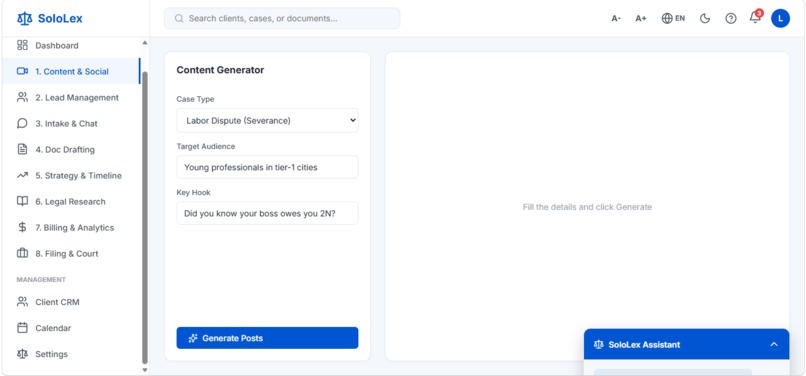
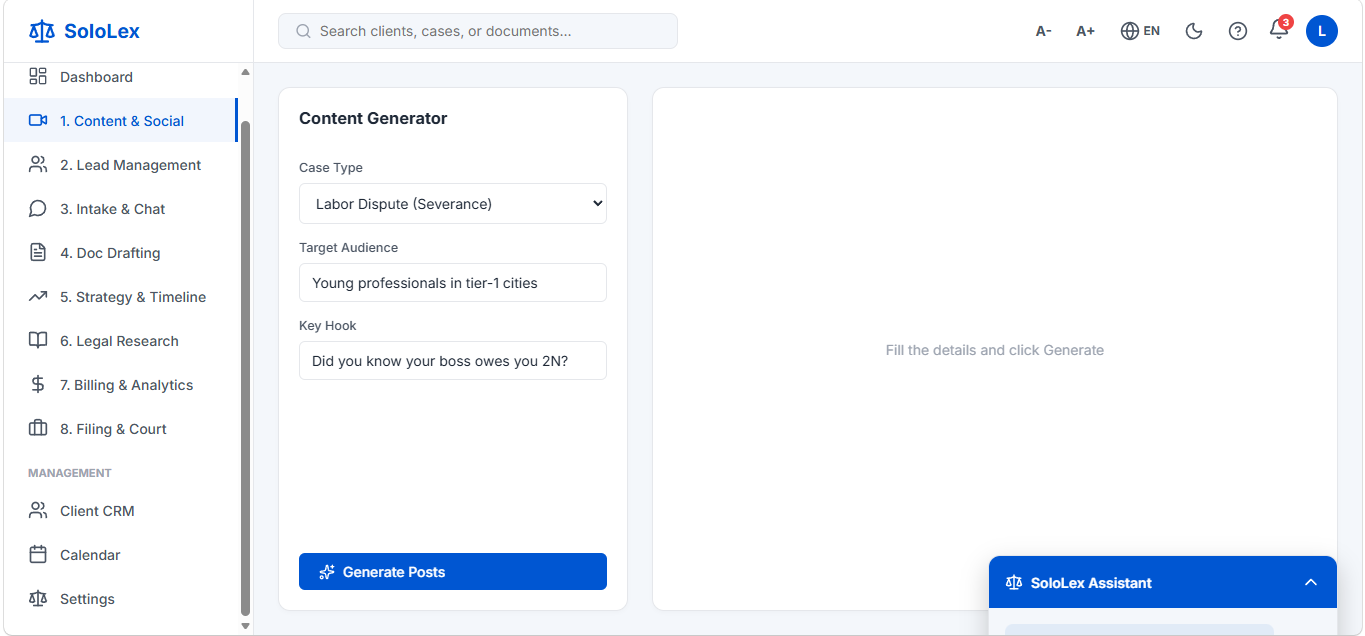
Auto-generates legal posts and video scripts for social media. One click. No writer needed. Saves 5 hours weekly.
-
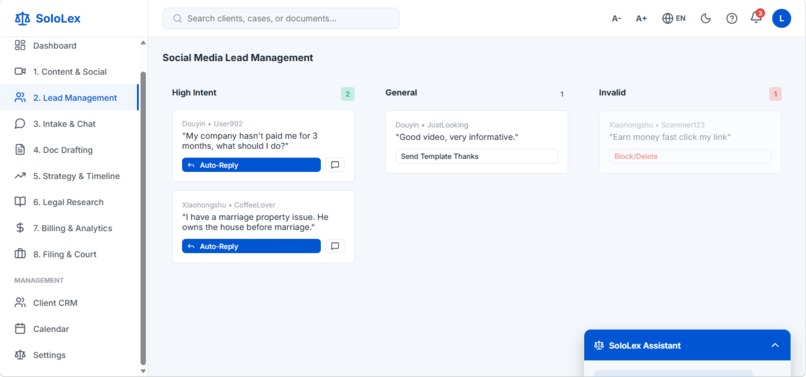
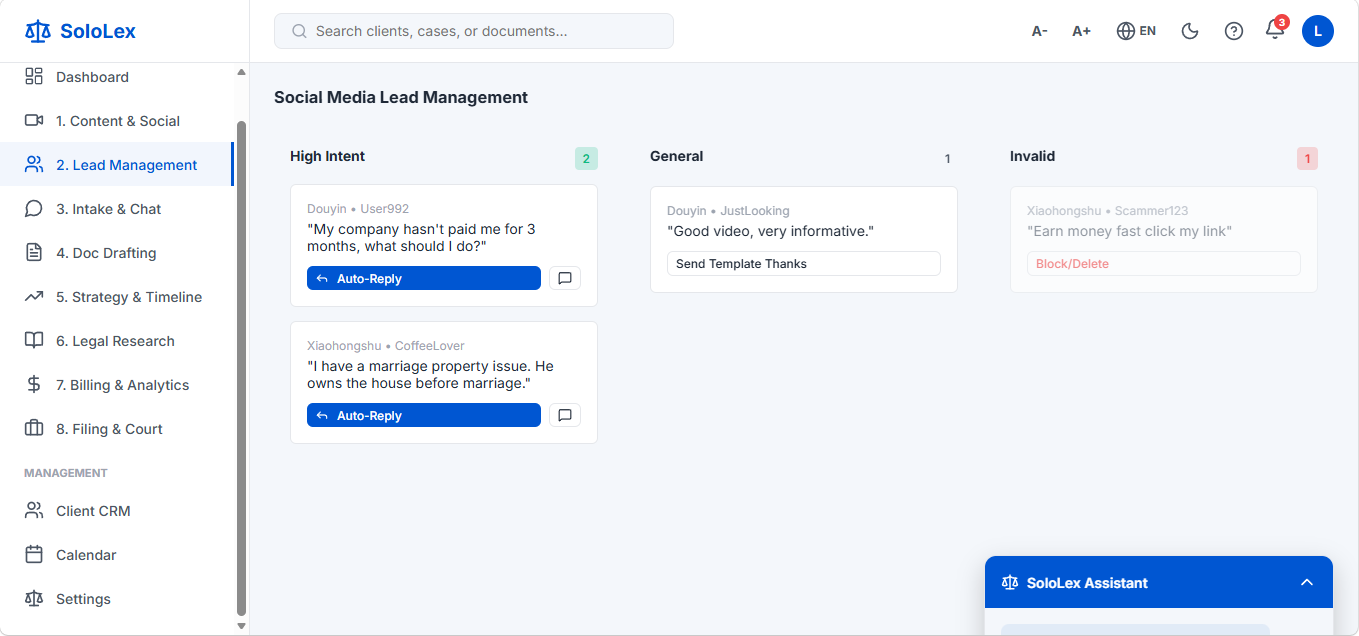
Auto-replies to comments and messages. Classifies leads as High-Intent, General, or Invalid. Saves 3 hours weekly.
-
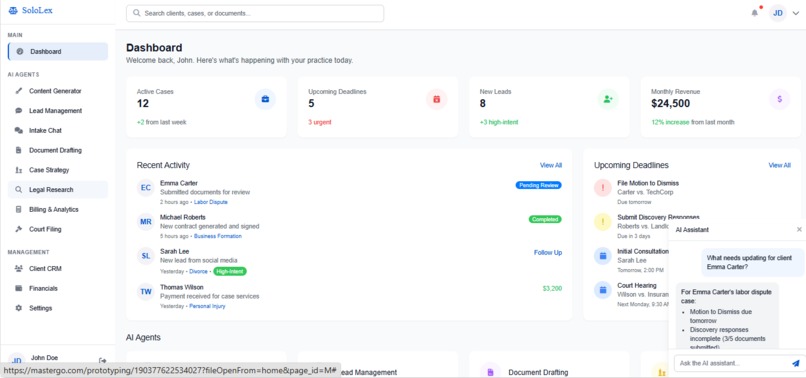
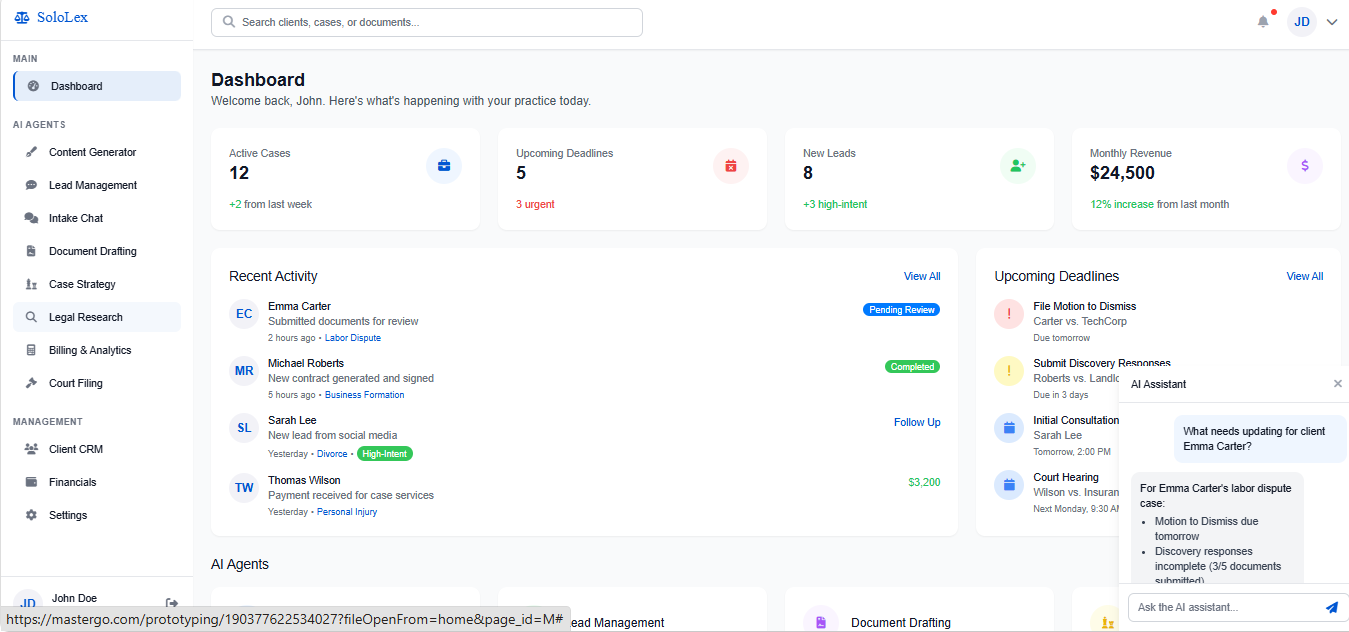
The Main dashboard , Heart of the Website . We can access every other feature from here including calling clients and sending messages
-
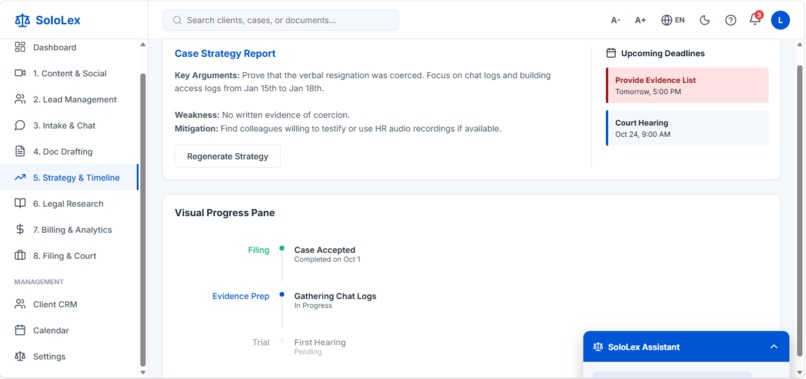
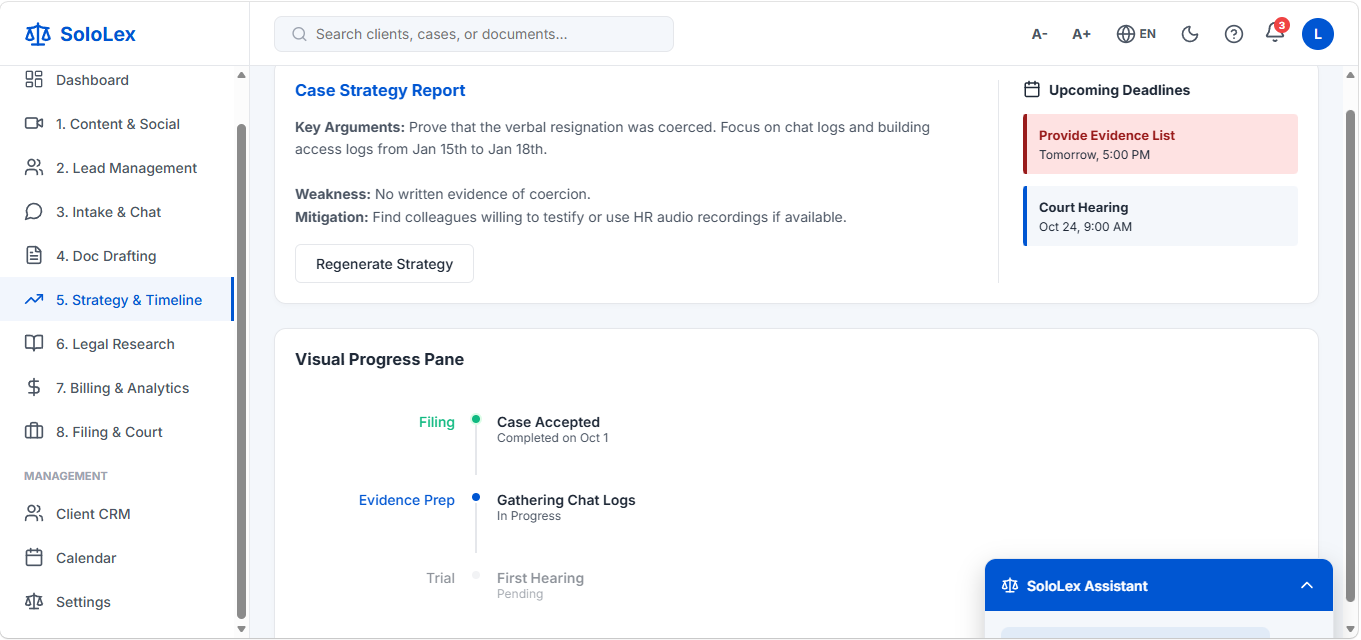
Generates case strategy. Sets deadline reminders. Visual progress tracking. Never miss a filing date. Saves 6 hours.
-
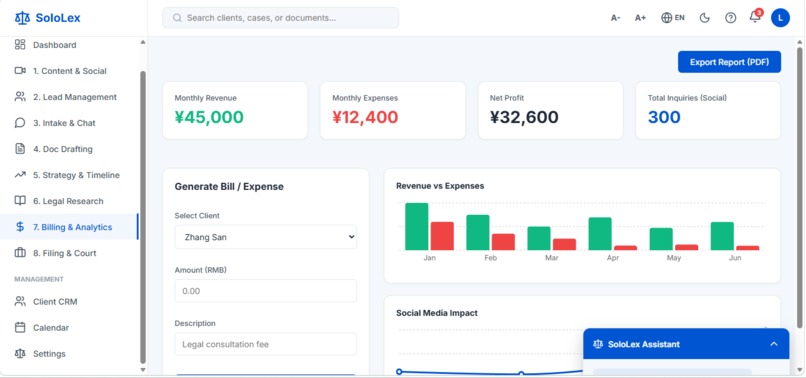
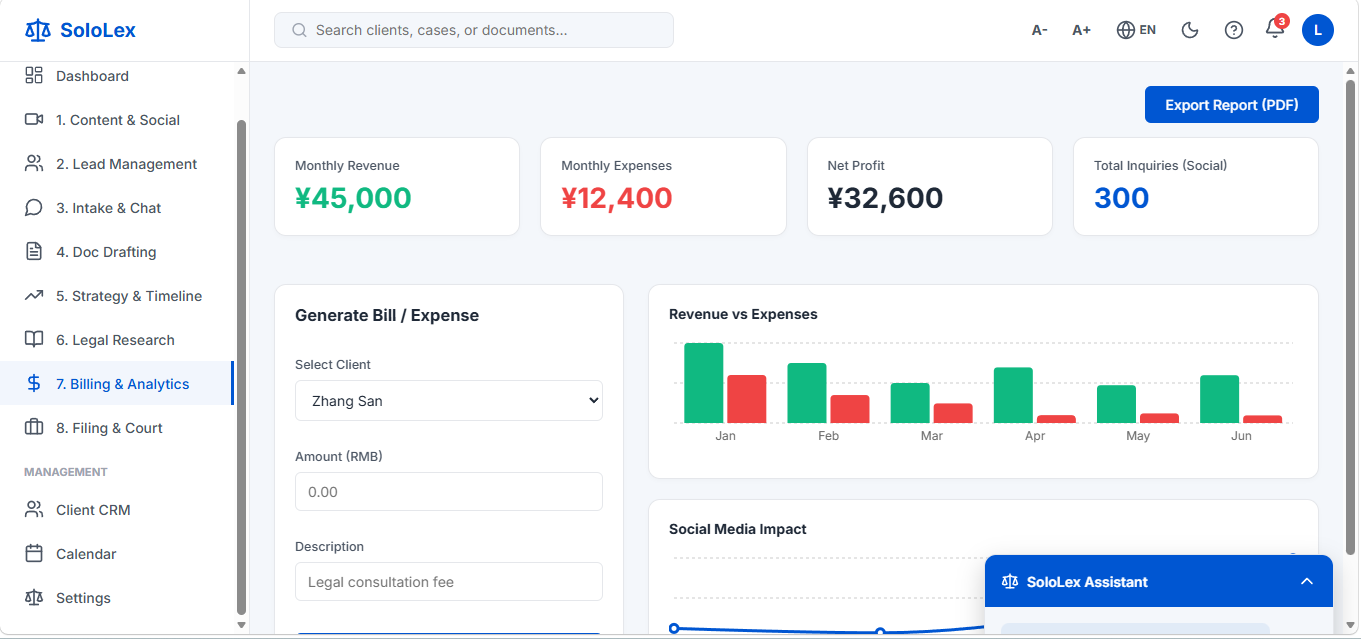
Client invoices. Revenue and expense tracking. Financial reports. Know your firm's health instantly. Saves 4 hours.
-
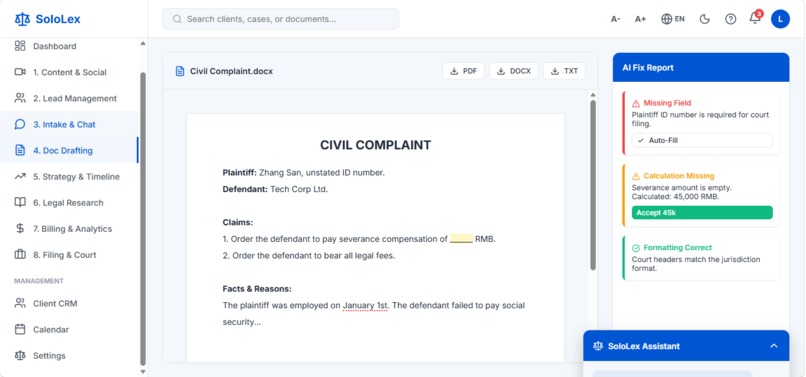
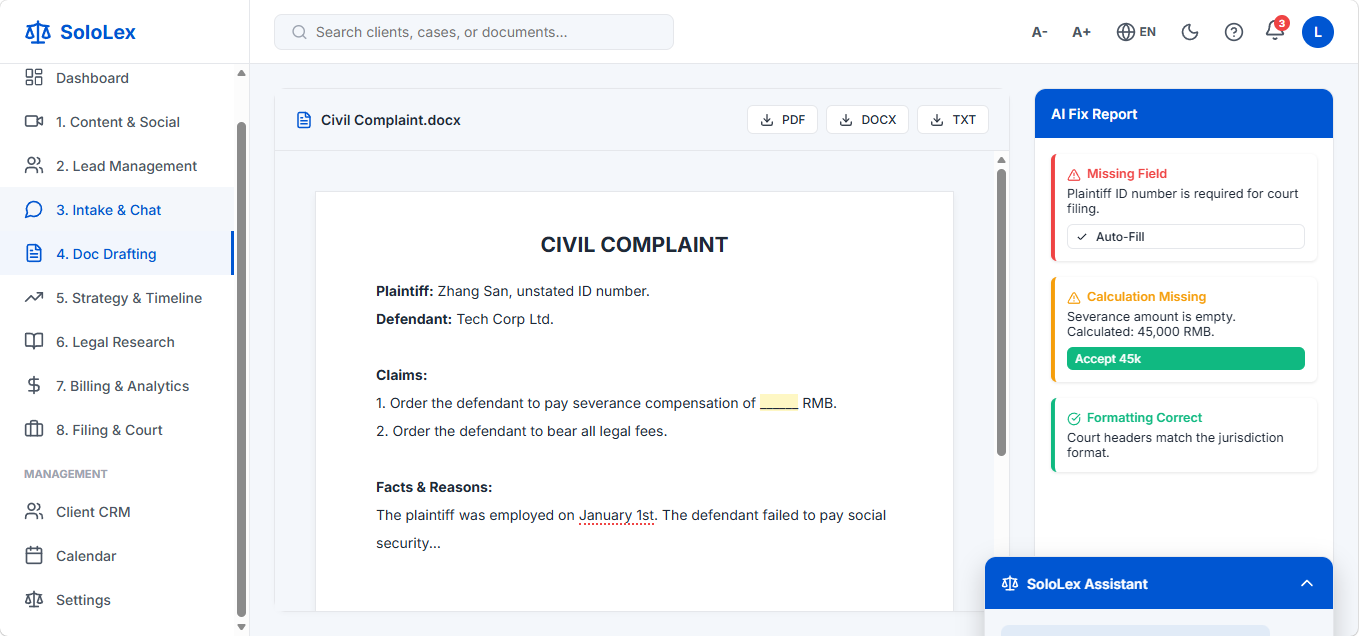
One-click complaints, contracts, letters. Auto-reviews for errors and compliance. Saves 10 hours weekly.
-
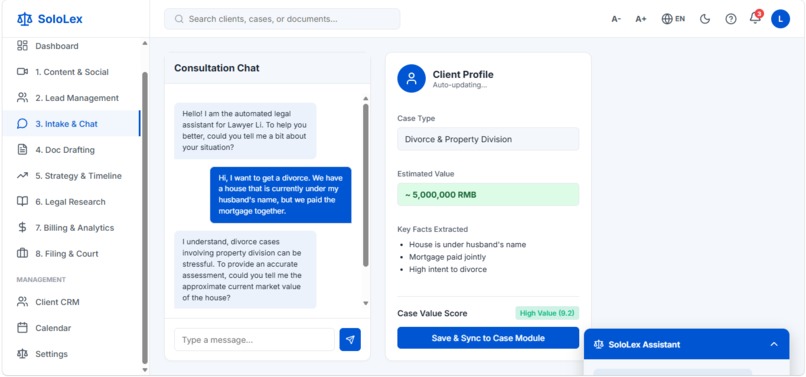
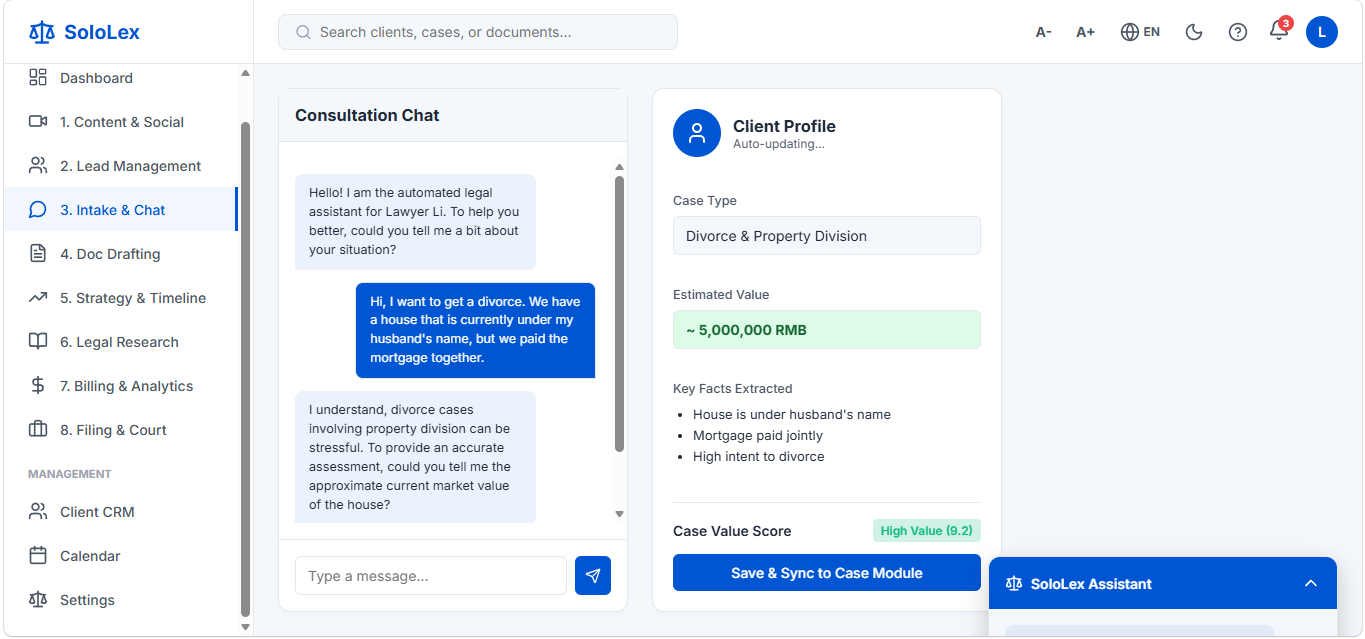
Multi-turn legal Q&A. Screens clients by case value and timeline. Creates client profiles automatically. Saves 8 hours.
-
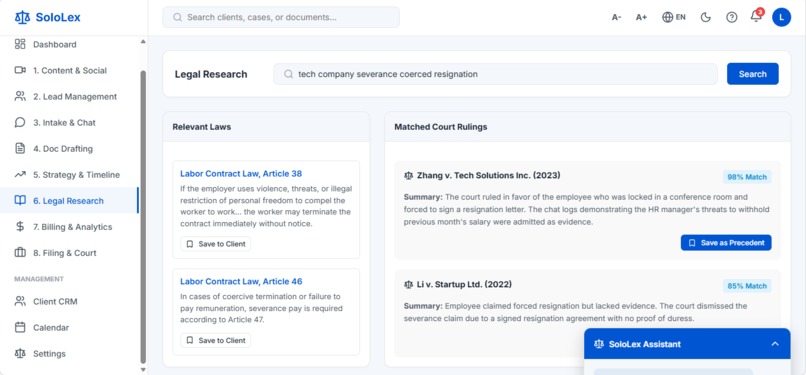
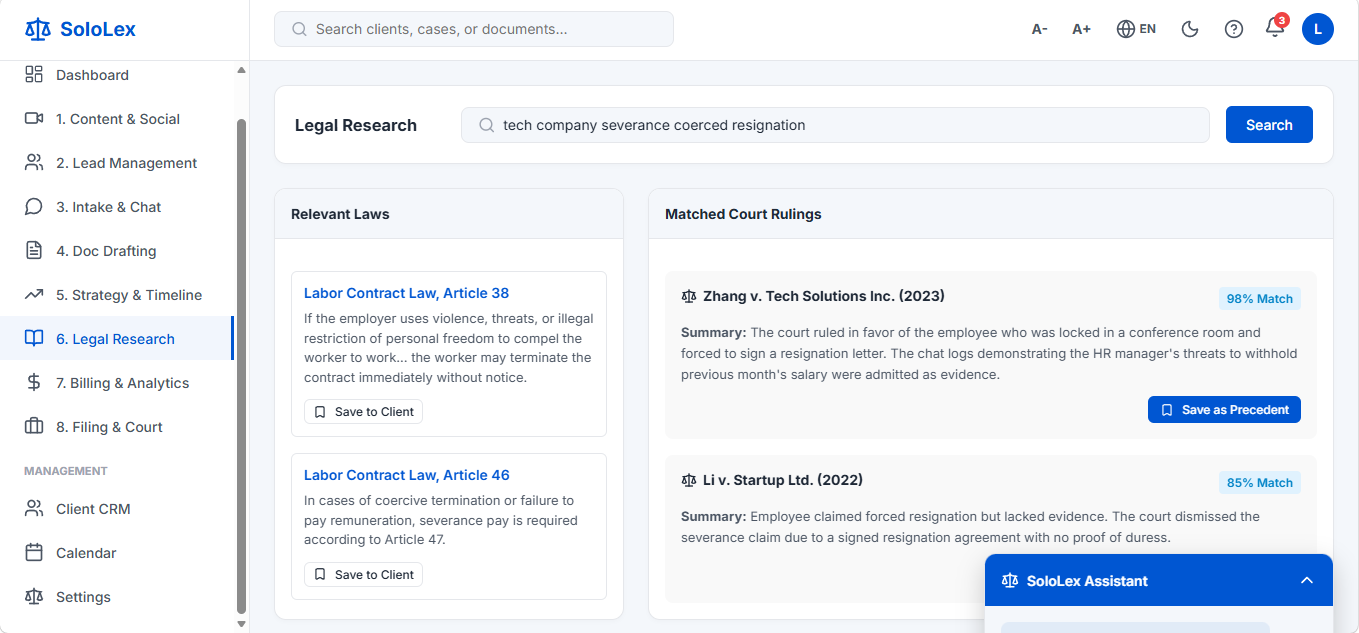
Real-time regulation updates. Matched court cases by practice area. No expensive databases needed. Saves 6 hours.
SOLOLEX — COMPLETE PROJECT STORY
For Devpost Submission
The Inspiration
The inspiration for SoloLex came from a simple but painful observation: solo lawyers are drowning. I have friends and family members who are solo practitioners. They work 60 to 70 hours a week, yet they spend less than five percent of their time actually practicing law. The rest is consumed by marketing, document drafting, legal research, client screening, billing, and court filing. They became lawyers to help people, not to be accountants, marketers, and IT specialists.
One of them told me: "I spend twenty hours a week just on documents and emails. I don't have time for my clients. I don't have time for my family. I don't have time for myself."
That hit hard. I realized that solo lawyers are the backbone of legal access worldwide — over one million across China, the United States, the United Kingdom, India, and Europe. Yet they are overworked, under-supported, and burning out at alarming rates. Forty percent report burnout. Fifty-five percent leave private practice within five years. The problem is universal. The solution needed to be universal too. That is how SoloLex was born — an AI-powered operating system that gives solo lawyers their time back.
What I Learned
This project taught me more than any textbook ever could. First, I learned the power of simplicity. A single HTML file can be more powerful than a complex stack. SoloLex runs in any browser, on any device, anywhere in the world. No installation. No dependencies. No server costs. Judges can open it and see it working in seconds. That simplicity is a superpower.
Second, I learned that agent architecture is about boundaries. Designing eight distinct AI agents taught me that the hardest part is not making them smart — it is keeping them separate. Each agent must have one job and do it well. The Content Generation Agent creates content. It does not reply to comments. The Lead Management Agent replies to comments. It does not handle consultations. Clear boundaries prevent chaos.
Third, I learned that data flow is the real challenge. Getting eight agents to collaborate was harder than building them. Data must flow seamlessly from Lead to Intake to Document to Billing to Court. I learned to use localStorage as a shared data store and implement JavaScript state management to track data flow in real-time.
Fourth, I learned that a five-minute demo is a weapon. Building a project is one thing. Showing it in five minutes is another. I learned to prioritize ruthlessly. Each agent gets forty-five seconds. Every second must prove value. If it does not, it gets cut.
Fifth, I learned that global problems need global solutions. The hackathon is global. Solo lawyers everywhere face the same struggle. I learned to build for adaptability — currency flexibility across dollar, yuan, euro, and pound, platform flexibility across Xiaohongshu, Douyin, Instagram, TikTok, and LinkedIn, and language readiness with an English-first interface that is API-ready for localization.
Sixth, I learned that AI is an enabler, not a replacement. The goal of SoloLex is not to replace lawyers. It is to free them. The lawyer makes the final decisions. The AI handles everything else. This is the core principle of OPC — One Person Company — one person, augmented by AI, doing the work of a full team.
How I Built It
Tech Stack:
I used HTML5 for page structure, Tailwind CSS for professional and responsive styling, JavaScript ES6 for interactive UI elements, agent modals, and state management, ECharts for data visualization including case progress charts and revenue charts, Font Awesome for icons, and LocalStorage for data persistence in demo mode.
Architecture:
The entire application is a single HTML file with embedded CSS and JavaScript. No backend. No database. No installation. Each agent is a self-contained module with a modal interface, input fields, generate and process functions, output display, and data sync with localStorage. The dashboard aggregates data from all agents and displays key metrics, recent activity, upcoming deadlines, and charts.
Data Flow:
All data flows through localStorage with a shared schema containing clients, transactions, documents, leads, and cases. The flow is Lead Agent to Intake Agent to Document Agent to Billing Agent to Court Agent.
AI Integration:
The architecture is designed to plug into OpenAI API or Claude API for real AI power using LangChain for orchestration and Pinecone for vector database retrieval. For now, the demo uses realistic mock data to simulate AI behavior — enough to prove the concept.
Deployment:
The single HTML file deploys to GitHub Pages, Vercel, or Netlify with no build step, no dependencies, and instant deployment.
The Eight Agents:
Content Generation Agent auto-generates social media posts and scripts saving five hours weekly. Lead Management Agent auto-replies to comments and classifies leads saving three hours weekly. Intake Chat Agent handles multi-turn legal Q&A and screens high-value clients saving eight hours weekly. Document Drafting Agent generates complaints, contracts, and lawyer letters with one click and auto-reviews them saving ten hours weekly. Case Strategy Agent creates strategies, sets deadline reminders, and tracks progress saving six hours weekly. Legal Research Agent provides real-time regulation updates and matched court cases saving six hours weekly. Billing and Analytics Agent generates client invoices and tracks revenue and expenses saving four hours weekly. Court Filing Agent validates documents and tracks court announcements saving two hours weekly. Total time saved is forty-four hours per week — equivalent to one full-time employee.
The Biggest Challenge
The biggest challenge was designing eight non-overlapping AI agents that work together seamlessly — all in a single HTML file with no backend.
The first sub-challenge was agent role clarity. Every agent wanted to help with everything. I had to enforce strict boundaries. The Content Agent creates content only. The Lead Agent replies and classifies only. The Intake Agent screens clients only. The Document Agent drafts only. The Strategy Agent plans only. The Research Agent finds only. The Billing Agent invoices only. The Court Agent validates only.
The second sub-challenge was data flow between agents. Getting data from Lead to Intake to Document to Billing to Court was complex. The solution was localStorage as a shared data store combined with JavaScript state management.
The third sub-challenge was creating a professional UI that did not look like a basic hackathon project. I used Tailwind CSS for polished design, ECharts for real-time data visualization, and a professional blue and white color scheme that conveys trustworthiness for legal applications.
The fourth sub-challenge was the five-minute demo constraint. With eight agents, the risk was spending too much time on one and rushing through others. I created a structured script with strict time allocation — each agent gets no more than forty-five seconds.
The fifth sub-challenge was building without a backend. No database. No authentication. No real AI APIs. I used localStorage for data persistence, designed API-ready architecture for future integration, created realistic mock data, and built a demo mode with no login required.
The sixth sub-challenge was making it work for a global audience. I built the interface in English, designed for global legal workflows, added multi-currency support, and made content generation adaptable to any platform worldwide.
The lesson I learned is that the biggest challenge was not the technology — it was the design. Clear boundaries, clean data flow, and ruthless prioritization are what made SoloLex work.
The Impact
Before SoloLex, solo lawyers spent forty-four hours per week on administrative work and only five percent of their time on actual legal work. Their weekly workload was sixty to seventy hours. After SoloLex, administrative time drops to zero, legal work time increases to ninety-five percent, weekly workload reduces to sixteen to twenty-six hours, and clients served triples. Annual savings exceed fifty thousand dollars per lawyer.
Why It Matters
SoloLex is not just a hackathon project. It is a mission. For solo lawyers, it provides freedom to practice law instead of doing admin. For clients, it delivers faster, better, more affordable legal services. For the legal system, it enables more accessible justice. For society, it creates lawyers who are happy, healthy, and focused on helping people.
What's Next
Phase one is the complete eight-agent web demo, which is done. Phase two is integrating GPT-4 and Claude for real AI power, which is in progress. Phase three is building a mobile app using React Native for lawyers on the go. Phase four is adding multi-language support for Chinese, Spanish, French, and Arabic. Phase five is creating an API for law firms to build custom agents. Phase six is launching as a paid SaaS product.
Acknowledgments
I thank my team for their relentless energy, the solo lawyers who shared their pain points, the hackathon organizers for creating this opportunity, and the open source community for tools like Tailwind, ECharts, and Font Awesome.
SoloLex — One Lawyer. Eight Agents. Infinite Capacity.
Built With
- api-ready
- claude-api
- css
- echarts
- font-awesome
- frontend
- html
- javascript
- langchain
- legal-tech
- localstorage
- openai-api
- single-page-application
- tailwind-css
- web-development

Log in or sign up for Devpost to join the conversation.