-
-
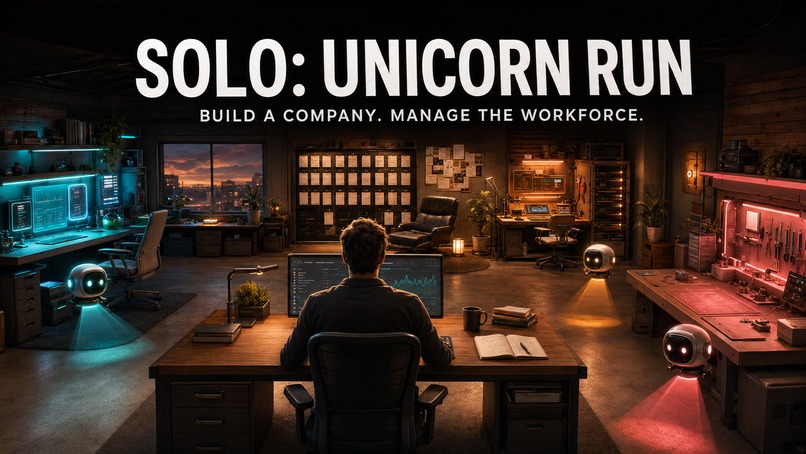
Making a Unicorn Run!
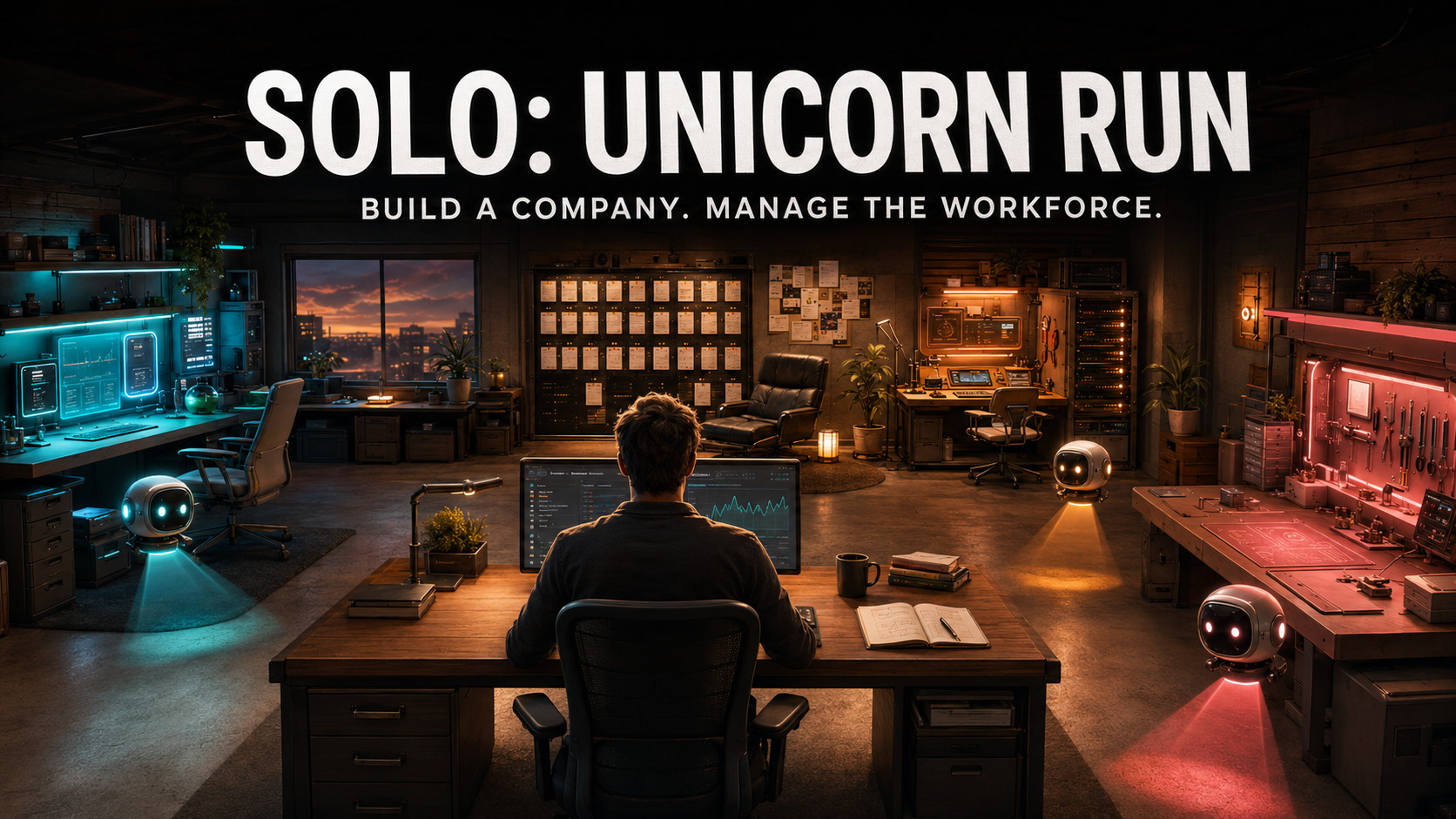
Inspiration
SOLO: UNICORN RUN came from my own experience trying to build as a solo founder.
I have the same dream a lot of founders have: build something meaningful, grow it into a real company, and maybe one day create a unicorn.
But the reality of that journey is very different from the polished version people usually see online.
There are moments when everything feels like it is working.
Then there are days when something breaks, an idea does not work, progress slows down, money matters more than expected, a decision turns out to be wrong, or you realize that something you were confident about was never really validated.
There are wins.
There are failures.
There are moments where you feel like you are building the future, and others where you wonder whether you are building anything at all.
I realized that I was learning lessons through actually living this journey that would be difficult to explain through another article, course, or startup checklist.
So I started asking:
What if I could put the experience itself into a game?
That became SOLO: UNICORN RUN.
The idea is to take what I am learning, experiencing, getting right, and getting wrong as a real solo founder and turn those lessons into systems, decisions, consequences, and stories that other people can experience for themselves.
The simplest way I describe it is:
The Sims for AI solo founders.
What SOLO is
SOLO is a startup simulation game about trying to build a company from almost nothing.
You begin in a Founder Garage.
You have limited money, limited time, limited attention, limited energy, and a very large ambition.
You are also working with AI agents:
- Aurora — Research & Evidence
- Stacks — Engineering & Execution
- Brio — Growth & Campaigns
But the game is not about pressing a button and letting AI build your startup for you.
That would not reflect what I am experiencing in real life.
The real challenge is learning:
- What should I work on?
- What should I ignore?
- When should I trust AI?
- When should I verify something myself?
- Is this actually progress, or does it just feel like progress?
- Should I spend money now or protect runway?
- Should I keep building or talk to customers?
- Should I change direction?
- Am I moving too slowly?
- Am I moving too quickly without enough evidence?
- Should I intervene, or am I micromanaging?
- What happens when something I believed turns out to be wrong?
Those are the kinds of questions I want SOLO to turn into gameplay.
Turning real founder experiences into game systems
Many of SOLO's systems come directly from problems and lessons I encounter while building in real life.
The player has to manage things like:
- Runway
- Revenue
- Expenses
- Capital
- Trust
- Momentum
- Founder Energy
- Founder Attention
- Company Track Record
- Evidence
- AI agent reliability
- Agent workload
- Agent confidence
- Agent drift
These are not meant to be isolated statistics.
They interact.
A decision can improve momentum but hurt runway.
Moving quickly can create progress while increasing the chance that something was not properly validated.
Reviewing every AI decision may protect quality, but it can consume the founder's limited attention.
Giving an AI agent more autonomy may increase leverage, but now the founder has to decide how much that agent should actually be trusted.
That tension is a big part of what I am experiencing while building with AI today.
Success and failure both matter
One thing I do not want SOLO to become is a game where the player simply follows the "correct" startup formula and wins.
That is not how entrepreneurship works.
Sometimes a reasonable decision fails.
Sometimes a bad idea teaches you something important.
Sometimes something that looks like a failure becomes useful later.
Sometimes you get lucky.
And sometimes you make the right decision but do not understand why it worked until much later.
I want the player to experience those moments.
SOLO includes systems around evidence, hindsight, trust, momentum, and track record because I want decisions to have history.
The game should eventually be able to remind you:
You have been in a situation like this before. What did you learn?
That is something I am constantly doing as a founder myself.
The AI founder problem
Another major inspiration for SOLO is the rise of AI agents.
AI gives solo founders capabilities that would previously have required entire teams.
That is incredibly powerful.
But it creates a new problem:
Being able to generate more work does not mean you automatically know which work is good.
An AI agent can be confident and still be wrong.
It can complete exactly what you asked for even when what you asked for was the wrong thing.
It can produce something impressive that has very little evidence behind it.
And sometimes the founder becomes the bottleneck because everything still requires review.
I wanted that tension inside the game.
SOLO's agents are not meant to be perfect assistants.
They can have different levels of reliability, confidence, workload, calibration, and drift.
The founder has to learn how to manage them.
That creates situations where doing more is not always the best move.
Sometimes the right decision is to intervene.
Sometimes the right decision is to let the agent decide.
And sometimes the most important founder skill is recognizing the difference.
Building the world
I wanted the game world itself to reflect the founder journey.
SOLO begins in a small Founder Garage.
It is intentionally modest.
The player is sitting at a desk trying to build something much larger than the environment around them.
As the company grows, the physical world is designed to grow too.
The long-term progression moves from:
Founder Garage → Loft → Small Office → Office → Small Building → Big Building
The larger world is called Atlantis, a fictional technology hub populated by startups, investors, media organizations, and rival companies.
The goal is for company growth to become visible.
Instead of only seeing a revenue number increase, I want the player to eventually look around and realize:
I built this.
How I built it
SOLO is being built as a native Apple-platform experience using technologies including:
- Swift
- SwiftUI
- RealityKit
- Xcode
- Blender
- USD / USDZ
- Git
- GitHub
- AI-assisted development tools
One of the biggest technical principles behind the project is separating the startup simulation from the visual world.
The simulation controls the truth of the company:
finances, decisions, agents, evidence, progression, consequences, and saved state.
RealityKit and SwiftUI present that world to the player.
That separation lets me continue improving the graphics, animations, cameras, environments, and characters without changing the underlying business simulation every time.
What I learned
The biggest thing I have learned while building SOLO is that the game and my real founder journey are starting to teach each other.
Something happens while I am building my company, and I think:
That should be a mechanic.
Then I try to turn it into a mechanic and realize I do not fully understand the problem yet.
Designing the game forces me to think more clearly about the real decision.
Why was that difficult?
What information did I actually have?
What did I think I knew?
What turned out to be wrong?
What resource did the decision consume?
What would have happened if I had chosen differently?
That process has made SOLO more than a game project for me.
It has become a way of documenting and understanding the founder journey while I am still living it.
Who I am building it for
I am building SOLO for people who are curious about what it actually feels like to build a technology company.
That includes:
- Solo founders
- Aspiring founders
- Startup founders
- Builders
- Developers
- AI enthusiasts
- Tech enthusiasts
- People who enjoy simulation and management games
You should not need an MBA or years of startup experience to play it.
And you should not need to already want to become a founder.
My hope is that someone can play SOLO, make decisions, fail, recover, experiment, and come away understanding something about entrepreneurship that would have been much harder to learn from reading a definition.
What makes SOLO personal
I am not trying to build a game that pretends I already know everything about building a unicorn.
I do not.
That is actually part of the point.
I am building the game while I am living the journey.
As I encounter new problems, make mistakes, learn better approaches, discover tools, understand AI differently, and experience the emotional and strategic ups and downs of being a solo founder, those lessons can become part of SOLO.
The game can grow alongside the founder building it.
That makes SOLO, in a way, a living record of the journey.
What's next
My goal is to continue turning real founder experiences into playable systems.
That means expanding:
- AI agent behavior
- Founder decision-making
- Funding
- Customers and revenue
- Rivals
- Media attention
- Company growth
- Failure and recovery
- Founder energy and attention
- Team and AI autonomy
- Atlantis
- Character animation
- Environmental interaction
- Long-term company progression
Ultimately, I want SOLO to let someone experience the pursuit of building a startup from the Founder Garage all the way toward becoming a unicorn.
Not just the success story.
The whole journey.
The uncertainty.
The mistakes.
The late nights.
The breakthroughs.
The setbacks.
The decisions nobody sees.
And the feeling that despite everything that went wrong today, tomorrow you might still build something extraordinary.

Log in or sign up for Devpost to join the conversation.