-
-
DeepClear Studio
-
Deepclear Studio Hero
-
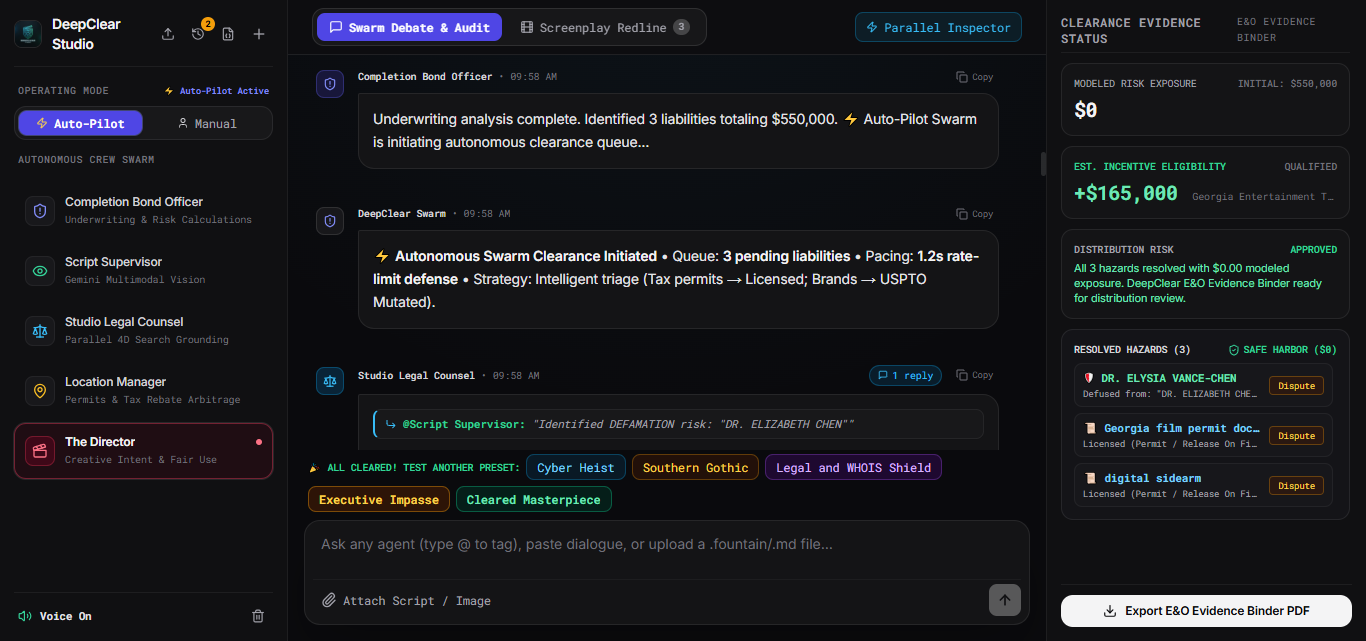
Deepclear Studio Swarm
-
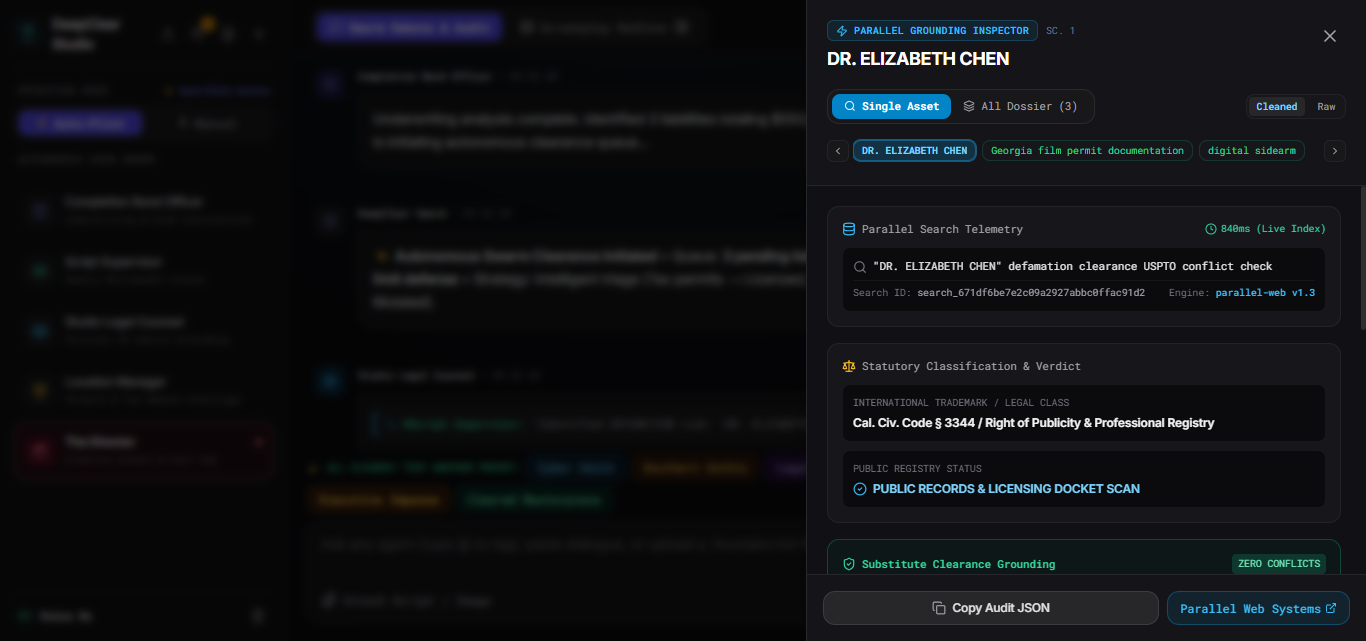
Deepclear Studio Parallel Inspector
-
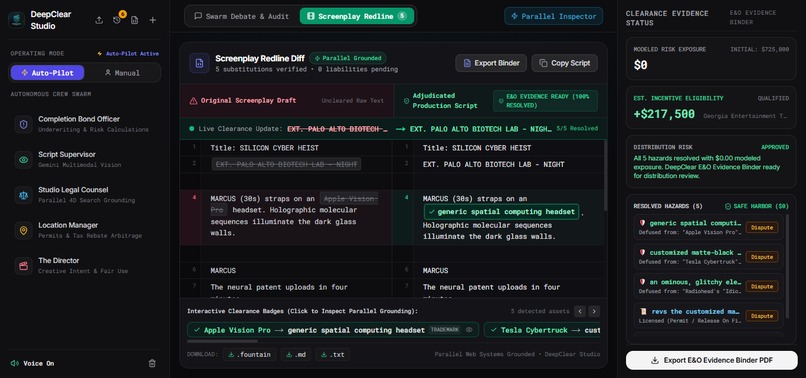
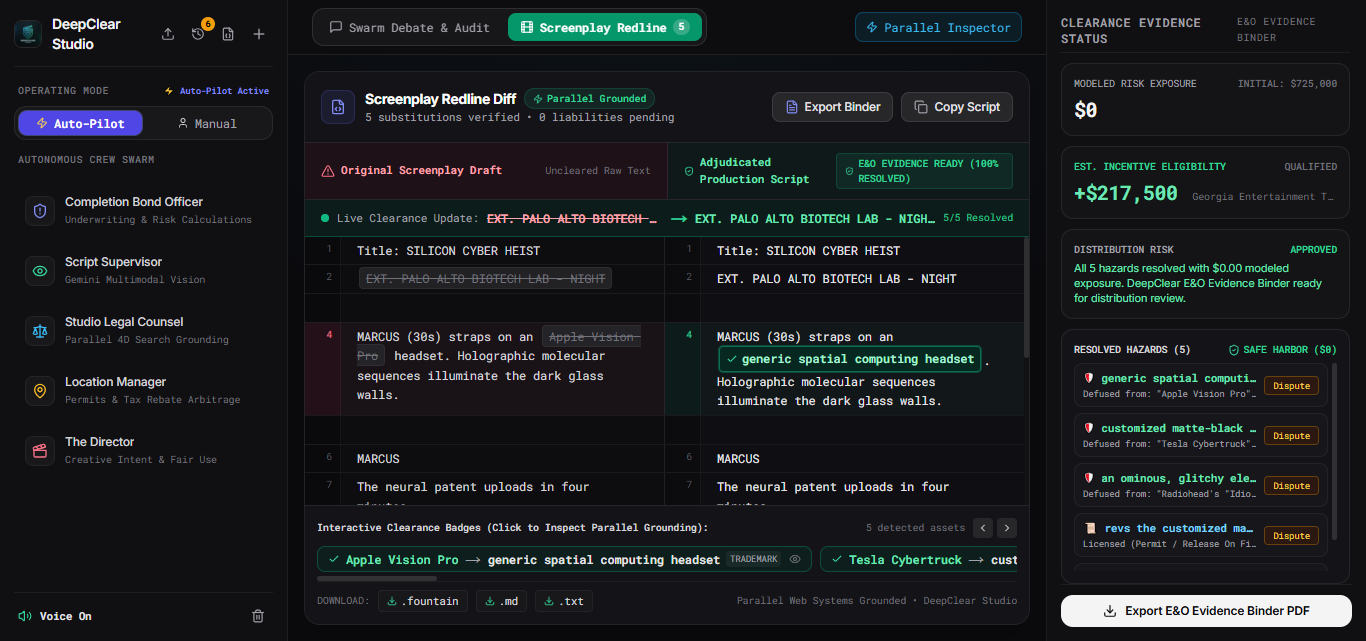
Deepclear Studio Redline
-
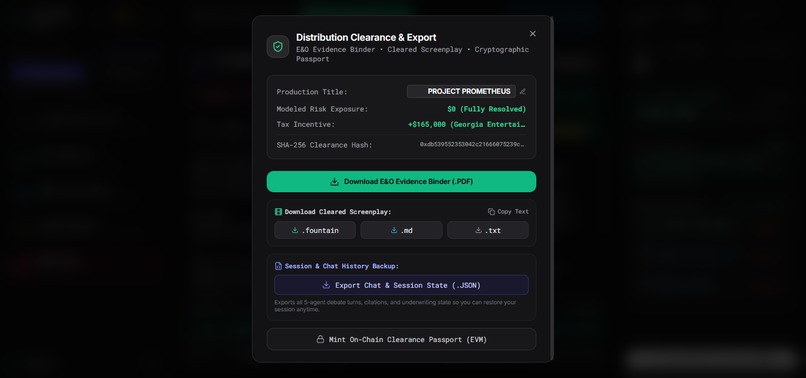
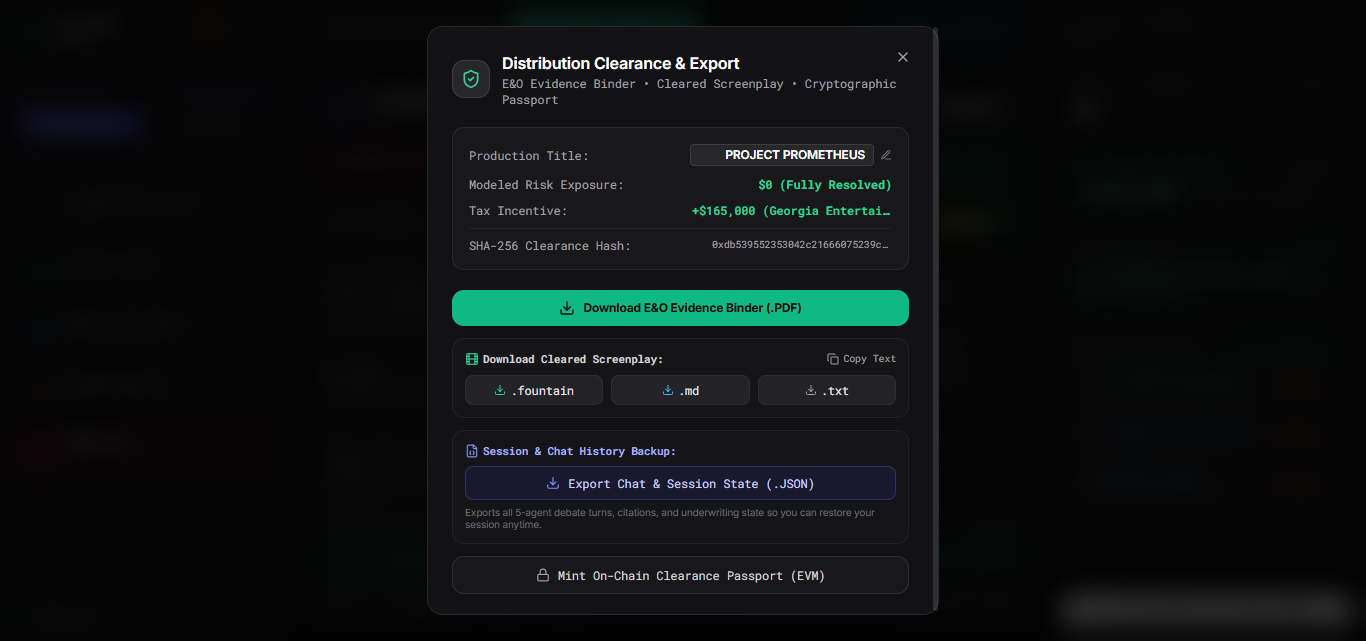
Deepclear Studio Evidence Binder
Inspiration
Getting a film from screenplay to distribution involves more than finishing the story. For many film and television distribution deals, Errors & Omissions (E&O) insurance is required, which means productions need to demonstrate that potentially problematic names, brands, locations, likenesses, music, and other references have been investigated and appropriately resolved.
Traditional clearance can be slow and expensive, especially when risks are discovered late in production.
What if filmmakers could identify clearance risks across an entire screenplay in seconds, and then resolve them through an evidence-driven workflow?
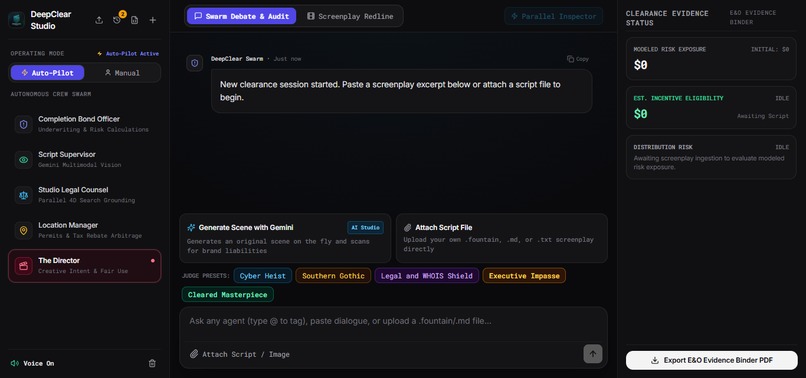
That became DeepClear Studio, an agentic screenplay clearance and evidence-preparation system that detects potential hazards, proposes story-aware resolutions, grounds those proposals in external evidence, and routes them through a deterministic Clearance Gate.
AI proposes. Evidence decides. Cryptography locks it.
How We Built It
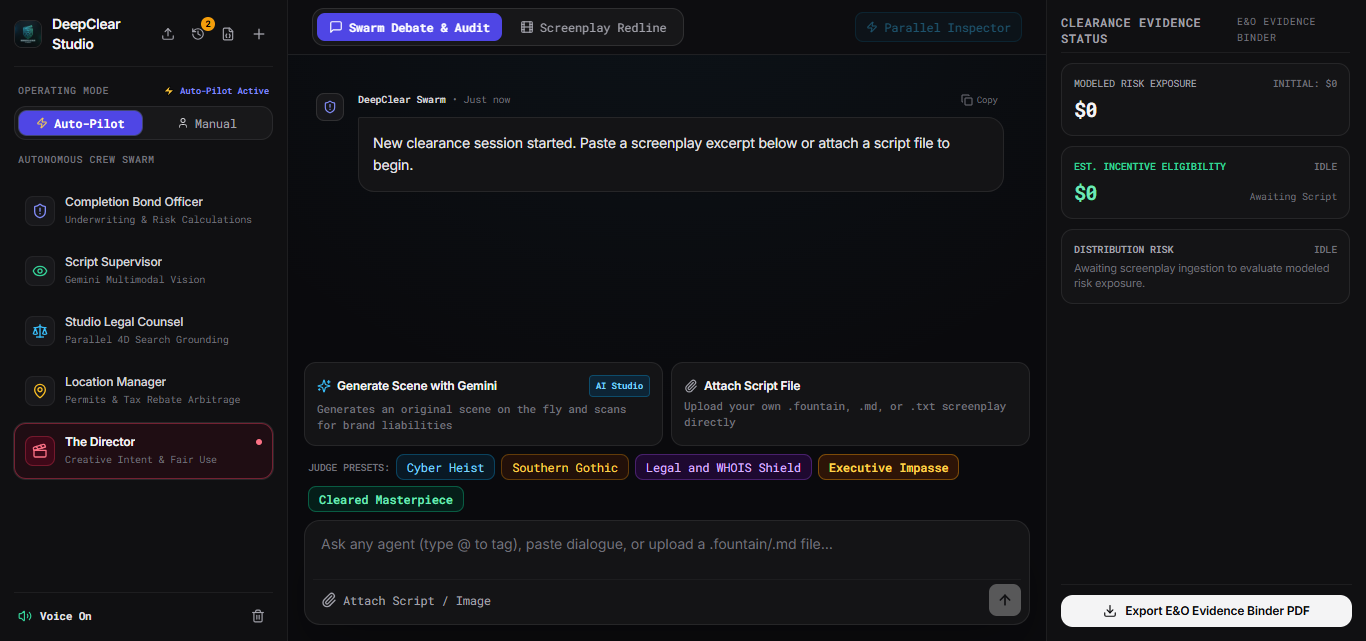
We combined Google Cloud Gemini with Parallel Web Systems to create an agentic studio clearance workflow inside the browser.
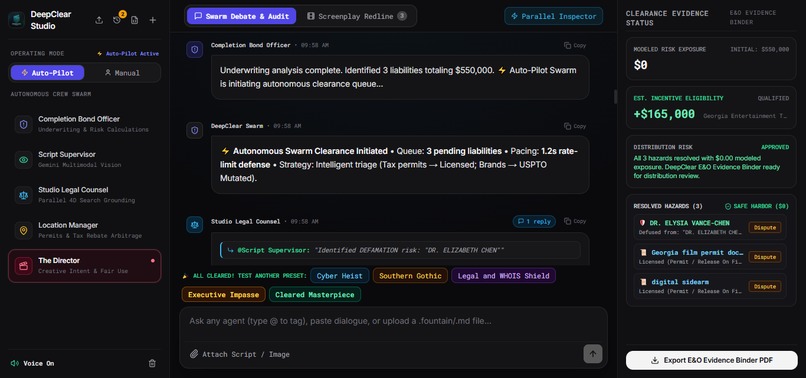
Google Cloud Gemini powers the extraction engine and a 5-agent operational swarm: Studio Legal Counsel, The Director, Location Manager, Script Supervisor, and Bond Officer. Each agent approaches a hazard from a different perspective: legal, creative, production, continuity, and completion-bond-oriented. Their bounded debate helps surface conflicts and propose practical resolutions.
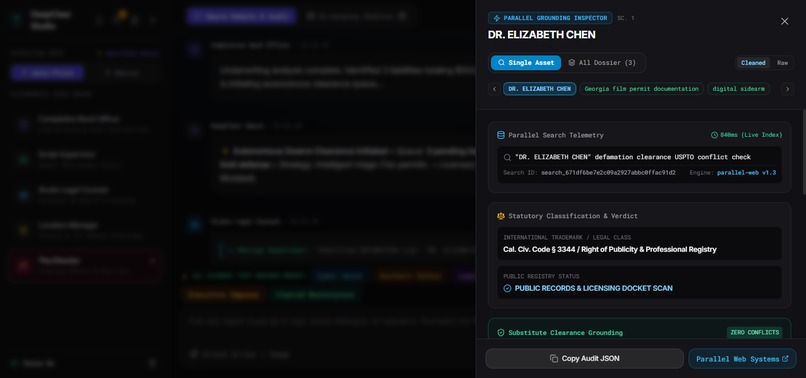
Parallel Web Systems provides external web research that grounds proposed resolutions in current evidence from configured sources. DeepClear normalizes that research into a structured evidence contract rather than treating an external search result as automatic legal clearance.
Clearance Gate is the deterministic control point. Agents can detect, debate, recommend, request evidence, or escalate to human review, but they cannot independently mark a hazard as verified.
NO VERIFIED EVIDENCE. NO CLEARANCE.
Redline Diff Viewer compares the original screenplay with the proposed production version, making substitutions and mutations visible while preserving screenplay structure across supported formats such as .fountain, .md, and .txt.
E&O Evidence Binder packages the screenplay version, hazards, evidence references, resolutions, verification outcomes, and relevant history into a client-side evidence artifact for downstream professional review. It is an evidence-preparation artifact, not insurer certification.
Clearance Passport creates a tamper-evident record of screenplay and version identity, hazard history, evidence references, Gate outcomes, and a SHA-256 state/history manifest, giving teams an auditable record of how clearance decisions evolved.
How We Model Risk and Incentives
DeepClear deliberately keeps modeled clearance risk and production incentive eligibility independent.
Modeled Risk Exposure
$$\text{Modeled Risk Exposure} = \sum(\text{Modeled Exposure of Unresolved Hazards})$$
Estimated Incentive Eligibility
$$\text{Estimated Incentive Eligibility} = \text{Qualified Production Expenditure} \times \text{Applicable Illustrative Rate}$$
These figures are never netted against each other.
An eligible production may be modeled using its applicable base incentive and potential uplift where applicable. The result is presented as Estimated Incentive Eligibility, not as guaranteed financing or a guaranteed tax benefit.
A potential production incentive does not make a clearance hazard disappear, and a modeled risk value is not an actual legal liability.
Challenges We Solved
1. Preserving Creative Intent During Resolution
A simple text replacement can technically remove a risky reference while making the screenplay worse.
DeepClear treats resolution as a multi-perspective problem. The Director considers creative intent, Legal Counsel considers rights implications, the Script Supervisor considers continuity, and the production-oriented agents consider practical consequences. The result is a proposed resolution that can be inspected rather than an invisible AI rewrite.
2. Moving From AI Suggestions to Evidence-Backed Decisions
LLMs can propose plausible answers without having reliable evidence behind them.
We separated reasoning from verification. The agents can propose a resolution, but the system still requires evidence and evaluates that evidence through the Clearance Gate before a hazard can become VERIFIED. When evidence is missing, ambiguous, contradictory, or insufficient, the workflow fails closed or escalates to HUMAN_REVIEW rather than guessing.
3. Keeping a Multi-Agent Workflow Bounded
Five agents debating every hazard indefinitely would be expensive and unpredictable.
We bounded debate to a maximum of three turns per hazard. If the agents cannot reach an acceptable resolution, the workflow moves into controlled human review rather than allowing the reasoning loop to continue indefinitely.
4. Making Clearance Traceable
A final cleared label is not enough for an evidence-heavy workflow.
DeepClear preserves the full chain: screenplay → hazard → evidence → resolution → verification → state history.
The Redline Diff makes screenplay changes visible, while the Clearance Passport preserves a tamper-evident record of the decision history.
What We Learned
AI is good at proposing. Evidence is what makes a decision defensible.
Our biggest lesson was that adding more AI agents is not automatically the answer. The difficult part is deciding where AI stops having authority.
DeepClear therefore separates: Detection → Reasoning → Evidence → Verification → Clearance
The agents provide specialized reasoning. External sources provide evidence. The Clearance Gate makes the deterministic decision.
Human control is not a failure state.
Some clearance questions are genuinely ambiguous. Instead of pretending an AI system can resolve everything autonomously, DeepClear uses HUMAN_REVIEW and COUNSEL_RESOLUTION as controlled escalation paths. Human input can influence the proposed resolution, but it still returns to evidence evaluation and the Clearance Gate.
Auditability matters as much as automation.
For an evidence-heavy workflow, it isn't enough to say what the AI decided. You need to be able to show: what changed, why it changed, what evidence supported it, and which state the system reached.
That is why DeepClear treats evidence and cryptographic history as first-class product components rather than afterthoughts.
Built With
- agentic-ai
- autonomous-agents
- canvas-confetti
- film-clearance
- gemini-api
- gemini-flash
- gemini-pro
- google-cloud
- google-generative-ai
- jspdf
- jspdf-autotable
- legaltech
- microsoft-edge
- multi-agent-systems
- nextjs
- node.js
- parallel-api
- parallel-web
- puppeteer
- react
- screenplay
- tailwindcss
- typescript
- web-speech-api

Log in or sign up for Devpost to join the conversation.