Solidus — Revenue Intelligence That Takes the First Useful Action
Every customer message contains a support request, a commercial signal, and a decision waiting to happen. Solidus turns it into all three.
Solidus is an AI-powered revenue operations workspace for B2B SaaS teams. It reads customer messages from support, Gmail, and Slack; understands the account behind the message; detects revenue risk or growth opportunity; and prepares the next best internal action. Routine coordination can move forward autonomously. Sensitive and customer-facing work always stops behind an explicit human approval boundary.
Inspiration
The most expensive customer messages rarely look expensive.
A message saying, “The export timed out again and my team is getting frustrated,” might be treated as an ordinary support ticket. But if that customer is a $48,000 account renewing in 45 days, and a sales representative promised reliable exports, it is not just a bug report. It is a retention event involving Support, Customer Success, Sales, Product, and leadership.
Most teams discover that connection too late. Support tools optimize for closing tickets. CRM tools optimize for pipeline. Analytics dashboards show what happened after the fact. The people who need to protect a renewal are left stitching together messages, account history, commitments, calendar availability, and internal ownership manually.
We built Solidus around one idea: a customer conversation should become operational intelligence while it still has time to change the outcome.
Rather than building another inbox or another static dashboard, we wanted to create an agentic system with commercial judgment. It should be able to coordinate reversible internal work automatically, recognize when a situation is commercially sensitive, and involve people before an external promise or customer communication is made.
What it does
Solidus turns one customer message into three connected outcomes:
- A support resolution draft that helps the right team respond.
- Revenue intelligence including churn risk, expansion intent, competitor mentions, feature requests, sentiment, and urgency.
- A next-best action routed to the right internal team, with reasoning and approval controls.
The Revenue Overview
The Revenue Overview is the live operating surface. It shows:
- ARR currently at risk and accounts that need attention.
- A live Signal Stream containing evidence extracted from customer conversations.
- Account health cards with ARR, renewal date, health score, health status, and a human-readable reason.
- An approval queue for generated support, save-play, upsell, and product actions.
- A persistent audit trail showing how each piece of intelligence was created.
The guided Live Demo makes the value visible in seconds: a Northwind Analytics export complaint becomes evidence of frustration and urgency, a $48,000 churn-risk event, a RED health score, a Promise Drift event, and an approval-gated recovery action.
Real Message Analysis
Users can paste a new customer message into Solidus and select the relevant account and channel. A real GPT analysis then:
- Stores the message.
- Extracts structured evidence and a support-resolution draft.
- Recalculates account health.
- Creates the single best routed action.
- Explains what Solidus detected and why the action was selected.
The system deliberately makes one model request per user click, making the interaction visible, controlled, and cost-conscious for a hackathon demo.
Revenue Autopilot
Revenue Autopilot is the product’s autonomy layer. It classifies every event into a decision lane:
| Lane | What Solidus does |
|---|---|
| Routine | Completes safe, reversible internal coordination. |
| Sensitive | Creates a draft and waits for human approval. |
| Revenue-critical | Escalates the case, assembles a recovery operation, and never sends externally without approval. |
This distinction is central to Solidus. The goal is not to automate every response. The goal is to remove operational delay while preserving human judgment when customer trust, commercial commitments, or material revenue are at stake.
Promise Drift Detector
Promise Drift detects the moment a sales commitment and customer reality start moving apart.
For example, a recorded sales commitment may say that a finance team can rely on CSV exports before renewal. When new support evidence says exports are repeatedly failing, Solidus presents both sides side-by-side, explains the contradiction, assigns a severity score, and makes the commercial risk visible before the renewal conversation becomes a surprise.
Revenue Rescue Rooms
When Autopilot identifies a revenue-critical event, Solidus creates a Revenue Rescue Room: a structured internal recovery workspace built before trust is lost.
Each Rescue Room includes:
- The exact customer message and extracted evidence.
- ARR exposure and commercial context.
- An executive briefing.
- Recommended owners across Customer Success, Support Engineering, Sales, and Product.
- A recovery meeting title, agenda, and target window.
- Approval-gated internal actions.
- A separately approval-gated customer recovery invitation.
The Rescue Room archive preserves the history of recovery cases and lets teams filter them by case status and business outcome.
Recovery Calendar
Solidus includes a dedicated Recovery Calendar workspace. It can check Google Calendar availability for the internal recovery team and create the internal recovery meeting only after an explicit approval action. Once created, the event can be opened directly in Google Calendar.
Customer invitations remain separate and approval-gated. Solidus can prepare the work, but it does not quietly create customer commitments.
Revenue Memory and Outcome Learning
Every Rescue Room can become a Revenue Memory record. Teams can record whether an intervention resulted in monitoring, recovery, loss, or expansion. This closes the loop between AI reasoning and business outcome, helping Solidus distinguish a playbook that sounded plausible from one that actually protected revenue.
Connected Customer Systems
Solidus connects to the systems where customer truth arrives:
- Gmail: Secure OAuth, mailbox watching, account matching by sender domain, automatic ingestion, and a visible manual “Sync Gmail now” fallback.
- Slack: Secure OAuth and event-driven ingestion from connected workspace channels.
- Google Calendar: Availability lookup and creation of approved internal Rescue Room meetings.
An incoming Gmail or Slack message can be matched to an account, run through the same intelligence pipeline, trigger Autopilot, and create a Rescue Room when the commercial conditions require it.
Ask Solidus
Ask Solidus provides natural-language analytics grounded in the project’s account data. Users can ask questions such as “Which accounts need attention before renewal?” and receive an answer plus a data-backed chart rendered directly in the workspace.
How we built it
Solidus is a full-stack Next.js application, not a static prototype.
Intelligence pipeline
The core pipeline follows this sequence:
Customer message
  + account ARR, renewal, and health context
  + prior messages and signals
        |
        v
GPT-5.6 structured extraction
        |
        +-- Support-resolution draft
        +-- Revenue signals with confidence and reasoning
        +-- Sentiment and urgency evidence
        |
        v
Health scoring + next-best-action selection
        |
        v
Revenue Autopilot decision lane
        |
        +-- Routine internal coordination
        +-- Sensitive approval queue
        +-- Revenue-critical Rescue Room escalation
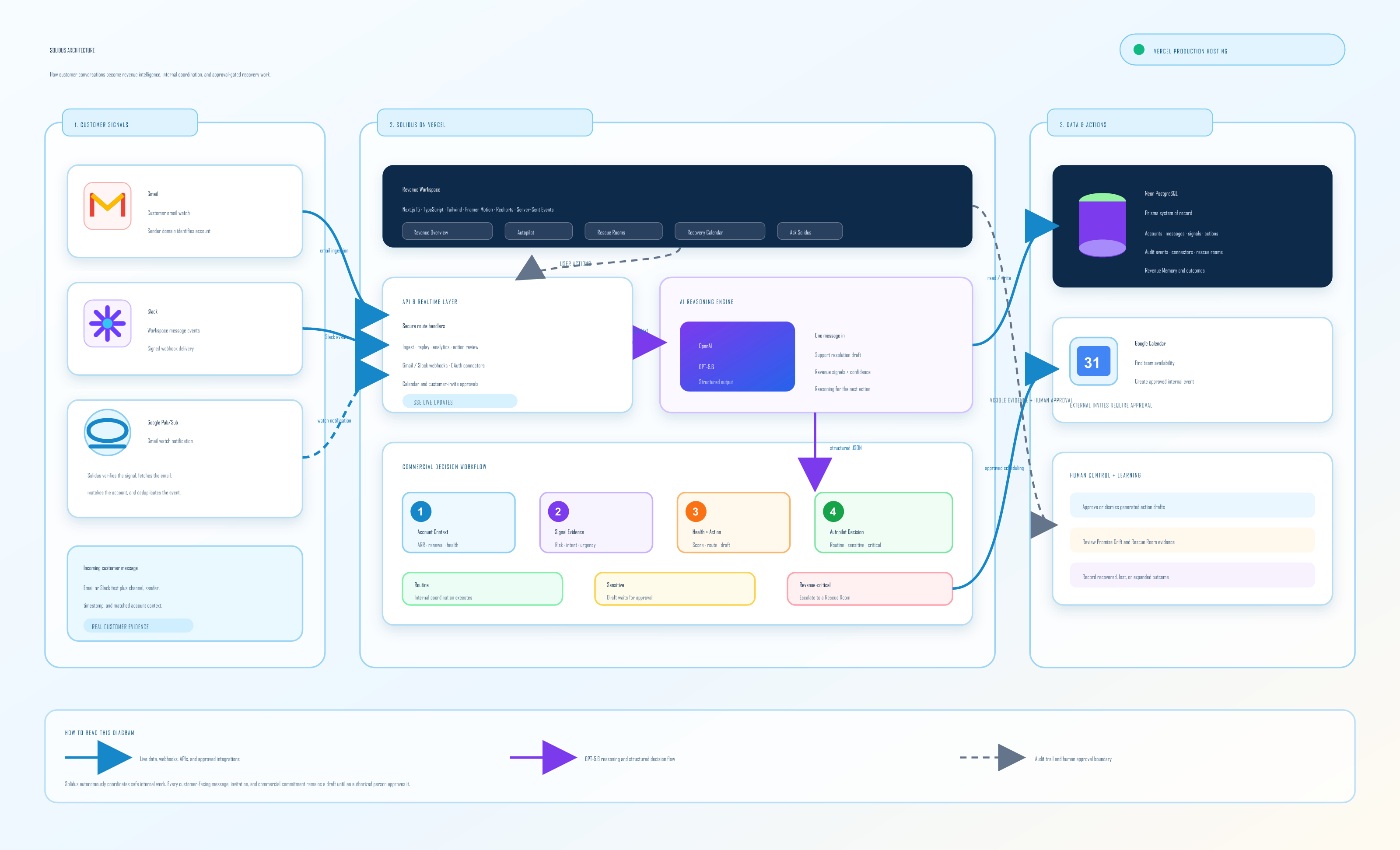
We use the official OpenAI SDK and strict structured JSON outputs so downstream logic receives typed, predictable signal data rather than free-form text. The model is given the message plus account context, not merely a customer sentence in isolation. This is what allows a seemingly ordinary complaint to be understood as a material renewal risk.
Product architecture
- Frontend: Next.js 15 App Router, TypeScript, Tailwind CSS, Framer Motion, Lucide icons, and Recharts.
- Backend: Next.js route handlers for ingestion, structured analysis, SSE updates, action review, analytics, connectors, webhooks, outcome recording, and calendar workflows.
- Database: Prisma ORM with Neon PostgreSQL for accounts, messages, signals, actions, audit events, Autopilot decisions, Promise Drift events, Rescue Rooms, connectors, and Revenue Memory.
- Realtime: Server-Sent Events refresh the Revenue Overview when new activity is recorded.
- Integrations: Gmail API, Google Calendar API, Google Pub/Sub delivery, and Slack OAuth/events.
- Deployment: Vercel serverless deployment with production environment variables for OpenAI, Neon, Google OAuth, Slack OAuth, and encryption keys.
Safety and autonomy design
We made the safety boundary a product feature rather than a disclaimer.
- Generated support replies, save plays, upsells, and customer invitations are drafts.
- Every external-facing action requires approval.
- Google Calendar creation is an explicit action from a dedicated Recovery Calendar workspace.
- OAuth tokens are encrypted at rest in the application database.
- Gmail and Slack ingestion uses event identity and message deduplication to avoid repeated processing.
- Autopilot records what it did and why in an audit trail.
Using Codex and GPT-5.6
Codex was used as an active engineering collaborator throughout the project: shaping the system architecture, generating and iterating on the Next.js and Prisma implementation, building API routes, integrating Gmail, Calendar, Slack, and Vercel, running migrations and builds, verifying production routes, refining the UI, and maintaining GitHub deployment flow.
GPT-5.6 is the core intelligence engine. It does the high-value reasoning keyword rules cannot: it interprets ambiguity, connects emotional language to commercial context, extracts multiple types of evidence from a single message, drafts a support resolution, and returns structured outputs that drive scoring and next-best actions.
Architectural Diagram
Challenges we ran into
Designing autonomy that earns trust
The biggest design challenge was deciding what Solidus should do automatically. A system that sends customer messages or creates commitments without context could damage trust. A system that only creates alerts would not solve the operational problem.
We resolved this with the Routine, Sensitive, and Revenue-critical autonomy lanes. Solidus can move internal, reversible work forward. It pauses when a customer-facing decision matters. The recovery process becomes faster without removing human accountability.
Connecting real external systems
Gmail, Slack, and Google Calendar introduced practical complexity beyond a visual prototype:
- OAuth consent, redirect URLs, and environment configuration.
- Gmail watch registration and Google Pub/Sub message delivery.
- Correct scope handling for Calendar availability and event creation.
- Slack workspace installation, request signing, event subscriptions, and message deduplication.
- Account matching from a real sender domain.
These integrations were important because Solidus is most compelling when intelligence arrives from the customer systems teams already use.
Making the outcome visible in a demo
Agentic workflows can be hard to judge when they happen invisibly in a backend. We built a guided Live Demo, Signal Stream, Account Health Board, Autopilot cards, Promise Drift comparison, Rescue Rooms, and approval controls so the full chain from evidence to coordinated action is visible on screen.
Keeping the product coherent as it grew
Solidus grew from a support intelligence engine into an integrated revenue operations workspace. We introduced a persistent feature-based sidebar and dedicated workspaces for Rescue Rooms, Recovery Calendar, Connectors, and analytics so the application feels like a product rather than a collection of disconnected demos.
Accomplishments that we’re proud of
- Built a working, end-to-end workflow from an actual Gmail or Slack message to revenue signals, health scoring, Autopilot decision, and Rescue Room escalation.
- Made GPT-5.6 reasoning operational through strict structured outputs, typed data models, auditable state changes, and clear UI evidence.
- Created a novel bridge across Support, Sales, Customer Success, Product, and Analytics instead of treating them as separate systems.
- Designed a useful autonomy model that balances speed with approval gates and commercial judgment.
- Built real OAuth integrations and deployed the working product to Vercel with Neon PostgreSQL persistence.
- Turned a $48,000 Northwind Analytics renewal scenario into a compelling, visible end-to-end demo rather than a slide-only claim.
- Added outcome learning so Solidus can become more useful over time, not just more automated.
What we learned
- The quality of an AI product is not only the model response. It is the workflow around the response: context, structured data, permissions, auditability, and the right moment for human approval.
- Customer support is a rich, underused source of commercial intelligence. The strongest signals are often implicit rather than keyword-based.
- The most valuable autonomous actions are often internal coordination steps, not customer-facing messages.
- Clear visual storytelling matters for agentic systems. A visible chain of evidence, reasoning, and approval makes the product understandable and trustworthy.
- Real integrations create credibility. Connecting to Gmail, Slack, and Calendar transformed Solidus from a dashboard concept into an operational workspace.
What’s next for Solidus
- More connectors: Zendesk, Intercom, HubSpot, Salesforce, Microsoft Teams, and Linear/Jira for incident and product follow-through.
- Account identity resolution: Map contacts and companies across multiple domains, aliases, CRM records, and product usage data.
- Outcome-informed recommendations: Use accumulated Revenue Memory outcomes to rank recovery plays by segment, product area, ARR tier, and renewal window.
- Multi-account pattern detection: Detect a recurring feature complaint or reliability issue across customers and automatically assemble a product-impact brief.
- Executive portfolio view: Show the total ARR exposed by issue category, owner, renewal quarter, and Promise Drift severity.
- Approval workflows for teams: Add role-based approvals, Slack approval prompts, escalation policies, and complete change history.
- Customer-safe automation: Expand routine automation only where a team has defined policy, approved templates, and measurable safeguards.
Solidus is built around a simple ambition: customer conversations should not disappear into disconnected tools. They should become timely, explainable action that protects revenue and helps teams earn customer trust.
Built With
- ai-agents
- codex
- framer-motion
- gmailapi
- google-calendar-api
- google-pub/sub
- gpt-5.6
- lucide
- neon
- next.js
- node.js
- oauth2.0
- openai-api
- openaisdk
- postgresql
- prisma
- react
- recharts
- rest-api
- revenue-operations
- server-sent-events
- slack-api
- tailwindcss
- typescript
- vercel

Log in or sign up for Devpost to join the conversation.