-
-
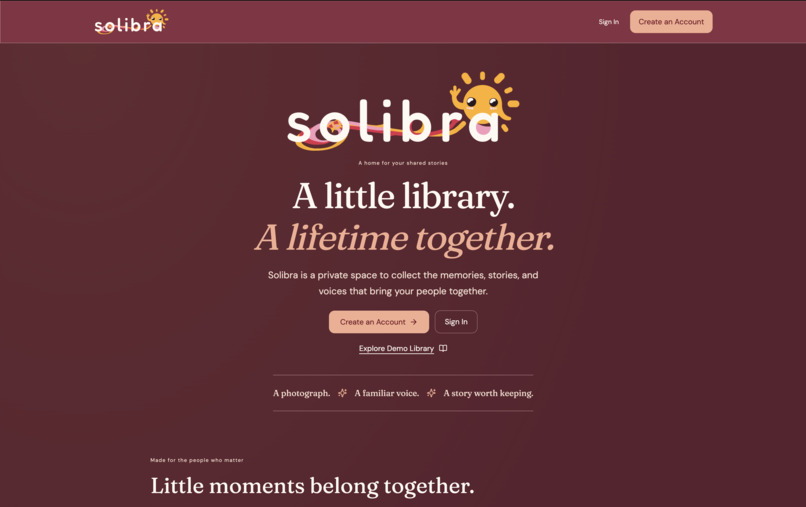
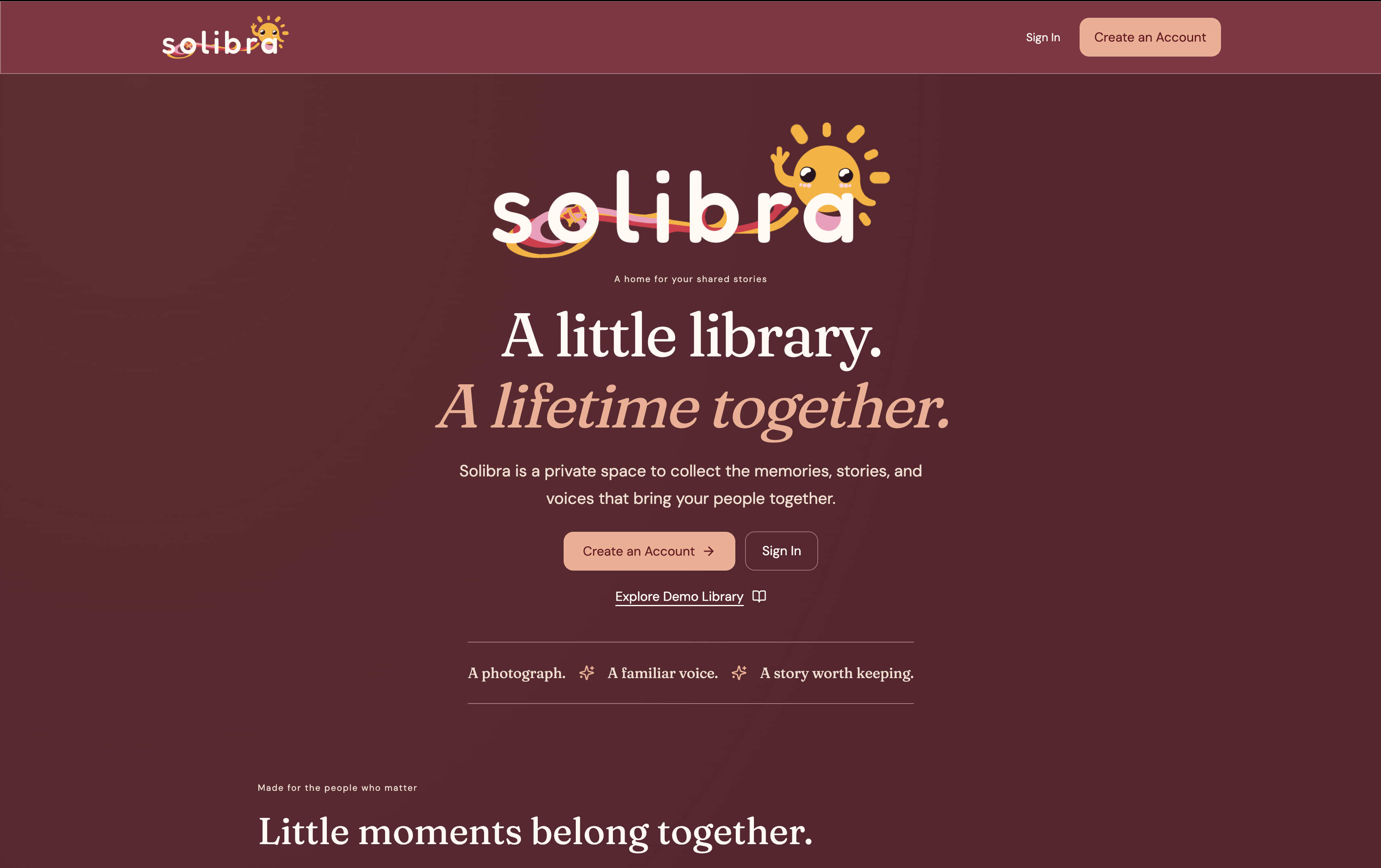
Main Landing Page
-
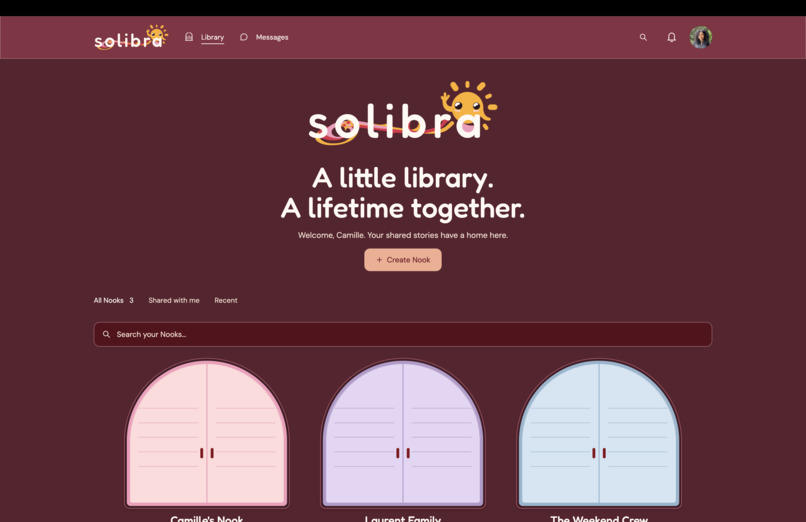
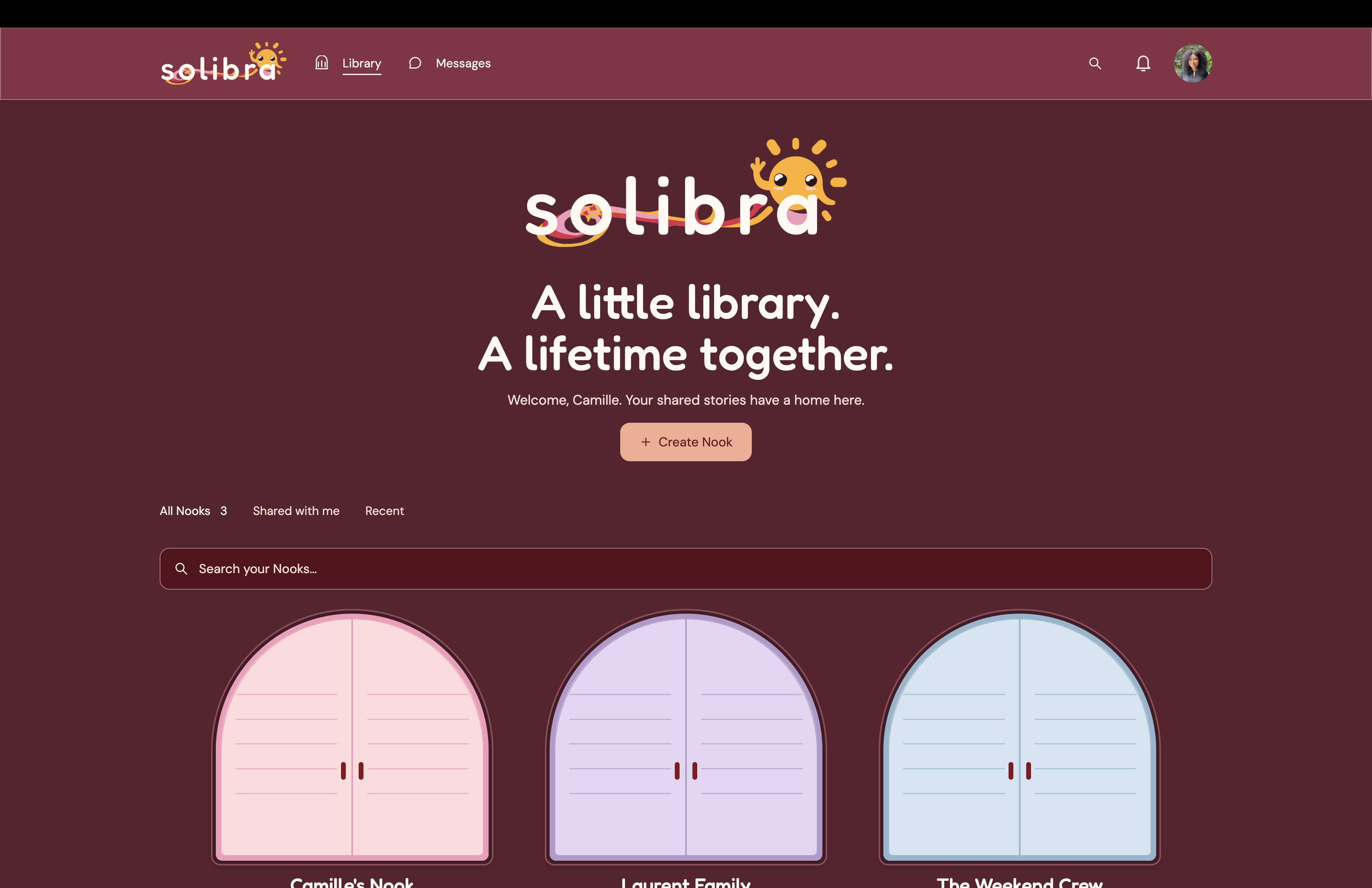
Library Homepage
-
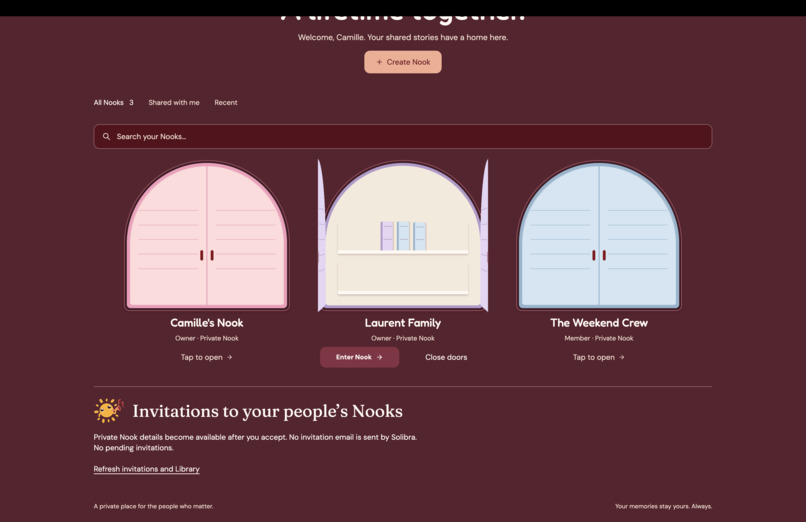
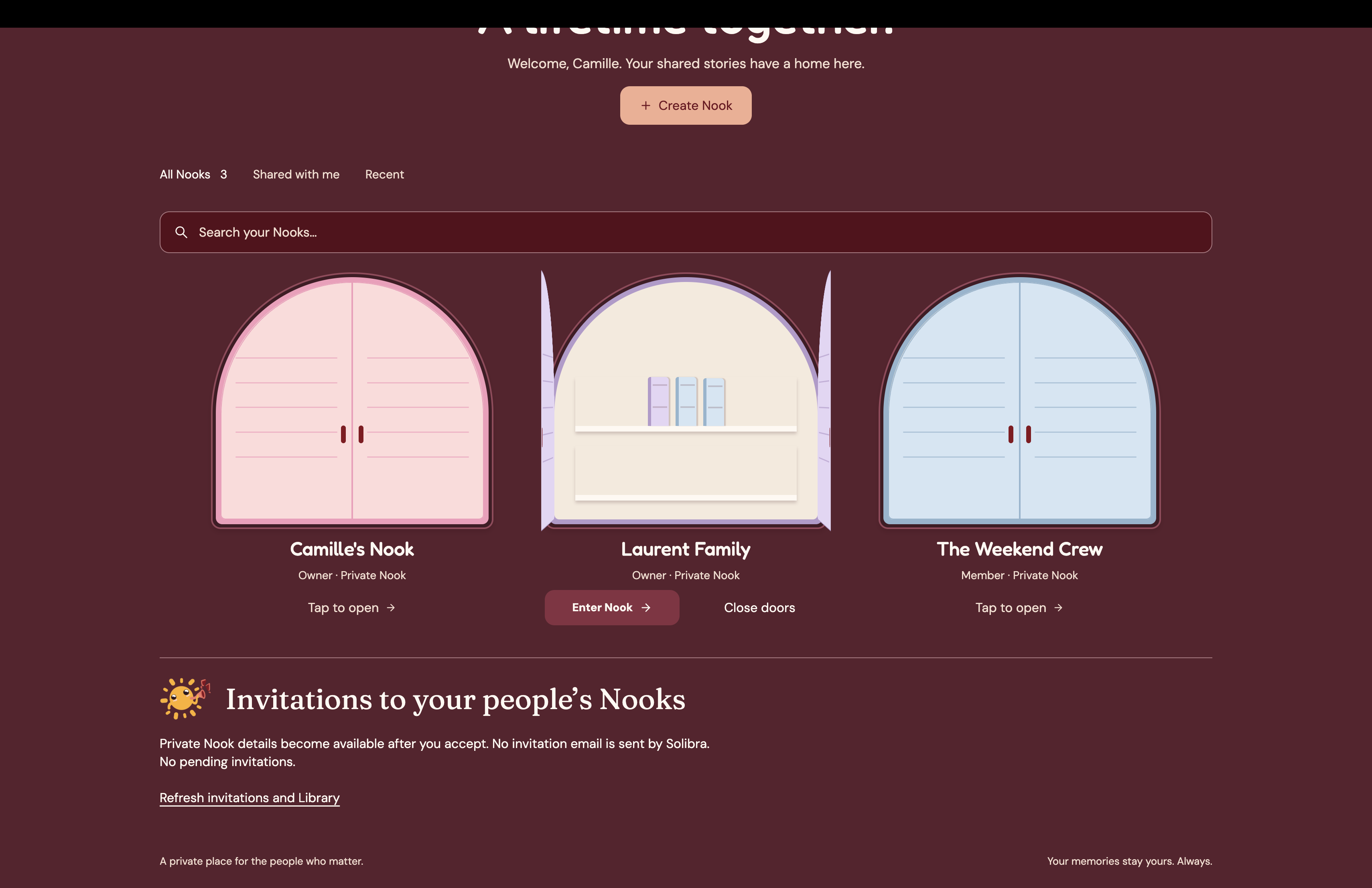
Library Homepage (Continued)
-
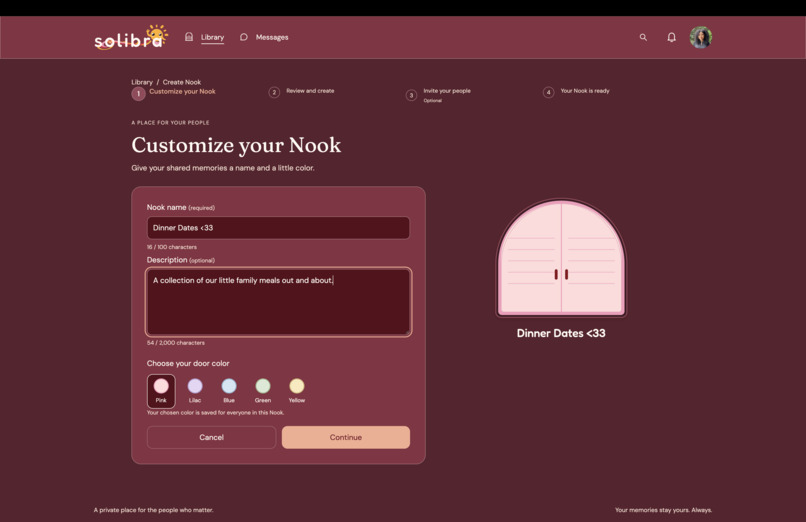
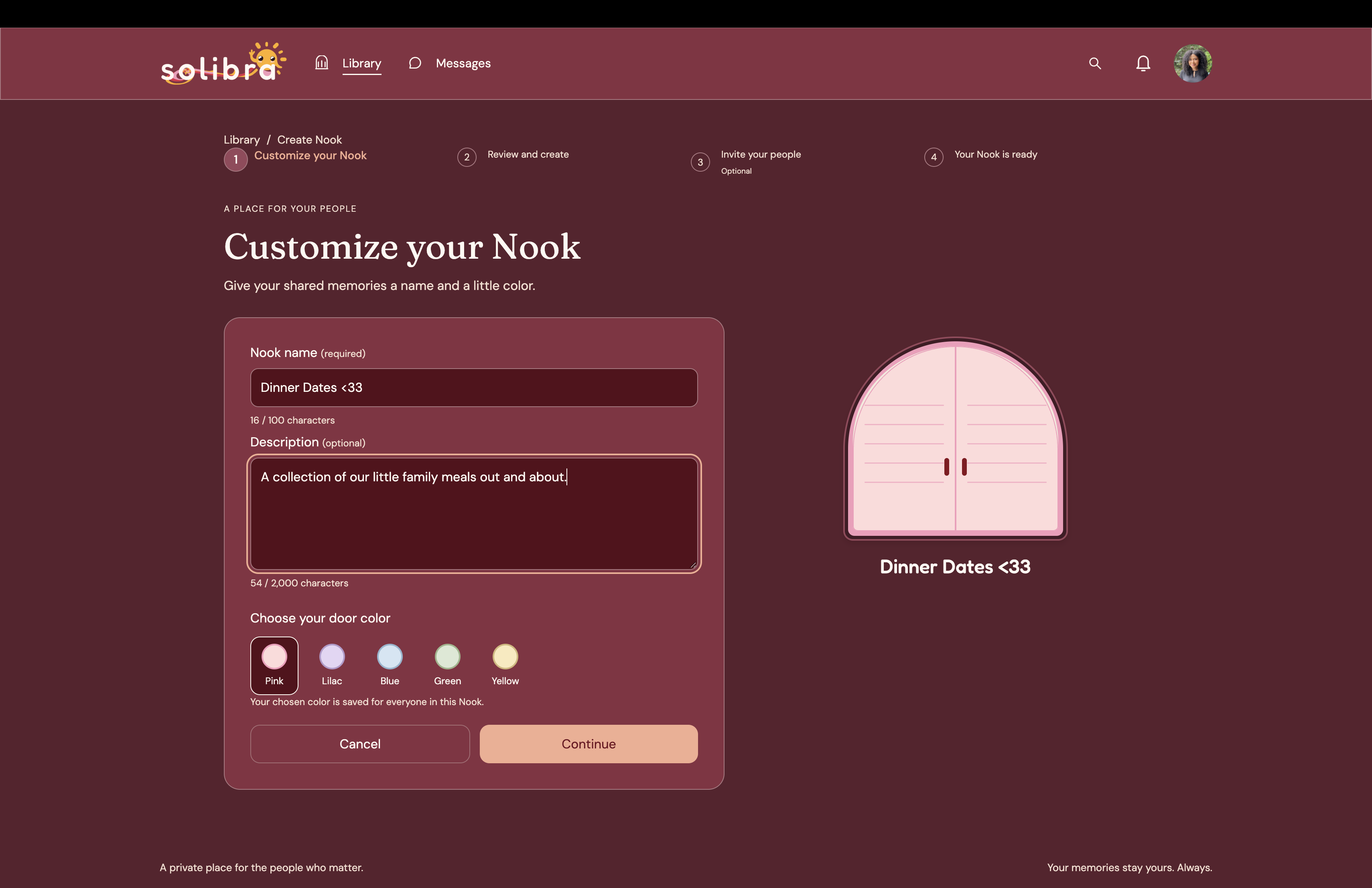
Nook Creation - Step 1 Customize
-
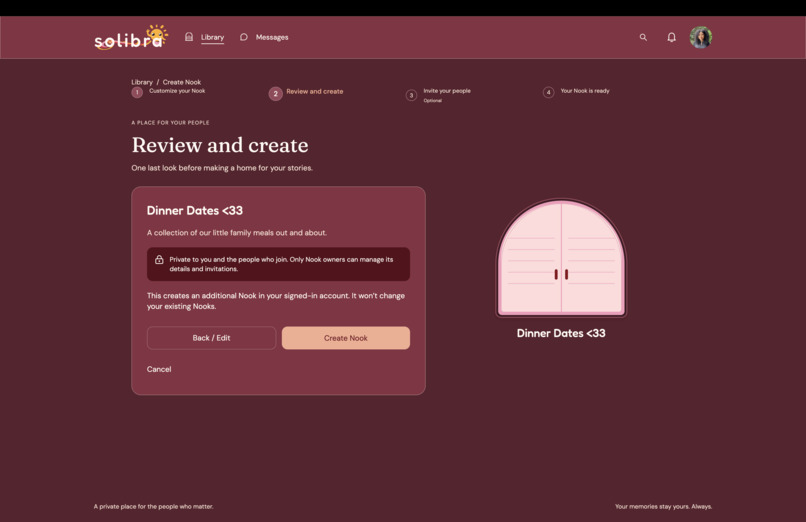
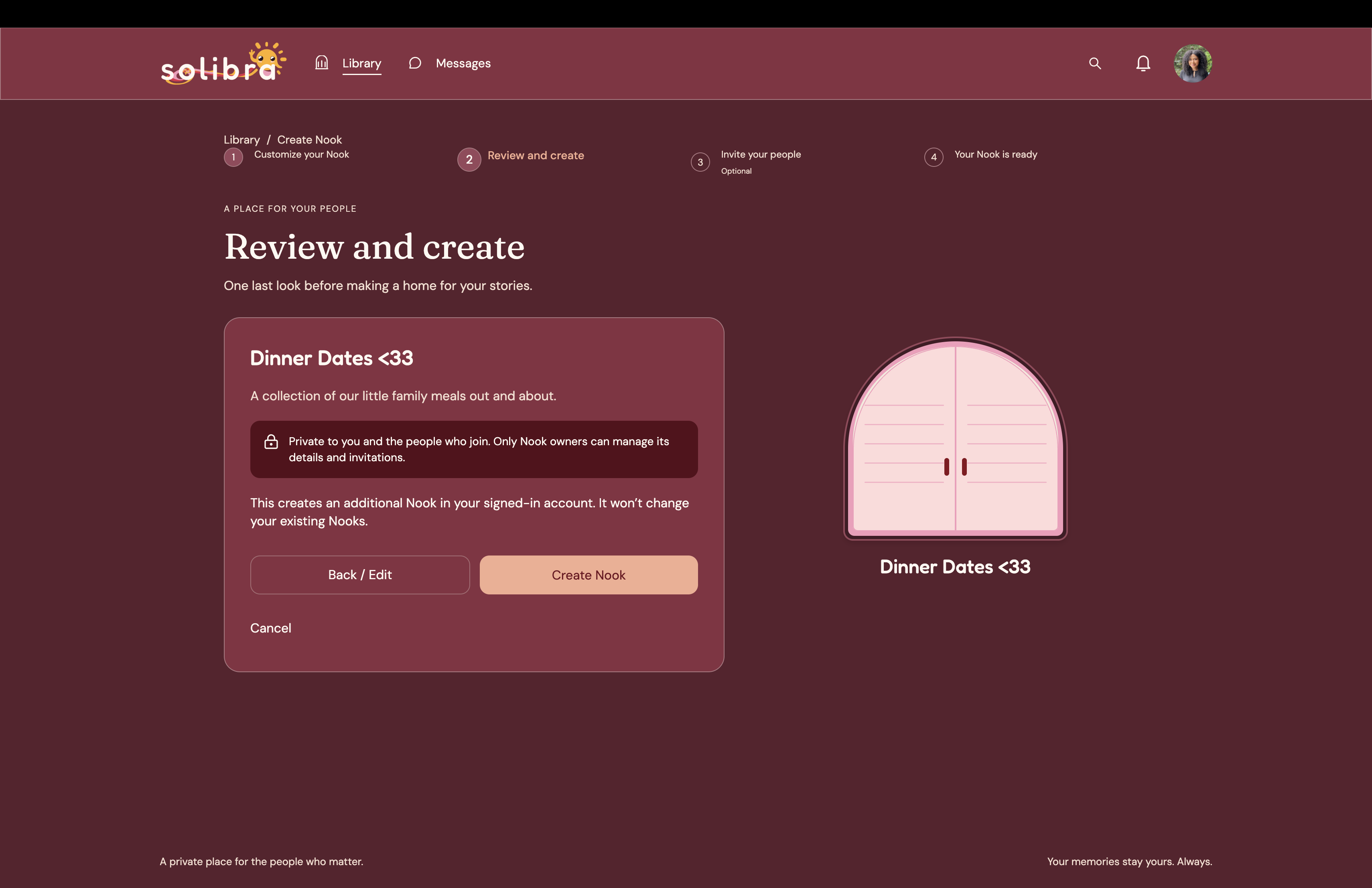
Nook Creation - Step 2 Review
-
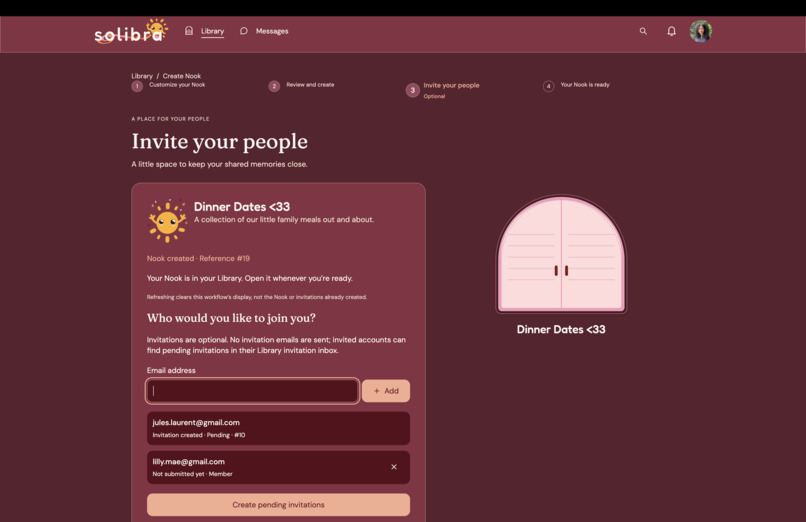
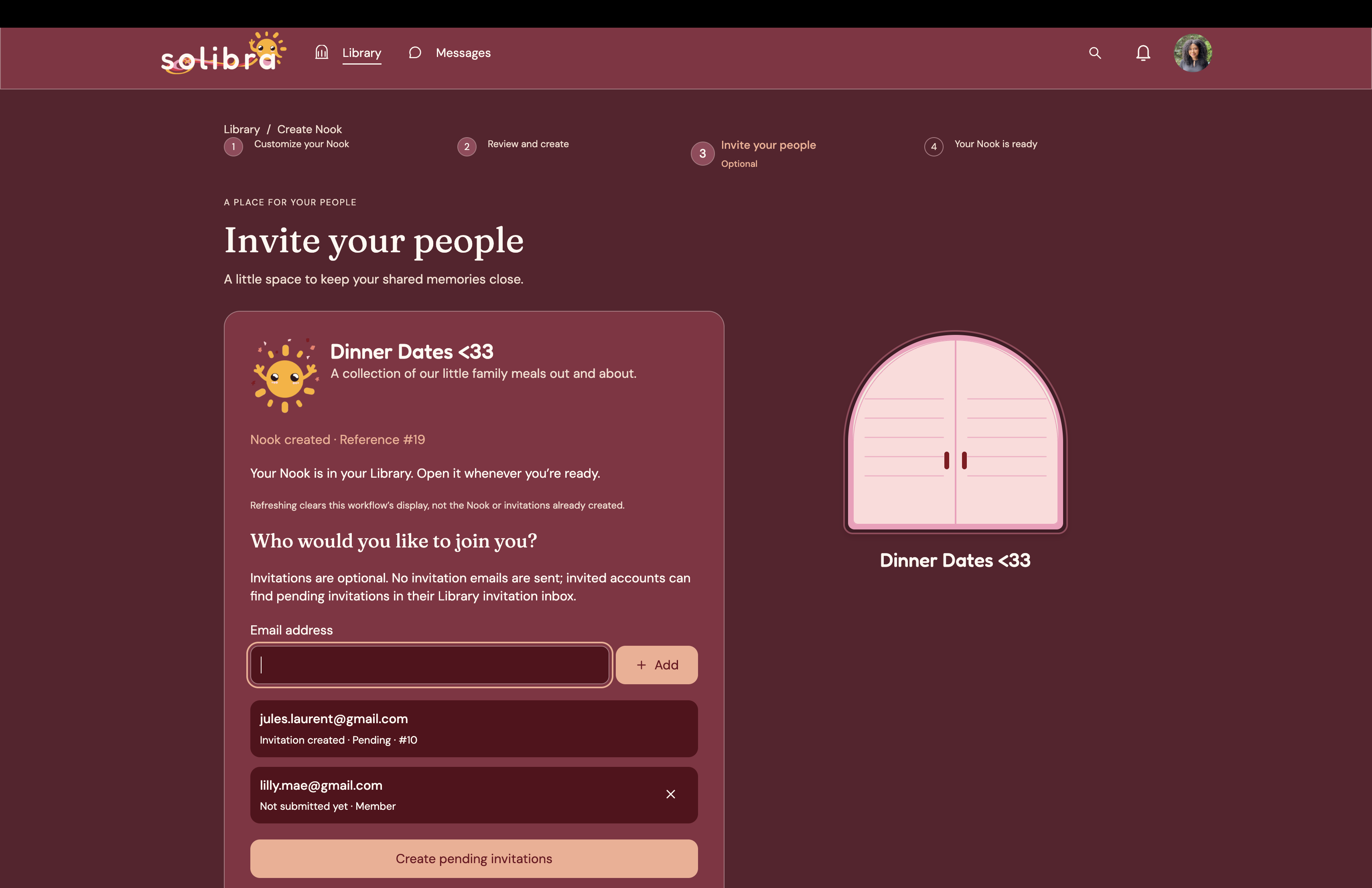
Nook Creation - Step 3 Send Invites
-
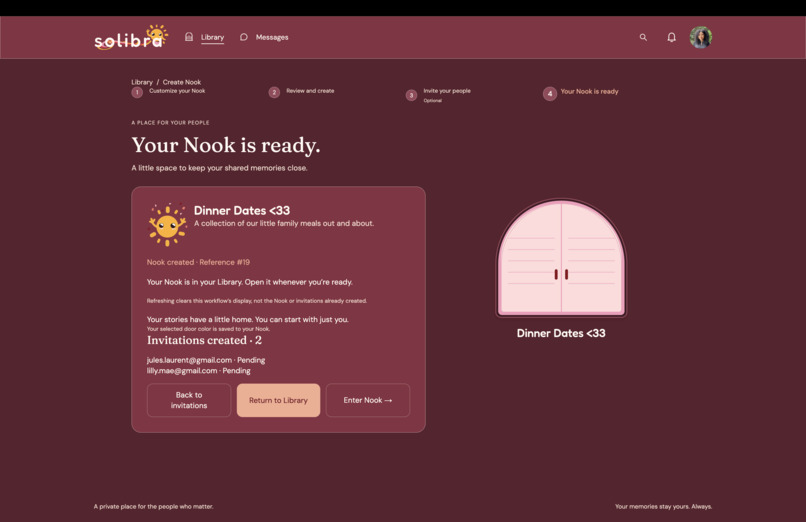
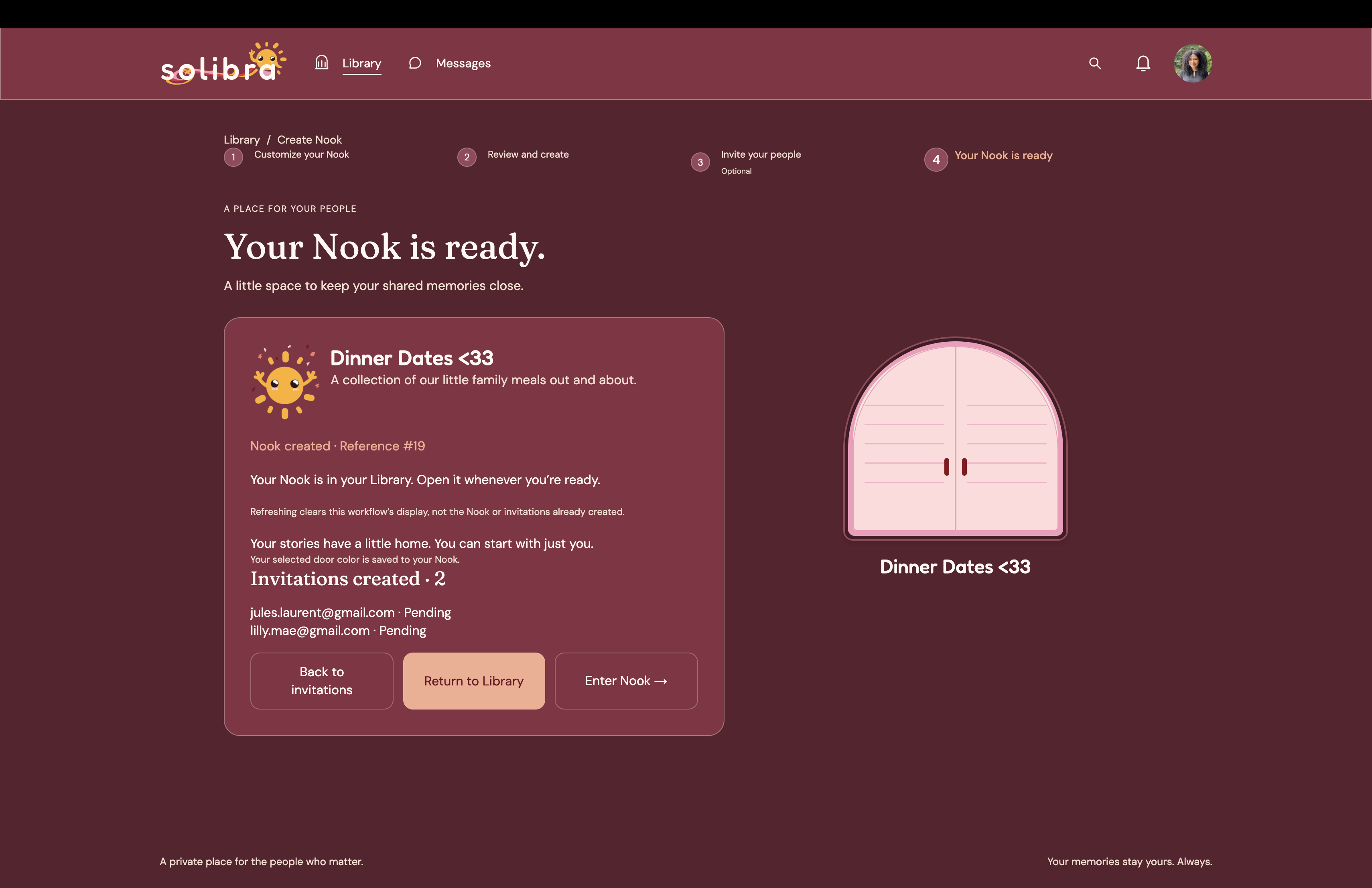
Nook Creation - Step 4 Ready
-
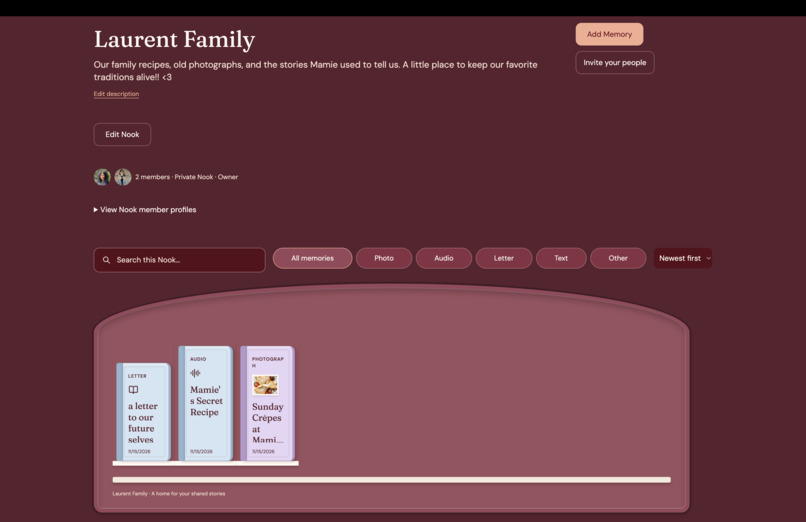
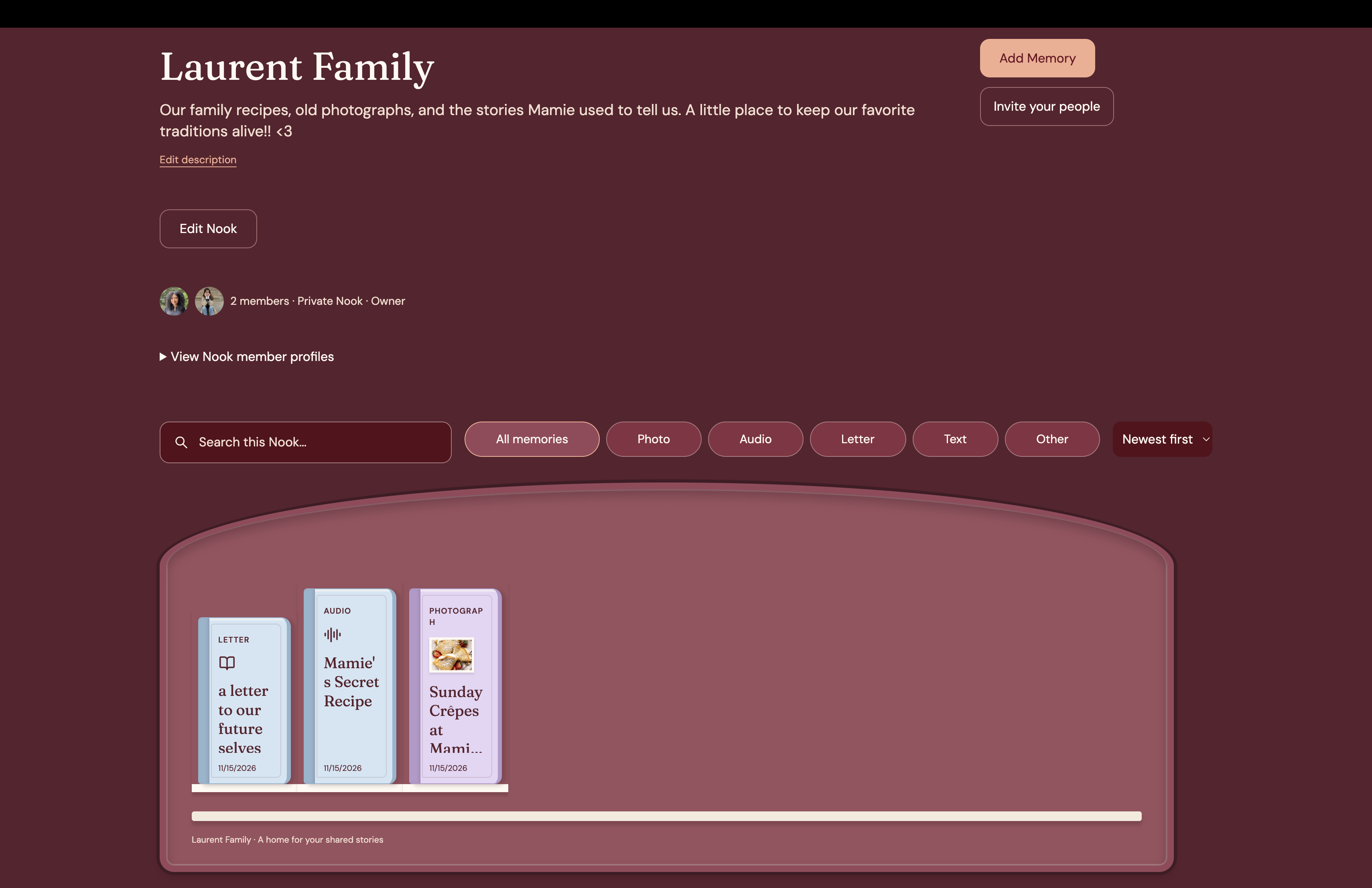
View Nook Page
-
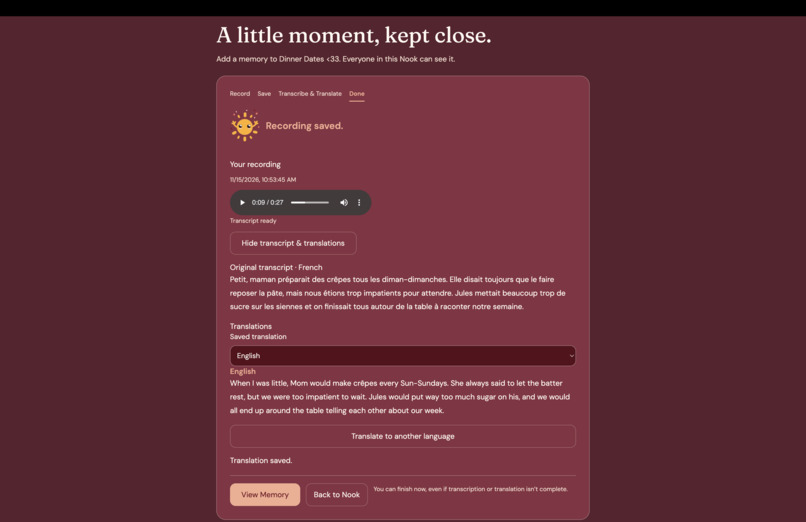
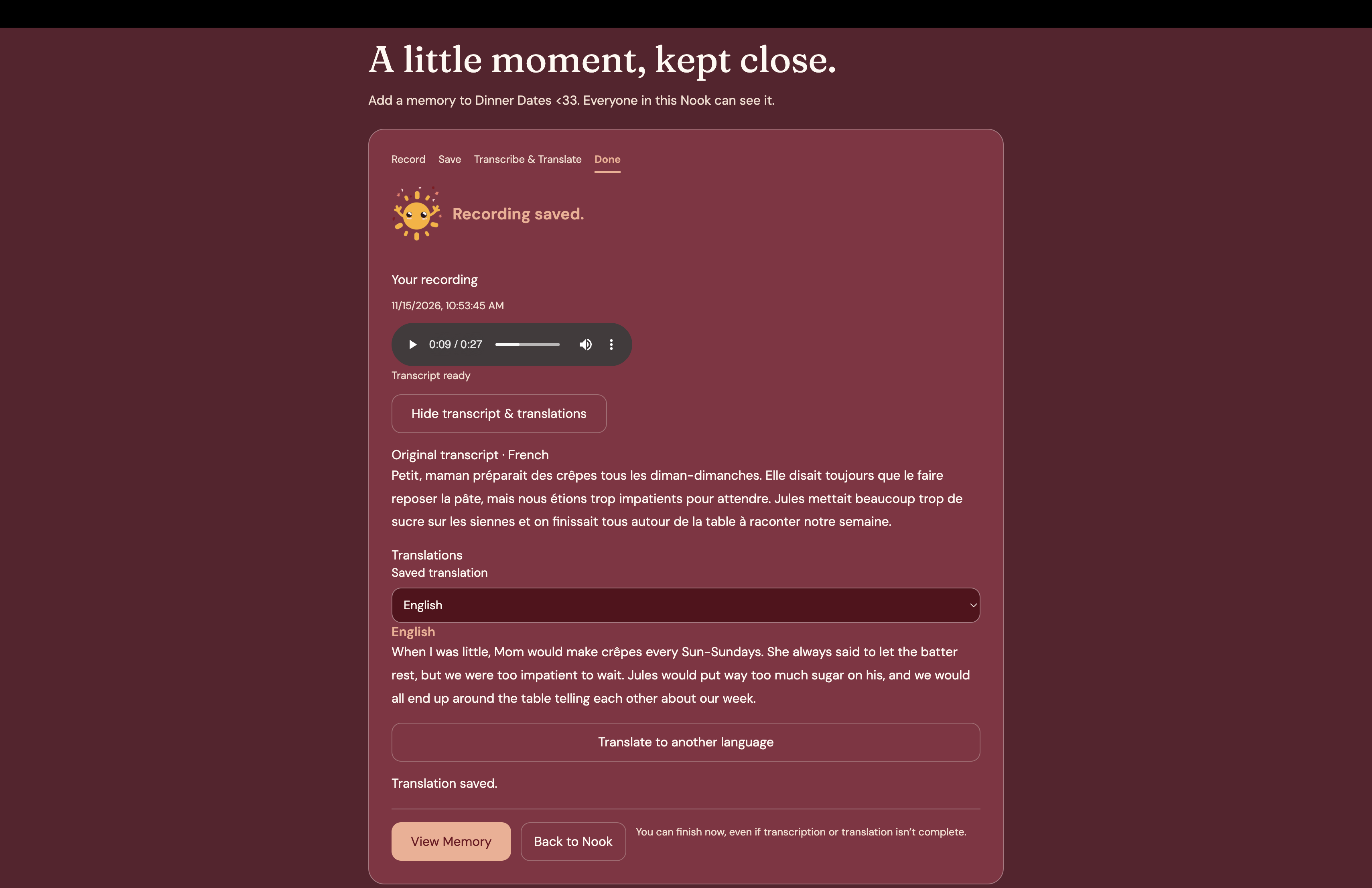
Memory Creation - Voice Recording
-
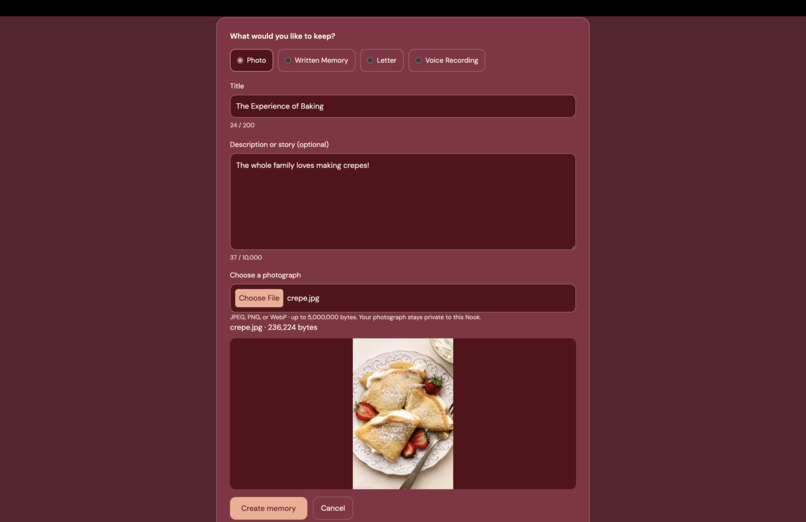
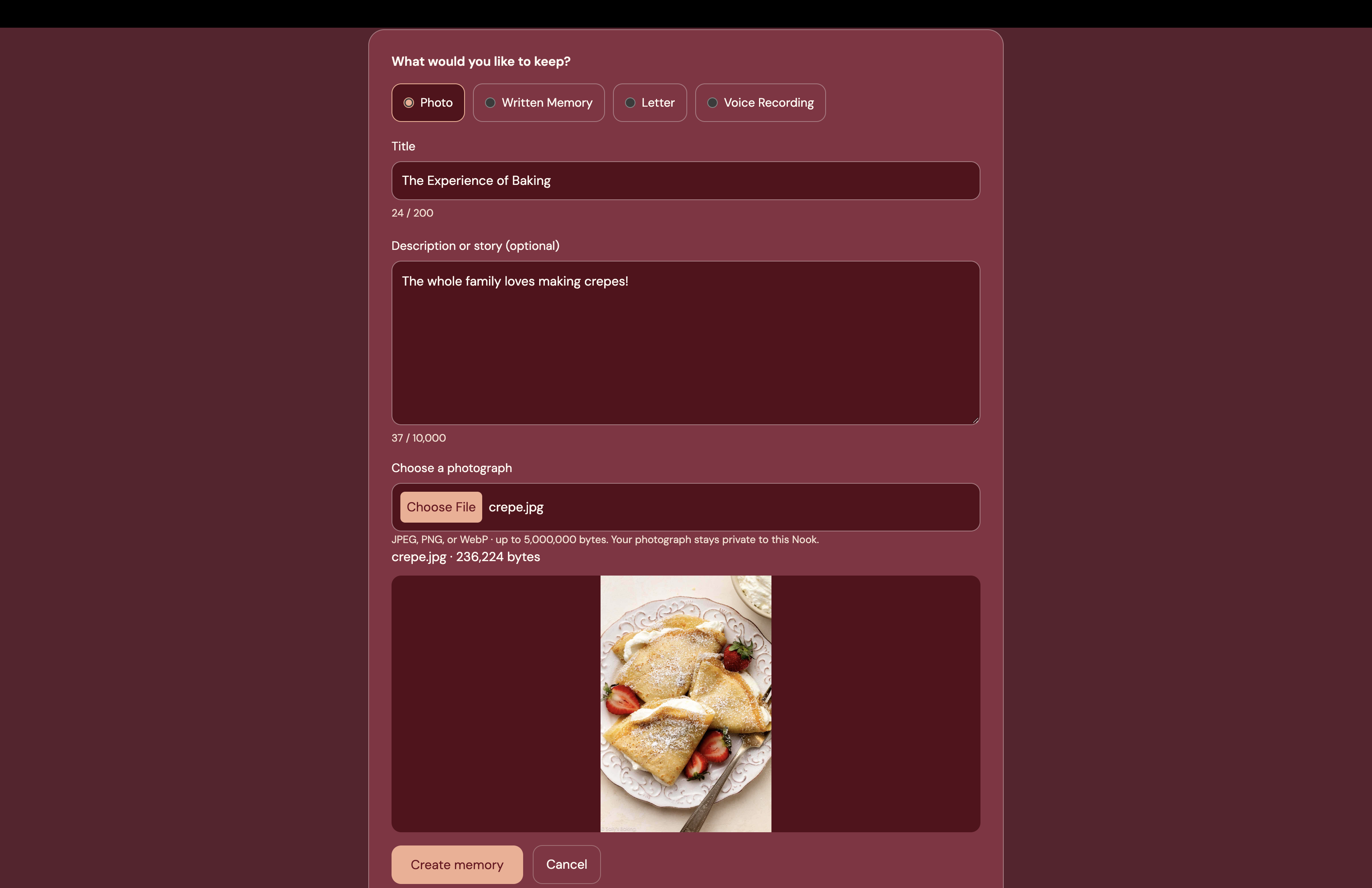
Memory Creation - Picture
-
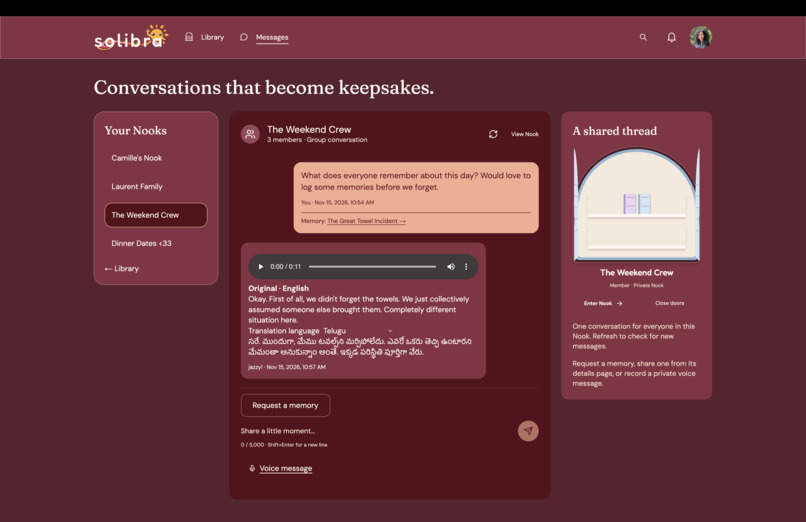
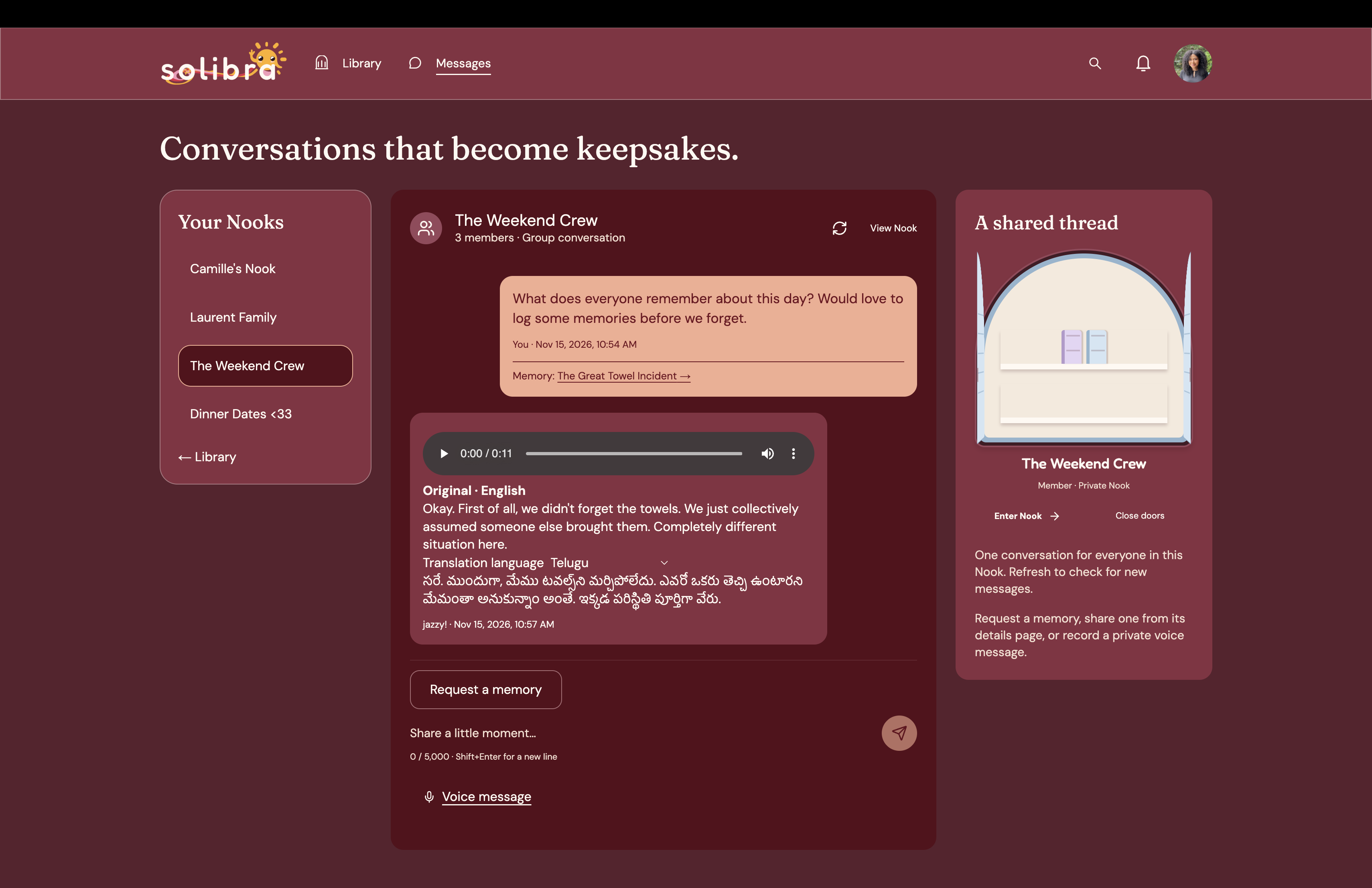
Messaging Page
-
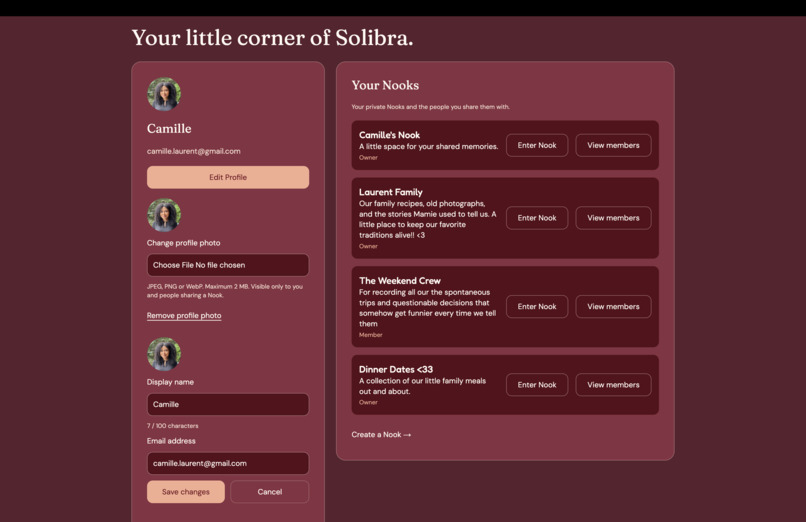
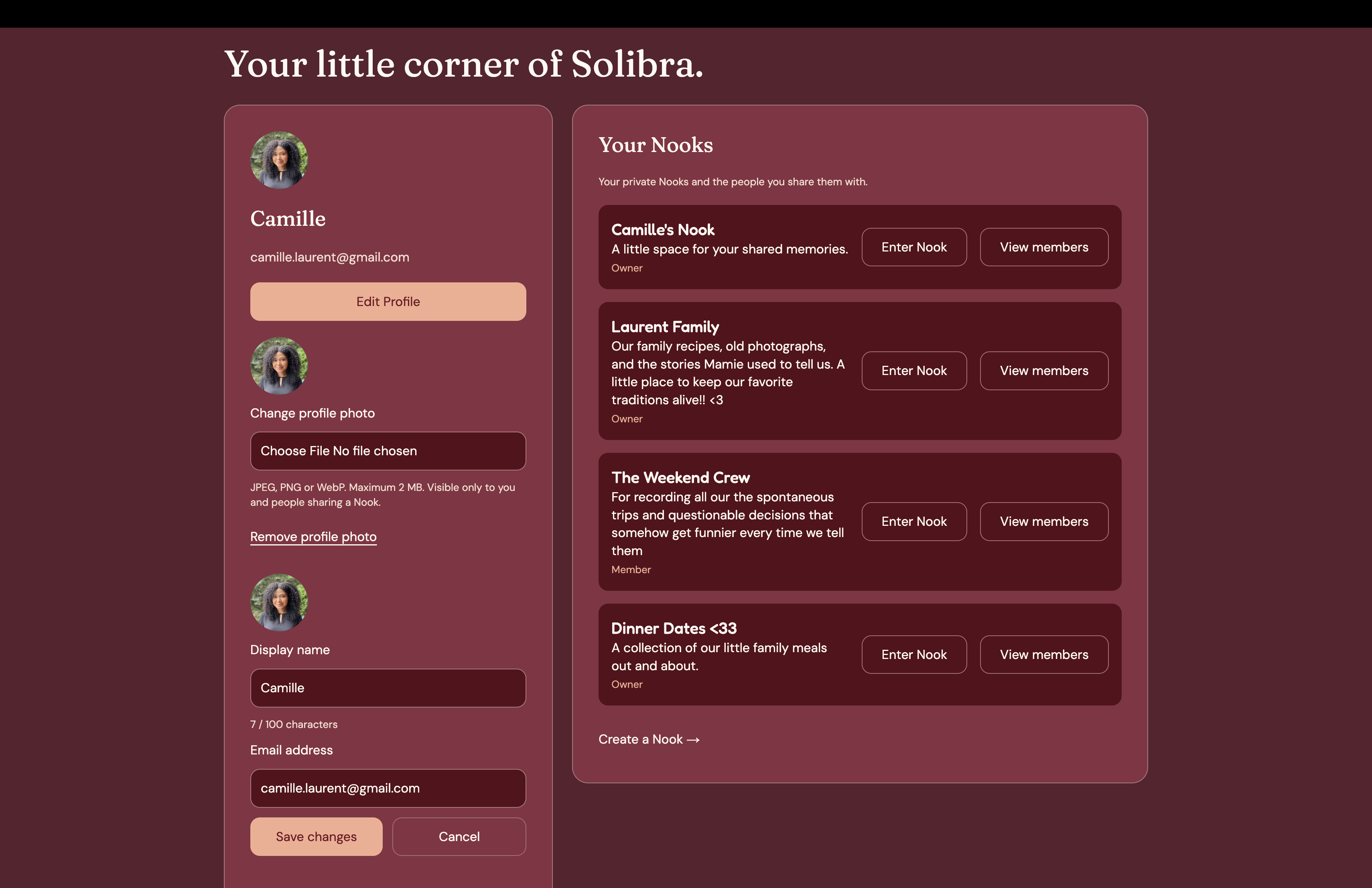
Profile Editing Page
-
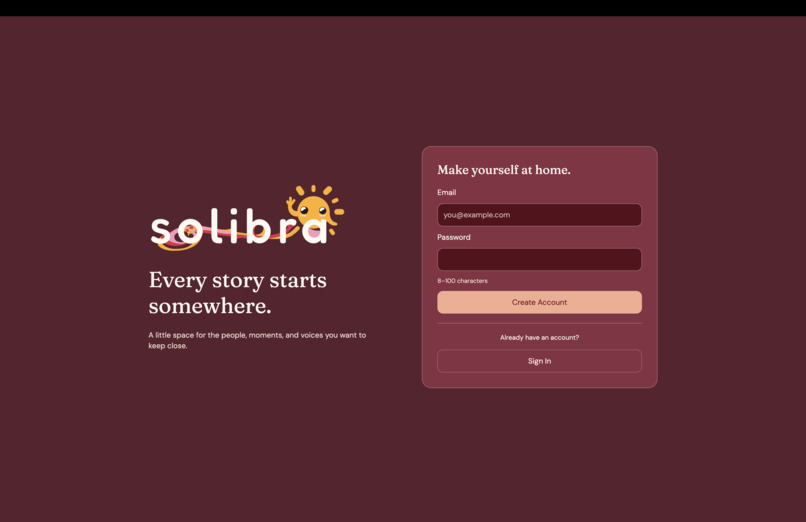
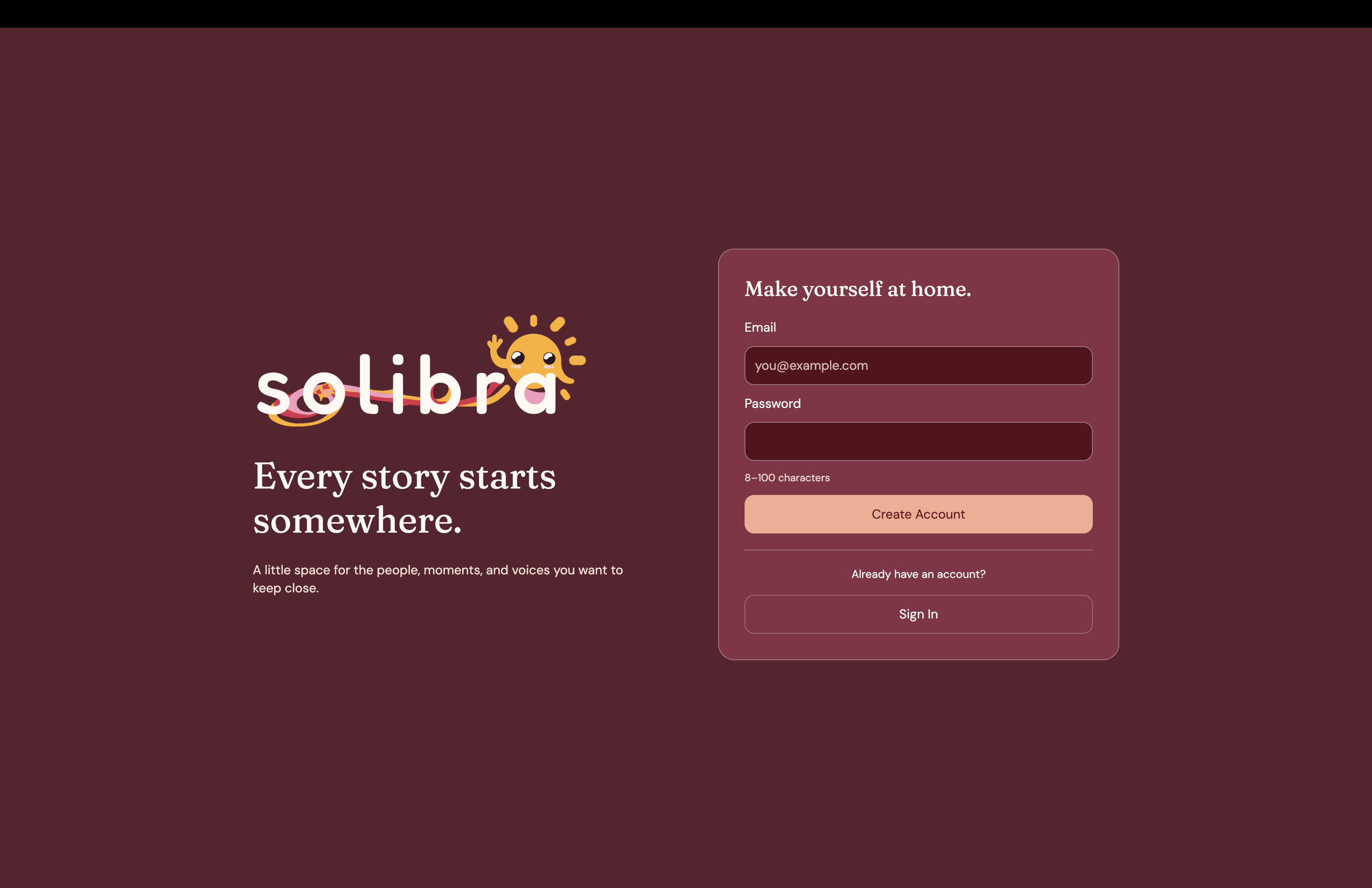
Create Account Page
-
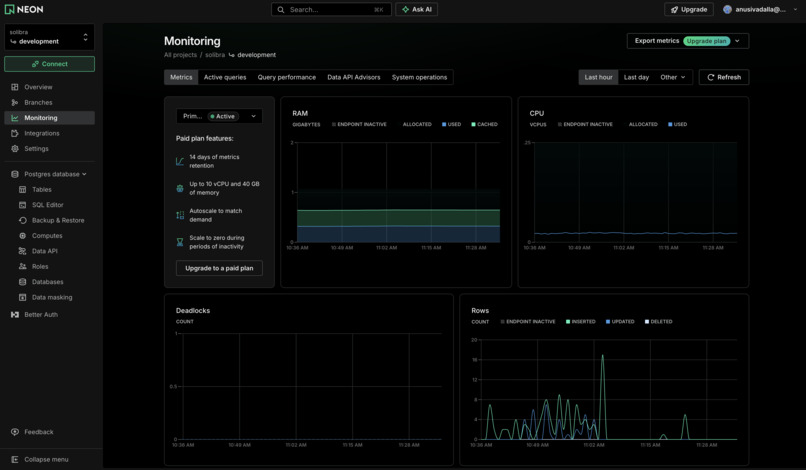
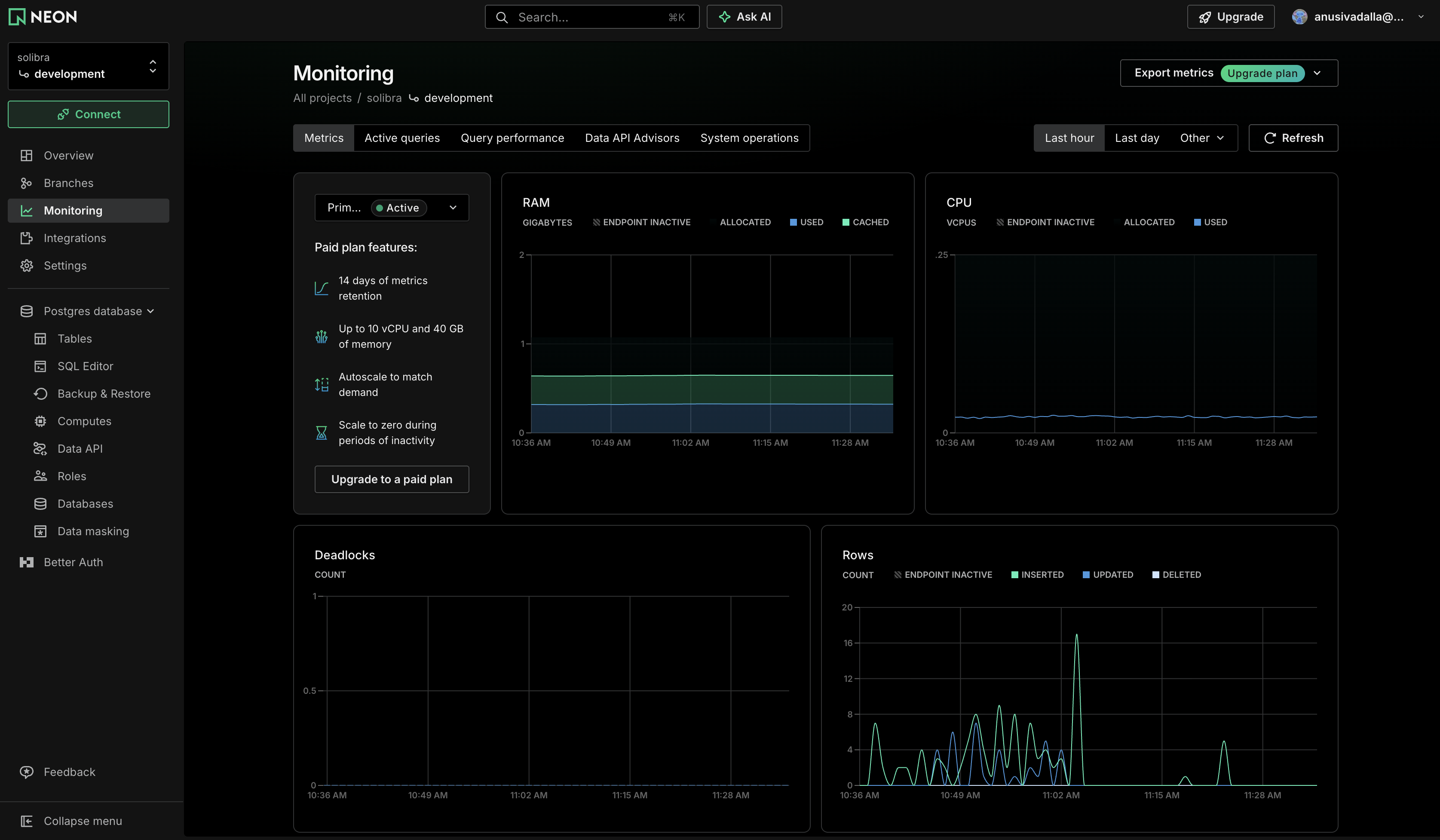
Neon Database
-
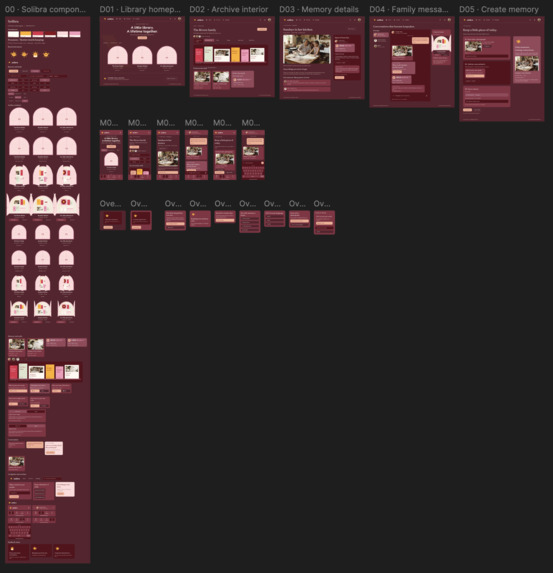
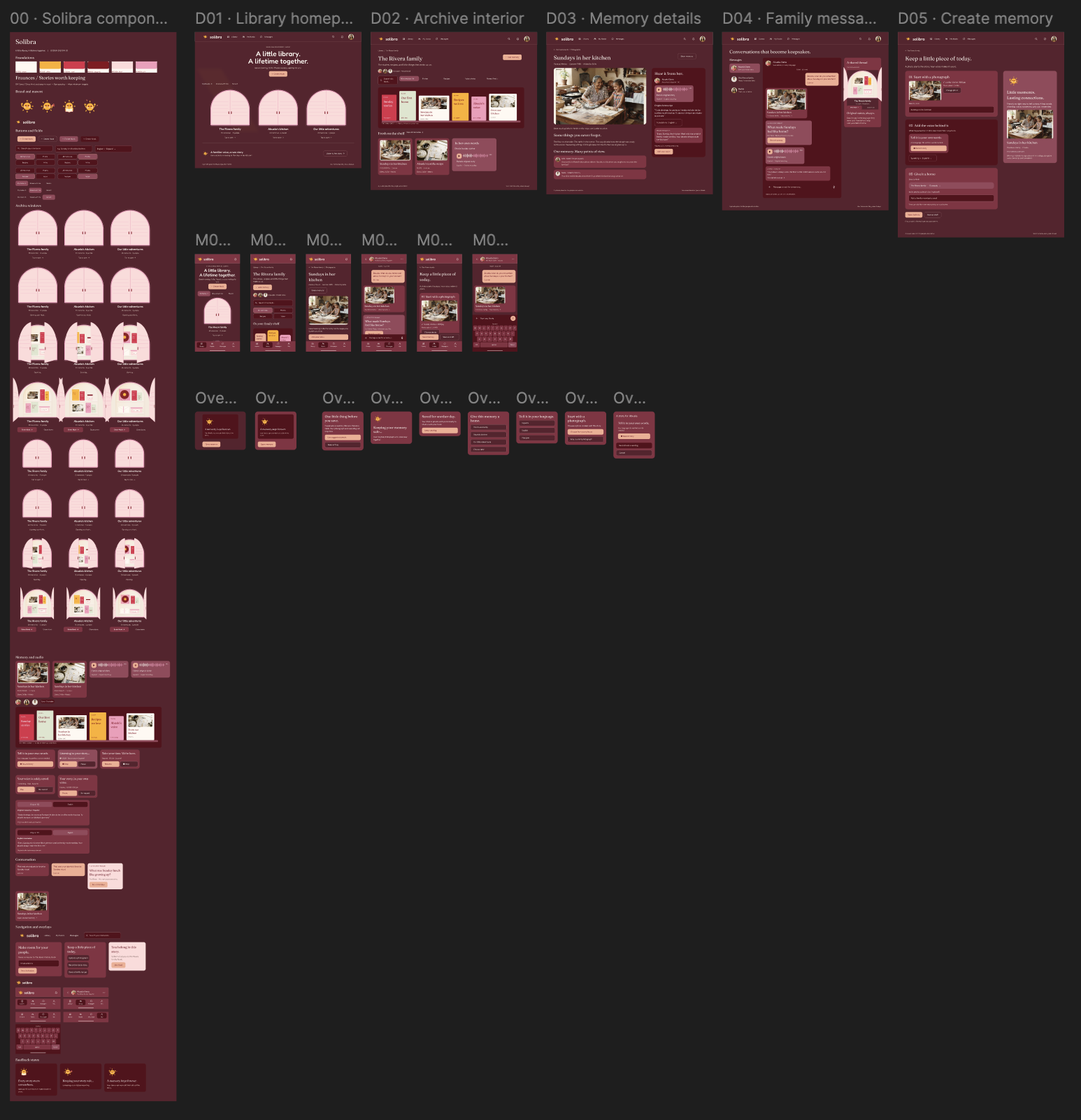
Figma Designs
Solibra — Every memory has more than one voice.
Preserving memories, connecting generations.
Inspiration
Some of the most meaningful stories in our lives are also the easiest to lose. They live in old photographs, family recipes, cultural traditions, and the little anecdotes that come up in conversation. We might remember what a moment looked like, but not necessarily the story behind it or the person who told it.
This becomes especially difficult across generations. For families who speak different languages, preserving a story is one thing, but making sure everyone can understand and appreciate it is another.
We wanted to create a space where these memories could live beyond a passing conversation, without making the process feel like a chore. Somewhere that felt familiar, comfortable, and personal, whether you were listening to a grandparent recount their childhood or reminiscing about a trip with your friends.
That idea became Solibra, a collaborative digital memory library designed to preserve the memories, voices, and traditions that connect us.
What it does
Solibra turns memory preservation into a shared experience.
Users can create private spaces called Nooks, where families, friends, and communities can build collections of shared memories. Each Nook opens into a cozy, interactive library, complete with bookshelves, photographs, and little keepsakes waiting to be rediscovered.
Within a Nook, members can:
- Create and preserve memories through photographs, letters, written stories, and voice recordings, displayed as books on a shared shelf.
- Share different perspectives by contributing their own written recollections or voice recordings to an existing memory.
- Speak in their own language, using ElevenLabs Scribe v3 to transcribe the original recording and Google Gemini to translate it into another language.
- Preserve original voices and translations, allowing members to replay recordings, read the speaker's original words, and revisit saved translations.
- Stay connected through group conversations, exchanging text and voice messages, with optional transcription and translation for recorded messages.
- Request and share memories through chat, linking conversations to specific memories, inviting others to share their recollections, and bringing saved voice replies back into the discussion.
- Invite others into their Nooks through private, in-app invitations, building a collective archive that grows with the people who contribute to it.
One of our favorite ideas behind Solibra is that a single memory doesn't have to belong to just one person. The same photograph might remind a parent of a family tradition, a sibling of an embarrassing moment, and a friend of an entirely different detail. We wanted each of those perspectives to have a place, without losing the original story.
For example, someone might request a recollection about a family gathering in their Nook's group conversation. Another member can open that memory, record what they remember in their native language, save the recording with its transcript and translation, and share their contribution back into the conversation. The result is a memory that can be revisited and understood from more than one perspective.
We also wanted the experience itself to feel special. Rather than presenting memories as another collection of folders and files, Solibra invites users to open windows, explore bookshelves, and rediscover stories in a space that feels like their own.
How we built it
We built Solibra as a two-person team during SanD Hacks 2026, working in parallel on its visual experience and backend infrastructure before integrating everything into one application.
For the frontend, we designed Solibra in Figma and brought it to life using Next.js, React, TypeScript, Tailwind CSS, and shadcn/ui. We developed a visual identity centered around warm burgundy tones, soft pink accents, arched windows, and interactive bookshelves. We also added customizable Nook door colors, profile photos, and subtle loading animations to make the library feel more personal and cohesive.
Our goal was to create something playful and inviting without sacrificing usability, especially when navigating between memories, Nooks, and conversations.
For the backend, we started with Vercel's Next.js SaaS starter and adapted its authentication and team-management infrastructure to fit Solibra. This involved removing the unnecessary subscription and payment functionality while preserving the foundation for accounts, memberships, and permissions.
We used Neon PostgreSQL and Drizzle ORM to build the data layer connecting Nooks, members, memories, contributions, conversations, and translations. Each memory can contain multiple contributions from different people, allowing stories to grow rather than remain static.
Because these memories can be personal, privacy was an important consideration from the beginning. We implemented authenticated APIs and private media storage through Neon Object Storage, with membership-based permission checks controlling access to photographs, recordings, and shared content.
Our multilingual voice pipeline combines the browser's MediaRecorder API, ElevenLabs Scribe v3, and the Google Gemini API. Users can record a story, save the original audio, generate a transcript with automatic language detection, and request a translation. The original recording, transcript, and translated text are associated with the saved contribution, allowing people to return to them later without repeating the entire processing process.
We also integrated this pipeline into Nook conversations, enabling members to send private voice messages and optionally transcribe and translate them.
We tested transcription and translation with English, Spanish, French, and Telugu, helping us build beyond a single language or family experience.
Challenges we ran into
One of our biggest challenges was making everything work together. We had a fairly ambitious vision for a two-person hackathon project, and building a polished frontend while simultaneously developing authentication, database relationships, private storage, and AI integrations required plenty of coordination.
Setting up our backend came with its own learning curve. We had to adapt an existing starter without disrupting authentication, understand how Neon and Drizzle handled database migrations, and implement the permissions needed for people to share memories privately. We also ran into an unexpected complication with storage availability across Neon regions, which led us to use separate Neon projects for our database and private media.
The voice system was another major challenge. Getting a recording to transcribe and translate was only the beginning. We also needed to handle microphone permissions, different browser recording formats, audio playback, persistent storage, and errors from external services.
We encountered issues with recording duration and playback behavior, particularly when handling browser-generated audio files. Fixing these required us to look beyond the transcription API and understand how recorded audio was captured, finalized, uploaded, and retrieved.
Connecting that pipeline to the actual memory library took several iterations. A recording that only exists temporarily in the browser isn't much of a preserved memory. We had to make sure audio, transcripts, and translations could be saved and retrieved through the same system as everything else.
We also had to account for partial failures. If transcription succeeded but translation failed, we didn't want the original story to be lost or require someone to record it again. Preserving successful results and allowing translation retries became an important part of the experience.
On the design side, we had to balance our creative ideas with practicality. We wanted Solibra to feel like a real library, but it still needed to be straightforward to navigate. A considerable amount of our time went into refining layouts, simplifying interactions, and making the recording experience less confusing.
With the hackathon deadline approaching, deciding what to prioritize became just as important as implementing the features themselves.
Accomplishments we're proud of
We're particularly proud that Solibra became more than a collection of attractive mockups or a standalone AI demonstration. We built a working application with real user accounts, collaborative spaces, persistent memories, private media handling, and a multilingual voice-processing system.
One of our biggest accomplishments was connecting the memory library with group conversations. Members can request recollections about existing memories, contribute their own written or recorded perspectives, and share those contributions back into the conversation. We also implemented direct voice messaging, bringing more of the experience into the natural conversations where memories often begin.
We're equally proud of the design. Giving Solibra its own personality through the library aesthetic, interactive windows, customizable Nooks, bookshelves, and mascot helped make a fairly technical application feel much more approachable.
Most importantly, we managed to bring together two sides of the project that were developed largely in parallel, creating an experience where the underlying technology supports the story we're trying to tell.
What we learned
Building Solibra gave us a much better understanding of what goes into creating a full-stack application beyond just making individual features work.
We learned how to structure relational data for collaborative experiences, manage authentication and permissions, work with private cloud storage, and connect multiple AI services while accounting for failures and unexpected behavior.
We also gained a greater appreciation for communication and careful integration. With each of us working on different parts of the application, agreeing on API contracts, coordinating Git branches, and testing how our changes affected one another became essential.
Perhaps our biggest takeaway, though, was that AI is most meaningful when it helps people connect rather than trying to replace the human part of an experience. We didn't want Solibra to generate memories for people. We wanted it to help preserve the ones they already had, in their own words and voices.
What's next
There's still plenty we'd love to explore with Solibra.
We want to make contributing memories even easier for less tech-comfortable relatives, particularly through simpler recording and invitation experiences. We'd also love to connect direct voice messages to the memory library more seamlessly, allowing a meaningful moment from a conversation to become a preserved memory with just a few steps.
Other ideas include time capsules, family timelines, and new ways to discover connections between memories across different people and generations.
Ultimately, we hope Solibra can become a place where stories are not just saved, but continually shared, revisited, and passed on.
Because the people who make our memories meaningful deserve to be remembered, too.
Built With
- aws-sdk-for-javascript
- css3
- drizzle-orm
- elevenlabs
- elevenlabs-scribe
- figma
- github
- google-gemini-api
- html5
- javascript
- lucide-react
- neon
- neon-object-storage
- next.js
- pnpm
- postgresql
- radix-ui
- react
- shadcn/ui
- swr
- tailwind
- tailwind-css
- typescript
- web-audio-api-/-mediarecorder
- zod
