-
-
-
-
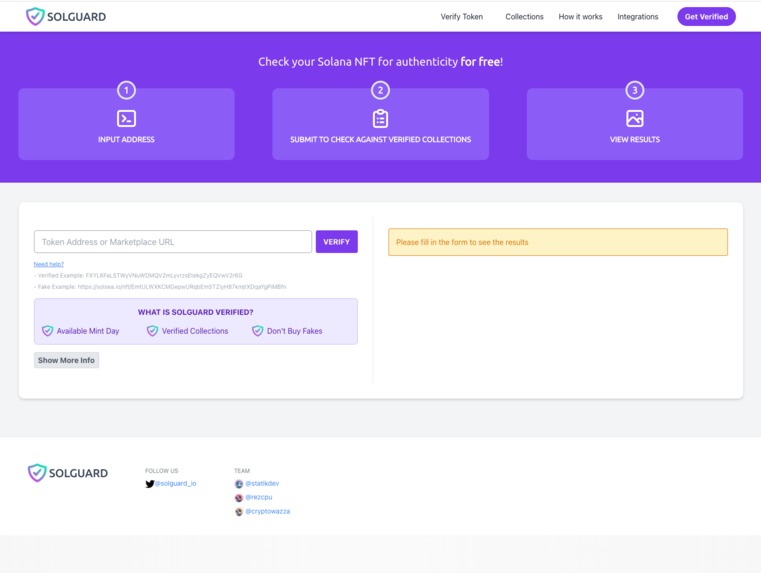
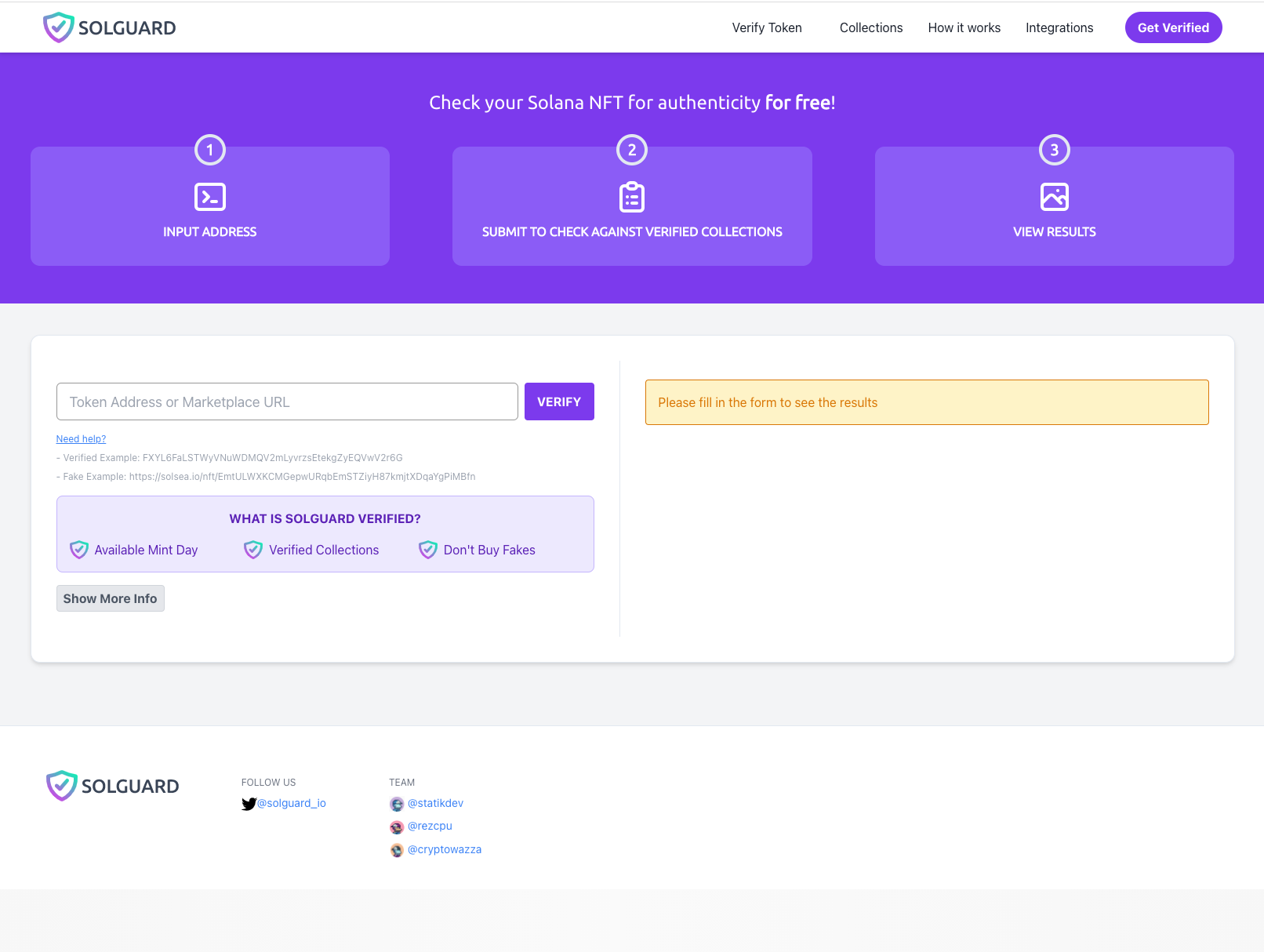
Home Page
-
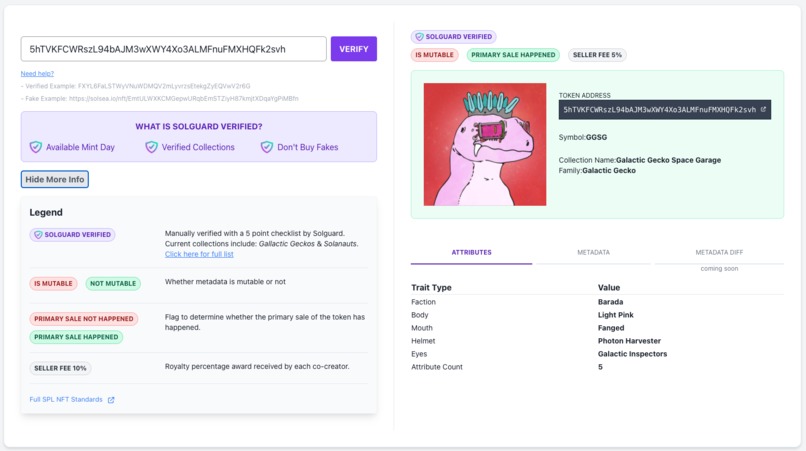
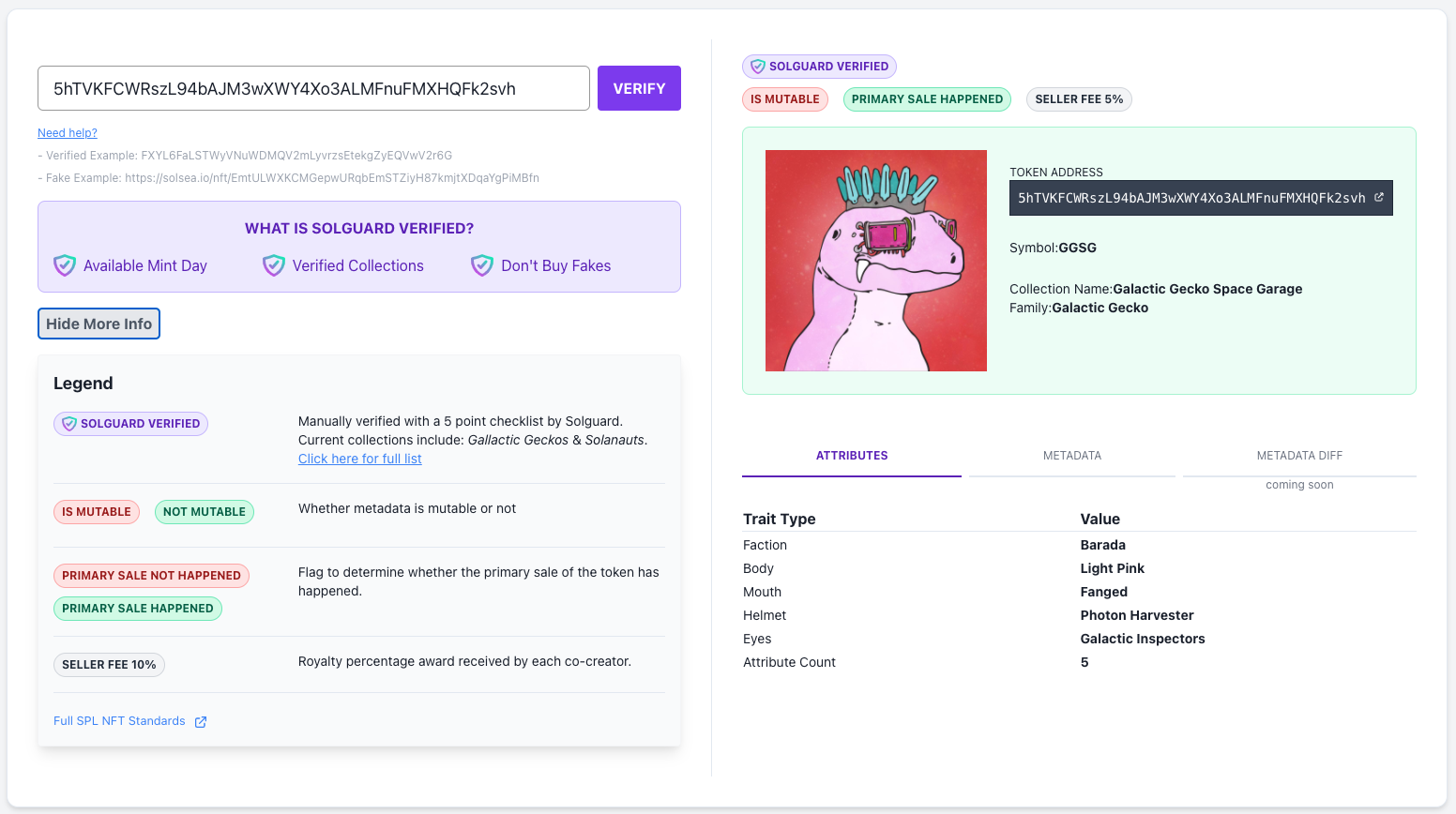
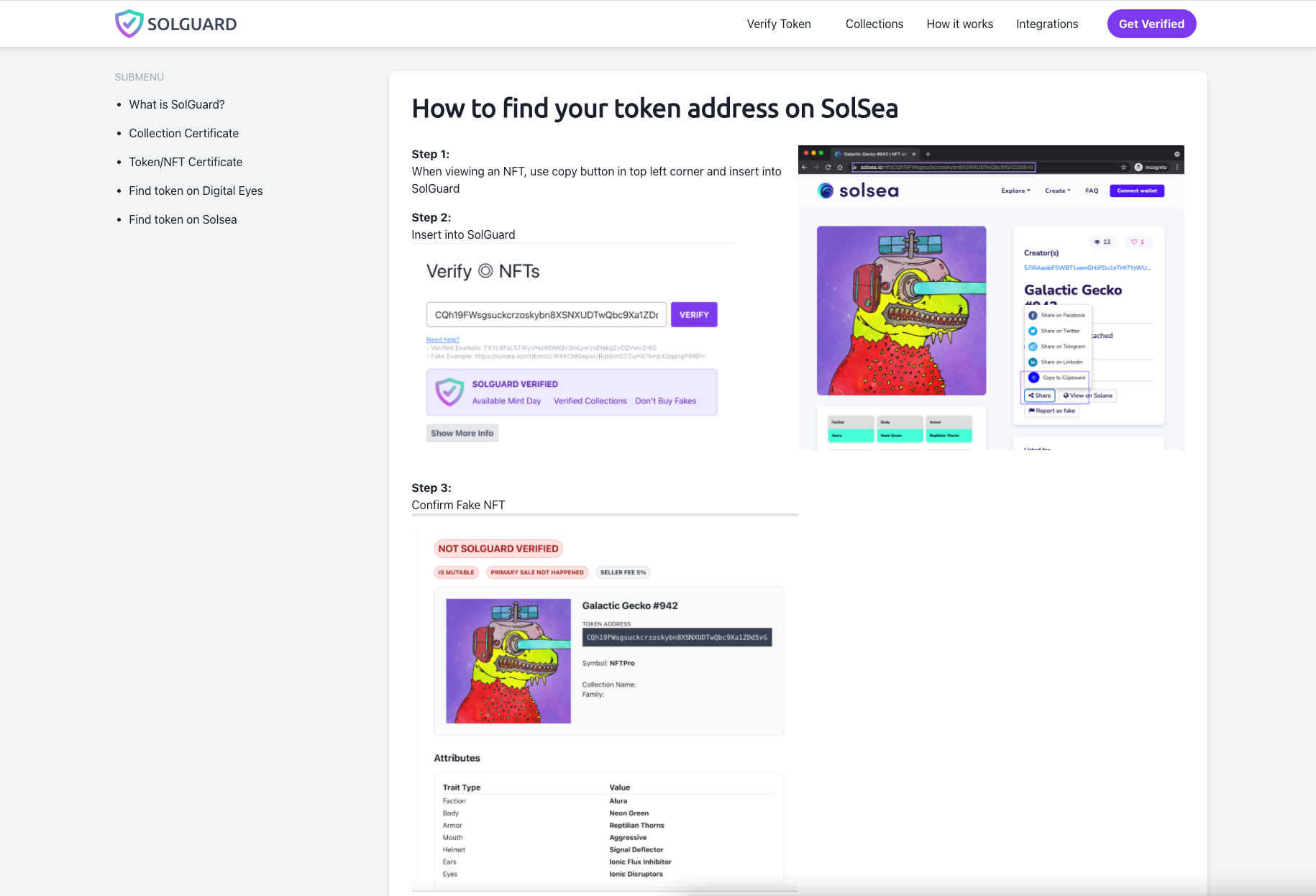
Verified Galactic Gecko w/ Legend
-
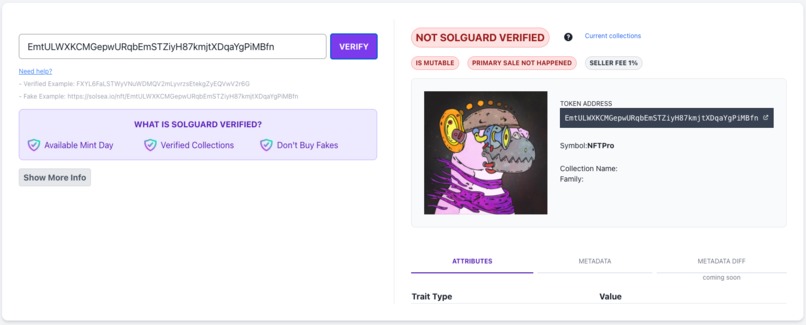
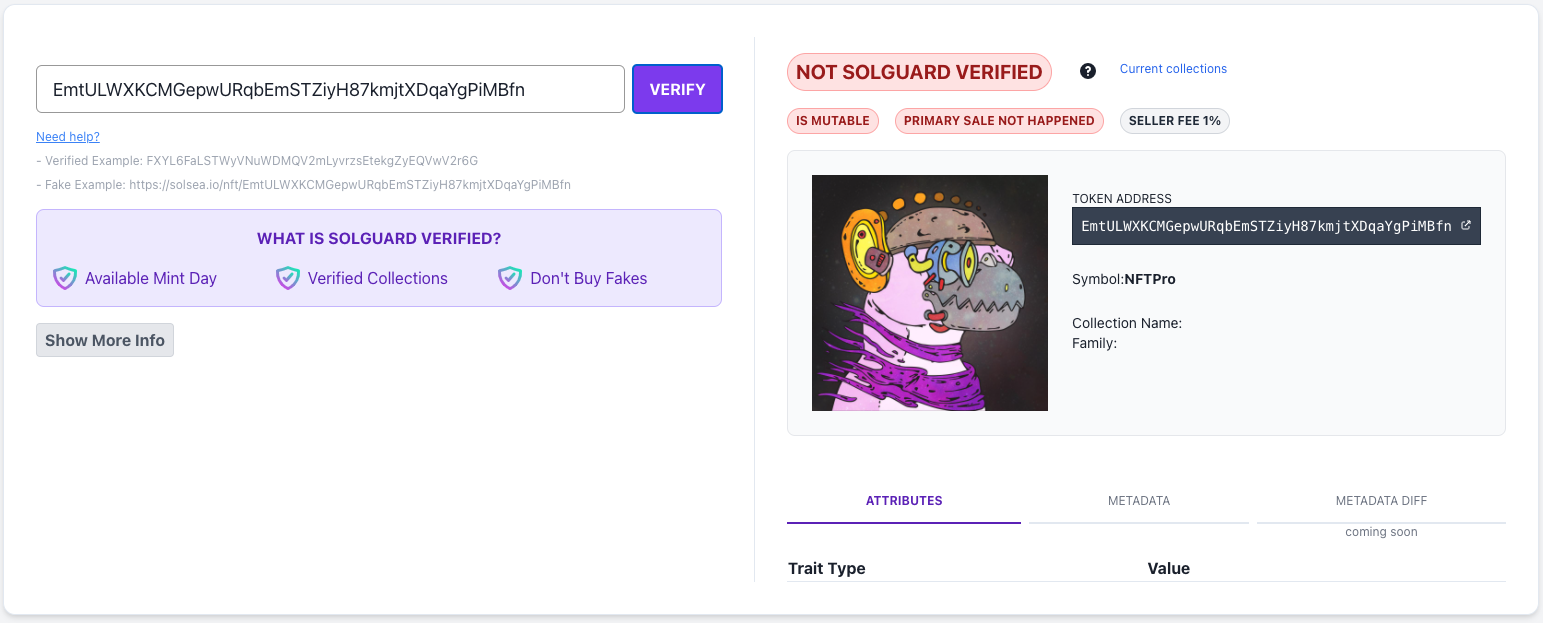
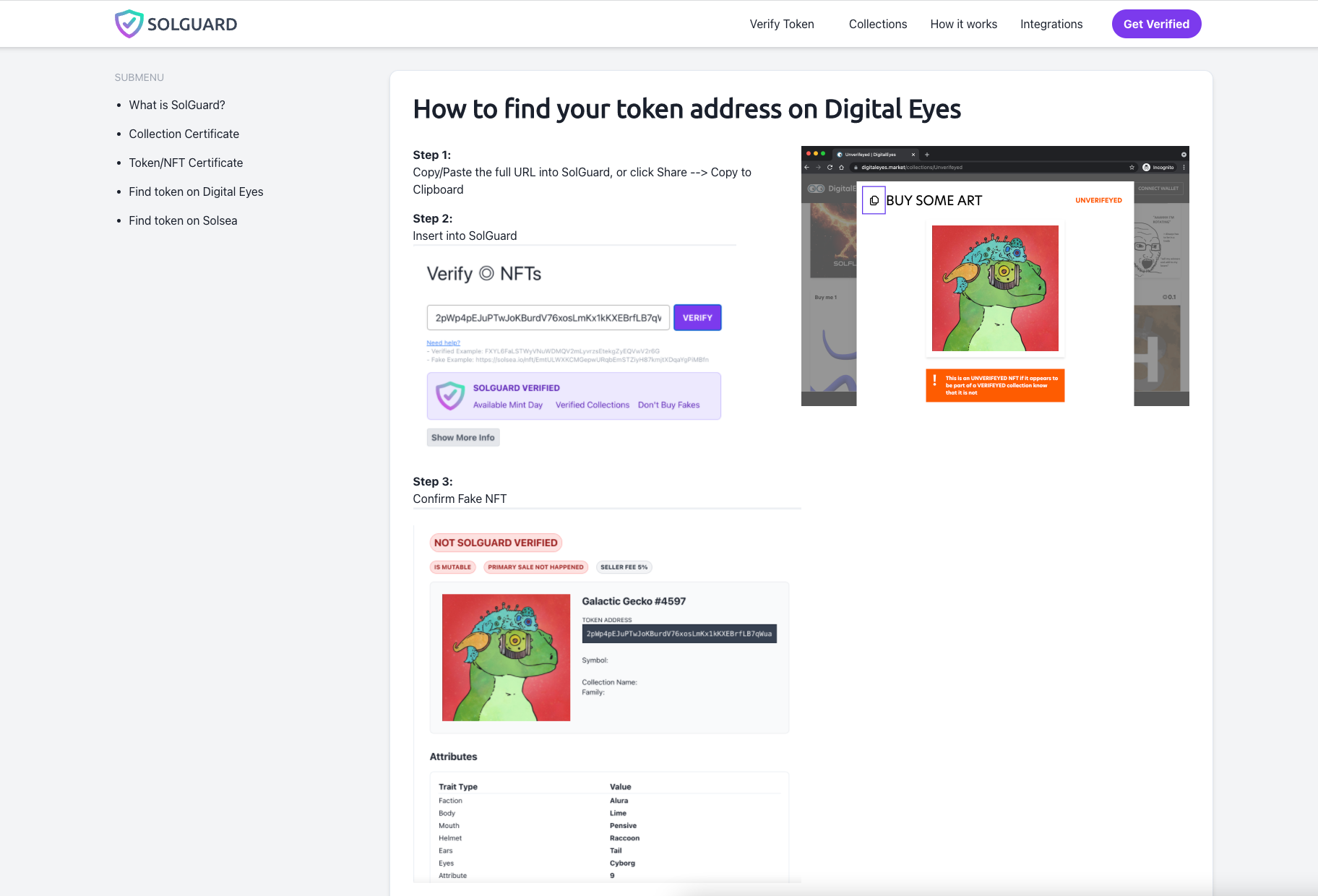
Fake Galactic Gecko For Sale
-
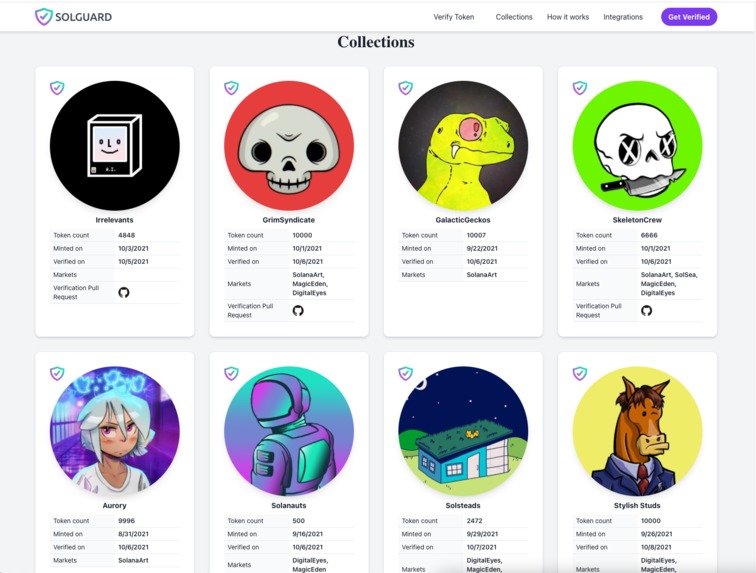
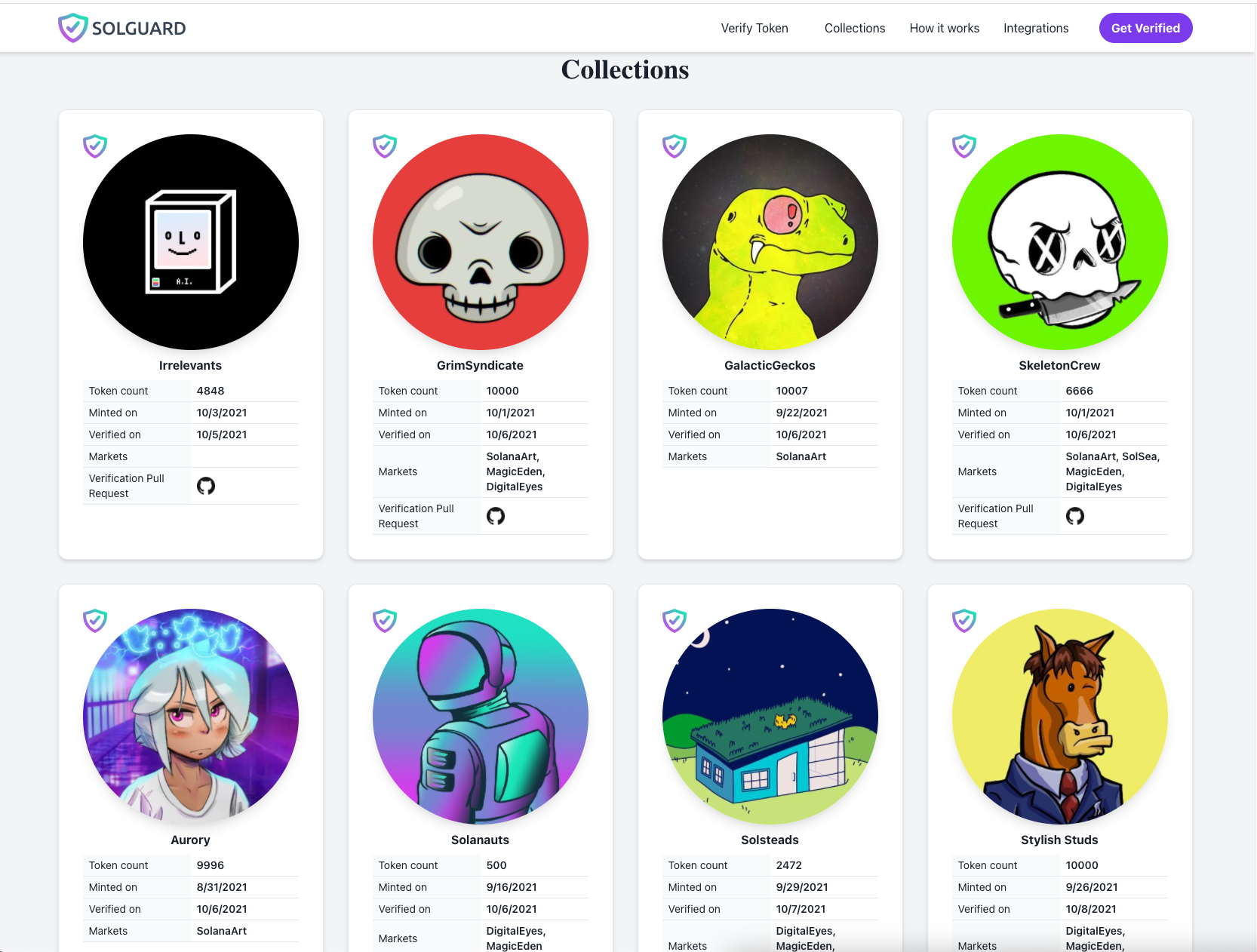
Current Collections
-
-
Inspiration
SolGuard was inspired by the insurmountable rise of NFT projects on the Solana blockchain. Metaplex brought about great innovation and speed to the chain, and with it naturally arises bad actors. We want to bring awareness and accountability to projects minting on Solana so users can be informed on what they are putting their money in.
There are many ways for NFTs to change hands right now. Users can purchase on marketplaces, exchange via escrow in discord, or work out a trade between themselves via social media. There is no easy way to determine if the token you are about to purcahse is valid (with the exception of verified collections on marketplace). One major issue that has cropped up occurs right after mint, where bad actors create fake NFTs of a mint that just occurred in the hopes to sell for a small amount. SolGuard hopes to be a central spot that users trust to check the validity of a token.
In addition to providing whether the token belongs to a collection, SolGuard will educate users about the metadata of their NFT beyond the image and basic attributes defined by the project. Users should be educated about the properties within the Metaplex standard such as isMutable and how it affects their NFT. If an NFT has isMutable, there is the possibility for the image and metadata to change. This is not an inherently bad thing after mint to give projects the ability clean up issues that occurred (bad image upload, incorrect metadata, etc). It also allows innovative ideas for NFTs that can change over time -- say for holiday events, etc. But, projects should be transparent about this as it does have an affect on the value of the NFT. If a project is not planning to do anything with the collection after mint, it should switch it to immutable.
In addition, education about where the metadata is stored (centralized vs decentralized), what the royalty percentage is back to the creators, who the mint authority is, and most importantly whether the token is apart of the mint collection it claims to be.
What it does
Verifies NFTs on Solana on whether they are authentic against the collection they claim they belong to.
A user will input a token address or Displays the metadata pertaining to that NFT so the user is informed on aspects like the seller fee, the mutability, the collection name and the mint authority.
To provide a verified list, rojects submit their project, collection, and mint details through a Github pull request for transparency. The file for each project includes the full mint tokens list that were used in the mint for that collection. Additional data is provided that drives the SolGuard website in regards to which collections are verified and where to find the project. It will be verified by the SolGuard team (with plans to make this community ran in the future).
This list will be used to check the validity on the main website. Once the user inputs the token, it will check all verified lists in GitHub and return the result along with other information.
How we built it
SolGuard is a Next.js React application hosted on Netlify with a MongoDB backend. The project collection data is stored in an open source GitHub repository that anyone can access and comment on. Upon verification (merge), the file is uploaded to an S3 bucket which will be used for future querying.
Due to time constraints, the data is inserted into MongoDB for quick lookup.
Here is an example verification PR: https://github.com/solguard-org/sg-verification/pull/8
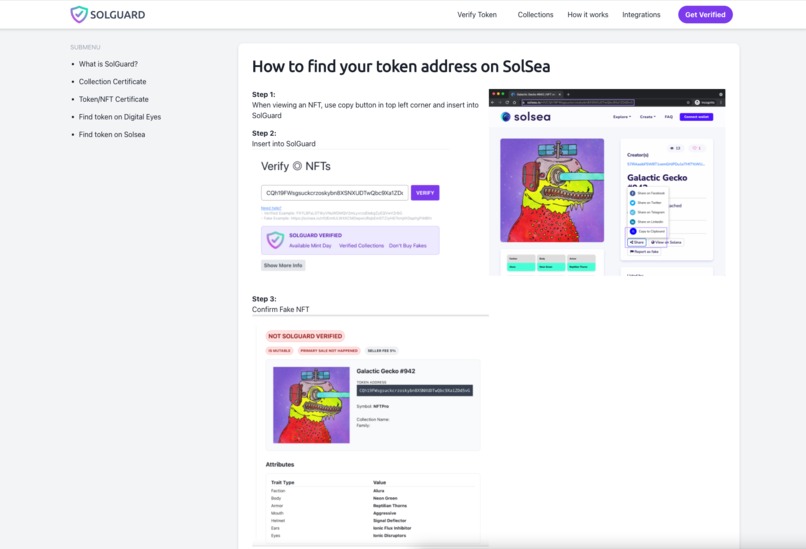
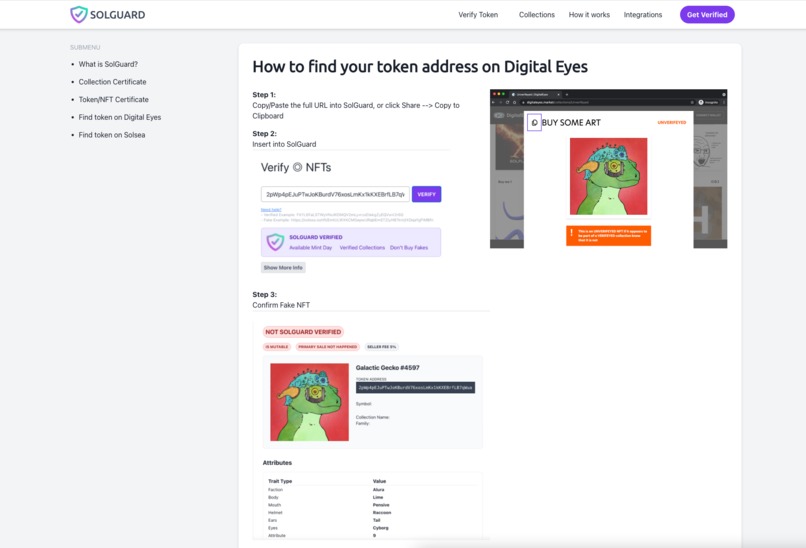
Once a project is verified, a user inputs a token address or marketplace URL for an NFT, SolGuard checks this address with the verified list, confirms whether it belongs or not, then pulls metadata for this token from the chain to display on the UI.
Challenges we ran into
- With how candy machine works, the token list cannot be provided until after mint completes. If a project doesn't sell out fast, it could require multiple PR submissions to SolGuard to get the full mint list.
- Making the verification process as open and transparent as possible. Currently, the GitHub PR json files that are reviewed are then inserted into a MongoDB instance for quick lookup. Upon merge of the GitHub pull request, the file is uploaded into S3. With more time, we plan to use Amazon Athena to quickly query S3 as a database and remove MongoDB from the architecture. This will allow for almost everything in the stack (except the login to the S3 bucket and hosting server) to be transparent and open to the community.
- Onboarding projects -- the choice for using GitHub was to allow projects to provide the data to us in a specified format which will then be reviewed by the team (and the community in the future). Once approved, it will be loaded into the SolGuard system and be displayed as a verified collection.
- The initial design assumed that collections used one Candy Machine to perform the entire mint. It was quickly discovered that due to the early nature of Metaplex and everyone's limited experience, that this was not the case. This caused some lag time trying to track down everything needed to onboard a collection.
Accomplishments that we're proud of
13k page views across 2k+ users in less than a week of launch.
It took approximately two weeks of part time work due to day jobs from conception to a beta.
At launch time, we were able to onboard a four major collections in the NFT Solana ecosystem: Aurory , Galactic Geckos, SolSteads and Grim Syndicate.
As of this submission, SolGuard has 10 collections loaded and has had very positive feedback.
What we learned
- There is a need for SolGuard after seeing fake tokens sold on marketplaces, users being scammed in escrow and peer-to-peer trades, and the fast pace of this ecosystem bringing bad actors to the space.
- NFT's are created by software and bugs happen. We have found several NFT's that either contain duplicates, don't have metadata stored or have tokens minted erroneously.
- Mutability of an NFT is not an inherently bad thing. Prior to SolGuard, almost every NFT launch was meant to be a static piece of art that did not change. SolGuard was partially born out of the fact that a lot of these NFTs were still set to mutable. After seeing projects launch with metadata issues or innovative ideas come out around mutations and game mechanics, mutability definitely has a place in the Solana ecosystem. It is vital that users understand what mutability means and how it can affect their NFTs.
What's next for SolGuard
SolGuard has the potential to be a cornerstone in the Solana NFT universe. There is a lot of work to do to further educate users and find the best way to provide this information. In addition, the goal is for SolGuard to become the trusted verification of NFTs across the entire ecosystem.
Primary Goals
- We are working on API Integrations so that we can provide third party verification to marketplaces, escrow services, and discord bots.
- Additional features to show the full token list in a searchable manner for each collection and provide more analytics and stats around what is being searched.
- Providing a way to onboard projects quicker with a simple tool to provide a way to look up mint list and open the pull request automatically.
- Display whether metadata has changed over time for a token.
Stretch Goals
Recently, projects have shown up in the Solana ecosystem with the promise of great art, a large mint, and a dedicated team for the foreseeable future. As soon as mint starts, the team takes whatever they got during mint and disappears before users are able to get the word out. This usually is found when the images being minted are emojis or blank.
SolGuard could be instrumental in getting a project verified prior to mint to check that the assets exists, that the teams are legit, and that users can feel safe participating in the mint.


Log in or sign up for Devpost to join the conversation.