-
-
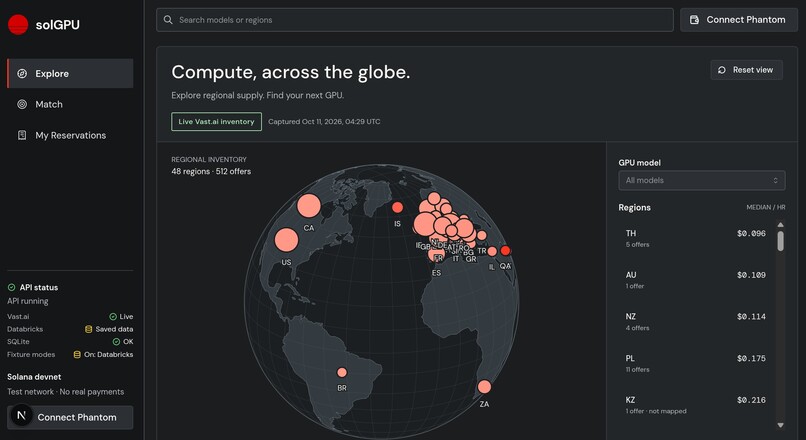
Main page
-
Inspiration
With the rise of local AI models, more and more people are using local hardware to run AI. The moment a model does not fit on your own GPU, the next step is renting one, and that market is a mess. On Vast.ai, the same RTX 4090 rents for $0.16 an hour in one listing and $0.94 in another, in the same minute. Listings expose forty technical fields at once, reliability varies by host, and a cheap card can be a bad deal.
We wanted the experience a careful buyer gets in any mature market: a clear view of prices, a recommendation you can explain, and a receipt you can verify. solGPU does that for GPU compute. We wanted to build a compute marketplace for all, from indie developers to enterprises.
What it does
solGPU has three different views:
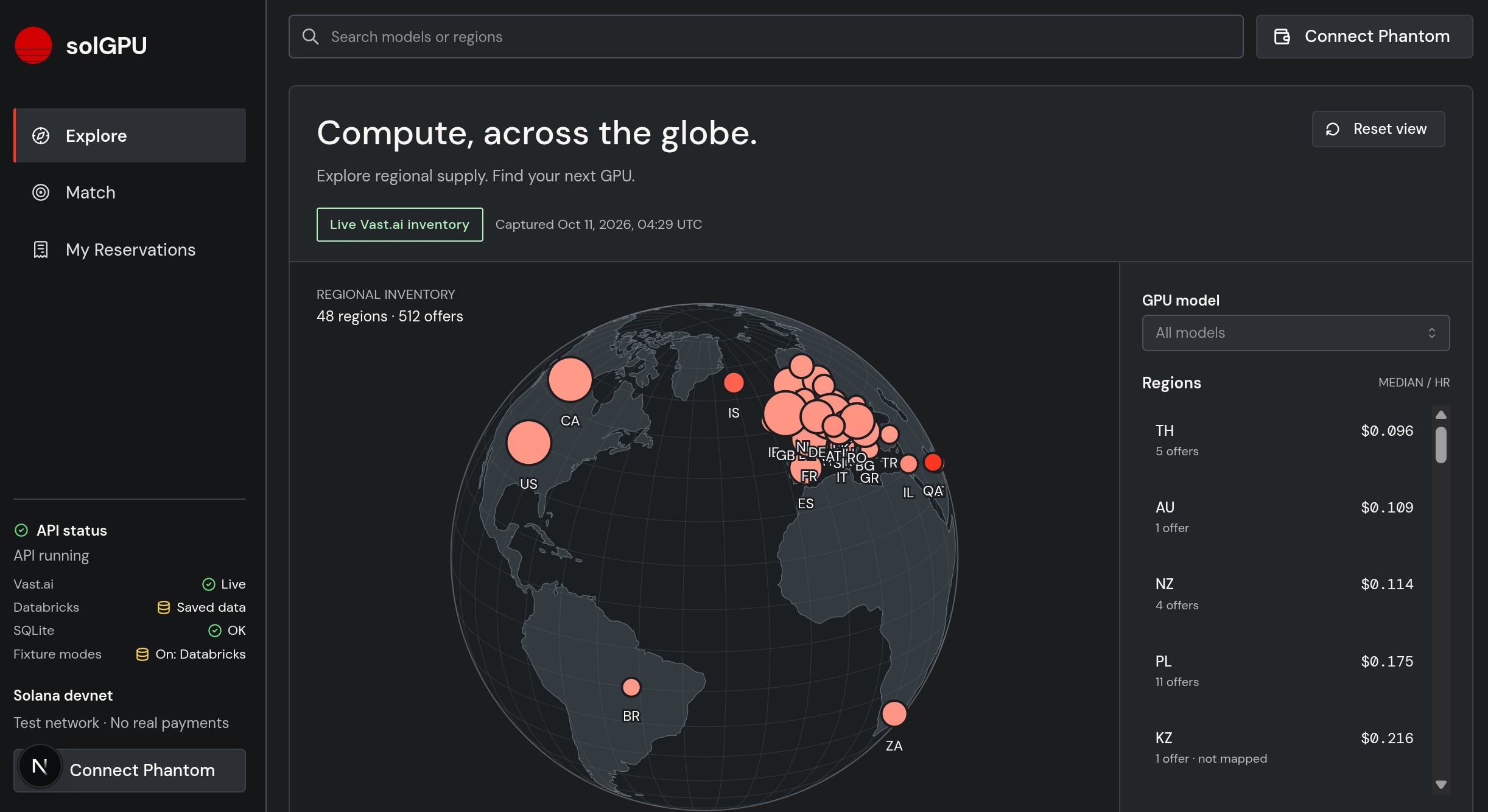
Explore shows live Vast.ai inventory (512 on-demand offers across 54 GPU models at the time of writing) with filters for model, VRAM per GPU, region, price, reliability, and verified hosts. Next to the live list, Databricks gives you insights into what the market usually looks like: the lowest, typical (median), and high (p90) price for the selected model, a price trend chart with a p10 to p90 band built from snapshots we collected every ten minutes during the Hackathon, and a badge on each listing such as "Good price, 20.6% below typical". Every number names its source and its capture time.
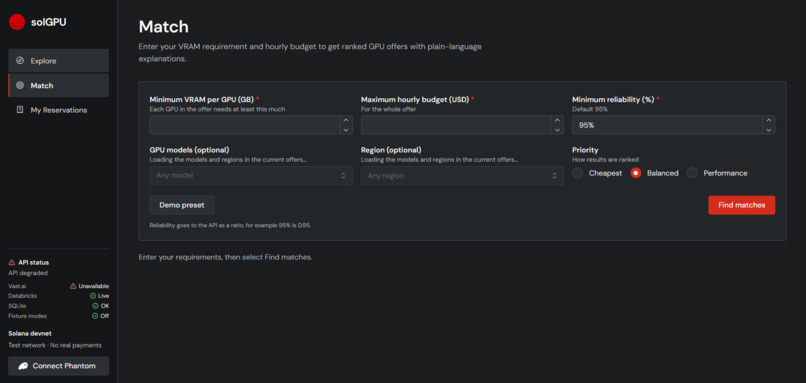
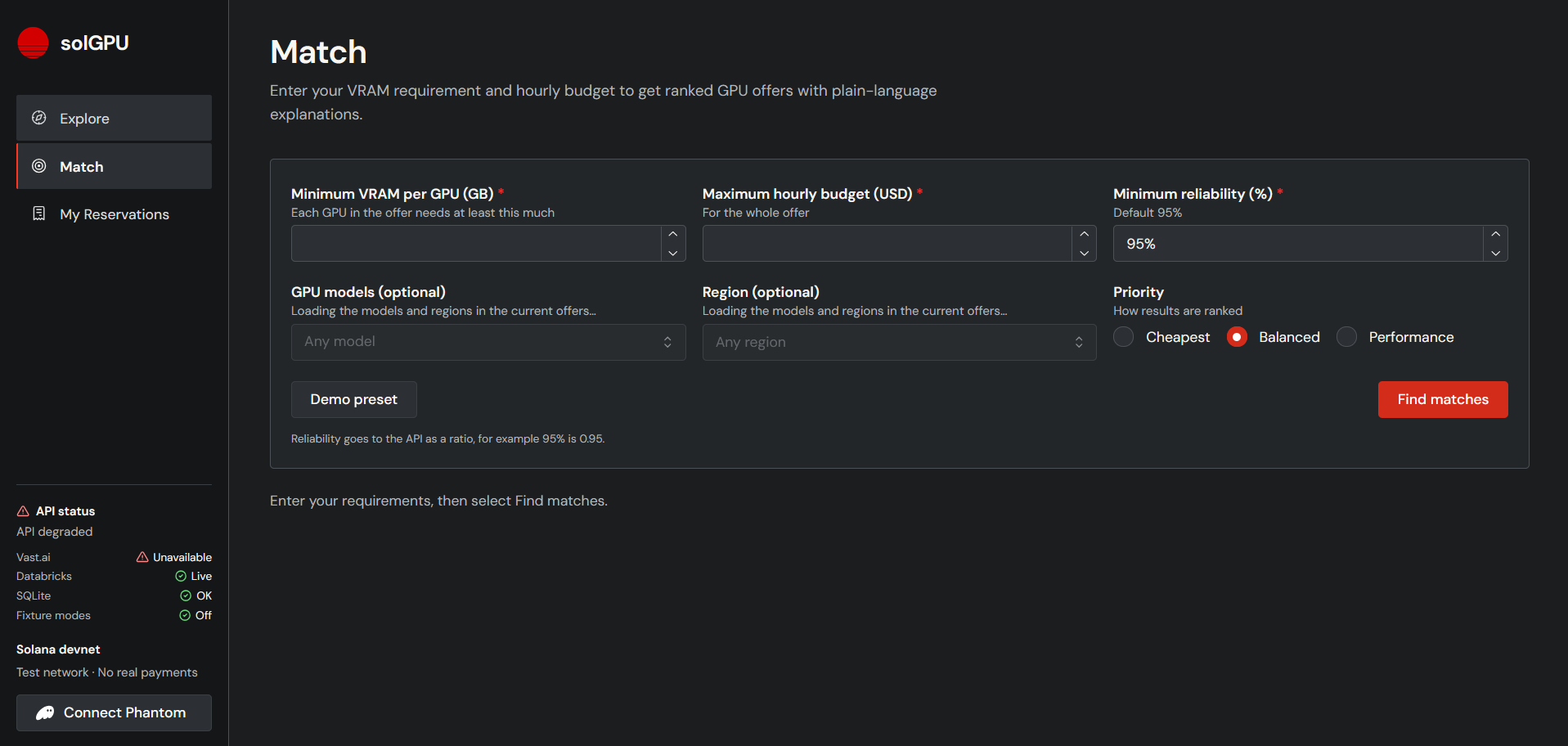
Match takes your requirements (minimum VRAM per GPU, hourly budget, minimum reliability, a priority of cheapest, balanced, or performance) and ranks the suitable offers with a fully explained rule set. You see how many offers were checked, how many qualify, and why the rest were excluded.
My Reservations lets you connect your Phantom wallet (or any other wallet) and sign a reservation intent on Solana devnet. The app builds a canonical payload (offer, quoted price, your requirements, your wallet), hashes it with SHA-256, and Phantom signs a memo transaction carrying that hash. The receipt card shows the signature and an Explorer link, and "Verify receipt" re-checks five things against the chain: the transaction exists, your wallet signed it, the memo carries this reservation ID, the memo hash equals the stored payload, and the transaction is confirmed.
How we built it
Our tech stack is Next.js, React, TypeScript, Mantine, Recharts, Go, SQLite, Databricks (Unity Catalog, Delta Lake, Workflows, SQL Warehouse, Lakeview), PySpark, Spark SQL, Vast.ai API, Solana devnet, Phantom, Wallet Adapter, web3.js, solana-go.
Challenges we ran into
We originally planned to use a FastAPI application, but decided on using Go instead for our API. This was a drastic change and we had to adapt as we went, updating our sources of truth as we went. We also had issues getting Phantom wallets integrated into our application, which took a few hours to solve. Lastly, we had to learn through each of the Databricks services we were using, Unity Catalog Volume, Bronze, Gold and Delta Lake alongside with building the actual pipeline that turns our aggregated data into insights.
Accomplishments that we're proud of
We are proud that we built a functional, beautiful web application that is responsive on the frontend, includes live data from the backend, and has meaningful insights. Our team worked tirelessly to make this a reality. We also proud to use Solana for this application, the transaction costs are near zero, no credit card fees or processor fees, all managed straight through your wallet of choice. Our Phantom and wallet integration directly connects to the extension, creates a reservation, hashes that reservation, confirms and runs 5 different check on with no token, no transfer and no custom program, which kept the trust story for our users.
Using Go for this project was a major milestone for us, before many of the applications we built was using python but by moving to Golang, our API response time, amount of customers that are able to be supported and what we learned along the way is something we are very proud about. our Databricks integration to our application. Raw Vast.ai data snapshots land directly in a Unity Catalog that flows through a bronze table, A silver layer is then used for explicit name maps, then four gold tables that are built with SQL window functions. Lastly, a Go API reads these gold tables through the statement execution API. This pipeline is our "source of truth" for how we can price a GPU through market insights
What we learned
Once we actually saw GPU offerings, we noticed some interesting trends. Mainly, that the same compute hardware can cost drastically different, as the example we gave above. We also saw that compute hardware of all shapes and sizes is available on the market, even including a laptop-grade RTX 3060! By using Go, we realized it only needs a standard library, no router, no framework and no middleware stack to learn, allowing us to develop this as soon as possible.
What's next for solGPU
Our next steps would include a full account authentication platform so users can see more personalized insights. We would also expand our compute listings to include offerings from multiple providers and update our Solana integration to include actual transactions. We also need to finalize the workflow so users can get a SSH key and an API key to buy the compute.Finally, turning this into a real application which anyone can use.
Built With
- databricks
- devin
- golang
- mantine
- nextjs
- python
- react
- solana
- typescript


Log in or sign up for Devpost to join the conversation.