Inspiration
America is facing a huge obesity epidemic. While traditional fitness apps offer digital badges, we believe true behavioral change requires an ecosystem where physical well-being is a literal economy. SolFit was created because we wanted to come up with a solution that is aimed to help people exersice, using Solana’s high-speed, low-fee infrastructure to create real-money prize pools that incentivize exercise through tangible stakes. SolFit creates an ecosystem where your physical well being is an economy. By combining the competitive energy of esports with decentralized finance, we’ve built a platform that moves people off the couch and into the game.
What it does
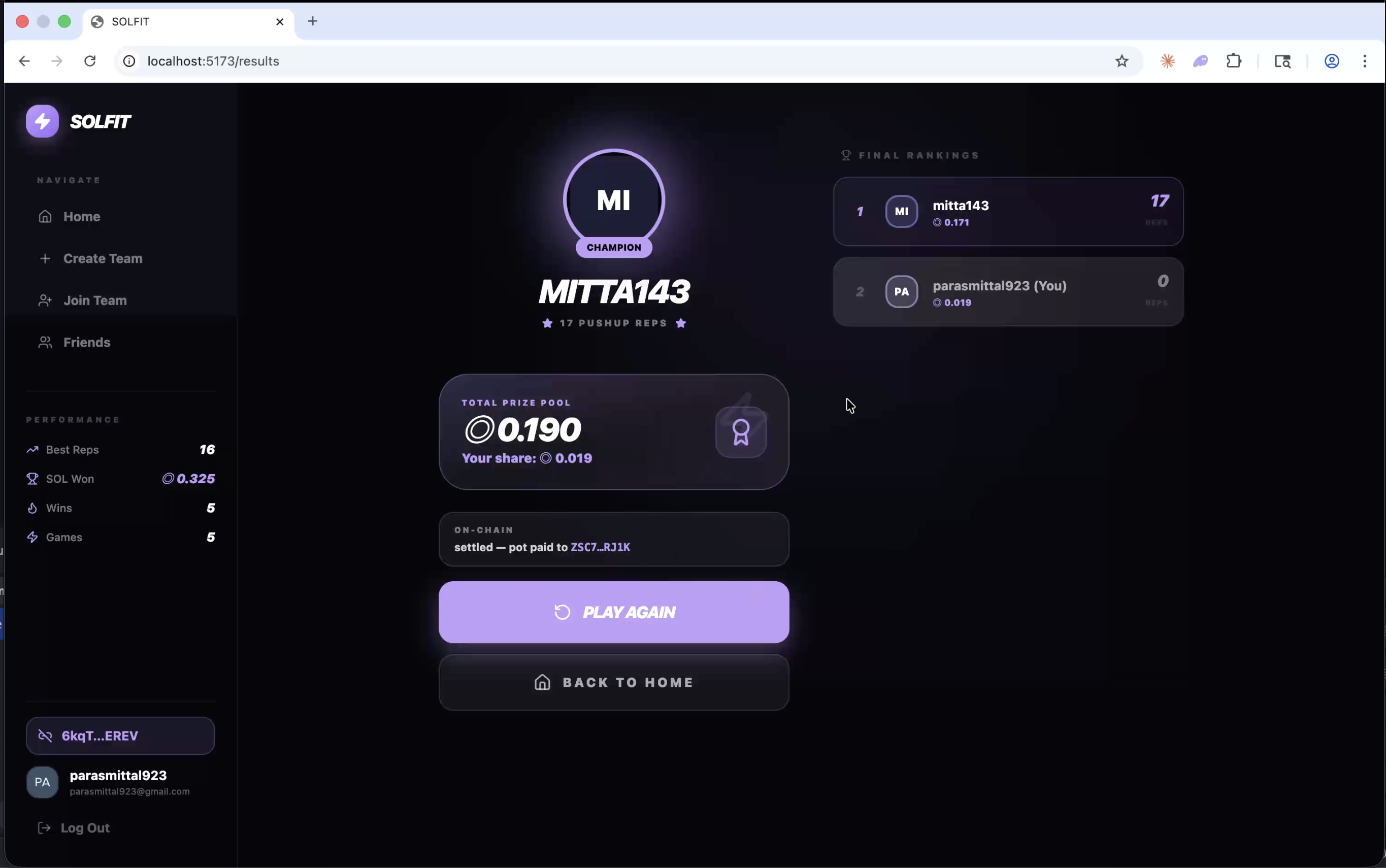
SOLFIT is a real-time competitive fitness web app where players wager Solana, compete doing physical exercises on camera, and the person with the most verified reps when the timer runs out wins the prize pool.
How it works:
- Sign up or log in with your username
- Create a squad or invite a friend directly
- The host sets the SOL entry fee (0.05–2.0 SOL) and picks the game type (Pushup, Squat, or Plank)
- The device with sensors counts your reps
- Everyone's webcam activates: AI tracks your reps live using pose detection to make sure your form is correct
- A live leaderboard updates in real time across all players
- When the timer ends, the winner takes 90% of the pot
How we built it
Working on the front end, we used React 18, TypeScript, and Vite to code the designs. We first selected a color palette and fonts on Figma Design, and used it to create basic frames of what we wanted our webapp to look like. We then converted it into a proper working frontend.
We next incorporated authentication into our project for the login/signups. We did this using Auth0. It was the best option out of all since it required the person to have a username along with their email, sent out verification emails for the account, and had additional security features such as Suspicious IP Throttling and Brute-force Detection.
For the backend, we worked on Node.js and Express. The rooms created for each squad are managed in-memory with 6-character codes. Socket events can handle lobby synchronisation, live rep relay between friends with a live leaderboard, game-start broadcast, and prize calculation at the end.
From the hardware standpoint, we implemented an ESP32 microcontroller connected to an ultrasonic sensor. Powering these devices from an external battery, we coded the sensor to count how many times it came 8cm closer.
We also implemented AI rep tracking, Google’s Mediapipe CNN is used for pose estimation and to provide feedback to the user. We extract shoulder, elbow, and wrist landmarks, compute the 3D elbow angle via dot product, smooth it, and feed it into a state machine: arm extended >160° followed by bent <90° followed by arm extended again = 1 verified rep with correct posture.
Challenges we ran into
The first challenge we faced was not being able to work on our original idea because of lack of hardware equipment. We initially planned on building a robot, but we did not have access to motors and chassis materials, so we had to change our idea and head in a different direction entirely.
We faced several issues with integrating Solana. Building SolFit as a decentralized application needed us to create a Solana program instead of relying on a traditional backend, which we were new to. We worked on it by breaking the system into smaller components and learning how basics of blockchain works. We also encountered the issue of tested without spending our real money since this is based on blockchain. We solved that by using the Solana Devnet to test.
We also faced issues with the sensors and ESP32. Most of those issues were faced while working on the software-hardware integration.
Accomplishments that we're proud of
- We are proud of building a webapp that actively helps tackle an ongoing issue in this country with the resources and time we had available.
- Real Solana Wallet Integration - It took us a long time to study blockchain and build the wallet integration into the project.
- We got Auth0 integrated with extra security features to ensure there are no data-leaks or privacy concerns.
What we learned
We learnt how to integrate hardware such as the ESP32 microcontroller and ultrasonic sensor with its respective software. We also learnt how to integrate different softwares, such as the Solana software, the entire frontend of the project, logistics of the backend, and software of the sensors + the vision system.
What's next for SolFit
We plan to expand SolFit into a more engaging and scalable platform by adding tournaments, ranked matchmaking, and more exercise modes, such as squats, planks, burpees, etc., to keep users coming back. On the technical side, we want to improve AI rep tracking so users don’t need external hardware, while strengthening our blockchain system for better security and fairness. Long term, we aim to build a community-driven fitness ecosystem with leaderboards, challenges, and real incentives which turns exercise into a competitive, sustainable economy.
Built With
- auth0
- express.js
- javascript
- node.js
- react
- solana
- typescript
- vite


Log in or sign up for Devpost to join the conversation.