-
-
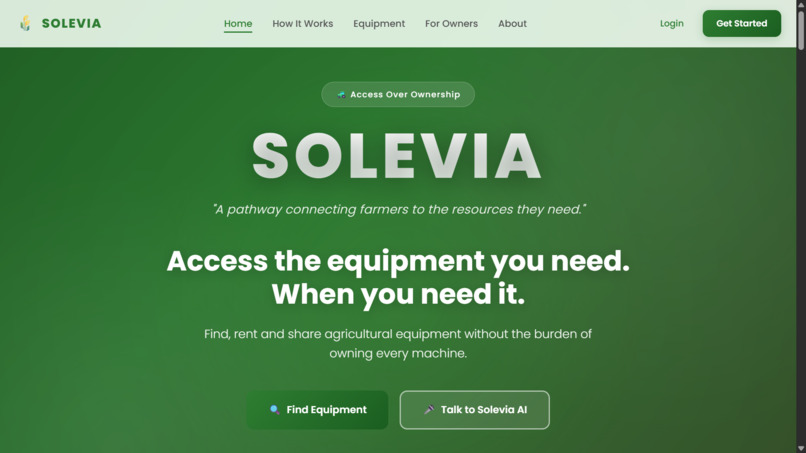
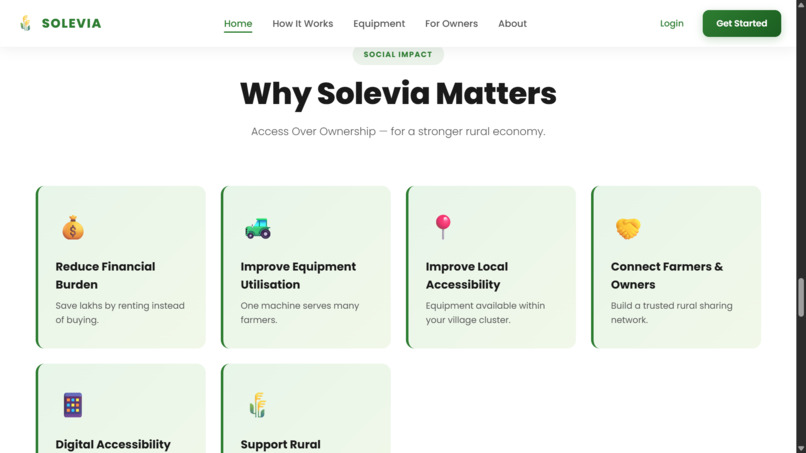
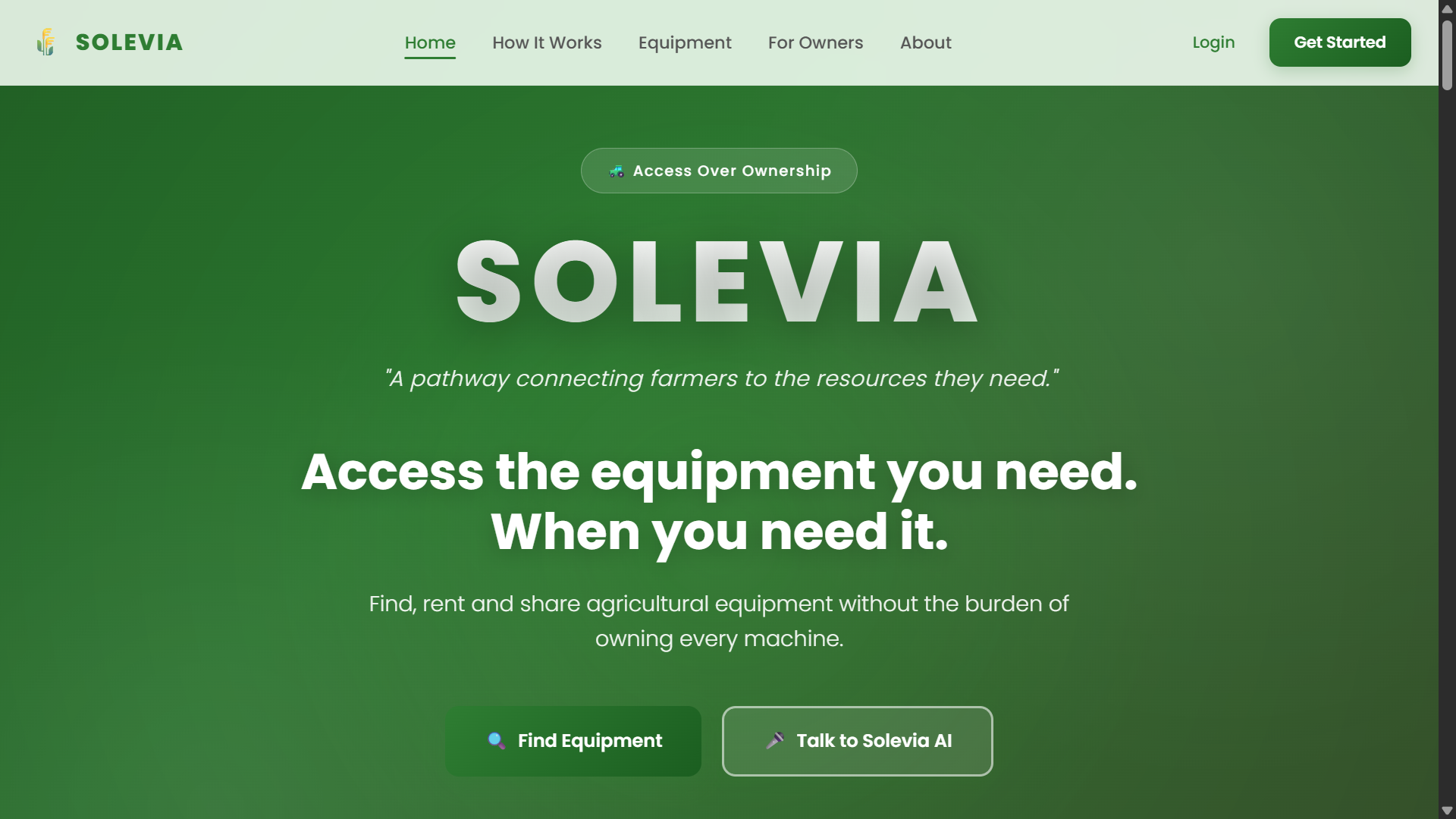
landing page
-
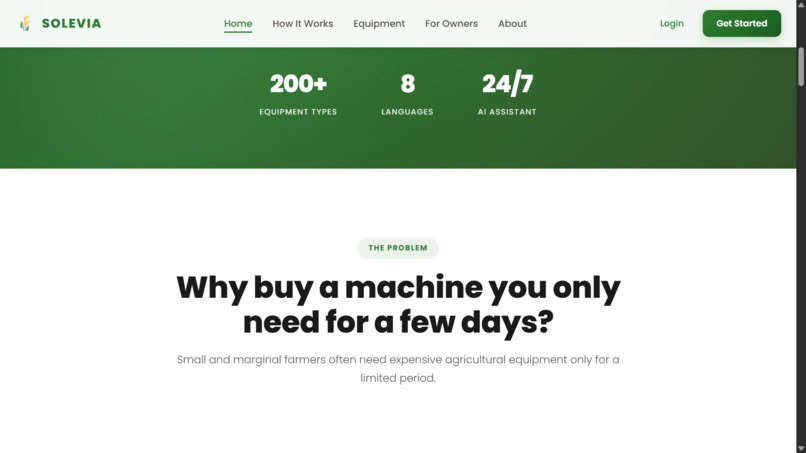
-
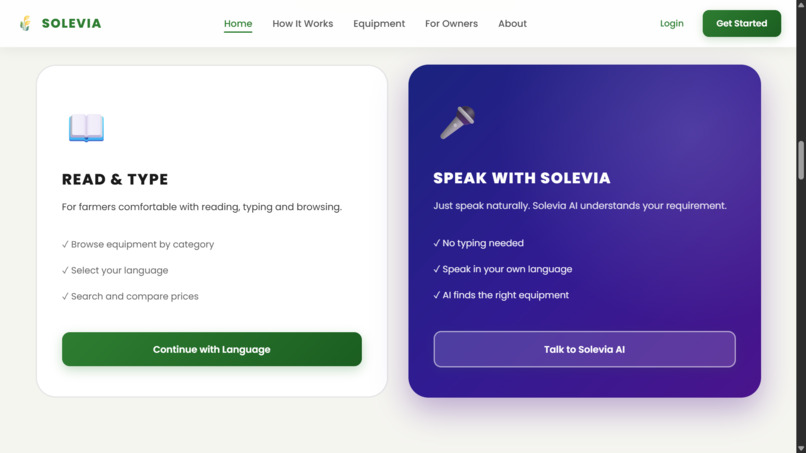
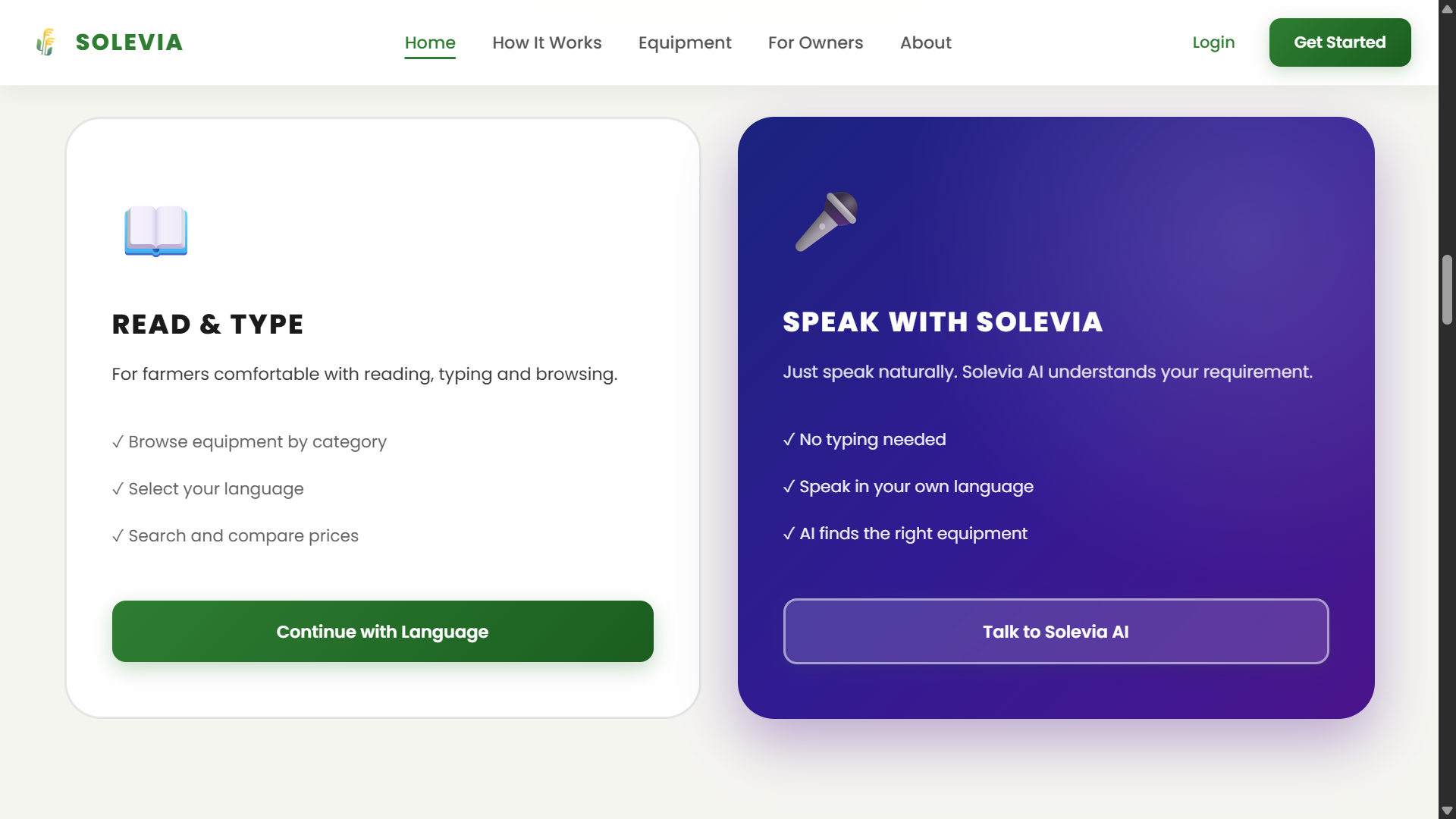
option niether type or ai assistance(solevia)
-
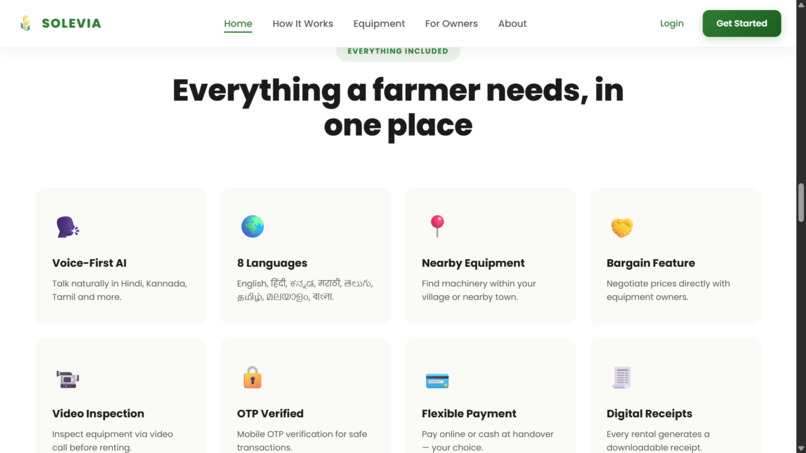
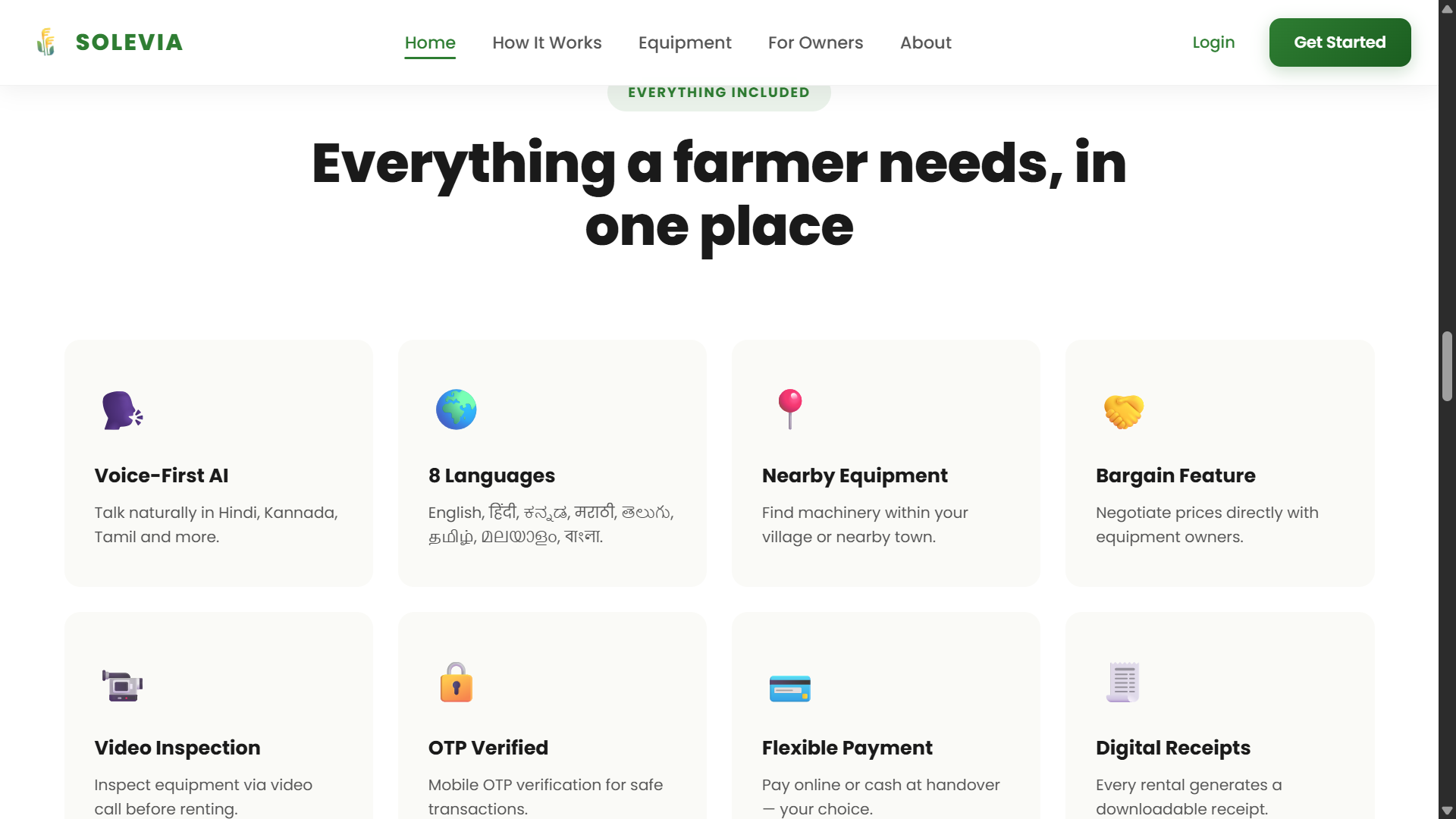
listing all features
-
-
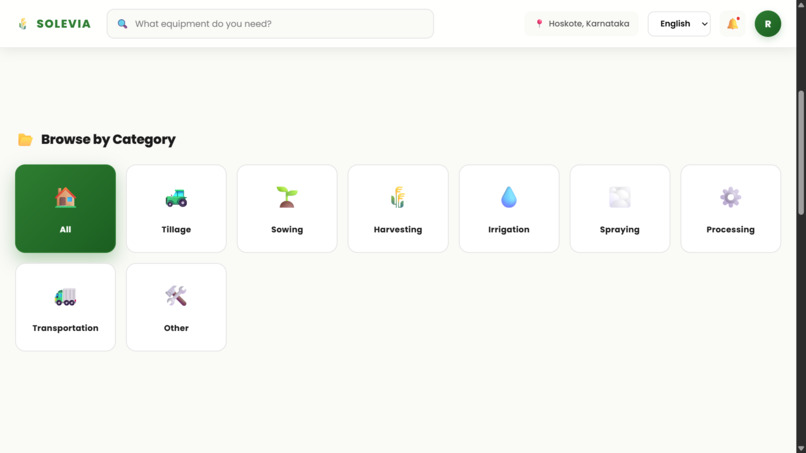
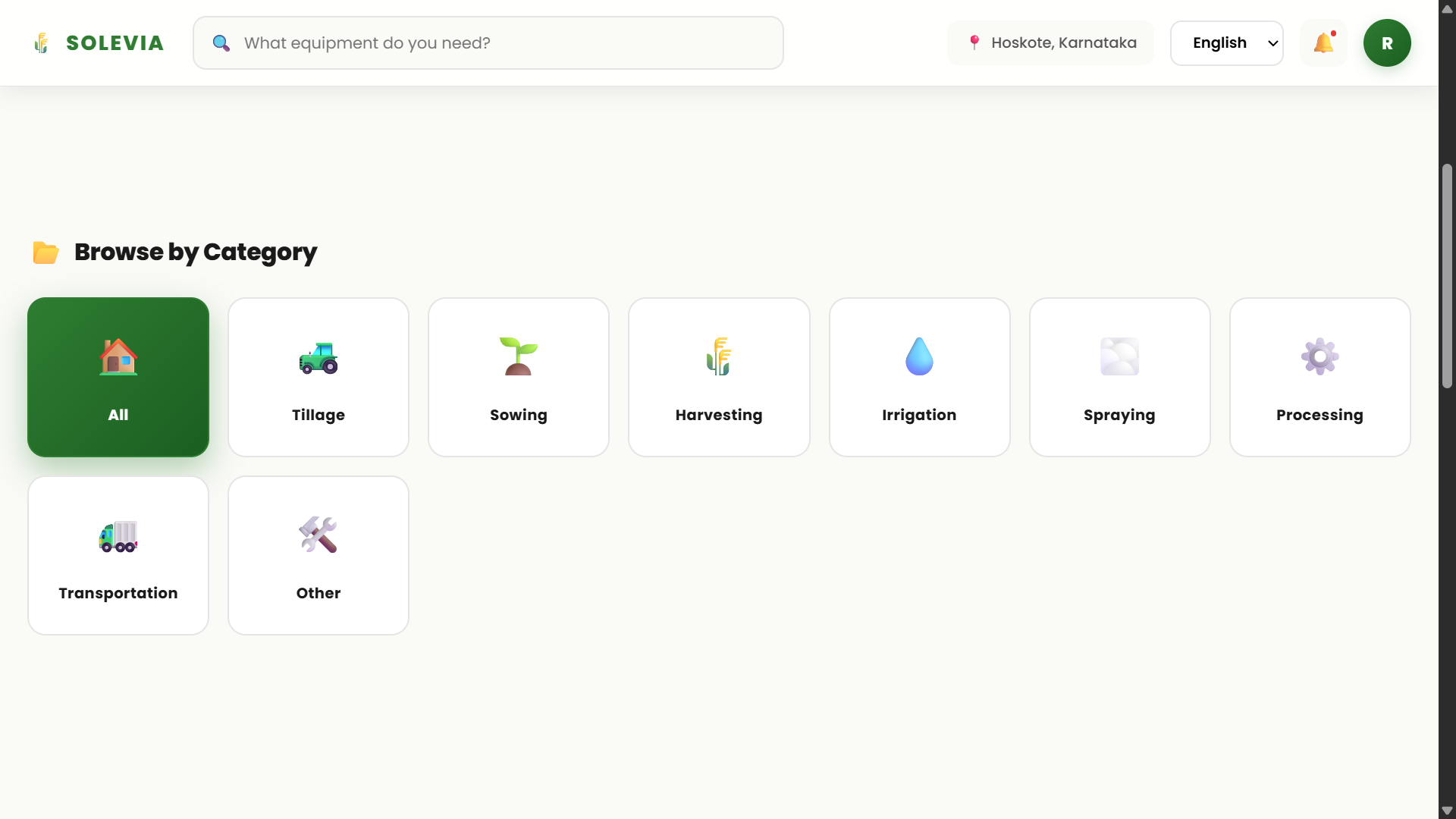
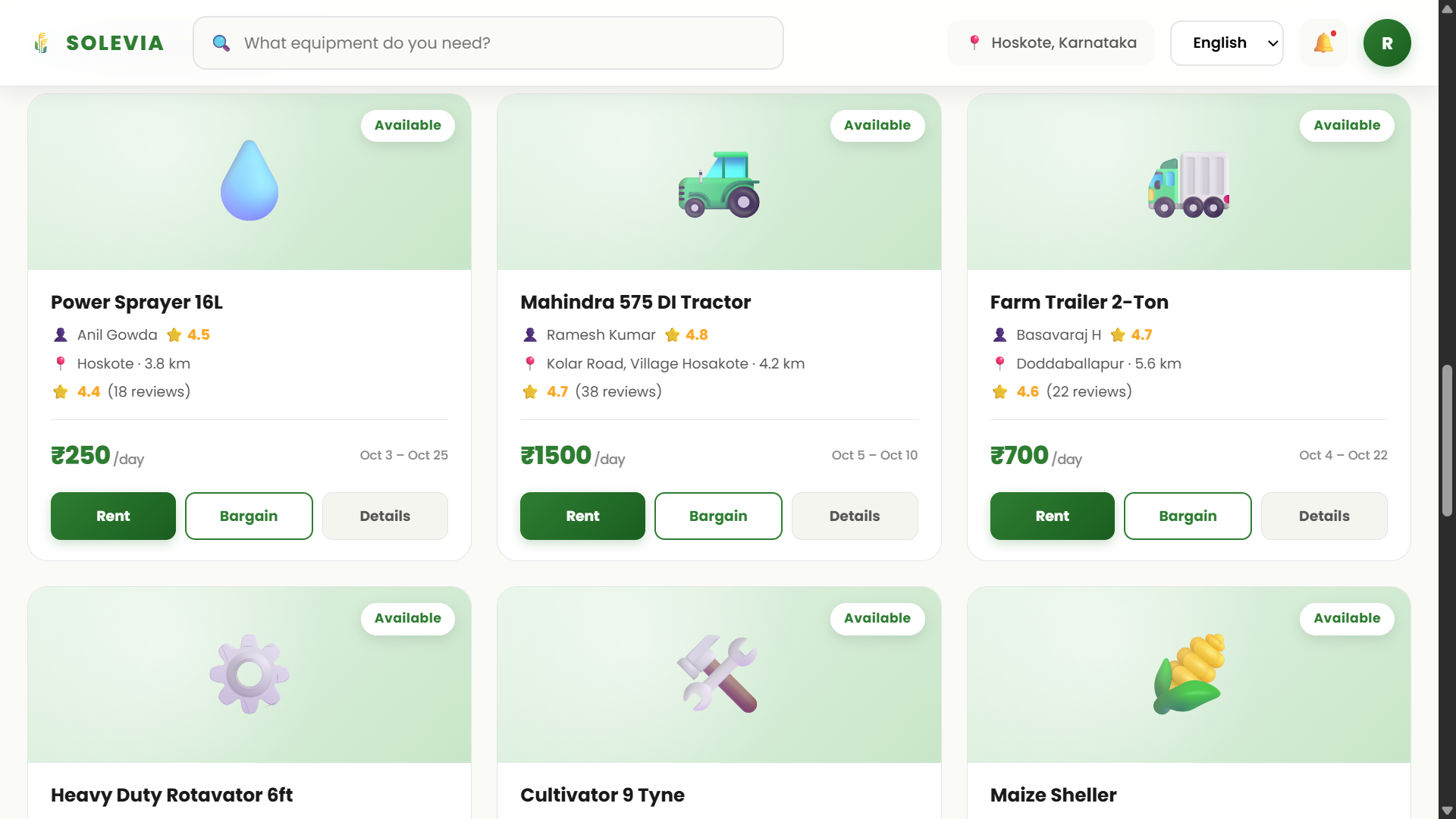
category
-
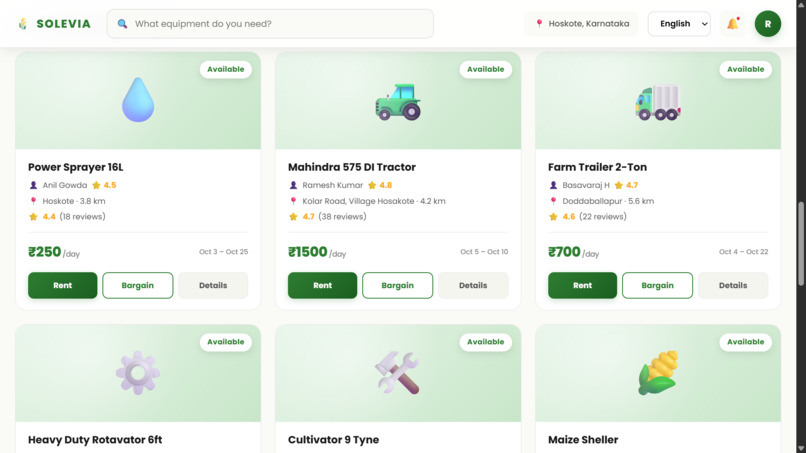
all available equipment
-
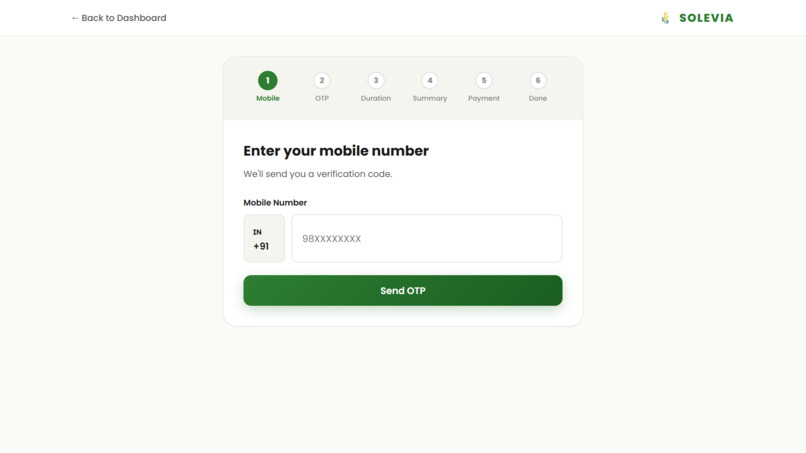
after renting procedures
-
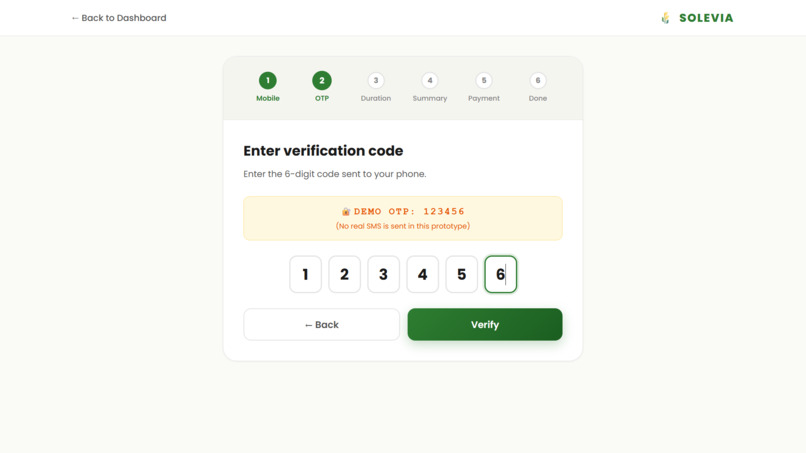
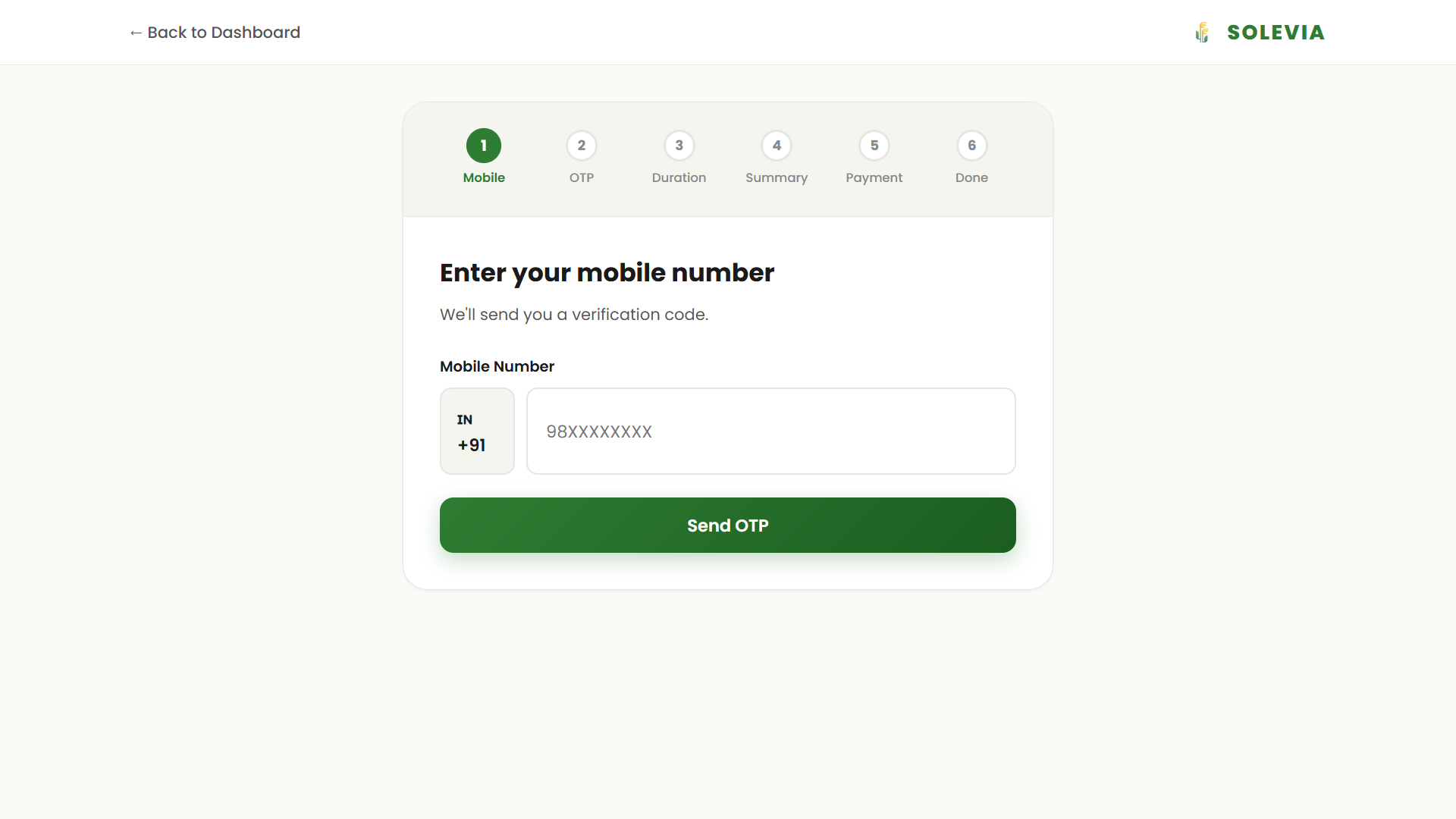
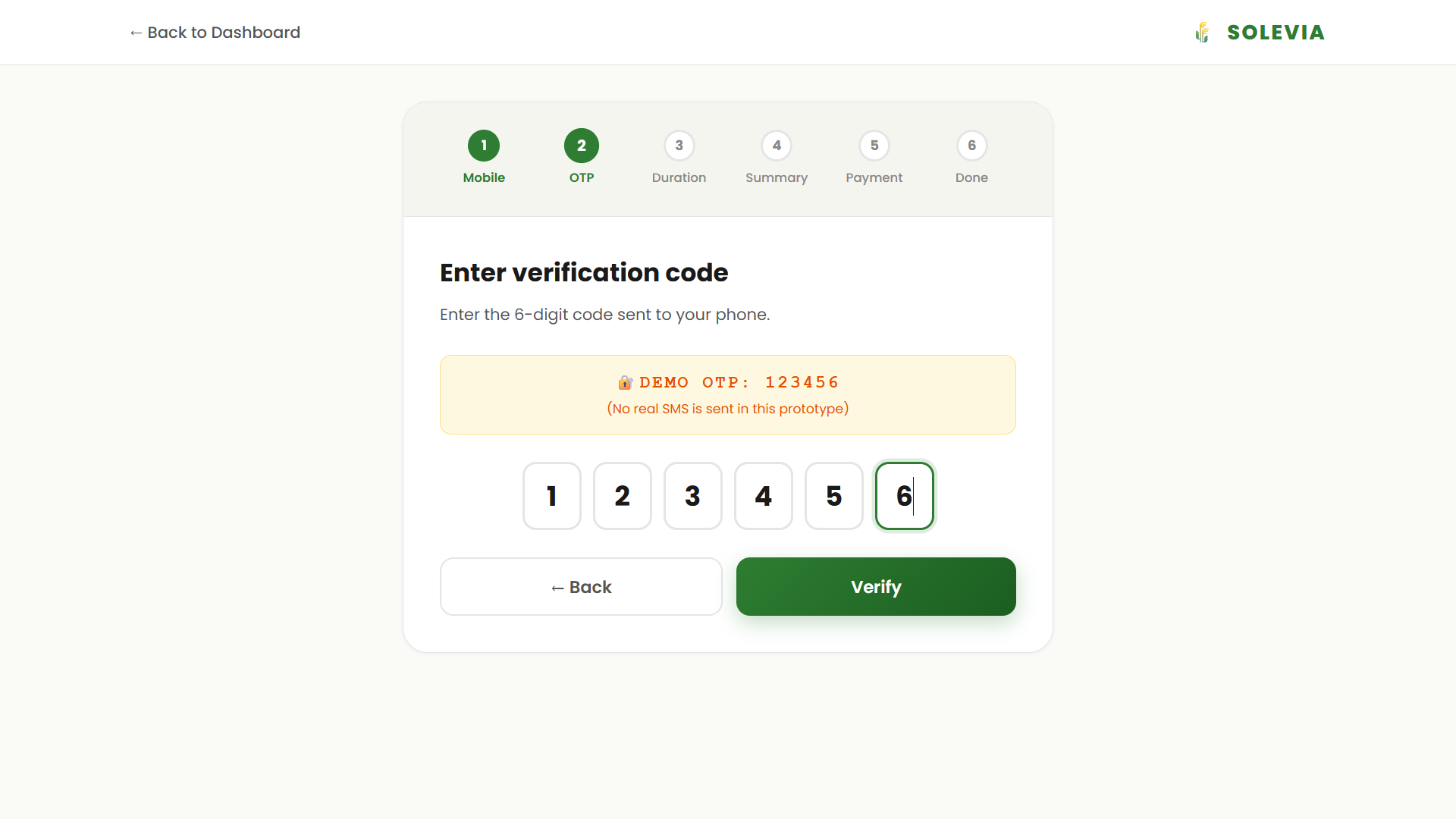
OTP verification
-
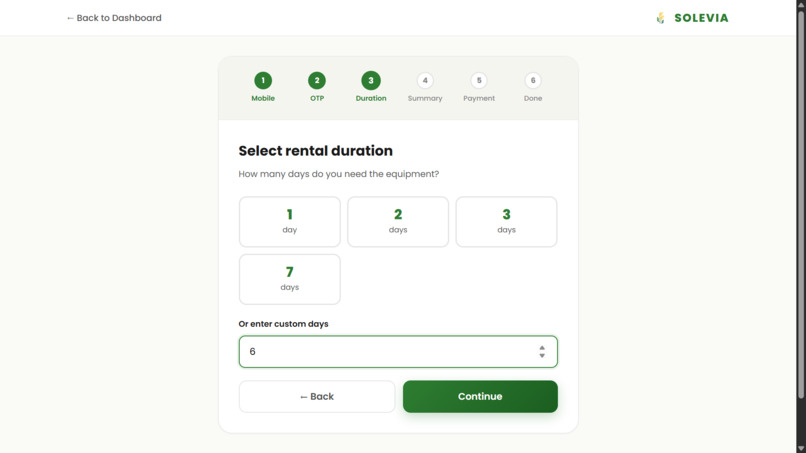
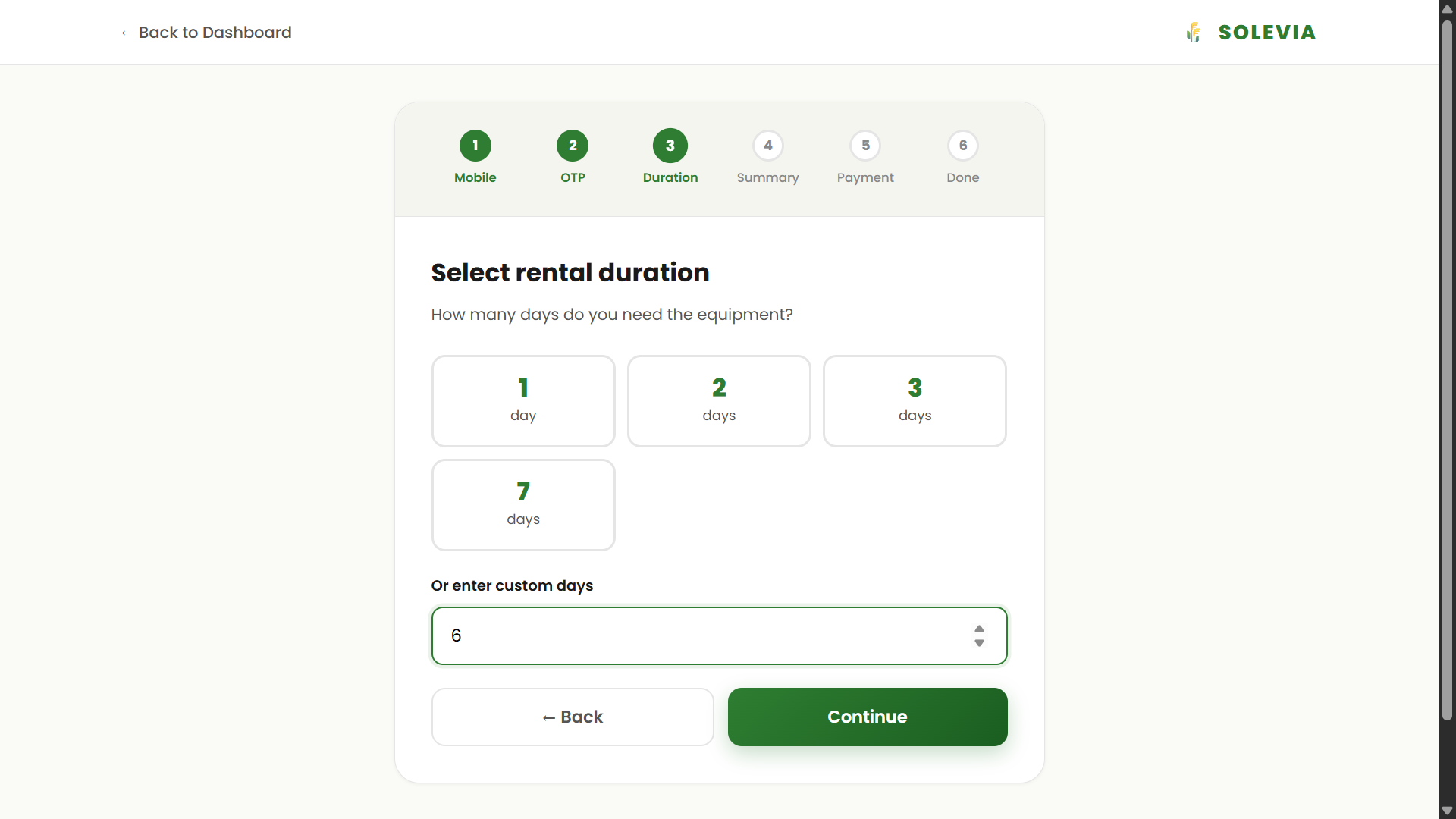
for how many days required
-
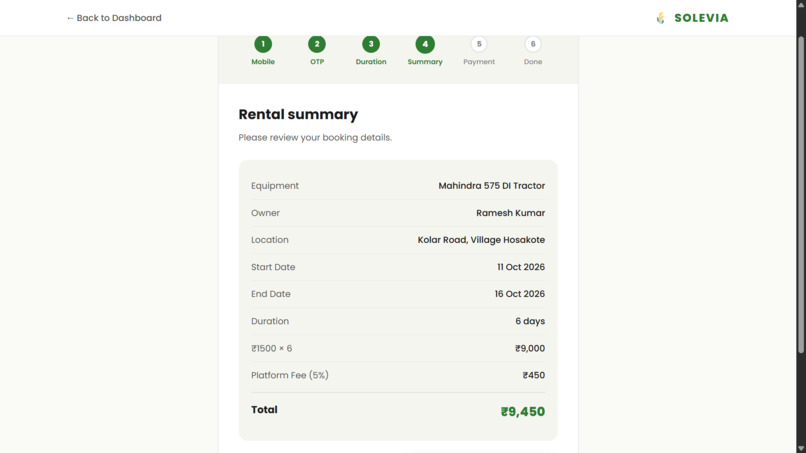
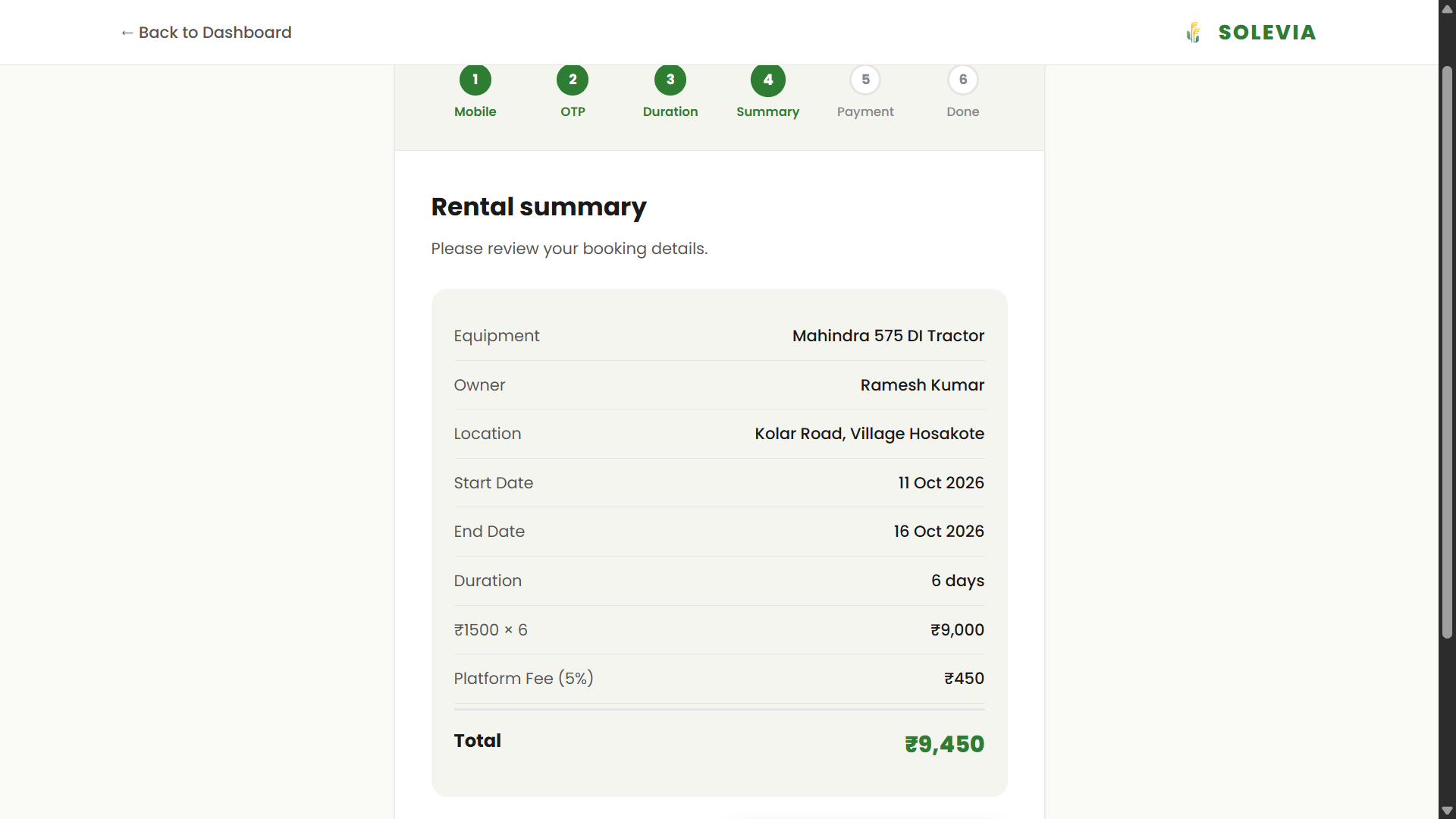
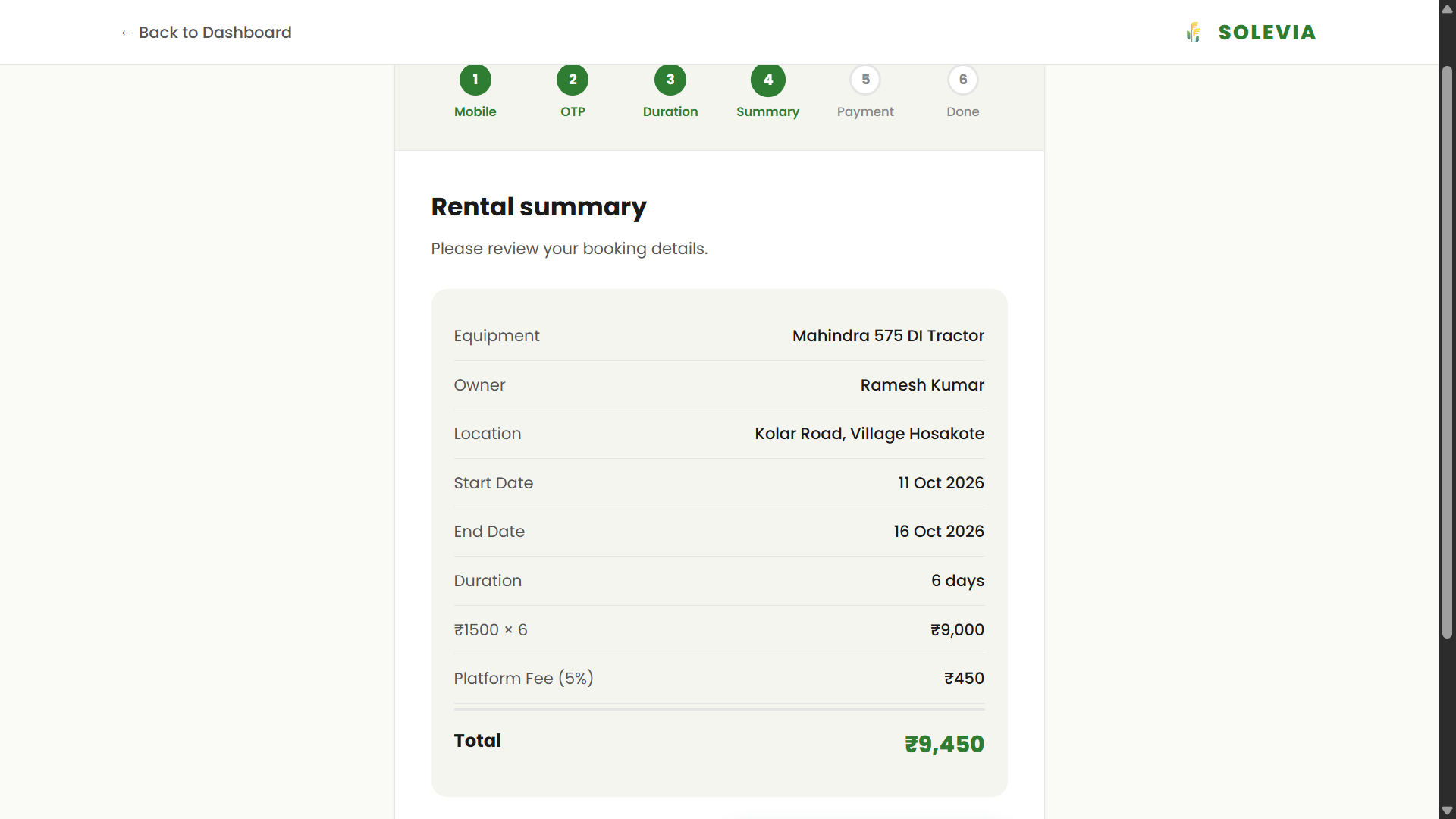
receipt details
-
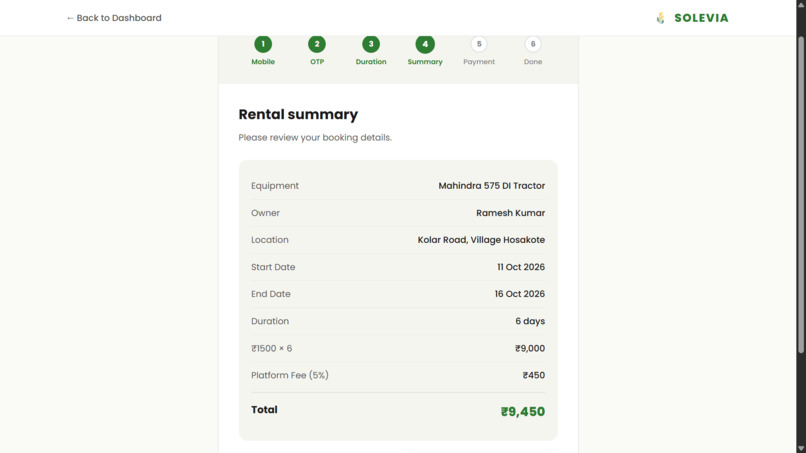
total cost
-
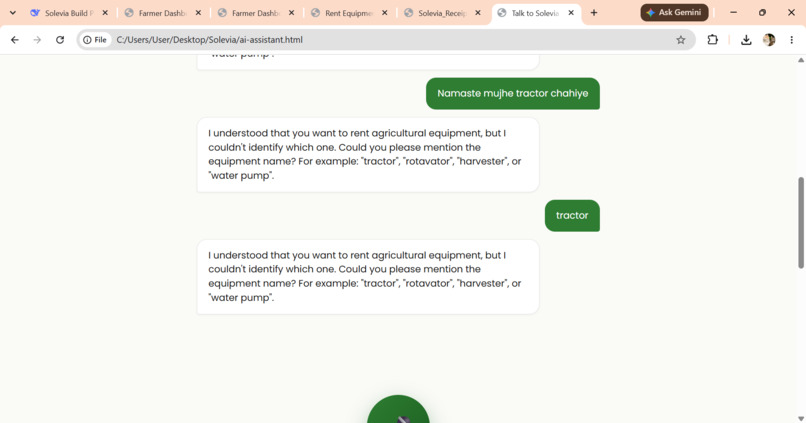
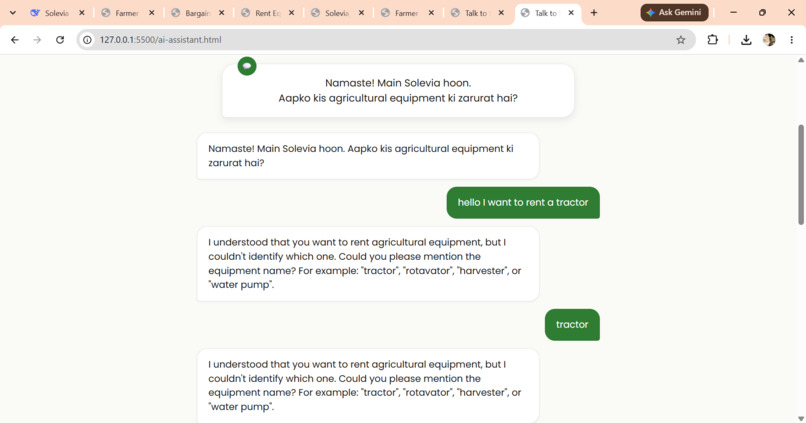
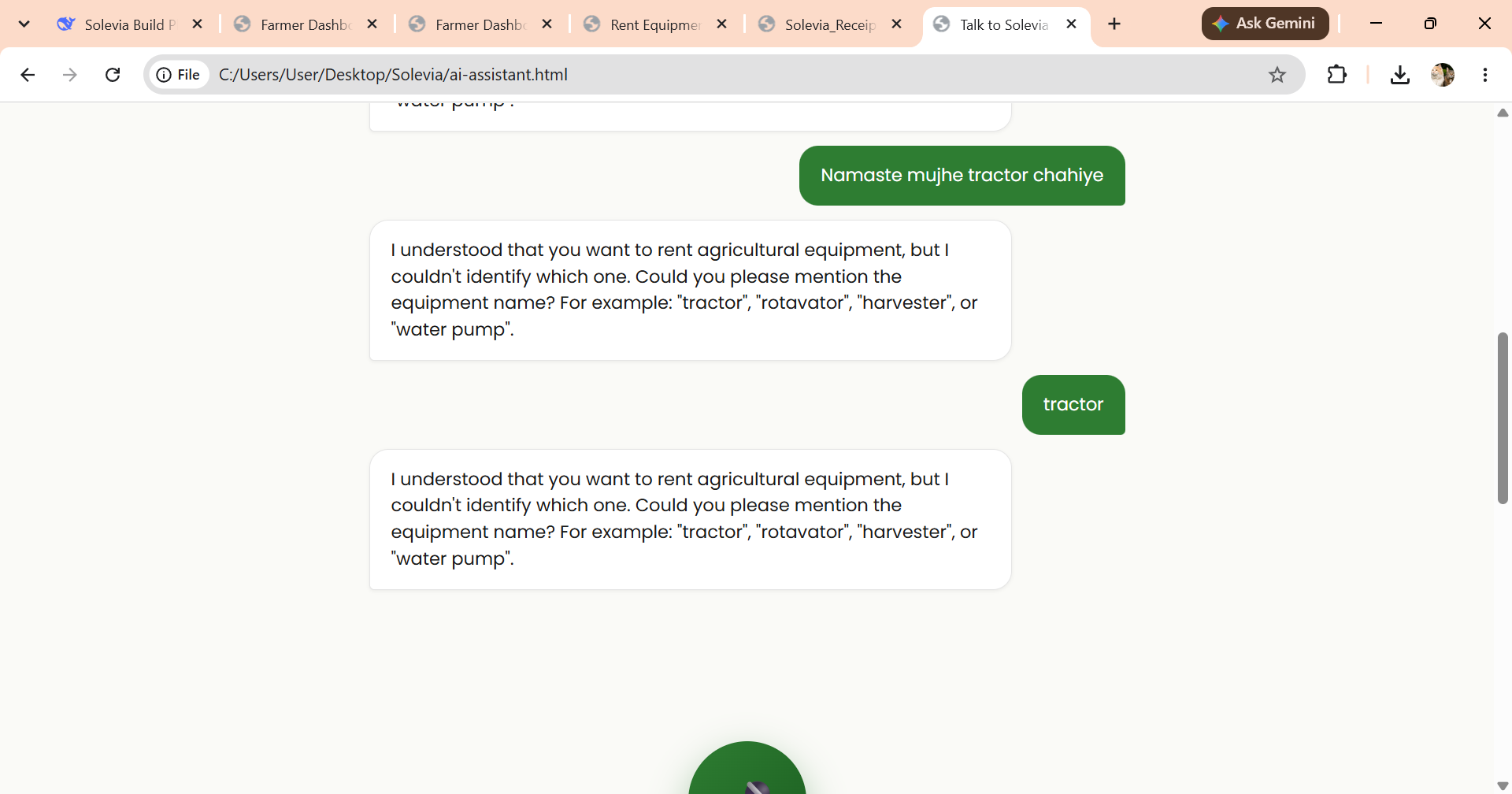
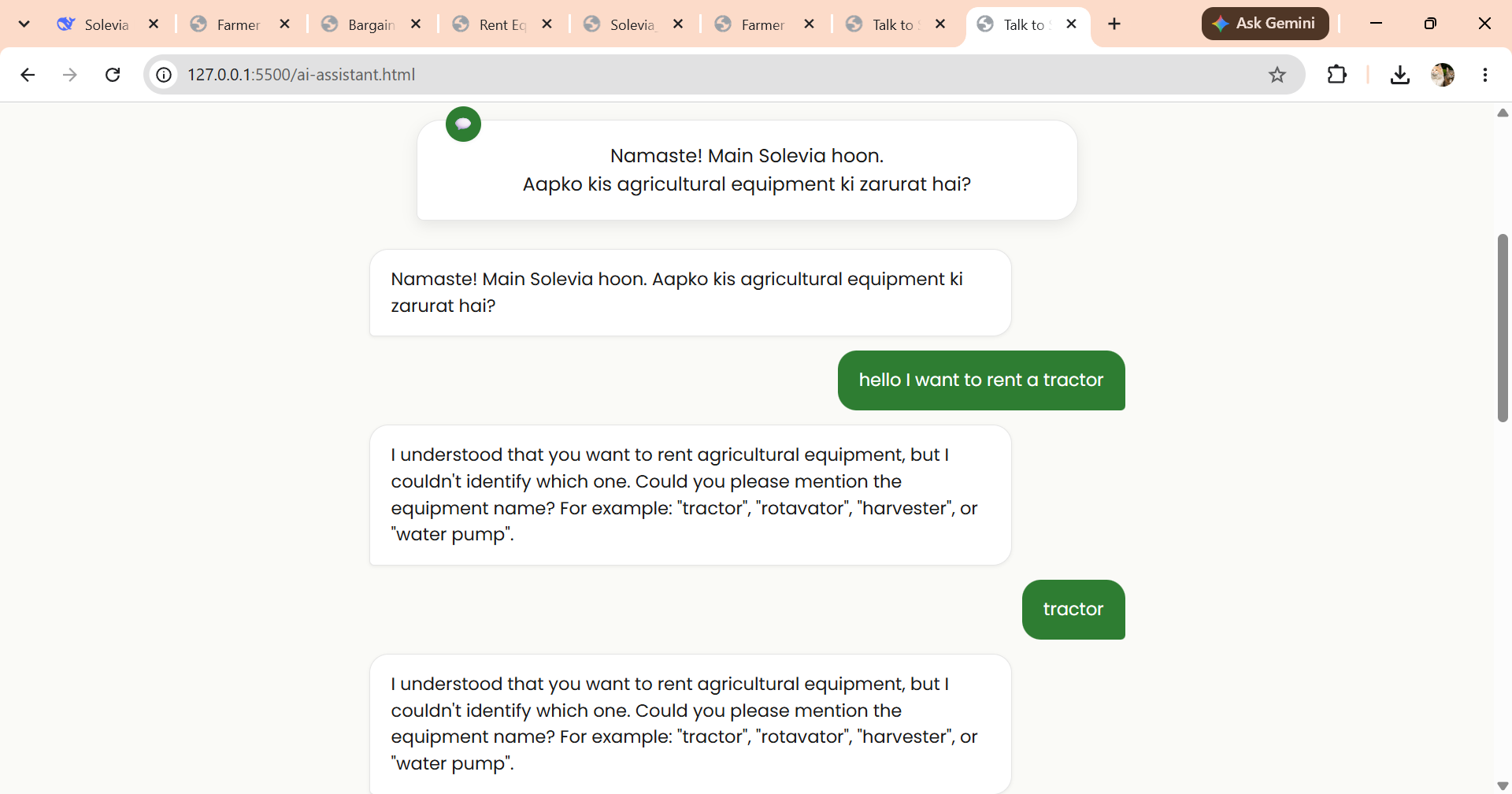
chats with ai assistance
-
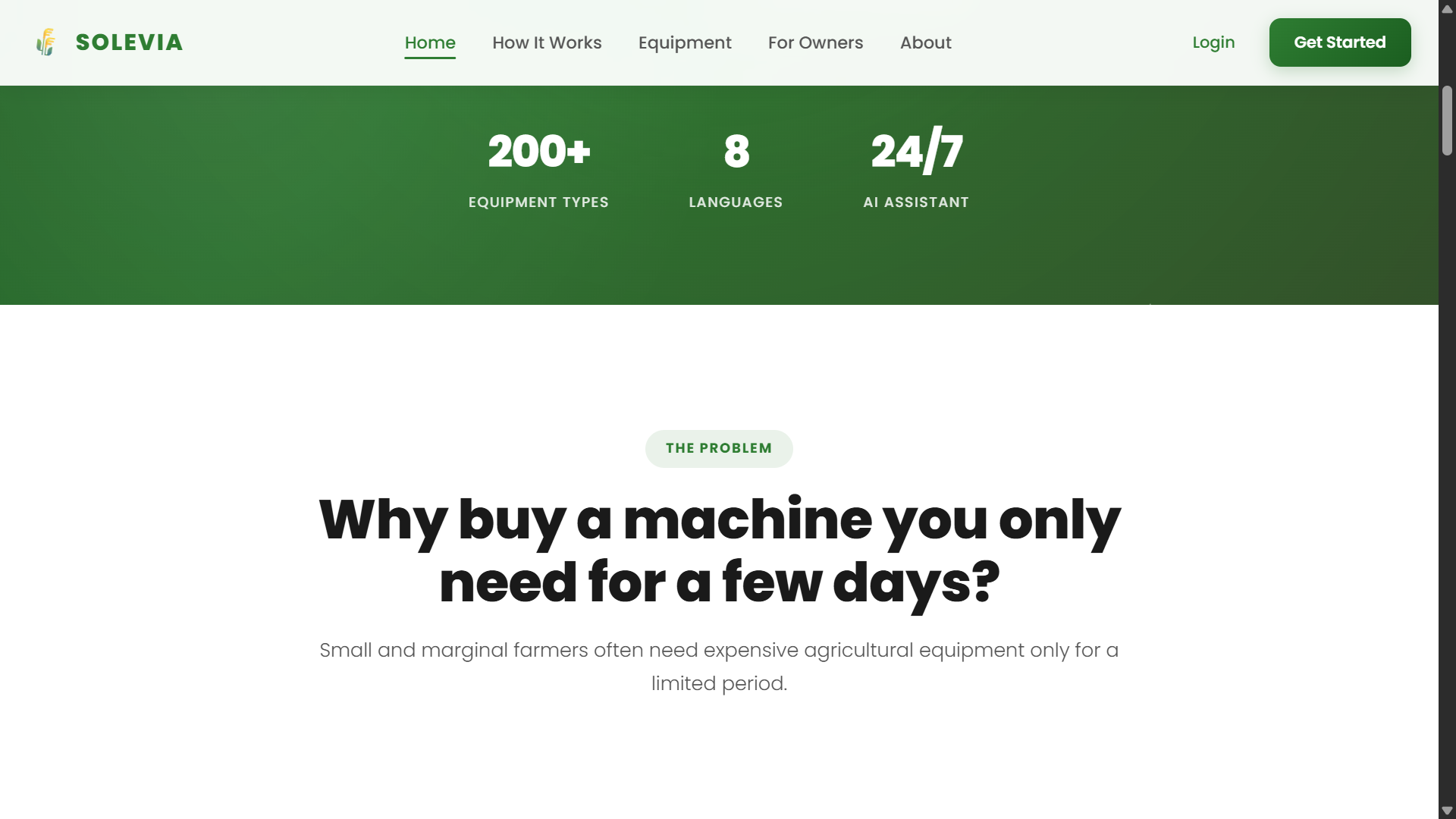
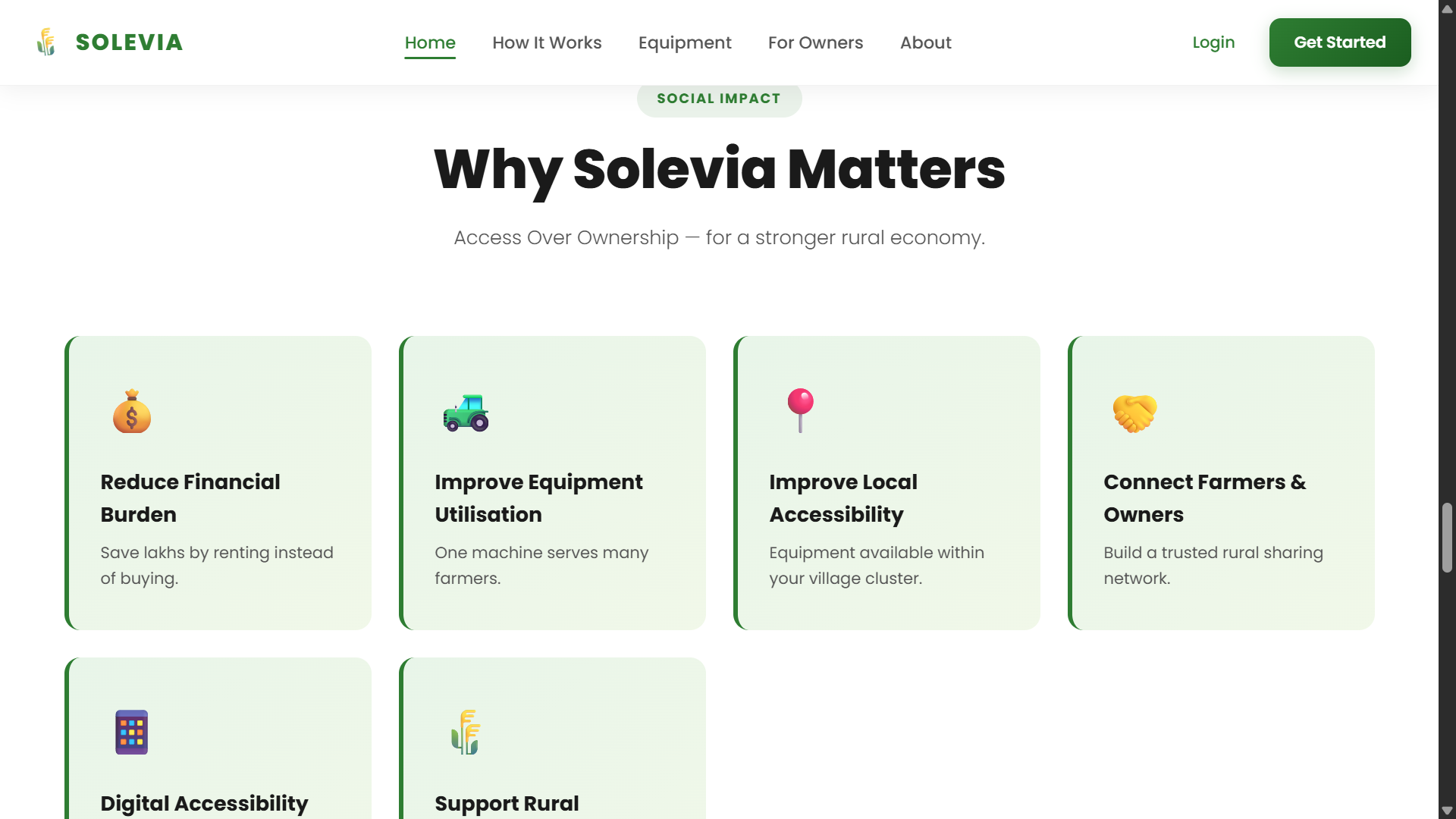
Inspiration Small and marginal farmers across India often need expensive agricultural equipment like tractors, rotavators, harvesters, and seed drills, but only for a few days at a time. Buying such machinery individually costs six to eight lakhs, which is often more than a small farmer's annual income. Meanwhile, equipment sitting idle on one farm could be earning money for another farmer nearby.
We asked ourselves: how can small farmers share expensive equipment instead of owning it?
That question became Solevia. Beyond cost, we noticed a deeper issue: most agri-tech platforms assume farmers can read, type, and navigate in English. Millions of Indian farmers speak Hindi, Kannada, Tamil, or Telugu, and many have limited literacy. A real solution had to be voice-first and multilingual from the start.
What it does Solevia is an agricultural equipment-sharing platform built on one principle: access over ownership. It connects two sides: farmers who need equipment for a few days, and owners who want to rent out their idle machinery.
Key features:
Voice-first AI assistant. Farmers just speak their requirement naturally, for example "Mujhe do din ke liye rotavator chahiye." The AI detects the language, understands intent, asks follow-up questions about budget and duration, and matches available equipment nearby. Every response is spoken aloud, so no reading is required.
Multilingual interface. Full UI translations in English, Hindi, and Kannada, with a keyword engine that also recognizes Tamil, Telugu, Marathi, Bengali, and Malayalam speech.
Location-based matching. Equipment is shown by distance from the farmer, with mock GPS coordinates in the prototype and a clear path to real geolocation.
Real-time bargaining. Farmers can offer a lower price; owners can accept, counter-offer, or reject. Includes voice bargaining where farmers speak their offer and the system extracts the price.
OTP-verified rentals. Mobile verification flow ensures transactions are traceable and secure.
Digital receipts. Every rental generates a downloadable PDF receipt with booking ID, dates, cost breakdown, and payment method.
Flexible payments. Choose online payment or cash at handover.
Two-sided marketplace. Owners get their own dashboard to list equipment with photos, price, and location, view incoming rental requests, and respond to bargain offers.
Complete workflow. From AI conversation to equipment discovery, bargaining, OTP verification, payment, digital receipt, and My Rentals history.
How we built it Frontend. HTML5, CSS3, and vanilla JavaScript with no frameworks, for maximum portability and speed. Responsive design with mobile-first breakpoints. Custom CSS animations including gradient shifts, scroll reveals, ripple effects, floating avatars, and pulse rings.
Voice and AI. Web Speech API for real browser-based voice input, working in Chrome, Edge, and Safari with zero external dependencies. SpeechSynthesis API for spoken AI responses in Indian English, Hindi, and Kannada. Custom intent parser with keyword matching across eight Indian languages, extracting equipment type, budget, and duration from natural speech. Language auto-detection using weighted keyword scoring.
Data and state. A JSON file with twelve realistic equipment listings and full specifications. localStorage for owner-added equipment, rental history, and user preferences, enabling a complete two-sided demo without any backend. URL parameters to pass AI filters between pages.
Utilities. jsPDF for generating downloadable rental receipts. Custom debounce for search filtering. IntersectionObserver for scroll-based reveals. MutationObserver for dynamically added cards.
Deployment. Firebase Hosting, deployed live at solevia-warriorhacks.web.app. Firebase CLI for one-command deploys.
Challenges we ran into Browser security blocking local file access. Fetch calls fail silently when HTML files are opened via file protocol. We had to switch to Live Server for development, and this became an important lesson about why static hosting matters.
Cross-page state without a backend. We needed equipment added by an owner to appear instantly in the farmer's dashboard, but we had no database. We used localStorage as a shared store, merged with static JSON at load time. This gives a fully functional two-sided loop without any server.
Voice input across languages. Web Speech API's language setting is per-session, not per-word. We solved this by keeping the recognizer on Indian English, which handles Indian-accented English and Romanized Hindi well, and then applying our own multi-language keyword matcher on the transcript. This gives us pseudo language detection without needing a heavy NLP model.
Making the AI actually conversational. An early version redirected to the dashboard the moment a farmer said "tractor." We realized this failed farmers who do not know what to do next. We rebuilt the assistant as a stateful multi-turn conversation: equipment, then budget, then duration, then results. Each stage speaks its question aloud.
Extracting prices from natural speech. A farmer might say "1500," "fifteen hundred," or "twelve hundred rupees." We built a parser that handles digits, word numbers, and hundred or thousand multipliers.
Balancing polish with a three-day timeline. We rewrote the CSS twice. The first version was clean but forgettable. The final version adds an animated gradient hero, ripple buttons, a floating avatar, scroll reveals, and gradient text, while keeping the pages fast and mobile-first.
Accomplishments that we're proud of A working voice AI on the web. Actual speech recognition and speech synthesis, not a video mockup. You can open the site on Chrome, tap the mic, and have a real conversation in Hindi or Kannada.
A complete two-sided marketplace. Farmers can rent, owners can list, and both sides see each other's data through a single shared store.
Full rental lifecycle in a prototype. From voice request to filtered results, bargaining, OTP verification, PDF receipt, and rental history. Every step is functional.
The bargaining feature with voice. Being able to say "I can pay 1200 per day" and have the system parse, negotiate, and reach an agreed price felt genuinely innovative.
Eight-language support in a solo build. Most hackathon projects are English-only. Ours defaults to the language the farmer chooses, which is a step toward digital equity.
Deployed and demo-ready. The site is live at solevia-warriorhacks.web.app, works on mobile, and has zero external API dependencies or keys required.
Built by one person in three days. Every pixel, every line of code, every word of copy.
What we learned Fetch needs a real server. File protocols break everything. This is the first gotcha for beginners building multi-page sites.
localStorage is a legitimate prototype backend. For hackathons, it can power cross-page state without any Firebase config, database rules, or auth setup.
Web Speech API is underused. Real voice input is built into every modern browser. Voice-first apps do not need OpenAI Whisper for a demo.
Multi-language detection is hard without NLP. Our keyword-scoring approach works for a prototype, but real deployment would need a proper language ID model or Google Cloud Speech API.
Simple beats clever for farmer UX. We removed a "confirm details" step because judges testing the app paused too long on it. Real farmers would too.
CSS animations should support the story, not steal it. Our first version had animation everywhere. The final version has animation only where it reinforces the feeling of smart, alive, and trustworthy.
Testing on a phone matters. We found a broken nav layout on mobile that looked fine on desktop. Always test at 375px width.
Deploying is the easy part. Firebase Hosting took five minutes. Building something worth deploying took three days.
What's next for Solevia Short-term, next four weeks. Real backend with Firebase Firestore to replace localStorage with a live database so farmers and owners across devices see the same listings. Real OTP SMS via MSG91 or Twilio to replace the demo OTP. Real Google Maps integration to replace mock distances with real geolocation. Razorpay or UPI payment gateway to enable real transactions with escrow support.
Medium-term, two to three months. Video inspection calls via Agora.io to let farmers verify equipment condition before renting. Rating and review system with photo uploads after each rental. Multi-language expansion to all 22 scheduled Indian languages. WhatsApp bot integration to meet farmers where they already are.
Long-term, six to twelve months. AI-powered equipment recommendations based on crop type, land size, and season. Community equipment pools for village-level cooperative ownership models. Insurance integration for rented machinery. Regional expansion to Bangladesh, Nepal, and Sri Lanka, where similar patterns exist.
Our north star is making agricultural equipment accessible to every small farmer, regardless of language, literacy, or land size.

Log in or sign up for Devpost to join the conversation.